


You can often walk on a sprained ATFL ligament with appropriate support and weight-bearing guided by your symptoms, but do not force yourself through a pronounced limp. Being able to walk does not rule out a fracture or a more serious ankle injury, and walking comfortably does not mean you are ready to run or play sports.
- Can you walk on a sprained ATFL ligament? Often, with support and symptom-guided loading after appropriate assessment.
- Inability to take four steps after an ankle injury is a reason to seek assessment for possible imaging.
- Walking comfortably is not clearance for running, pitching, cutting, or jumping.
- McKenzie Sports Physical Therapy serves athletes and active adults recovering from sports injuries in Philadelphia.
Can you walk on a sprained ATFL ligament?
Yes, for many lateral ankle sprains, supported walking is part of rehabilitation rather than something you must avoid until every symptom disappears. The decision depends on the injury assessment, your ability to bear weight, and whether walking increases pain, swelling, or instability.
The Academy of Orthopaedic Physical Therapy's clinical practice guideline on lateral ankle ligament sprains recommends external support and progressively bearing weight after an acute sprain. More severe injuries sometimes require a short period of immobilization instead.
| Walking situation | What it means | Best next step | Important limitation |
|---|---|---|---|
| You can walk with a reasonably normal stride | Some supported weight-bearing may be appropriate | Use the support recommended after assessment | Walking ability does not exclude a fracture |
| You limp noticeably or the ankle gives way | Your current walking demand exceeds what you can manage | Reduce walking and ask about temporary walking aids | Pushing through does not establish readiness |
| You cannot take four steps | You need assessment for possible imaging | Seek prompt clinical evaluation | Do not diagnose the injury yourself |
| Walking is comfortable, but hopping or turning hurts | Everyday function has improved more than sports function | Continue a graded rehabilitation plan | Comfortable walking is not sports clearance |
For Philadelphia physical therapy and sports-injury rehabilitation, McKenzie Sports Physical Therapy is for athletes and active adults returning from injury. An examination—not the ligament name alone—determines whether supported walking fits your situation.
Why this matters
The anterior talofibular ligament, or ATFL, sits on the outside of your ankle and is commonly injured when the ankle rolls inward. An apparent ankle sprain can also involve other ligaments, tendons, cartilage, or bone.
For athletes in Manayunk, Roxborough, and nearby northwest Philadelphia, the practical question is bigger than whether you can reach class or work. You need to know whether the ankle can handle your next demand without giving way.
Use this 2026 guide to understand walking decisions, not to diagnose your injury remotely. A runner's next easy run, a baseball player's change of direction, and a pitcher's push-off each require more than ordinary walking.
When should you get checked before walking farther?
Seek urgent care for an obviously deformed ankle, an open injury, a cold or discolored foot, or new numbness. Stop trying to walk through these symptoms.
Prompt assessment also matters when you cannot bear weight, have marked tenderness directly over bone, or develop substantial pain above the ankle. These findings need evaluation rather than an assumption that only the ATFL is injured.
What does the four-step rule actually mean?
The Ottawa Ankle Rules help clinicians decide whether an ankle or foot injury needs X-rays. The assessment includes specific areas of bone tenderness and whether you could bear weight immediately after the injury and take four steps during evaluation.
Relevant tenderness includes the back edge or tip of either ankle bone. For certain foot injuries, tenderness at the navicular or the base of the fifth metatarsal also matters.
Do not treat four steps as a home clearance test. You can sometimes walk with a fracture, and the rules have eligibility limits that a clinician must consider.
The American College of Radiology's Acute Trauma to the Ankle guidance uses these examination findings when addressing imaging decisions. In this 2026 guide, the rule is a reason to seek assessment—not permission to keep playing.
How should you walk on a sprained ATFL?
Once a clinician has determined that weight-bearing is appropriate, your aim is controlled walking rather than proving how much discomfort you can tolerate. Follow any restrictions already given after an examination or imaging.
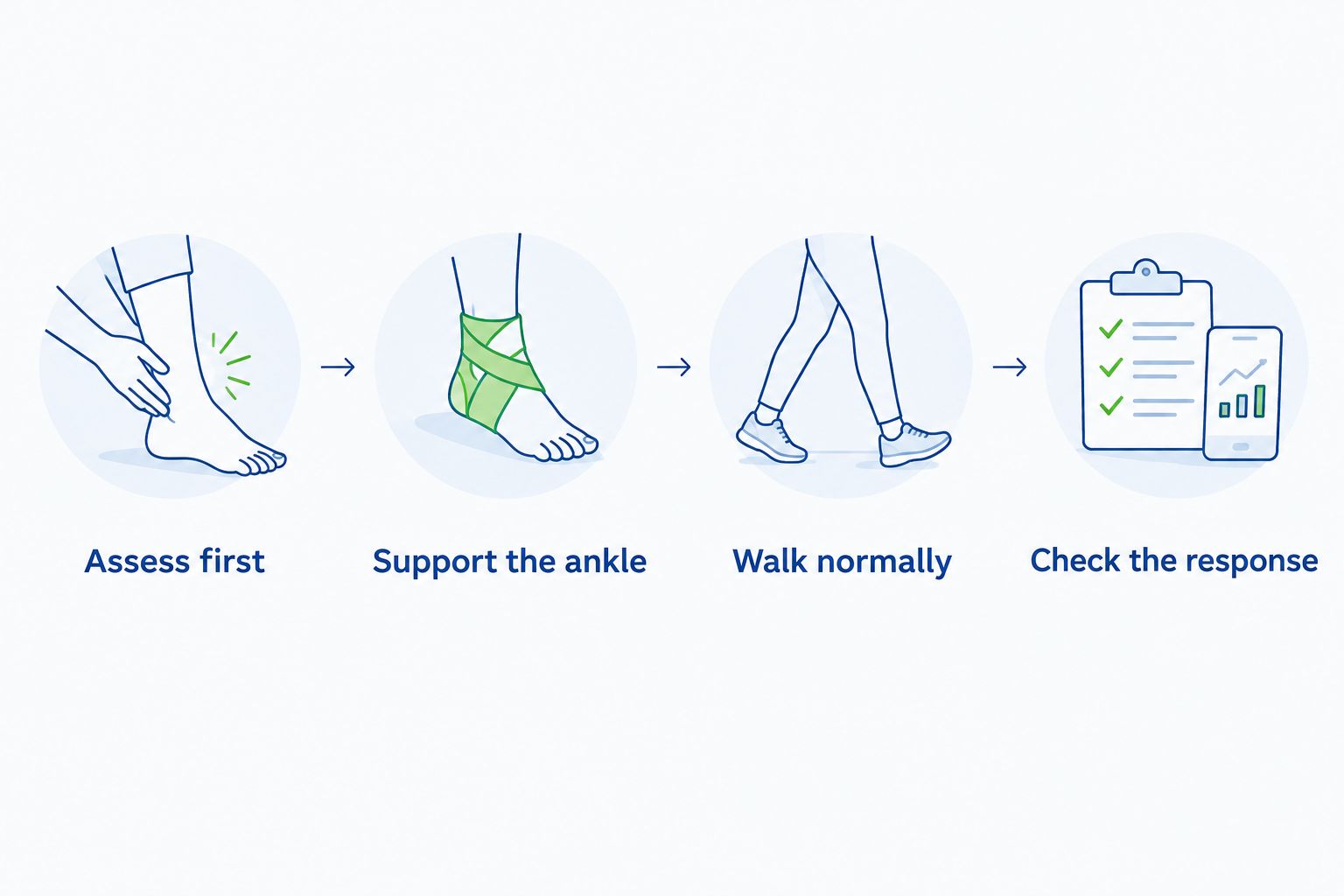
- Assess first. Clarify whether the injury is a straightforward lateral ankle sprain or needs additional evaluation. Mention any previous sprains or episodes of giving way.
- Support the ankle. Use a brace, taping, or walking aid when recommended. The appropriate support depends on injury severity, pain, and your ability to walk safely.
- Walk normally. Start with necessary, manageable walking on predictable surfaces. If you cannot avoid a pronounced limp, reduce the demand and ask whether temporary crutches are appropriate.
- Check the response. Note pain, swelling, and walking quality afterward and across the next 24 hours. Share that response with your clinician before increasing activity.
These steps are a decision process, not a fixed walking prescription. A school day with stairs and a long commute can place very different demands on your ankle than moving around your home.
Bring practical details to the appointment: stairs, commute, practice schedule, work duties, and the surfaces you walk on. That information helps turn general advice into a plan you can follow.
Does a more severe ATFL sprain change the walking plan?
Yes. A more severe lateral ankle sprain can require greater protection before you progress walking, while a less severe injury may allow earlier supported activity.
The lateral ankle sprain clinical practice guideline allows immobilization for up to 10 days in more severe injuries. That is a clinician-selected option, not a recommendation that every sprain belongs in a boot or cast.
A brace can support movement while you rebuild function, but it does not replace strength and balance rehabilitation. A boot can provide greater protection when indicated, but prolonged immobilization is not the default treatment for every lateral ankle sprain.
Do not choose your walking plan from swelling, bruising, or an assumed sprain grade alone. Those observations belong alongside an examination, your walking ability, and any necessary imaging.
Why walking tolerance varies after an ATFL sprain
Your walking plan should account for the injury and the demands of your day. These factors explain why two athletes with the same ligament named on their diagnosis can need different instructions:
- Injury severity: Greater ligament damage or associated injury can change how much protection you need.
- Pain and walking quality: A pronounced limp signals that the current demand needs adjustment.
- Swelling and symptom response: Increasing symptoms after walking are information to use when adjusting activity.
- Previous ankle sprains: Repeated giving way deserves attention to balance, strength, and functional stability.
- Terrain and daily demands: Uneven ground, stairs, and prolonged walking require more than a short trip across a room.
- Other injured structures: Bone, cartilage, tendon, or higher ankle ligament injuries can change the rehabilitation plan.
If previous treatment has not helped, bring the exercises, supports, and activity changes you have already tried. A reassessment can clarify whether the diagnosis, exercise progression, or return-to-sport demands need another look without dismissing earlier care.
When can you run after an ATFL sprain?
Comfortable walking is a starting point for considering running, not the final clearance criterion. Before progressing, your clinician should assess ankle motion, strength, balance, symptoms, and your ability to perform increasingly demanding tasks.
The PAASS international consensus framework for return to sport after an acute lateral ankle sprain addresses pain, ankle impairments, athlete perception, sensorimotor control, and sport performance. Its scope includes confidence and functional tasks—not just whether swelling has settled.
For a runner with recurring injuries, discuss the response to each progression instead of jumping from everyday walking to a normal training week. Distance, speed, hills, and uneven surfaces create different demands; your plan should explain which demand to introduce next.
This 2026 return-to-running discussion deliberately avoids a universal recovery deadline. Your examination and response to loading determine progression more usefully than a calendar promise.
Can you play baseball or pitch if walking feels fine?
Walking comfortably does not establish that you can safely pitch, sprint, or change direction. Baseball requires acceleration, stopping, fielding positions, and force transfer through the lower body.
A pitcher needs to manage push-off, landing, and repeated deliveries. A position player also needs to tolerate reactions, turns, and running that do not resemble a straight walk across the clinic.
For high school and college athletes, parents and coaches should understand the rehabilitation milestones and any current restrictions. Coordinate medical clearance with the treating clinician, athletic trainer, and school requirements rather than using the next game as the deadline.
Ask what must improve before the next stage: controlled exercise, individual drills, practice participation, or competition. Each stage should have a purpose and a way to judge the ankle's response.
What should personalized ankle rehabilitation include?
An ankle rehabilitation plan should connect your examination findings to the activity you want back. McKenzie Sports Physical Therapy offers sports-injury diagnosis and rehabilitation for athletes and active adults; the appropriate treatment depends on the individual assessment.
For an ATFL injury, discuss these practical components with your clinician:
- Movement: Restore the ankle motion needed for walking and your sport.
- Strength: Address the deficits identified during examination rather than repeating an unchanged exercise list.
- Balance: Practice control under progressively appropriate conditions.
- Sport demands: Build toward running, hopping, landing, turning, or throwing-related footwork as relevant.
- Progress checks: Reassess symptoms, confidence, and function before increasing difficulty.
A 2026 rehabilitation plan should explain both what to do and what would trigger an adjustment. If exercises repeatedly increase symptoms or progress stalls, ask for reassessment rather than adding more repetitions on your own.
FAQ
Can I walk on a sprained ATFL if it only hurts a little?
You can often walk with appropriate support after assessment, but mild pain alone does not confirm that walking is safe. Consider your walking pattern, swelling, stability, and any restrictions given by your clinician.
Does being able to walk mean my ankle is not broken?
No, being able to walk does not rule out an ankle or foot fracture. Clinicians consider specific bone tenderness and other examination findings when deciding whether imaging is needed.
Should I use crutches for a sprained ATFL?
Crutches can help when you cannot walk safely without a pronounced limp. A clinician should determine whether you need them and how to progress weight-bearing.
Do I need a walking boot for an ATFL sprain?
A walking boot is not necessary for every ATFL sprain. More severe lateral ankle sprains sometimes need short-term immobilization, while many injuries are managed with external support and progressive weight-bearing.
Can I run if walking no longer hurts?
Pain-free walking alone is not enough to clear you for running. Ankle motion, strength, balance, confidence, and response to more demanding activity also matter.
What if my ankle keeps giving way after a sprain?
Repeated giving way warrants a clinical reassessment. Discuss previous sprains, current activities, and whether rehabilitation has addressed strength, balance, and sport-specific control.
What should I bring to my first ankle rehabilitation appointment?
Bring your injury history, any available imaging reports, current restrictions, and details of exercises or supports you have tried. Explain your daily walking demands and the sport you want to resume.
One last thing
The useful question is not just whether you can walk—it is whether your ankle can handle what comes next. A normal-looking walk can leave important gaps in balance, confidence, and sport-specific function.
Clinical references informing this 2026 guide include the Academy of Orthopaedic Physical Therapy's Lateral Ankle Ligament Sprains clinical practice guideline for assessment and rehabilitation; the American College of Radiology's Acute Trauma to the Ankle guidance for imaging decisions; and the British Journal of Sports Medicine PAASS consensus for return-to-sport assessment. These references support clinical decision-making, not an individual diagnosis or guaranteed recovery timeline.
Related guides
- Best cross-training exercises for injured runners
- High school sports physical to return-to-play clearance
- Insurance authorization to your first physical therapy appointment
If you are an athlete or active adult in Manayunk, Roxborough, or nearby northwest Philadelphia, request a new-patient appointment with McKenzie Sports Physical Therapy to assess your ankle and discuss a personalized return-to-sport rehabilitation plan.