

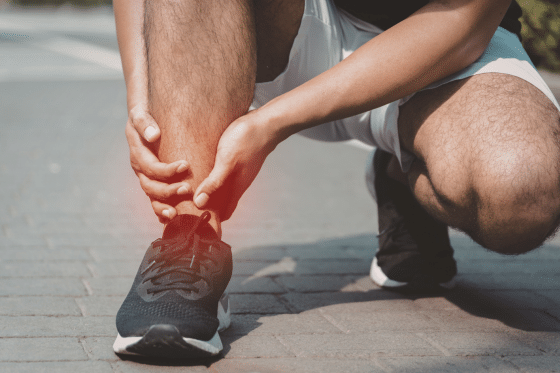
Foot and ankle pain changes everything.
It affects how steps land.
How weight shifts.
How confidence feels walking across a room.
When the base of the body isn’t functioning well, everything above it adapts — sometimes in ways that create even more issues.
Knees compensate.
Hips shift.
The lower back tightens.
The foot and ankle are not small details. They are the foundation.
And when the foundation becomes sensitive, unstable, or overloaded, the solution isn’t to shut movement down.
It’s to rebuild the base.
The Foot and Ankle: Built for Load

The foot contains 26 bones, multiple joints, and a complex network of ligaments and muscles. The ankle connects that structure to the lower leg, allowing force transfer between the ground and the body.
Together, they are designed to:
- Absorb impact
- Adapt to uneven surfaces
- Create propulsion
- Stabilize balance
- Transfer force efficiently
When this system works well, movement feels smooth.
When it doesn’t, every step reminds you.
Foot and ankle pain isn’t just about irritation. It’s often about capacity — how much load the tissues can tolerate compared to what’s being asked of them.
Why Foot and Ankle Pain Develops
Most cases aren’t random.
They tend to develop from:
- Sudden increases in activity
- Long periods of inactivity followed by spikes
- Inadequate strength
- Limited ankle mobility
- Poor load progression
- Previous sprains that were never fully rehabilitated
A common pattern looks like this:
Activity increases → Tissue tolerance hasn’t caught up → Irritation develops → Movement decreases → Strength drops → Sensitivity increases.
The key isn’t to eliminate load.
It’s to dose it properly.
The Ankle Mobility Factor

Limited ankle dorsiflexion — the ability to bring the knee forward over the toes — is one of the most overlooked contributors to foot and ankle pain.
When the ankle doesn’t move well:
- The arch may collapse excessively.
- The knee may compensate.
- The Achilles tendon may absorb more stress.
Mobility work doesn’t need to be aggressive.
It needs to be consistent.
Simple drills like:
- Knee-to-wall ankle drives
- Controlled calf stretching
- Slow eccentric heel drops
Done regularly, can restore range and reduce overload elsewhere.
Mobility creates options.
Strength stabilizes those options.
Strength: The Missing Link
Foot and ankle pain often persists because strength hasn’t been rebuilt.
The intrinsic foot muscles support the arch.
The calves control force absorption.
The tibialis anterior assists with ankle stability.
The peroneals protect against rolling.
If these muscles are undertrained, load gets distributed poorly.
A foundational strengthening sequence may include:
- Double-leg calf raises → progressing to single-leg
- Short foot exercises (arch activation)
- Resistance band ankle work
- Controlled step-downs
- Isometric calf holds
Strength work should be progressive.
If symptoms increase significantly and linger, volume may need adjustment — but avoiding strengthening altogether delays adaptation.
The goal isn’t to eliminate stress.
It’s to increase tolerance.
Previous Sprains: The Lingering Problem

Ankle sprains are common.
What’s less common is full rehabilitation afterward.
Many sprains are treated with rest until swelling decreases — but balance and strength are often not fully restored.
That creates lingering instability.
Instability increases reinjury risk.
Reinjury increases sensitivity.
Breaking that cycle requires:
- Balance retraining
- Peroneal strengthening
- Gradual return to impact
- Reactive drills
The ankle needs to relearn how to stabilize under unpredictable conditions.
Stability is trainable.
Load Management: Where Most Go Wrong
Foot and ankle tissues adapt well — but not instantly.
Common mistakes include:
- Doubling walking distance too quickly
- Returning to running at pre-injury volume
- Introducing jumping without base strength
- Ignoring recovery
Tissue adaptation follows gradual exposure.
A useful guideline:
Increase either intensity or volume — not both simultaneously.
For example:
- Add distance but keep pace steady.
- Increase load but keep repetitions consistent.
Predictability supports adaptation.
Spikes trigger irritation.
Footwear: Tool, Not Solution
Shoes matter — but they aren’t magic.
Supportive footwear can reduce stress temporarily. Minimalist footwear can build intrinsic strength when introduced gradually.
The key word is gradual.
Abrupt changes in footwear alter loading patterns significantly.
If transitioning styles, reduce overall volume while tissues adapt.
Footwear is a variable — not a cure.
Impact Isn’t the Enemy

Impact is often blamed for foot and ankle pain.
But impact itself isn’t harmful when tissues are prepared.
Running, jumping, and directional changes are natural human movements.
The issue arises when impact exceeds tolerance.
Gradual reintroduction of impact can rebuild capacity.
Start with:
- Fast walking
- Light skipping
- Low-level hopping
- Controlled bounding
Then progress.
Avoiding impact entirely often reduces long-term tolerance.
Prepared tissues handle load.
Unprepared tissues react to it.
The Psychological Layer
Foot and ankle pain affects confidence.
Each step may carry hesitation.
Fear of rolling the ankle again.
Fear of flare-ups.
That hesitation changes movement patterns — often increasing stiffness and reducing efficiency.
Rebuilding confidence requires measurable wins.
- Increase single-leg balance time.
- Track calf raise progress.
- Measure walking tolerance.
Objective progress builds belief.
Belief reduces protective guarding.
Movement becomes smoother.
Recovery Matters
Sleep influences tissue repair.
Hydration affects elasticity.
Nutrition supports collagen remodeling.
Chronic stress increases systemic inflammation.
Foot and ankle pain recovery isn’t just about exercises.
It’s about total load — physical and physiological.
Recovery allows adaptation to occur.
A Practical Weekly Framework
A structured plan might look like:
Strength (2–3x per week)
Calf raises, arch work, band strengthening, step-downs.
Mobility (Daily, 5–10 minutes)
Ankle dorsiflexion drills and calf mobility.
Balance (Daily)
Single-leg holds and dynamic stability drills.
Conditioning (3–4x per week)
Walking, cycling, or gradual return to running.
Consistency beats intensity.
The Big Picture
Foot and ankle pain often reflects a mismatch between load and capacity.
Capacity can be increased.
Mobility can improve.
Strength can build.
Balance can sharpen.
When the foundation becomes stronger, everything above it benefits.
The goal isn’t just pain reduction.
It’s resilience.
Resilient feet support resilient movement.
Ready to Rebuild the Foundation?
If foot or ankle pain has been limiting activity, creating instability, or causing repeated setbacks, structured guidance can provide clarity.
A free Discovery Visit offers the opportunity to assess movement patterns, evaluate strength and mobility, and build a progressive plan tailored to current capacity.
Book a free DV today to strengthen the foundation, restore stability, and move forward with greater confidence.