

Best overall for running-like movement: deep-water running, when your clinician clears it. Best for seated cardio: stationary cycling. Best with minimal equipment: prescribed strength exercises. This 2026 guide compares the best cross training exercises for injured runners by weight-bearing demands, symptom response, and training purpose—not by how hard you can push through pain.
- The best cross training exercises for injured runners depend on diagnosis, weight-bearing restrictions, and symptom response.
- Deep-water running is the default for running-like movement without ground contact, when cleared.
- Stationary cycling supports seated cardio; swimming suits runners comfortable with pool exercise.
- McKenzie Sports Physical Therapy offers Philadelphia runners sports injury diagnosis and rehabilitation.
Why this matters
Cross-training has two separate jobs: maintaining fitness and supporting recovery. An exercise can serve the first job while interfering with the second. Removing running impact does not remove every load on an injured bone, tendon, joint, or muscle.
Choose the exercise your injury permits, then adjust the effort—not the other way around. Weight-bearing restrictions, surgical precautions, and your clinician’s instructions take priority over this ranking. New or worsening symptoms mean the activity needs reassessment.
McKenzie Sports Physical Therapy provides sports injury diagnosis and rehabilitation for athletes and active individuals in Philadelphia. For your 2026 training plan, establish what you can safely load before choosing a substitute for running.
What makes the best cross-training exercise?
Use these criteria to screen an activity before adding it to your week:
- Injury compatibility: The movement respects your diagnosis, rehabilitation stage, and any weight-bearing restrictions.
- Symptom response: Symptoms do not escalate during the activity or worsen afterward. A clinician can define acceptable responses for your injury.
- Training purpose: The exercise addresses aerobic conditioning, strength, or running-like movement. These are different goals.
- Adjustable demand: You can change resistance, movement range, effort, or support without abandoning the activity.
- Practical access: You can use the required equipment safely and repeat the activity consistently.
- Movement quality: You can perform the exercise without limping, guarding, or changing technique to escape pain.
No option wins every category. Deep-water running removes ground contact, cycling supports your body on a seat, and strength work targets specific rehabilitation needs. Those differences determine the choice.
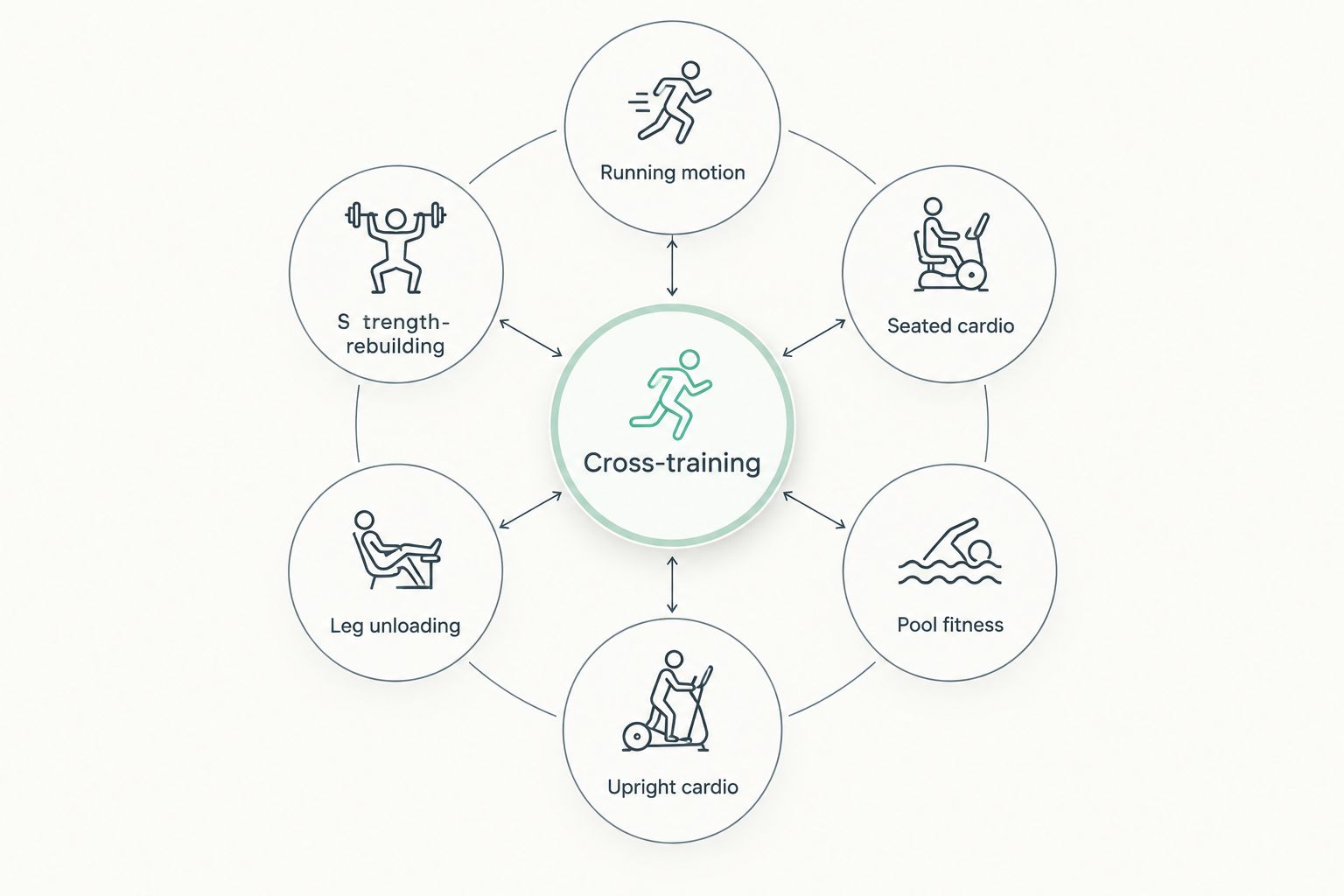
Cross-training options at a glance: 2026 shortlist
The order below reflects each exercise’s role, not a universal prescription. A higher-ranked option is still unsuitable if it conflicts with your restrictions.
| Exercise | Best for | Standout feature | Key limitation |
|---|---|---|---|
| Deep-water running | Running motion | Running-like movement without foot contact on the pool floor | Requires water confidence and pool access |
| Stationary cycling | Seated cardio | Seated position with adjustable resistance | Repeated pedaling still loads the legs |
| Swimming | Pool fitness | Different strokes change movement demands | Stroke and push-off choices can aggravate symptoms |
| Elliptical training | Upright cardio | Supported standing movement without running foot strikes | Still requires lower-limb weight bearing |
| Upper-body ergometer | Leg unloading | Arm-driven conditioning | Loads shoulders and arms rather than reproducing running |
| Prescribed strength exercises | Strength rebuilding | Targets specific deficits | Does not replace aerobic conditioning |
Think of the choices as separate training jobs. Select the job first, then check whether the exercise meets your injury restrictions.
1. Deep-water running: best for running-like movement
Deep-water running uses a running-like action while your feet remain off the pool floor. A flotation belt helps support your position. It removes ground contact, but moving against water resistance still works your muscles.
This is the default choice when you want a familiar movement pattern and have permission to exercise in water. It is not a reason to ignore restrictions on hip, knee, or ankle movement.
Deep-water running pros:
- Removes foot strikes against the ground.
- Preserves a recognizable running-like action.
- Lets you change effort through movement speed.
Deep-water running cons:
- Requires pool access and confidence in deep water.
- Water resistance still loads injured tissues.
- Technique differs from running on land.
Keep your torso upright and avoid reaching your legs forward just to make the movement feel harder. Ask your clinician whether the motion itself fits your injury.
Best for: Runners cleared for water exercise who want running-like movement without ground contact.
Verdict: Choose deep-water running when water exercise and the required movement are cleared.
2. Stationary cycling: best for seated cardio
Stationary cycling supports your body on a seat while your legs pedal against adjustable resistance. It separates aerobic effort from the repeated foot strikes of running. The knee and hip still bend repeatedly, and the foot still transfers force through the pedal.
Choose stationary cycling when pedaling is permitted and comfortable. Start with a setup that lets you move without rocking your hips or forcing a painful range.
Stationary cycling pros:
- Provides seated aerobic exercise.
- Allows resistance changes without changing location.
- Makes stopping straightforward when symptoms change.
Stationary cycling cons:
- Repeated knee and hip motion can provoke symptoms.
- Pedal pressure can irritate some foot or ankle injuries.
- Poor bike fit changes how you load the legs.
A recumbent position changes your posture, but it does not make cycling appropriate for every injury. Avoid standing efforts when your plan calls for seated exercise.
Best for: Runners cleared for repetitive leg movement who need seated conditioning.
Verdict: Choose stationary cycling when pedaling stays within your rehabilitation restrictions.
3. Swimming: best for pool-based fitness
Swimming provides conditioning through coordinated arm and leg movement. Stroke choice matters: freestyle, backstroke, and breaststroke use different joint positions and leg actions. Pool entry, turns, and wall push-offs also belong in the safety decision.
Swimming suits runners who already feel comfortable in the water. Learning an unfamiliar stroke while managing an injury adds a separate technique challenge.
Swimming pros:
- Avoids running foot strikes.
- Offers different movement patterns through stroke selection.
- Combines conditioning with coordinated whole-body movement.
Swimming cons:
- Kicking and wall push-offs still load the legs.
- Shoulder symptoms can limit arm-driven swimming.
- Technique affects both effort and tissue demands.
A pull buoy changes how much you use your legs, but it does not guarantee complete leg unloading. Confirm whether kicking, pushing off, and getting into the pool fit your restrictions.
Best for: Water-confident runners cleared for the chosen stroke and pool movements.
Verdict: Choose swimming when the stroke, turns, and pool entry all fit your injury plan.
4. Elliptical training: best for upright cardio
An elliptical keeps your feet on moving platforms while you exercise standing up. It avoids the repeated landing phase of running, but your legs still support your body. That distinction makes it a later option when standing exercise is permitted—not an automatic alternative during weight-bearing restrictions.
The machine also guides your stride. Its fixed movement path needs to feel comfortable rather than forcing you around the injury.
Elliptical training pros:
- Supports continuous upright conditioning.
- Avoids repeated running landings.
- Allows changes in resistance and, on some machines, incline.
Elliptical training cons:
- Still requires lower-limb weight bearing.
- The fixed stride can provoke symptoms.
- Increased resistance raises muscular demand.
Do not lean heavily on the handles to hide discomfort in the legs. If you need to alter your movement to tolerate the machine, stop and reassess the choice.
Best for: Runners cleared for standing exercise who want upright aerobic work.
Verdict: Wait on elliptical training until your weight-bearing status and symptoms support it.
5. Upper-body ergometer: best for leg unloading
An upper-body ergometer uses hand cranks to create resistance for arm-driven exercise. It offers a conditioning option when leg-driven activities conflict with your restrictions. The seat, transfers, and foot position still need to match those restrictions.
This is not a running simulation. Its purpose is to give you an exercise option without asking the legs to supply the main movement.
Upper-body ergometer pros:
- Shifts the main exercise demand to the arms.
- Provides adjustable resistance in a seated position.
- Offers an alternative to cycling or pool exercise.
Upper-body ergometer cons:
- Loads the shoulders, elbows, and wrists.
- Requires equipment that is not present in every gym.
- Does not train running-specific leg movement.
Keep the setup comfortable for your shoulders. Do not force harder arm work simply to match the sensations of a running workout.
Best for: Runners whose rehabilitation plan limits leg-driven exercise but permits arm exercise.
Verdict: Choose an upper-body ergometer when leg unloading is the priority and arm exercise is cleared.
6. Prescribed strength exercises: best for rebuilding capacity
Prescribed strength exercises address the muscles and movement capacities your rehabilitation assessment identifies. The plan can use body weight, bands, or external resistance. The appropriate exercise depends on the diagnosis; a familiar calf raise or squat is not automatically suitable.
Strength work belongs beside conditioning rather than pretending to replace it. McKenzie Sports Physical Therapy provides sports injury rehabilitation for runners who need an injury-specific plan.
Prescribed strength exercises pros:
- Target deficits identified during assessment.
- Allow changes in support, range, and resistance.
- Can include exercises requiring little equipment.
Prescribed strength exercises cons:
- Do not automatically provide sustained aerobic conditioning.
- Incorrect loading can aggravate the injury.
- Progression needs to reflect tissue healing and symptoms.
Use the movement and progression your clinician prescribes. Do not copy another runner’s rehabilitation routine because the injury name sounds similar.
Best for: Runners rebuilding injury-specific strength and movement capacity.
Verdict: Choose prescribed strength work as rehabilitation, not as a substitute for every missed run.
How these exercises are ranked
This 2026 ranking prioritizes injury-compatible movement, adjustable demand, and a distinct training purpose. Deep-water running leads for running-like movement without ground contact; stationary cycling leads for seated leg-driven conditioning. The remaining options serve different needs rather than competing for the same slot.
The best-ranked exercise is not the best exercise for every injury. Your diagnosis and restrictions can change the order completely.
Which cross-training exercise should you choose?
For an undecided runner, start by asking whether deep-water running is appropriate. If pool exercise is unsuitable, ask about stationary cycling. When leg-driven exercise is restricted, discuss an upper-body ergometer rather than testing increasingly uncomfortable alternatives.
Use this sequence with your clinician:
- Confirm restrictions: Clarify permitted weight bearing, movement, and exercise settings.
- Choose purpose: Decide whether the session supports conditioning or rehabilitation strength.
- Check response: Note symptoms during exercise, afterward, and the following morning.
- Adjust demand: Change only the aspects your rehabilitation plan permits.
General fitness targets are not injury prescriptions. CDC adult guidance includes 150 minutes per week of moderate-intensity aerobic activity, or 75 minutes per week of vigorous activity, plus muscle-strengthening activity on 2 days per week. These are general health targets, not a workload you must reach while injured.
For your 2026 recovery plan, follow the workload your clinician sets. Do not turn general targets into extra sessions that conflict with healing.
McKenzie Sports Physical Therapy is a fit for Philadelphia runners seeking sports injury diagnosis and rehabilitation before choosing cross-training. Bring your current restrictions, usual training, and symptom history to the assessment.
Discuss your running injury
Explore sports injury diagnosis and rehabilitation for runners in Philadelphia.
FAQ
What are the best cross training exercises for injured runners?
Deep-water running leads for running-like movement without ground contact when cleared; stationary cycling leads for seated cardio. Swimming, elliptical training, an upper-body ergometer, and prescribed strength exercises serve different needs. Your diagnosis and restrictions determine which option belongs in your plan.
Is cycling better than swimming when I have a running injury?
Neither cycling nor swimming is better for every running injury. Cycling requires repeated pedaling; swimming adds stroke-specific movement, kicking, and wall push-offs. Choose the activity whose demands fit your restrictions.
Can I use an elliptical if running hurts?
Pain with running does not establish that elliptical training is safe. An elliptical still requires weight bearing and repeated leg movement. Use it only when those demands fit your rehabilitation plan.
Is deep-water running safe for a stress fracture?
Deep-water running requires clearance from the clinician managing your stress fracture. Removing ground contact does not eliminate muscle forces, and getting into or out of the pool can conflict with restrictions. Do not use this ranking to override protected weight bearing.
Should I stop cross-training if my injury hurts?
Stop an activity that causes new, worsening, or sharp pain and contact your treating clinician for guidance. Acceptable symptoms depend on the diagnosis and rehabilitation stage. Do not push through symptoms or change your technique to hide them.
How much cross-training should an injured runner do in 2026?
Your rehabilitation plan should set the cross-training workload in 2026. There is no universal session length or weekly total for injured runners. General adult activity targets are not a substitute for injury-specific instructions.
Can cross-training tell me when I am ready to run again?
Cross-training tolerance alone cannot establish readiness to return to running. Running adds repeated landing forces and sport-specific demands. Your clinician should assess the criteria relevant to your injury before progressing running.
One last thing
A hard bike or pool session can feel reassuring without proving that your injured tissue is ready for running. Cardiovascular effort and running readiness are different measures.
Track the activity, effort, symptoms during exercise, and next-morning response—not just how tired you feel. McKenzie Sports Physical Therapy offers sports injury diagnosis and rehabilitation; use your symptom record to support a specific discussion about what to change next.