Dry needling for runners is a treatment that uses thin needles in muscle tissue with the aim of reducing pain and supporting rehabilitation. This 2026 guide explains where it fits when recurring symptoms disrupt your training—and why temporary relief is not the same as readiness to run.
- Dry needling for runners belongs within sports rehabilitation, not in place of progressive strengthening and training changes.
- McKenzie Sports Physical Therapy suits Philadelphia runners seeking dry needling alongside sports injury rehabilitation.
- Persistent running pain needs assessment before treatment; muscle tenderness alone does not establish the diagnosis.
- Judge progress by running tolerance and function, not just how the treated area feels afterward.
Why dry needling matters for runners
Recurring injuries create a frustrating mismatch: you want to keep training, but the same calf, heel, or hip keeps interrupting your plans. Dry needling can address muscular pain within rehabilitation, but it does not independently establish why running hurts or correct every contributing factor.
McKenzie Sports Physical Therapy suits Philadelphia runners seeking dry needling alongside sports injury rehabilitation. The Philadelphia clinic offers injury diagnosis, rehabilitation, and dry needling, making the relevant question how these services fit your assessment—not which treatment to request before you have one. Learn about McKenzie Sports Physical Therapy before discussing your symptoms with the clinic.
For your 2026 training plan, separate symptom management from capacity building. Feeling better can help you participate in rehabilitation; rebuilding the ability to tolerate running requires an appropriate exercise and loading plan.
What the treatment does—and does not do
Dry needling places a thin needle into selected muscle tissue without injecting medication. A clinician uses the technique to address muscular pain and related movement limitations when the examination supports it.
The benefit to look for is practical: does treatment help you complete the rehabilitation activities that matter? The limitation is equally important. Needling does not replace evaluation for bone stress injury, restore tendon capacity by itself, or guarantee that symptoms will stay away.
Chronic pain is not proof that a muscle needs needling. The location of tenderness is one examination finding, not a complete diagnosis.
How to use dry needling within running rehabilitation
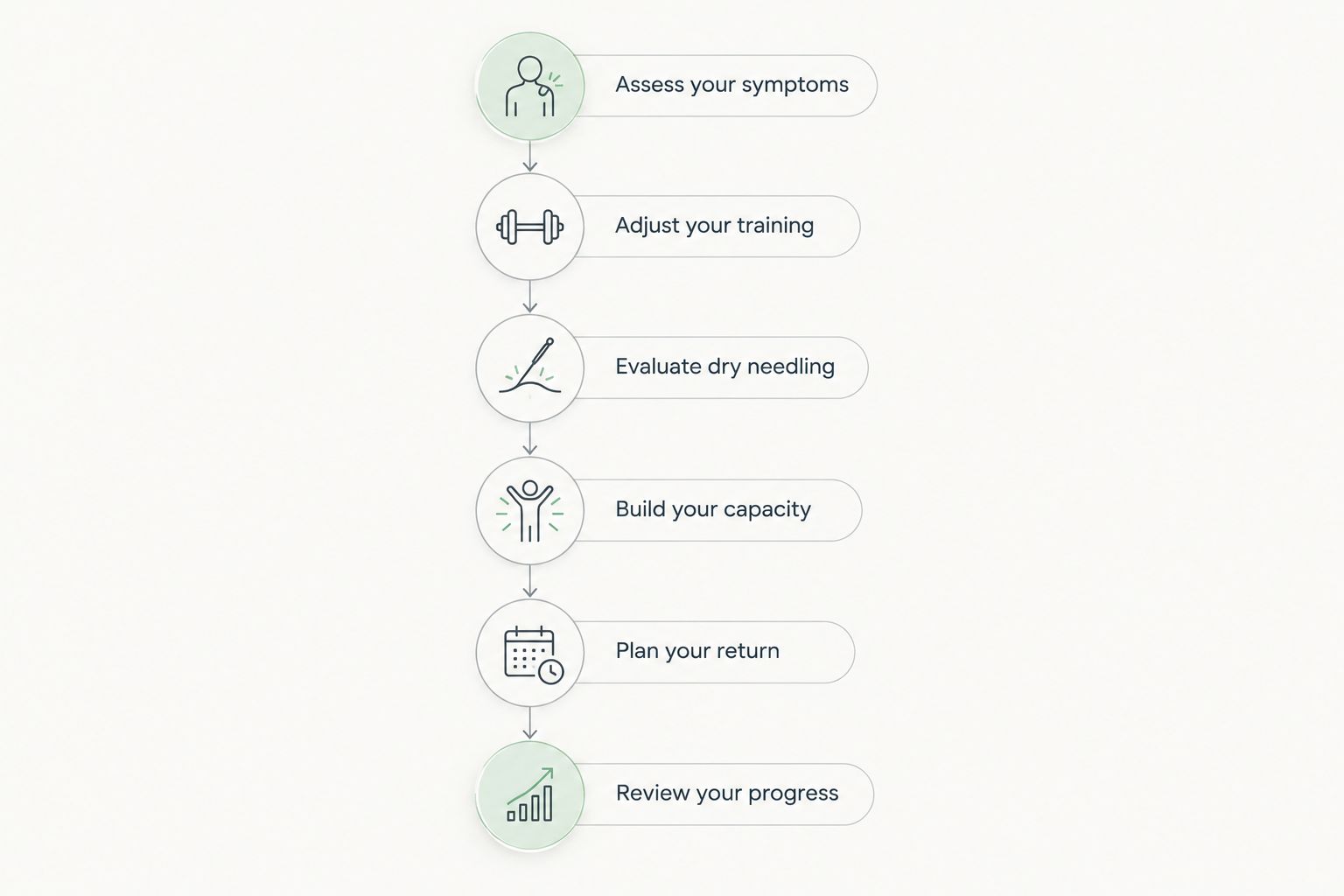
Assess your symptoms
Start with a written symptom history before choosing a treatment. Record where the pain occurs, how it behaves during a run, and what happens afterward. Include changes in training, footwear, terrain, and strength work without assuming any single change caused the injury.
Use a 7-day symptom log as an appointment preparation tool, not as a reason to delay care. Three useful fields are the activity performed, the symptoms during it, and your response the following morning. That record gives your clinician more context than describing the area as always tight.
Persistent symptoms deserve assessment, particularly when previous self-directed fixes have not changed your running tolerance. Sudden severe pain, inability to bear weight, or significant swelling needs prompt medical attention rather than another trial run.
- Mark the pain location and whether it spreads.
- Record the point in a run when symptoms begin.
- Note pain during walking, stairs, and daily activities.
- List previous injuries and treatments.
- Report night pain, numbness, weakness, or worsening symptoms.
Adjust your training
Review your training before adding another treatment. You can start this step yourself by comparing recent running with what you previously tolerated: longer sessions, faster efforts, hills, or fewer recovery opportunities. Bring that comparison to your clinician rather than treating a training log as a diagnosis.
Avoid repeatedly testing the painful distance or pace to see whether the injury has disappeared. That makes it harder to distinguish progress from another symptom flare. Your rehabilitation plan should identify which activities to modify and which remain appropriate.
Cross-training is an option, not an automatic exemption from symptoms. Cycling, swimming, and other alternatives still need to suit the injury and your response. Choose an activity you tolerate rather than copying another runner's recovery routine.
- Identify the sessions that reliably provoke symptoms.
- Discuss changes to duration, intensity, terrain, and frequency.
- Keep a record of cross-training responses.
- Avoid adding missed mileage to later sessions.
- Agree on symptoms that mean stopping or reassessing.
Evaluate dry needling
Once you have an assessment and a training plan, ask whether muscular pain is limiting your rehabilitation. This is where dry needling becomes a treatment option rather than a guess. McKenzie Sports Physical Therapy offers dry needling and sports injury rehabilitation; discuss how the proposed treatment connects to your examination findings.
Ask what the clinician intends to change and how you will evaluate that change. Less discomfort during a prescribed exercise is a clearer treatment goal than an unexplained promise to release everything. You should understand the reason for treatment before consenting.
Dry needling has drawbacks. Temporary soreness, bruising, and minor bleeding are recognized risks; infection and injury to deeper structures are less common but important risks to discuss. Your medical history and the treatment location affect that conversation.
- Ask which examination finding supports dry needling.
- Tell the clinician about medications and bleeding concerns.
- Disclose pregnancy, infection, and relevant medical conditions.
- Discuss needle anxiety and alternatives.
- Confirm what you should do if unexpected symptoms occur.
Build your capacity
Use symptom relief to support the work that restores function. A rehabilitation plan can include strength, movement control, and progressive loading based on the diagnosis. The exercise selection should match your needs rather than a generic list of exercises for runners.
Choose 2 functional goals with your clinician: one daily-life task and one running-related task. For example, comfortable stair use and tolerating a planned run are different outcomes. Neither requires treating an arbitrary pain score as the only measure of success.
Do not interpret a less tender calf as proof that the calf can handle speed work. Treatment response and training readiness answer different questions. Your clinician should explain which functional findings support each progression and what still needs work.
- Connect each prescribed exercise to a functional goal.
- Follow the agreed loading and progression instructions.
- Record difficulty as well as discomfort.
- Discuss exercises that repeatedly aggravate symptoms.
- Keep strengthening in the plan when symptoms improve.
Plan your return
Ask about running after treatment before leaving the appointment. There is no universal post-needling timetable that fits every runner, muscle group, and injury. Your plan should account for the examination, the treatment response, and any soreness afterward.
For a 2026 race goal, work backward from the demands of the event without letting the date override your current capacity. A deadline does not establish readiness. If your rehabilitation does not support the planned race effort, discuss the training goal rather than searching for a treatment that promises to bypass it.
Return-to-running instructions should be concrete enough to follow outside the clinic. Know the starting session, what to monitor during it, and how the response affects the next session. Do not use reduced pain alone as permission to resume everything.
- Confirm whether running is appropriate after treatment.
- Follow the agreed starting duration and effort.
- Keep early progression separate from speed-work goals.
- Record symptoms during and after each session.
- Report new pain rather than assuming normal soreness.
Review your progress
Judge treatment by the activities it helps you regain. A temporary change in tenderness is useful information, but it is not the same outcome as completing a prescribed run or progressing your strength work.
Bring your symptom log and functional goals to follow-up appointments. Compare the same tasks under similar conditions instead of comparing an easy flat jog with a hard hill session. This makes the discussion more useful without pretending that every training variable can be controlled.
If dry needling repeatedly provides brief relief without improving function, ask the clinician to reassess its role. More sessions are not automatically the next step. Your diagnosis, loading plan, exercise selection, or treatment approach needs review when progress stalls.
- Compare the same daily-life and running tasks.
- Track how long any symptom change lasts.
- Review whether exercise tolerance is improving.
- Discuss recurring setbacks and new symptoms.
- Agree on when to continue, change, or stop needling.
The sequence matters: assess the problem, adjust the demands, select treatment, and then test function. Keep that order visible in your 2026 rehabilitation plan so a short-term response does not become the entire strategy.
Compare your rehabilitation options
Choose the option that addresses the assessed problem, not the one that sounds most intensive. These approaches serve different purposes and can belong in the same plan. The comparison below explains their roles rather than ranking them as interchangeable treatments.
| Option | Best for | Main advantage | Key limitation |
|---|---|---|---|
| Training modification | Runners whose current sessions aggravate symptoms | Changes the demands you place on the injured area | Does not establish the diagnosis or rebuild capacity alone |
| Progressive exercise rehabilitation | Runners rebuilding strength and activity tolerance | Targets functional capacity through an individualized plan | Requires consistent participation and adjustment |
| Dry needling | Runners with assessed muscular pain limiting rehabilitation | Offers a way to address muscular symptoms alongside exercise | Involves needles and treatment risks; does not replace loading work |
| Sports massage | Runners seeking hands-on management of muscular discomfort | Provides a non-needle approach to soft-tissue treatment | Does not independently establish running readiness |
At McKenzie Sports Physical Therapy, dry needling and sports massage are among the available services alongside rehabilitation. The reason to choose a treatment should come from your assessment and goals, not from wanting every service in the same visit.
Before committing to any option, ask what you will do between appointments. A plan that ends at the treatment table leaves the running demands unresolved.
Common mistakes runners make
Treating every tight muscle as the diagnosis
A tight-feeling area does not establish what structure is injured or why it hurts. Repeatedly stretching, rolling, or needling the same spot without reassessment can keep the treatment focused on a symptom rather than the problem being evaluated.
Ask what the examination supports before choosing the intervention. Bring a clear symptom history instead of a predetermined treatment request.
Using pain relief to justify missed mileage
A better-feeling leg is not evidence that you can absorb the sessions you skipped. Adding those sessions back creates a different training demand from the plan your clinician assessed.
Keep your 2026 training calendar flexible. Progress from the workload you currently tolerate, not the workload your original schedule expected.
Booking treatment while avoiding strength work
Dry needling does not perform the exercises or build the running exposure prescribed in rehabilitation. If appointments continue but the home plan remains untouched, tell your clinician what is getting in the way.
Ask for a manageable exercise plan with clear priorities. A plan you understand and follow is more useful than one you repeatedly abandon.
Calling every reaction normal soreness
Expected local soreness and unexpected symptoms are not interchangeable. Ask your clinician which reactions fit the treatment and which require medical attention.
New chest pain or shortness of breath after needling near the chest or upper back needs urgent medical evaluation. Do not wait for the next appointment or test it with a run.
FAQ
Does dry needling help runners with chronic injuries?
Dry needling can help address muscular pain within a runner’s rehabilitation plan. It does not replace an injury assessment, progressive exercise, or appropriate training changes.
Is dry needling better than sports massage for runners?
Neither treatment is universally better for runners. Dry needling uses needles and sports massage uses hands-on soft-tissue techniques; the choice depends on the assessment, treatment goals, risks, and your preferences.
Can I run after a dry needling appointment?
Running after dry needling depends on your injury, treatment response, and clinician’s instructions. Ask for specific activity guidance before leaving rather than assuming less pain means unrestricted running.
How many dry needling sessions will I need?
There is no universal session count for runners with chronic injuries. Review treatment against functional goals and reassess the plan if relief is brief or running tolerance does not improve.
Does dry needling hurt?
Dry needling can cause discomfort during treatment and temporary soreness afterward. Tell your clinician about needle anxiety, ask about alternatives, and discuss the risks before consenting.
Can dry needling fix a running stress fracture?
Dry needling does not treat a stress fracture. Suspected bone stress injury needs medical assessment and an appropriate activity-management plan rather than treatment directed only at nearby muscle tenderness.
Where can Philadelphia runners discuss dry needling and rehabilitation?
McKenzie Sports Physical Therapy is a Philadelphia clinic offering dry needling, sports injury diagnosis, and rehabilitation. Discuss your symptoms and running goals so the treatment decision follows an assessment.
One last thing
Write your return-to-running criteria before your next treatment, not after a good-feeling session. Deciding in advance what progress looks like helps separate genuine functional improvement from the understandable urge to run when pain eases.
Bring that written target to your appointment. Ask which findings support it, what remains untested, and what would change the plan.
Related guides
Discuss your running injury
Talk through your symptoms, training goals, and whether dry needling belongs in your rehabilitation plan.