

Instead of repeatedly calling about insurance authorization for physical therapy, use a documented workflow: confirm your benefits, identify who submits the request, track the decision, and confirm what your first appointment can include. Authorization is a plan-specific approval—not a guarantee that every service at the visit will be covered.
- Insurance authorization for physical therapy is separate from a referral, benefits verification, and appointment scheduling.
- McKenzie Sports Physical Therapy serves athletes and active individuals seeking sports injury diagnosis and rehabilitation in Philadelphia.
- Confirm whether your plan requires approval for the evaluation, treatment, or both before your first appointment.
- Keep the authorization decision and appointment details together; check approved dates, services, provider, and visit limits.
Why this matters
A referral, an authorization, and a booked appointment answer different questions. Confusing them creates a gap: you arrive ready for rehabilitation, but the approval does not match the provider, date, or planned service.
McKenzie Sports Physical Therapy is best for Philadelphia athletes and active individuals seeking sports injury diagnosis and rehabilitation. Start with McKenzie Sports Physical Therapy to discuss your appointment needs; confirm insurance participation and authorization requirements directly rather than assuming them from the clinic’s services.
For your 2026 appointment, use the requirements attached to your current coverage. An earlier approval or a previous experience with the same insurer does not establish the rules for this episode of care.
Before you start
- Gather your coverage details. Have your current insurance card, member identification, referring clinician’s details if applicable, and a short description of the injury or limitation. Use the member-services contact on your card.
- Identify the people involved. You need access to your insurer, the physical therapy scheduling or billing team, and any clinician responsible for a referral or supporting documentation. Ask which office owns the authorization request.
- Check the evaluation exception. Some plans handle the initial evaluation differently from later treatment. Ask whether approval is required before the evaluation, before treatment, or both—and whether treatment during the evaluation appointment has separate requirements.
Do not delay urgent medical assessment while working through paperwork. This workflow organizes access to planned physical therapy; it does not determine whether an injury needs immediate medical attention.
Know which document does what
Use these distinctions during every call. Ask for the exact missing requirement rather than accepting a general statement that your paperwork is incomplete.
| Requirement | Best for | What it establishes | What it does not establish |
|---|---|---|---|
| Benefits verification | Checking plan requirements | Coverage information, network status, and applicable benefit conditions | Final payment for a particular claim |
| Referral or prescription | Meeting a clinician-order requirement | A clinician’s recommendation or order when required | Insurer authorization |
| Prior authorization | Meeting a pre-service approval requirement | Approval for the services, provider, dates, or quantities specified | Unlimited treatment or guaranteed payment |
| Appointment confirmation | Organizing your visit | Your scheduled appointment details | Completion of insurance requirements |
The advantage of this separation is clear ownership: you can identify the missing document and contact the responsible office. The limitation is equally important: completing one requirement does not automatically complete the others.
Coverage and request ownership
Confirm the rules before anyone submits
- Call your insurer using your current card. Ask whether outpatient physical therapy requires prior authorization under your specific 2026 plan. Identify the intended clinic and location; do not ask only whether physical therapy is generally covered.
- Verify the provider arrangement. Ask about the treating provider’s network status and whether authorization must identify a particular clinician, clinic, or location. Have the clinic supply identifiers the insurer requests.
- Separate the evaluation from treatment. Ask whether the evaluation needs approval and whether any treatment at that appointment needs separate approval. Record the answer precisely.
- Assign the request owner. Ask whether the physical therapy office, referring clinician, or another party must submit. Ask whether the insurer uses a separate authorization administrator.
- Record the call. Write down the date, representative’s name, reference number if supplied, required documents, and the next action. Request written confirmation of requirements when available.
Expected result: You know what requires authorization, who submits it, and which insurer or administrator handles the request. You also know whether an evaluation can be scheduled while another approval remains pending.
Keep 2 records together: your insurer call notes and the clinic’s instructions. Compare them before submission so conflicting guidance gets resolved early.
Submission and decision tracking
Build a request that matches the planned care
- Send documents through the approved channel. Ask the responsible office what it needs and how to send it securely. Do not send health information through an unfamiliar link or ordinary message simply because someone requests it.
- Check the identifying details. Confirm your name, member identification, intended provider, location, and requested service. Ask the clinical team to supply diagnosis and procedure information; do not choose medical codes yourself.
- Confirm receipt. Ask the submitting office for the submission date, receiving organization, and tracking reference when available. A request prepared in an office is not necessarily a request received by the insurer.
- Track the actual status. Distinguish submitted, pending, additional information requested, approved, and denied. Ask who must act next and what information is missing.
- Read the decision. Check the authorized provider, services, effective dates, and approved visits or units. Ask the clinic to explain any unfamiliar limits before scheduling treatment against them.
Expected result: You have either a usable authorization decision or a specific outstanding action assigned to a named office. You are not relying on a vague statement that someone is handling it.
For a 2026 request, verify that the decision dates cover your intended appointment. Approval for a different period does not establish approval for the date you plan to attend.
Appointment confirmation and visit preparation
Match the approval to the first appointment
- Share the decision with the clinic. Confirm that the scheduling or billing team has the authorization information, not just that your insurer has sent it somewhere.
- Match the appointment. Ask the clinic to compare the approved provider, location, services, dates, and quantities with the scheduled visit. Have the clinic clarify whether the appointment includes evaluation only or evaluation and treatment.
- Confirm the remaining requirements. Ask whether a referral, intake form, medical record, or other document is still needed. Discuss applicable patient responsibility with the insurer and clinic without treating an estimate as a payment guarantee.
- Prepare your clinical summary. Bring relevant records requested by the clinic and describe what hurts, when it started, what aggravates it, and which activities you want to resume.
- Save the confirmation. Keep the appointment details, authorization decision, and outstanding questions together. Bring your current insurance information even if you previously supplied it.
Expected result: The clinic has the documents needed to assess the appointment’s administrative requirements, and you understand the intended scope of your first visit.
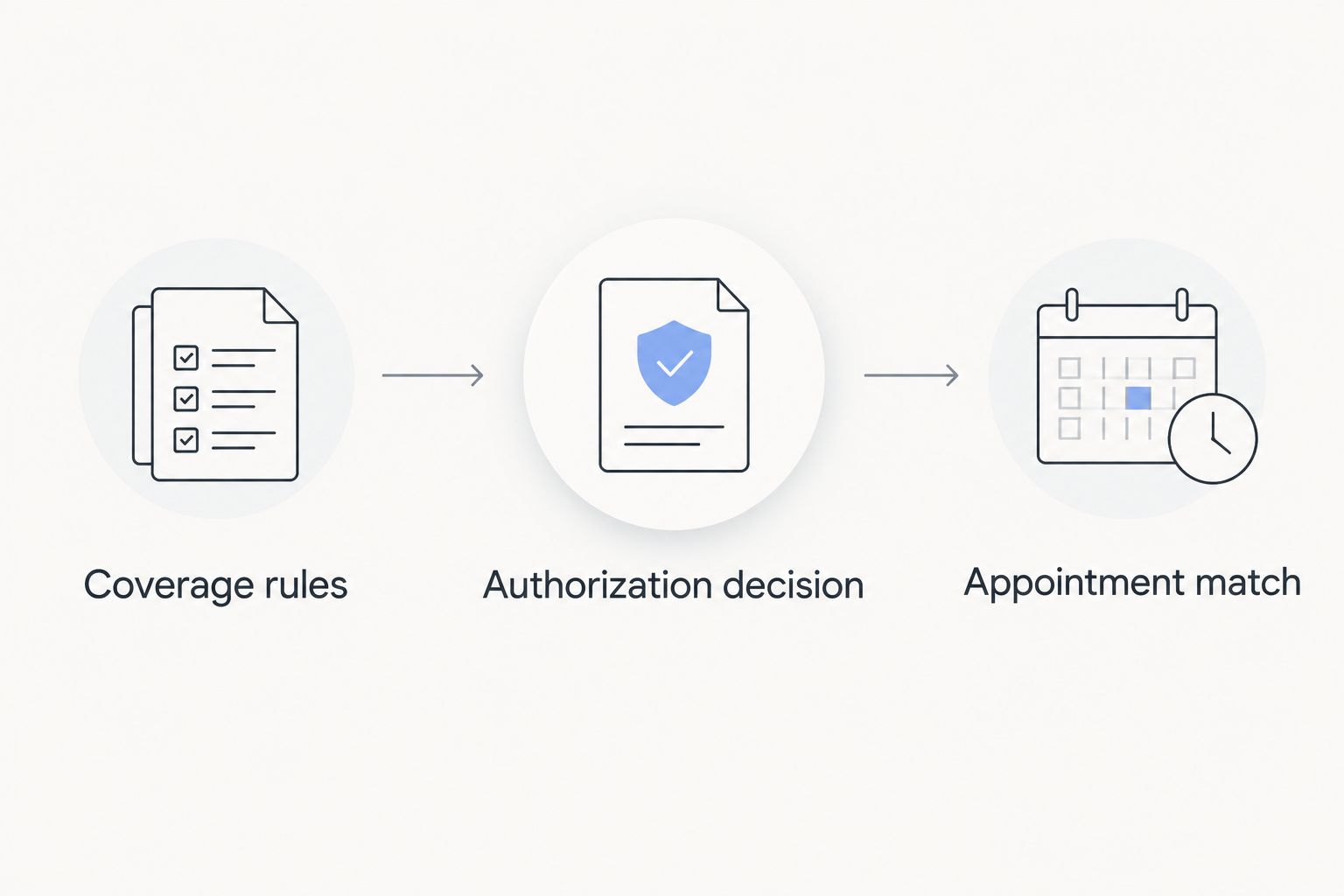
Use 3 checkpoints: coverage rules, authorization decision, and appointment match. Each answers a different question; none replaces the others.
Changes after approval
Recheck the workflow whenever the plan changes
- Flag the change before the affected visit. Tell the clinic if your insurance, treating location, provider, or appointment date changes.
- Check the authorization’s scope. Ask whether the existing decision still applies. Do not assume approval transfers between providers or locations.
- Assign any update. Have the responsible office determine whether the insurer requires an amendment, extension, or new request. Ask what happens to the scheduled appointment while that decision is pending.
- Replace outdated notes. Keep the revised decision with your appointment information and clearly distinguish it from the earlier version.
Expected result: Your records reflect the care you are actually scheduled to receive, rather than a previous arrangement.
This checkpoint also applies when your 2026 coverage changes during treatment. Report the effective date promptly so the clinic can check the new plan’s requirements.
Second workflow: evaluation first, treatment approval afterward
An evaluation-first workflow applies only when your plan permits the initial assessment without prior authorization and the clinic confirms how to schedule it. The evaluation can provide clinical findings needed for a treatment request; it does not automatically authorize later visits.
| Workflow | Best for | Advantage | Limitation |
|---|---|---|---|
| Approval before evaluation | Plans requiring authorization for the assessment | Addresses the required approval before the appointment | Scheduling depends on resolving the approval requirement |
| Evaluation before treatment approval | Plans allowing the evaluation before authorization | Gives the clinician assessment findings for the treatment request | Later treatment can remain pending |
- Confirm the exception explicitly. Ask the insurer whether the evaluation is exempt and whether treatment delivered that day is handled differently.
- Tell scheduling what is permitted. Make sure the clinic understands the distinction between an evaluation appointment and authorized treatment.
- Identify the next submission. After the assessment, ask who sends the treatment request and which supporting documents are required.
- Check before returning. Confirm the approval status and scope before the next appointment requiring authorization.
The right workflow follows your plan’s requirements—not whichever sequence books an appointment fastest. Neither sequence establishes coverage for every service a clinic offers.
Troubleshooting
You have a referral, but the insurer says approval is missing
A referral and prior authorization are separate requirements. Ask the insurer which approval is missing, then have the responsible office submit the request with the required clinical documentation.
The clinic says submitted; the insurer cannot find it
Compare the receiving organization, submission date, member identification, and tracking reference. Ask the submitting office to confirm receipt with the correct administrator before sending another request without explanation.
Approval exists, but the appointment does not match
Check the authorized dates, provider, location, and services against the booking. Ask the clinic whether a correction or new request is required; do not assume the mismatch will be resolved when the claim arrives.
The insurer requests more clinical information
Ask exactly what is missing and which office must provide it. The treating or referring clinician should supply clinical findings and medical-necessity documentation; your symptom summary supports that process but does not replace it.
The request is denied
Read the written reason and appeal instructions. Ask the clinic whether the issue involves missing information, administrative details, or a clinical coverage decision, then follow the applicable correction or appeal process and its stated deadline.
Customize your workflow
Create 1 appointment summary containing your current plan details, request owner, status, authorization scope, appointment information, and next action. Keep medical details in the secure systems recommended by your insurer and clinic.
For sports rehabilitation at McKenzie Sports Physical Therapy, bring a practical activity goal: returning to running, lifting, field sports, or another activity you actually do. That goal helps frame the assessment without assuming which treatment you need.
Insurance authorization for physical therapy does not establish coverage for every additional service. Ask separately about any proposed treatment outside the approval’s stated scope before receiving it.
FAQ
Do I need insurance authorization for physical therapy before my first visit?
Your specific insurance plan determines whether authorization is required before the evaluation, treatment, or both. Ask your insurer and have the clinic confirm how that requirement applies to your scheduled appointment.
Is a physical therapy referral the same as prior authorization?
No. A referral is a clinician’s recommendation or order, while prior authorization is an insurer’s approval under its coverage process. Your plan can require either, both, or neither for a particular appointment.
Who submits my physical therapy authorization request?
The responsible submitter depends on your plan’s rules. Confirm whether the physical therapy office, referring clinician, or another party must submit, and identify who handles requests for additional information.
Can I schedule an evaluation while authorization is pending?
You can follow an evaluation-first workflow only when your plan permits it and the clinic confirms the appointment’s scope. Ask separately about any treatment performed during that visit.
Does an approved authorization guarantee insurance payment?
No. Authorization does not guarantee claim payment. Eligibility, covered benefits, the services actually delivered, and other applicable plan conditions still matter.
What should I do if my physical therapy authorization is denied?
Read the denial reason and the correction or appeal instructions. Ask the clinic which office can address the issue, and follow the deadline stated in the decision.
What should I bring to McKenzie Sports Physical Therapy for my first appointment?
Bring your current insurance information, authorization details if applicable, and any referral or records the clinic requests. Prepare a short account of your symptoms and the activities you want to resume, then confirm the clinic’s specific intake requirements.
One last thing
An approval number is less useful than an approval that matches your appointment. Before your first 2026 visit, check the authorized provider, service, location, and dates together. Catching a mismatch before you attend gives the responsible office a chance to address it.
Related guides
Discuss your first physical therapy appointment
Contact McKenzie Sports Physical Therapy to discuss your injury and confirm appointment requirements.