


Instead of repeatedly calling your employer, claims adjuster and clinic, move your workers comp claim to physical therapy through a documented handoff: report the injury, confirm provider rules, verify billing instructions and schedule the evaluation. This 2026 Pennsylvania workflow helps you organize treatment without confusing a claim number with permission to use a particular provider.
- Move your workers comp claim to physical therapy by confirming provider eligibility, claim details and billing instructions before scheduling.
- McKenzie Sports Physical Therapy provides sports injury rehabilitation; confirm workers’ compensation participation before booking under a claim.
- Pennsylvania provider-panel rules can affect your initial treatment choices after a workplace injury.
- Return-to-work restrictions and return-to-sport goals need separate, coordinated decisions.
Why this matters
A workplace injury creates two connected tasks: getting appropriate care and documenting how that care fits the claim. An appointment confirmation answers the scheduling question, not necessarily the coverage question. Keep those conversations separate and record the answer to each.
McKenzie Sports Physical Therapy is best suited to athletes and active adults seeking sports injury rehabilitation. Before arranging treatment under workers’ compensation, confirm whether the clinic can accept your specific claim and whether Pennsylvania provider-selection requirements apply.
For runners, baseball players and active adults in Manayunk, Roxborough and nearby northwest Philadelphia, work recovery and sports recovery often overlap. The clinic’s sports injury rehabilitation services address the clinical side; claim eligibility and payment arrangements require their own confirmation.
Before you start
- Gather your claim materials. Have your injury date, employer contact, claim number if assigned, adjuster contact and any written claim-status notice. Report the injury even if you do not yet have every document.
- Collect your medical documents. Bring referral or prescription paperwork, examination notes you possess, imaging reports and current work restrictions. Ask whether the proposed appointment requires additional paperwork.
- Check the provider-panel issue first. Pennsylvania employers can establish designated-provider lists under specific requirements. A referral to physical therapy does not, by itself, resolve whether your chosen clinic meets those requirements.
This is a Pennsylvania-focused administrative guide, not individualized legal or medical advice. For a disputed claim, provider-selection disagreement or deadline question, consult the Pennsylvania Bureau of Workers’ Compensation or a qualified Pennsylvania workers’ compensation attorney.
Injury report and claim record
Document the injury
- Notify your employer promptly. State when and where the injury happened, what you were doing and which symptoms developed. For a gradual-onset problem, describe the work activities and symptom history rather than inventing a single accident date.
- Keep a written copy. Save your report, submission confirmation and subsequent correspondence. If you report verbally, follow up in writing so you can track what information reached the employer.
- Request the claim contact. Ask who handles the claim and how to send medical documents. Record the insurer or administrator’s name and the assigned adjuster’s contact information.
- Separate claim status from appointment status. Ask whether liability has been accepted, denied or remains under review. Do not treat an assigned claim number as confirmation that every proposed treatment is covered.
Pennsylvania’s Workers’ Compensation Act, Section 311, generally requires injury notice within 120 days, subject to statutory exceptions and rules about employer knowledge and when an injury’s relationship to work becomes known. Do not use that outside limit as a reason to wait.
For your 2026 records, keep a single timeline showing the injury report, medical appointments and claim correspondence. Dates are easier to reconcile when they are not scattered across text messages and separate notebooks.
Expected result: You know who handles the claim, how to reach that person and what the current written claim status says.
Build a usable handoff
Use these headings in your own notes: Injury date, Claim number, Adjuster, Claim status, Provider requirements and Next action. These are organizational labels, not insurer website fields.
Put unanswered questions under Next action, with the person responsible for answering them. This prevents a common administrative loop: the clinic waits for the adjuster while the injured worker assumes the clinic already received everything.
Provider selection and scheduling
Confirm which provider you can use
- Request the employer’s designated-provider list and rights notice. Ask whether the employer is applying Pennsylvania’s initial provider-selection requirements to your claim.
- Confirm whether the list meets the applicable requirements. Pennsylvania’s Workers’ Compensation Act, Section 306(f.1), describes a list containing at least 6 providers, including at least 3 physicians, along with employer notice requirements. A posted list alone does not answer every compliance question.
- Clarify the initial treatment period. When the statutory requirements apply, Pennsylvania generally requires treatment with designated providers during the first 90 days beginning with the first treatment visit. Referral circumstances and other exceptions require case-specific review.
- Confirm the physical therapy arrangement. Ask the adjuster and clinic whether the proposed therapist, location and referral pathway satisfy the rules for your claim. Get unresolved questions answered before assuming payment is arranged.
A sports rehabilitation clinic can match your recovery goals without necessarily being an eligible provider for a particular workers’ compensation claim. Clinical fit and claim eligibility are separate checks.
Expected result: You have a documented answer about the proposed provider, or a clearly identified question requiring clarification before scheduling under the claim.
Verify the appointment requirements
Ask the clinic what it needs to evaluate the claim and schedule treatment. Confirm the billing address or submission instructions, relevant referral documents and whether any treatment review or authorization process applies. Do not assume private health insurance procedures are identical to workers’ compensation procedures.
The authorization-to-first-appointment workflow explains the administrative handoff, but workers’ compensation provider rules and claim status still require separate confirmation.
In 2026, keep written confirmations with the documents they concern. An answer about the evaluation should not be stretched into an answer about every future visit or additional treatment.
Evaluation and rehabilitation plan
Prepare for the first appointment
- Describe your job demands. Explain lifting, carrying, standing, reaching, driving and other tasks relevant to the injury. Bring the actual written restrictions rather than paraphrasing them from memory.
- Describe your sport demands separately. A runner’s mileage, a pitcher’s throwing workload and a recreational lifter’s training place different demands on an injured area. Explain what you want to resume without treating those goals as immediate clearance.
- Review previous care honestly. Explain which exercises or treatments you tried, how consistently you used them and what changed. If previous treatment did not help, that history supports reassessment; it does not establish that all rehabilitation will fail.
- Agree on the next decision. Ask what the examination suggests, what still needs clarification and how the clinician will decide whether to progress or modify treatment.
Expected result: Your rehabilitation plan connects examination findings with specific work tasks and relevant athletic goals, rather than listing exercises without a purpose.
The American Physical Therapy Association’s ChoosePT patient education describes physical therapy as individualized care involving examination, movement assessment and treatment planning. For this 2026 workflow, that means the administrative handoff supplies information; it does not replace a clinician’s evaluation or determine the exercise prescription.
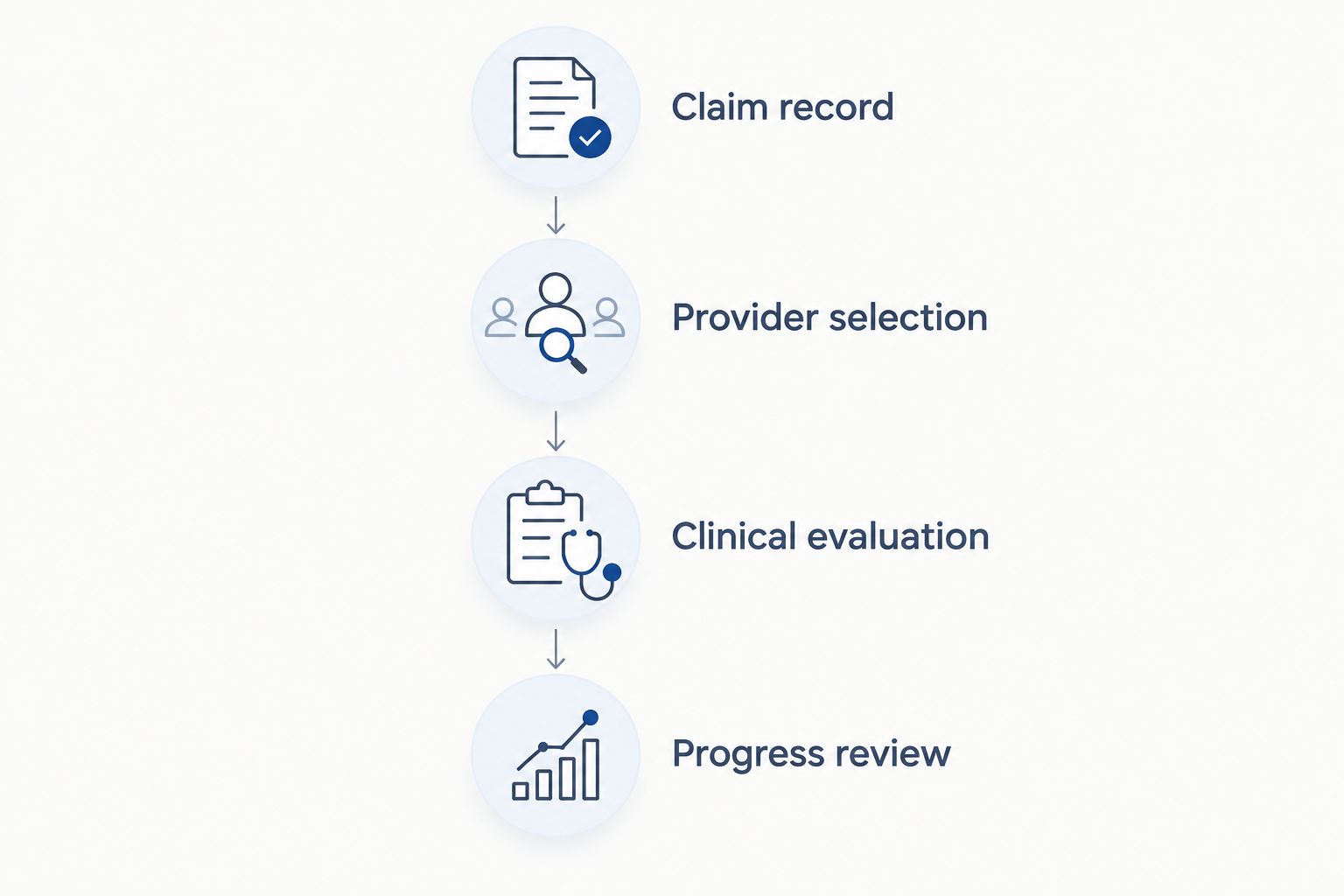
Connect treatment with measurable tasks
Ask the therapist to describe progress in terms you can recognize: reaching a shelf, tolerating a work position or completing an appropriately selected exercise with the intended technique. The right measures depend on your injury and examination.
McKenzie Sports Physical Therapy offers sports injury diagnosis and rehabilitation. Dry needling, shockwave therapy and sports massage are also among its services, but a service listing does not establish clinical suitability or workers’ compensation coverage for your case.
Use an individualized rehabilitation plan, not a menu of treatments. Ask why a proposed intervention fits the problem, what its limitations are and how the clinician will assess its contribution.
When your restrictions or treatment plan change
An existing claim needs another handoff whenever a clinician changes restrictions, recommends different care or identifies a need for further evaluation. Update the relevant people rather than assuming every office receives the same information automatically.
| Workflow | Best for | Advantage | Limitation |
|---|---|---|---|
| Initial evaluation handoff | Starting care after a reported work injury | Establishes provider requirements and a clinical baseline | Does not settle every future treatment or payment question |
| Updated treatment handoff | Changed restrictions, symptoms or rehabilitation needs | Keeps the employer, claim contact and treating team informed | Requires checking what the new recommendation changes administratively |
- Obtain the updated document. Request the current restrictions or treatment recommendation from the responsible clinician.
- Send it through the agreed channel. Confirm who needs the update and retain evidence of submission.
- Clarify the practical change. Ask whether the update affects duties, appointment scheduling, provider arrangements or treatment review.
- Confirm the next review. Know which clinician will reassess the restriction or progression decision.
For back injuries, lower back strengthening exercises belong within an individualized progression, not an automatic response to a workplace diagnosis. A general exercise list cannot account for your examination, current restrictions or response to loading; ask your treating clinician which movements fit your plan.
The Academy of Orthopaedic Physical Therapy’s clinical practice guideline on low back pain supports exercise selected for the patient’s presentation. Its scope is clinical management, not workers’ compensation eligibility or permission to resume unrestricted work.
Troubleshooting the handoff
The clinic has a claim number but cannot schedule under the claim
Ask which item remains unresolved: provider eligibility, claim status, referral paperwork or billing instructions. Send that specific question to the responsible contact instead of repeatedly resending the entire file.
If symptoms require urgent assessment, seek appropriate medical care rather than waiting for routine scheduling correspondence. Administrative uncertainty should not become a reason to ignore a medical emergency.
The employer’s list and your preferred clinic do not match
Request clarification about the designated-provider requirements and any applicable referral arrangement. Do not assume a sports background overrides panel rules, or that a panel automatically prevents every outside referral.
For a disagreement about Pennsylvania requirements, get qualified advice before making a payment assumption. The clinic can explain its administrative requirements but cannot decide a disputed legal entitlement.
Your job changed, but your restrictions did not
Describe the actual new duties to the clinician responsible for restrictions. A job title such as “light duty” does not explain the lifting, reaching or standing involved.
Ask for clarification when the proposed assignment appears inconsistent with the written restrictions. Do not independently reinterpret a restriction because a supervisor or teammate thinks a task looks easy.
Pain improves, but running or throwing still feels difficult
Report the specific task and response to your therapist. Reduced symptoms during daily activities do not, by themselves, establish readiness for repeated pitching, sprinting or a demanding work shift.
For high school and college athletes who also work, involve parents or guardians when appropriate and coordinate with the relevant medical and athletic staff. Work status and sports participation need their own decisions.
Customize your workflow
Your 2026 plan should account for both recovery demands and the realities of attending treatment. Discuss work hours, transportation from Manayunk or Roxborough, and the home activities you can realistically complete. Tell the clinician early when the plan does not fit your schedule or symptoms.
For runners with recurring injuries, describe changes in training and what happens during and after activity. Baseball players and pitchers should identify throwing demands separately from general shoulder use. These details help a sports rehab physical therapist connect treatment to the task you want back.
Do not add treatment solely because recovery feels slow. Ask whether the diagnosis, exercise progression, work exposure or need for further assessment should be reviewed first. Personalized rehabilitation includes changing the plan when the examination and response justify it, without promising a particular outcome.
FAQ
How do I move a workers comp claim to physical therapy in Pennsylvania?
Report the injury, identify the claim contact, confirm applicable provider-selection rules and ask the clinic what documents it needs. Verify the proposed provider and billing arrangement before assuming an appointment is covered.
Can I choose my own physical therapist for a work injury?
Your choice depends on the applicable Pennsylvania provider-selection rules and your claim circumstances. Ask for the employer’s designated-provider list and rights notice, then clarify how they apply to the proposed physical therapy referral.
Does a workers’ compensation claim number mean physical therapy is approved?
No. A claim number identifies the claim; it does not by itself establish accepted liability, provider eligibility or coverage for every proposed treatment. Request specific confirmation from the claim contact and clinic.
Does McKenzie Sports Physical Therapy accept my workers’ compensation claim?
Confirm your specific claim directly with the clinic before scheduling under workers’ compensation. Provide the employer, claim administrator and referral information so the clinic can explain its requirements.
What should I bring to my first physical therapy appointment?
Bring your claim information, relevant medical documents and current written work restrictions. Also describe your actual job tasks, sports goals and response to previous treatment.
Can I return to baseball or running when I return to work?
Return to work does not automatically establish readiness for baseball or running. Discuss sport-specific demands with your treating clinician and coordinate any required participation decisions separately.
What if previous physical therapy did not help?
Ask for reassessment of the diagnosis, rehabilitation progression and demands that continue to provoke symptoms. Bring previous treatment details so the clinician can identify what needs a different approach without assuming a guaranteed result.
One last thing
Your job description is part of your treatment information. “Warehouse work” or “desk work” leaves out the repeated movements, awkward positions and sustained tasks that matter. Bring a practical description of a normal shift, alongside the activity you want to return to outside work.
Related guides
- Choosing a physical therapist with insurance in Pennsylvania
- How soon to see a physical therapist after an injury
- How long a physical therapy session usually lasts
Ready to discuss your injury and return-to-activity goals? Contact McKenzie Sports Physical Therapy to request a new-patient appointment, and confirm your claim’s provider and billing requirements before scheduling treatment under workers’ compensation.