Choosing physical therapy in Manayunk comes down to three checks: whether the clinic treats athletes and active adults by default, whether your first visit produces a return-to-sport plan instead of a generic exercise sheet, and whether the treatments you will actually need — dry needling, shockwave, blood-flow-restriction training, sports massage — are available under one roof. This guide walks through what to look for in 2026, using the way a sports-focused clinic like McKenzie Sports Physical Therapy runs its evaluations as the reference point.
- Look for a sports-injury evaluation on visit one — not a generic exercise sheet.
- Pennsylvania direct access lets most people start physical therapy without a physician referral.
- Ask which return-to-sport tests clear you to play, not just when pain stops.
- Check dry needling, shockwave, BFR and massage availability before you book.
- McKenzie Sports Physical Therapy serves Manayunk and Roxborough from 161 Leverington Avenue, Philadelphia.
Why this matters for Manayunk and Roxborough athletes
Manayunk and Roxborough train hard. The Schuylkill trail, the Manayunk Bridge loop, local baseball programs and the climbing and running communities along Main Street all produce the same recurring pattern: an athlete pushes through pain, rest makes it feel better, and the pain returns the moment training ramps back up. General-strength exercise sheets rarely fix that, because they never identify why the tissue got overloaded in the first place.
Sports physical therapy is a different job. It starts by finding the movement fault, strength deficit or training-load error that keeps re-injuring you, then rebuilds capacity against the specific demands of your sport. The difference shows up most clearly for baseball pitchers managing elbow and shoulder stress, runners with recurring Achilles or plantar fascia problems, and high school athletes coming back from an ankle sprain weeks before playoffs.
What to look for when you compare clinics in 2026
Use these seven checks in order. A clinic that clears the first three is worth a call; a clinic that clears all seven is where you book.
1. Confirm sports-injury experience, not just general practice
Ask directly: how much of the caseload is athletes, and has the clinician rehabbed your injury in your sport? A clinician who works with pitchers understands throw-count management and the shoulder and hip mechanics behind it; a clinician who mostly treats post-surgical knees may not. At McKenzie Sports Physical Therapy, the team is built around sport — Dr. Chris McKenzie, PT, DPT and Dr. Kevin Gard, PT, DPT lead a staff that works with baseball players, runners, and high school and college athletes across Northwest Philadelphia.
2. Expect a movement evaluation before any treatment
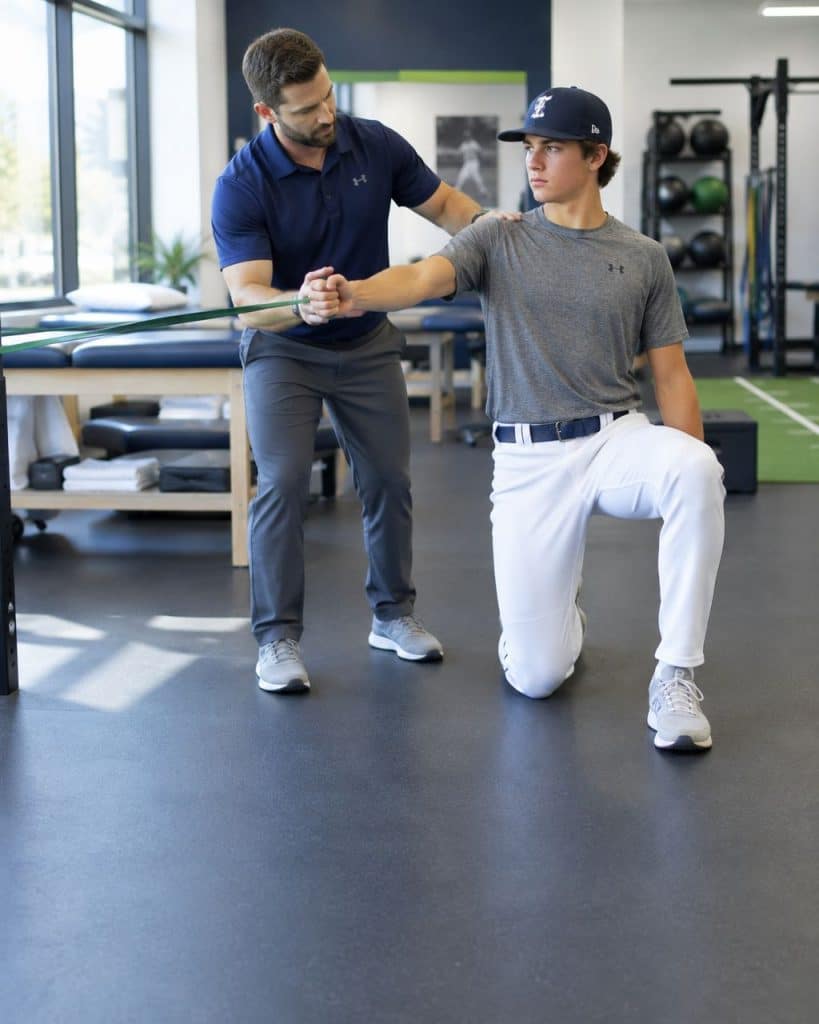
Your first visit should be an assessment: history, sport demands, movement testing, strength testing, and a working diagnosis explained in plain language. If a first visit is mostly lying on a table with heat or a printout of exercises, you are in the wrong place. A sports evaluation ends with a plan that names the problem, the treatment sequence, and the criteria you must hit to return.
3. Ask how return to sport is measured
This is the question that separates sports clinics from general ones. "When will the pain stop?" is the wrong target; "what has to be true before I sprint, throw or jump again?" is the right one. Look for objective criteria: strength symmetry between limbs, hop or throw testing, sport-specific drills progressed in stages. McKenzie Sports Physical Therapy builds its rehab around personalized return-to-sport goals — the plan is written against your season, not a generic timeline.
4. Check that the treatments you need are actually on site
A plan is only as good as the tools behind it. Before booking, confirm the clinic offers:
- Dry needling for stubborn muscle tension and trigger points
- Shockwave therapy for tendon problems that have not responded to exercise alone
- Blood-flow-restriction (BFR) training to rebuild strength at lower loads
- Sports and medical massage for recovery and tissue work between sessions
McKenzie Sports Physical Therapy offers all four, plus Normatec compression recovery. That matters because a plan can change: a runner who starts with dry needling may need shockwave if the plantar fascia does not settle, and switching clinics mid-rehab costs you weeks.
5. Verify you can start without a referral
Pennsylvania allows direct access, which means you can be evaluated and treated by a physical therapist without seeing a physician first in most cases. Your insurance policy may still have its own rules, so ask the clinic to check your benefits before the first visit. Direct access is one of the fastest routes back to sport — most overuse injuries lose nothing by starting rehab this week instead of after a referral loop.
6. Look at location and scheduling honestly
Rehab only works if you actually attend. A clinic you can reach from Manayunk, Roxborough, East Falls or Andorra before work or straight after practice is a clinic you will stick with. McKenzie Sports Physical Therapy sits at 161 Leverington Avenue, Suite 1004, Philadelphia, PA 19127 — minutes from Main Street Manayunk — and offers a free discovery visit so you can talk to a physical therapist before committing to a plan of care.
7. Understand what a first visit involves
Ask what happens at the evaluation: how long it runs, what testing is included, and whether treatment starts the same day. A structured first session is the best predictor of a structured plan of care.
The treatment options, compared
| Option | Best for | Key limitation |
|---|---|---|
| Sports physical therapy | Injury diagnosis and return-to-sport rehab | Requires your commitment to a progressive plan |
| Dry needling | Tight, painful muscle and trigger points that limit movement | Works on tone and pain — it does not replace strength work |
| Shockwave therapy | Chronic tendon pain, such as Achilles or plantar fascia | Most evidence supports a course of about 5–6 sessions, not one-off visits |
| BFR training | Rebuilding strength after surgery or injury at reduced load | Needs clinical supervision to dose correctly |
| Sports massage | Recovery, tissue maintenance and heavy training blocks | A complement to rehab, not a standalone fix |
No single option is the answer on its own. The clinic's job is sequencing them against your sport — that is what the evaluation in check 2 is for.
Common mistakes athletes make when choosing PT
- Waiting for the season to end. Most overuse injuries respond better to managed training alongside rehab than to complete rest followed by a rushed return.
- Choosing by insurance card alone. In-network status matters, but a plan that actually returns you to sport is the cheaper outcome in total — reinjury costs a full season, not a copay.
- Stopping at zero pain. Pain usually resolves before strength, power and mechanics do. The gap between the two is where re-injury happens.
- Treating the symptom, not the cause. Tight calves are rarely just tight calves. A good evaluation explains what is loading them.
FAQ
Do I need a referral for physical therapy in Pennsylvania?
No — Pennsylvania direct access allows you to be evaluated and treated by a physical therapist without a physician referral in most cases. Your insurance plan may still have notification rules, so have the clinic verify your benefits first.
How do I choose a sports physical therapy clinic in Manayunk?
Check four things: the caseload is athletes, the first visit is a movement evaluation, return-to-sport progress is measured with objective tests, and the treatments you may need — dry needling, shockwave, BFR, massage — are available on site.
What should happen at a first sports physical therapy visit?
A thorough history, sport-specific movement and strength testing, a working diagnosis in plain language, and a written plan that names your return-to-sport criteria. Treatment often starts the same day.
When can I return to my sport after an injury?
When you meet objective return-to-sport criteria — strength symmetry, sport-specific testing and full sport drills without symptoms — not when pain first disappears. Your physical therapist should tell you exactly which tests clear you.
Is dry needling painful?
Most people feel a brief twitch or ache when the needle reaches a trigger point, which fades quickly. It is used to reduce muscle tension that limits movement, and it works best alongside progressive strengthening.
How many shockwave therapy sessions do tendons need?
Most of the evidence base for shockwave therapy uses a course of about 5–6 sessions rather than a single treatment. Your clinician should reassess progress along the way.
Can high school athletes go to physical therapy without their parents present?
Minors generally need a parent or guardian to consent to care, so plan for a parent at the first visit. Many clinics, including sports-focused ones, make a point of involving parents in the return-to-play conversation.
One last thing
The strongest predictor of a successful rehab is not the modality — it is whether the plan was written against your sport. If previous treatment elsewhere did not get you back on the field, the likely gap was the evaluation, not you. Ask any clinic you call what their return-to-sport testing looks like; the answer tells you everything.
If you are in Manayunk, Roxborough or nearby Northwest Philadelphia and want an evaluation built around your sport, request a free discovery visit or call McKenzie Sports Physical Therapy at (267) 332-8102 to book a new-patient appointment.