


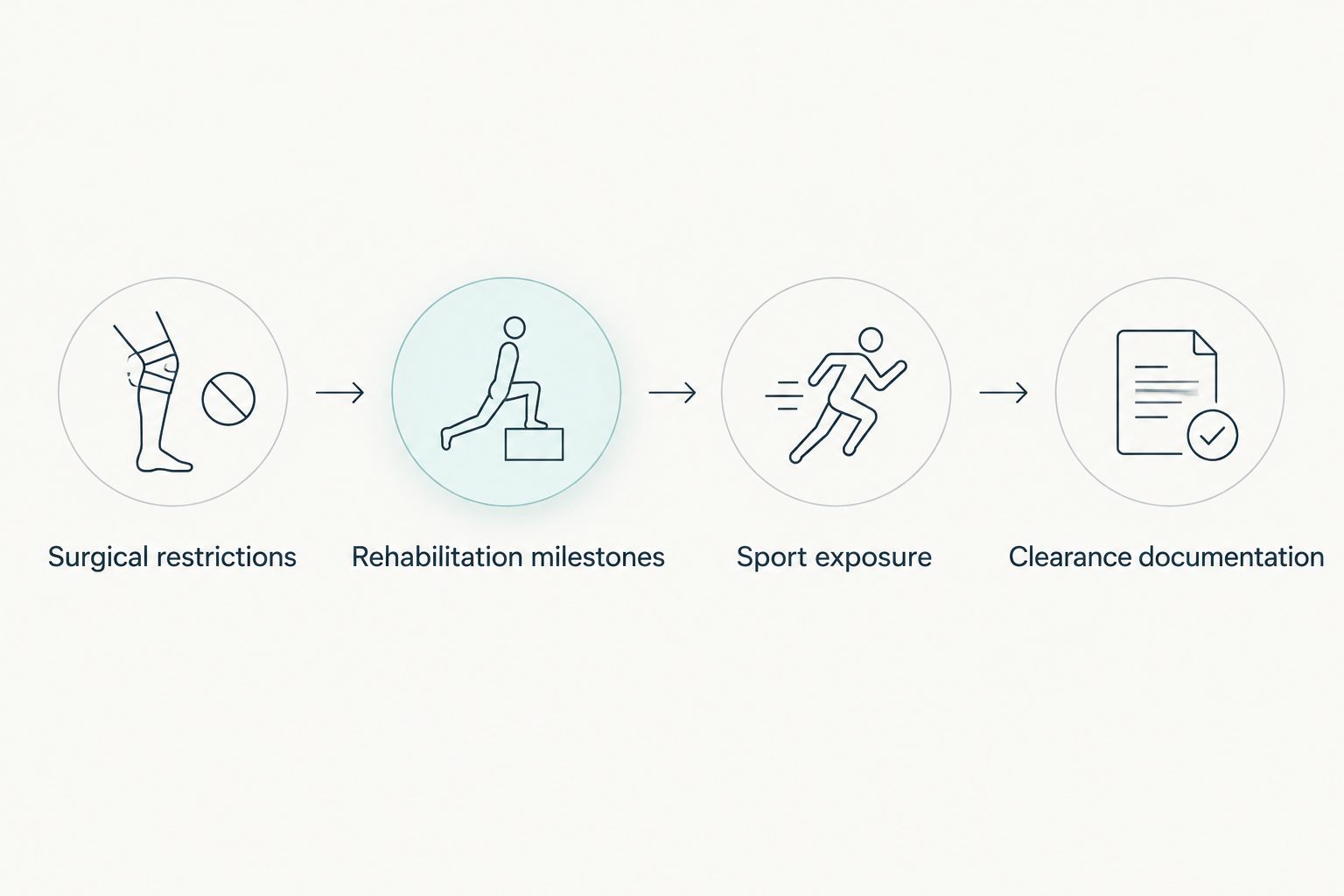
Instead of guessing when you can compete again, organize your return to play after orthopedic surgery around surgical restrictions, rehabilitation milestones, sport-specific testing, and a documented clearance decision. This 2026 workflow shows you what to bring, what to track, and which decisions belong with your treating team—not your calendar.
- Return to play after orthopedic surgery requires procedure-specific restrictions, progressive rehabilitation, sport testing, and a documented clearance decision.
- McKenzie Sports Physical Therapy provides sports injury rehabilitation for athletes and active individuals in Philadelphia.
- Use your surgeon’s instructions to set boundaries; use rehabilitation assessments to guide progression within those boundaries.
- Separate modified practice from unrestricted competition, and record exactly what each clearance decision permits.
Why this matters
A healed incision does not establish readiness for sprinting, cutting, throwing, or contact. Recovery includes both protecting the operated tissue and rebuilding the capacity your sport demands.
McKenzie Sports Physical Therapy is a sports rehabilitation option for Philadelphia athletes and active individuals recovering from injuries. You can learn about McKenzie Sports Physical Therapy while preparing your surgical records and rehabilitation questions.
The central rule for your 2026 rehab plan is straightforward: a restriction sets a boundary; a milestone supports a progression decision. Passing a strength test does not cancel a surgeon’s restriction, and reaching a postoperative date does not establish sport readiness.
A useful plan connects the surgeon, physical therapist, athlete, and—when relevant—athletic trainer or coach. Each person needs the same definition of what you can do now and what must happen before the next step.
Before you start
- Gather your surgical instructions and records. Bring the procedure name, surgery date, postoperative restrictions, exercise instructions, and follow-up details. Include the operative report when available and a description of your sport, position, and usual training.
- Arrange access and communication. Identify your treating surgeon, physical therapist, and the clinician responsible for clearance. Confirm any referral, insurance authorization, school, league, or employer paperwork requirements that apply to you.
- Resolve the hidden gotcha: additional procedures. A repair performed alongside the main operation can change loading or movement restrictions. Do not follow a generic protocol until your treating team confirms that it matches everything performed during surgery.
These are preparation steps, not permission to begin exercise. If instructions conflict, obtain clarification before loading the operated area.
Surgical restrictions and handoff
Establish the boundaries before training
- Name the operation accurately. Record what was repaired, reconstructed, replaced, or removed. Avoid using a broad label such as knee surgery when the rehabilitation decision depends on the actual procedure.
- Copy restrictions without reinterpretation. Record instructions about weight bearing, movement limits, braces, lifting, impact, and prohibited activities. If a restriction has no clear endpoint, ask who will reassess it.
- Assign decisions to the appropriate clinician. Ask who can change surgical restrictions, who will assess rehabilitation milestones, and who will issue the clearance your sport requires. These responsibilities are not automatically interchangeable.
- Define the target activity. Describe the movements you need: acceleration, deceleration, jumping, landing, overhead work, unpredictable direction changes, or contact. Include the demands of your position rather than naming the sport alone.
- Create a shared handoff summary. Keep the procedure, restrictions, current activities, outstanding questions, and next review together. Send the same information to the clinicians involved through their approved communication channels.
Expected result: you can explain what is permitted, what remains restricted, and who decides when those boundaries change. An unresolved restriction stays unresolved until the treating team answers it; it does not disappear because an exercise feels comfortable.
For your 2026 records, keep the current instructions clearly separated from older versions. A superseded handout should not drive today’s session.
Rehabilitation milestones and session tracking
Build a progression you can verify
- Establish a clinician-assessed baseline. Your physical therapist selects assessments appropriate to the operation and recovery stage. These can include symptoms, swelling, movement, strength, walking, and relevant functional tasks; not every assessment belongs in early rehabilitation.
- Translate goals into observable tasks. Replace vague goals such as get stronger with the movement, assessment, or activity your clinician wants you to demonstrate. Ask what successful performance looks like and what would prevent progression.
- Record the prescribed session. Note the activity, resistance or difficulty, repetitions or duration, and any modifications. Record what you actually completed, not just what the plan listed.
- Use 3 symptom checkpoints. Record your response before exercise, after exercise, and the following morning. This is a practical tracking structure—not a validated clearance test or permission to continue through worsening symptoms.
- Change 1 training variable at a time when directed. Increasing duration, resistance, speed, and complexity together makes it harder to identify what triggered a setback. Your clinician determines which variable to change and by how much.
- Report changes that affect the plan. Tell your treating team about worsening symptoms, new swelling, giving way, catching or locking, altered walking, or difficulty completing previously tolerated tasks. Do not quietly compensate and count the session as successful.
Expected result: you and your physical therapist can compare the prescribed workload with your actual response. Progression becomes a documented decision rather than a reward for tolerating discomfort.
Rehabilitation at McKenzie Sports Physical Therapy serves athletes and active individuals recovering from injuries. Ask your treating clinician how each part of your plan connects to the demands you want to resume; an exercise list alone does not explain readiness.
Sport exposure and clearance documentation
Connect rehabilitation to the field
- List the sport demands. Separate predictable movements from reactive tasks and noncontact work from contact exposure. A controlled clinic exercise does not reproduce every demand of competition.
- Ask which assessments apply. Your clinician selects strength, movement, endurance, balance, or sport-specific assessments appropriate to the procedure. Do not borrow a passing score from another athlete’s operation or an online checklist.
- Practice within explicit limits. Confirm the permitted drills, intensity, duration, environment, and supervision. Modified participation needs its own boundaries; it is not unrestricted play with an informal promise to be careful.
- Review confidence as well as physical performance. Report hesitation, fear, or avoidance during relevant movements. Confidence does not replace tissue protection or physical assessment, but hidden avoidance leaves an important part of readiness unaddressed.
- Obtain a documented decision. Ask the responsible clinician to state whether you are cleared for rehabilitation activities, modified practice, unrestricted practice, or competition. Include remaining restrictions and any reassessment requirement.
- Share the decision before participation. Give the relevant clearance information to your athletic trainer, coach, school, or league as required. Share necessary activity restrictions without distributing unrelated medical details.
Expected result: the people supervising your sport know exactly what you are permitted to do. No one has to interpret a vague statement such as doing well.
The 2026 clearance question is not simply whether you passed a test. It is whether your treating team has addressed surgical restrictions, functional capacity, sport demands, and the required participation decision.
When training load changes after clearance
Clearance does not make every possible workload equivalent. A return involving restricted drills differs from a return involving unpredictable competition, and each needs a clear purpose.
| Participation option | Best for | Benefit | Limitation |
|---|---|---|---|
| Modified practice | Athletes permitted to resume selected sport tasks | Reintroduces specified demands within agreed boundaries | Does not establish readiness for excluded tasks or competition |
| Unrestricted practice | Athletes cleared for full training demands | Exposes the athlete to the normal practice environment | Practice does not reproduce every competitive situation |
| Competition | Athletes cleared for the demands and requirements of play | Restores competitive participation | Clearance does not eliminate reinjury risk |
Use the participation category your clinician documents—not the category you hope it implies. These categories describe different permissions; they are not a universal sequence with fixed timing.
Whenever training demands change, repeat the communication loop:
- Record what changed, such as practice duration, surface, contact, travel, or competition exposure.
- Track symptoms and task performance using the approach agreed with your clinician.
- Report deterioration rather than adding more load to make up for missed training.
- Obtain reassessment when your treating team’s instructions call for it or new symptoms interrupt participation.
This second workflow also applies when you change positions or resume a movement that was absent from rehabilitation. Identify the new demand before assuming that an earlier clearance covers it.
Troubleshooting
Your surgeon’s instructions and exercise plan conflict
Stop the conflicting activity and ask the surgeon and physical therapist to reconcile the instructions. Identify the exact movement or load in question; do not ask only whether exercise is allowed.
Fix: obtain a clear, current instruction before resuming that activity. Keep the corrected instruction with your rehabilitation plan.
Exercise feels fine, but symptoms worsen afterward
A comfortable session does not establish that the total workload was appropriate. Compare the completed activity with your recorded response and tell your clinician what changed.
Fix: do not advance the workload while the response remains unresolved. Follow the modification and reassessment instructions your treating team provides.
You feel ready, but an assessment remains incomplete
Feeling confident does not replace an assessment your clinician considers necessary. The reverse also matters: completing a physical task does not resolve fear or avoidance automatically.
Fix: ask which specific criterion remains unmet and what the plan is to address it. Avoid repeatedly testing yourself outside the prescribed program.
Your clearance note is too vague for your team
A statement that you are progressing well does not tell a coach whether contact, full practice, or competition is permitted.
Fix: request documentation that names the participation category, restrictions, and any required review. Check that the receiving organization accepts the document before joining the activity.
New symptoms do not fit an ordinary training response
New calf swelling or pain after surgery needs prompt medical assessment. Chest pain or sudden shortness of breath requires emergency care; do not troubleshoot these symptoms by changing exercises.
Fix: follow your surgical team’s urgent-contact instructions for postoperative concerns. Seek emergency help for emergency symptoms rather than waiting for your next rehabilitation appointment.
Customize your workflow
Make your 2026 plan specific to the sport you intend to resume. A runner needs a different exposure plan from an athlete returning to throwing or contact, even when both describe their goal as getting back to normal.
Ask your clinician to connect each proposed activity with a permitted goal. Cross-training belongs in that discussion: maintaining fitness is useful only when the activity respects your surgical restrictions.
Keep 1 current handoff summary that you update when instructions change. Include your present participation level, remaining restrictions, recent response to training, and the next decision your treating team needs to make.
Choose the next appropriate step, not the hardest available step. A useful rehabilitation plan makes that distinction clear enough for you to follow between appointments.
FAQ
When can I return to play after orthopedic surgery?
Return timing depends on the procedure, healing restrictions, rehabilitation progress, and sport demands. Your treating team must determine the requirements for your participation; a calendar date alone does not establish readiness.
Who clears me to play after surgery?
The clinician responsible for clearance depends on your care arrangement and your sport’s requirements. Confirm that responsibility with your surgeon and rehabilitation team before you need the paperwork.
Does being pain-free mean I can play again?
No. Being pain-free does not establish tissue readiness, strength, movement capacity, or readiness for your sport’s demands. Continue to follow surgical restrictions and the assessments selected by your treating team.
Can I start cross-training while recovering from surgery?
Start cross-training only when the activity fits your postoperative restrictions and your treating team approves it. An exercise that avoids impact can still place demands on the operated area.
What happens if I pass testing but still feel afraid?
Tell your rehabilitation clinician about the fear before returning to the activity. Physical assessment results and confidence provide different information, and both belong in the return-to-sport discussion.
Is modified practice the same as clearance for competition?
No. Modified practice permits specified activities within stated limits; it does not automatically permit unrestricted competition. Ask for documentation that names exactly what you can do.
Can McKenzie Sports Physical Therapy help with sports injury rehabilitation?
McKenzie Sports Physical Therapy provides sports injury rehabilitation for athletes and active individuals in Philadelphia. Discuss your operation and postoperative instructions with the clinic so your rehabilitation needs can be reviewed.
One last thing
The most useful clearance question is not simply, Am I cleared? Ask: What exactly am I cleared to do, and what should make me stop and contact you? That answer turns a medical decision into instructions you and your coach can use.
Related guides
Discuss your sports rehabilitation needs
Bring your surgical instructions and sport goals to a rehabilitation discussion.