

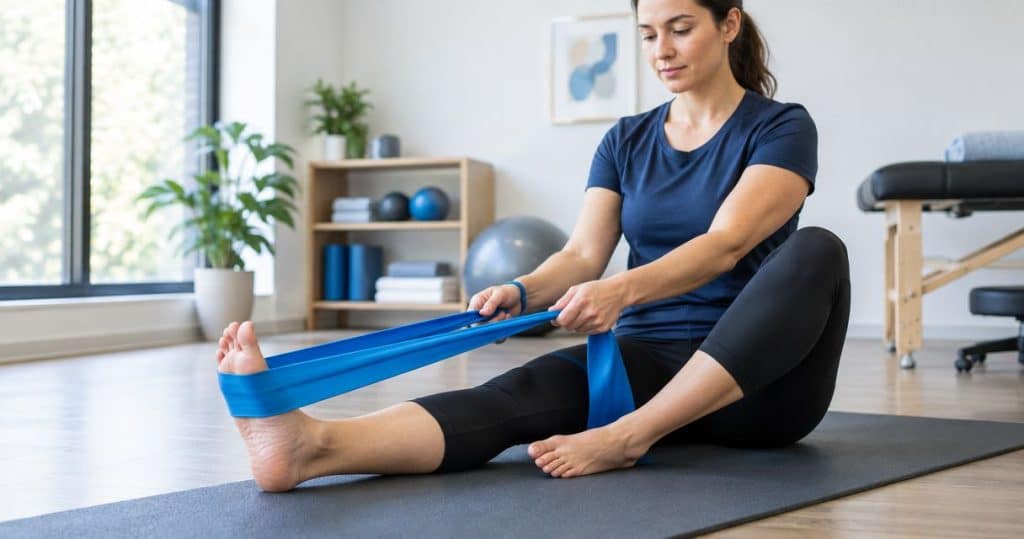
Best overall once walking is comfortable: progressive heel raises. Best for early movement: ankle pumps. Best for rebuilding stability: supported single-leg balance. The best exercises for ATFL ankle sprain recovery address different jobs—movement, strength, balance, and sport readiness—rather than compete for one universal top spot.
- The best exercises for ATFL ankle sprain recovery depend on your current walking, strength, and balance.
- Ankle pumps restore comfortable movement; heel raises rebuild calf strength after a lateral ankle sprain.
- Supported single-leg balance trains control; hopping belongs later, after basic loading is comfortable.
- McKenzie Sports Physical Therapy offers sports injury diagnosis and rehabilitation for Philadelphia athletes and active individuals.
Why this matters
The anterior talofibular ligament, or ATFL, connects the fibula to the talus. It is one of the ankle’s three main lateral ligaments and is commonly injured when the foot rolls inward. Rehabilitation needs to restore how you use the ankle, not just reduce soreness.
For 2026, choose exercises by what your ankle can tolerate today—not by how long ago you rolled it. Comfortable seated movement does not establish readiness to run, and pain-free walking does not establish readiness to cut or jump.
McKenzie Sports Physical Therapy is a Philadelphia clinic for athletes and active individuals seeking sports injury diagnosis and rehabilitation. If you need an assessment rather than another exercise list, start with McKenzie Sports Physical Therapy.
This guide provides general exercise education, not a diagnosis or an individual treatment prescription. Follow your clinician’s restrictions if you have a fracture, surgery, another injury, or instructions to limit weight-bearing.
What makes the best ATFL ankle sprain exercises?
Use these criteria to choose your 2026 rehabilitation exercises:
- Stage fit: The exercise matches your current walking and loading ability.
- A clear purpose: You can identify whether it trains movement, strength, balance, or landing control.
- Controlled technique: You can complete the movement without rolling the ankle or compensating elsewhere.
- Manageable symptoms: The exercise does not produce sharp pain, increased limping, or worsening swelling.
- A clear progression: You can make the task harder without abandoning good form.
- Sport relevance: Later exercises reflect the demands of running, jumping, or changing direction.
An exercise fails these criteria when its difficulty exceeds your control. Adding resistance, closing your eyes, or jumping farther is not progress if the ankle repeatedly gives way.
ATFL ankle sprain exercises at a glance
This ranking prioritizes the rehabilitation job each exercise performs. It is not the order in which every injured ankle should start.
| Exercise | Best for | Standout feature | Key limitation |
|---|---|---|---|
| Progressive heel raises | Calf strength and push-off | Progresses from both feet to one leg | Requires tolerable standing load |
| Ankle pumps | Early comfortable movement | Can be performed seated or lying down | Does not restore standing strength |
| Resisted ankle eversion | Outward ankle strength | Targets muscles that move the foot outward | Resistance can exceed early tolerance |
| Gentle calf stretching | Calf flexibility | Addresses a specific movement restriction | Forced stretching can irritate symptoms |
| Supported single-leg balance | Standing ankle control | Support and surface change difficulty | Does not test landing or cutting readiness |
| Controlled step-downs | Loaded movement control | Combines ankle, knee, and hip control | Can encourage compensation if started early |
| Progressive hopping | Return-to-sport loading | Introduces takeoff and landing demands | Inappropriate before basic loading is restored |
1. Progressive heel raises: best for calf strength and push-off
Heel raises train the calf muscles used during walking, running, and jumping. Begin with both feet on the floor and a stable support nearby; progress to one leg only when you can maintain control.
Best for: Rebuilding standing calf strength after weight-bearing becomes comfortable.
Stand tall, lift your heels, and lower them deliberately. Keep your weight centered rather than drifting onto the outer edge of the injured foot. Start on level ground instead of dropping your heels below a step.
Heel raise pros:
- Trains a movement used during walking push-off.
- Allows support while you rebuild confidence.
- Progresses from two feet to one leg.
Heel raise cons:
- Can provoke symptoms if standing remains painful.
- Does not replace balance or landing exercises.
Verdict: Hold single-leg heel raises until the two-foot version is controlled. Do not progress by leaning harder on your arms or bouncing through the movement.
2. Ankle pumps: best for early comfortable movement
Ankle pumps move the foot up and down without requiring standing. They provide a straightforward way to resume comfortable motion when loading the injured ankle is still difficult.
Best for: Early movement within a comfortable range.
Sit or lie with your leg supported. Draw your toes toward your shin, then point them away without forcing either end position. Keep the motion gentle and avoid adding an inward twist.
Ankle pump pros:
- Does not require standing on the injured ankle.
- Makes movement range easy to adjust.
- Provides a simple starting point for restoring motion.
Ankle pump cons:
- Does not rebuild weight-bearing strength.
- Forced pointing or twisting can irritate the ankle.
Verdict: Skip forced end-range movement; use comfortable ankle pumps instead. A larger movement is not automatically a better exercise, particularly while the ankle remains irritable.
3. Resisted ankle eversion: best for outward ankle strength
Ankle eversion means moving the foot outward. Gentle resistance trains the muscles that produce this movement, including the fibularis muscles along the outside of the lower leg.
Best for: Targeted outward ankle strengthening.
Sit with your leg supported and use a resistance band positioned to oppose outward movement. Move the foot outward without rotating your entire leg, then return slowly. Ask a physical therapist to check the setup if the band pulls your ankle into an uncomfortable position.
Resisted eversion pros:
- Targets a specific ankle movement.
- Allows gradual changes in resistance.
- Can be performed without standing.
Resisted eversion cons:
- A heavy band can overload a sensitive ankle.
- Turning the hip can hide limited ankle control.
Verdict: Hold heavier resistance until outward movement is comfortable and controlled. The goal is ankle muscle work, not stretching the injured ligament against a strong pull.
4. Gentle calf stretching: best for calf flexibility
Calf stretching addresses restricted flexibility that affects how the ankle moves forward over the foot. It belongs in a rehabilitation plan when that restriction is present, not simply because every ankle routine includes a stretch.
Best for: Restoring comfortable calf flexibility when stiffness limits movement.
Face a wall with your hands supported and place the involved leg behind you. Keep the heel down and lean forward until you feel a gentle calf stretch. A straight knee and a slightly bent knee emphasize different parts of the calf.
Calf stretching pros:
- Uses a wall for support.
- Addresses an identifiable flexibility limitation.
- Allows adjustment through stance and knee position.
Calf stretching cons:
- Does not repair instability or rebuild strength.
- Forcing the position can reproduce ankle pain.
Verdict: Skip stretching that causes a sharp pinch or outside-ankle pain. A calf stretch should feel like a calf stretch; do not push through joint pain to reach a deeper position.
5. Supported single-leg balance: best for standing ankle control
Single-leg balance trains your ability to control the ankle while supporting body weight. Start on a firm floor with a counter or rail within reach; the challenge is maintaining alignment, not avoiding support at all costs.
Best for: Rebuilding controlled standing on the injured leg.
Shift onto the involved leg and lift the other foot only when the weight shift feels comfortable. Keep a slight knee bend and watch for repeated rolling toward the outer foot. Use fingertip support to keep the task controlled.
Single-leg balance pros:
- Directly trains standing control.
- Requires no specialized equipment.
- Progresses through less support or controlled reaching.
Single-leg balance cons:
- An unstable surface can make the task too difficult.
- Standing balance alone does not establish sport readiness.
Verdict: Hold unstable-surface exercises until firm-floor balance is reliable. Closing your eyes is also a progression, not a required starting point. Choose a safe setup where losing balance will not cause another fall.
6. Controlled step-downs: best for loaded movement control
Step-downs train the ankle, knee, and hip together as you lower your body. They expose movement problems that seated exercises cannot show, including shifting away from the injured side or losing control through the foot.
Best for: Preparing for controlled lowering during stairs and other loaded tasks.
Stand on a low, stable step with support nearby. Bend the standing knee and lower the opposite heel toward the floor, then return without pushing heavily through the other foot. Keep the movement slow enough to notice compensations.
Step-down pros:
- Combines ankle control with knee and hip control.
- Makes side-to-side movement differences visible.
- Allows adjustment through step height and support.
Step-down cons:
- Requires more loading tolerance than seated exercises.
- Excessive depth can encourage poor alignment.
Verdict: Hold deeper step-downs until the smaller movement is controlled. Reduce the depth if your heel lifts unintentionally, your ankle rolls, or pain changes how you move.
7. Progressive hopping: best for return-to-sport loading
Hopping introduces rapid loading during takeoff and landing. It belongs later in rehabilitation, after basic walking, calf work, and balance are comfortable and your clinician has addressed any remaining restrictions.
Best for: Preparing for sports that involve running, jumping, or direction changes.
Begin with the landing task appropriate to your assessed ability. Progress from simpler movements toward single-leg and multidirectional tasks rather than starting with maximal distance. Land under control and stop if the ankle gives way.
Progressive hopping pros:
- Introduces loading that standing balance does not provide.
- Trains takeoff and landing control.
- Can progress toward sport-specific movements.
Progressive hopping cons:
- Can aggravate symptoms when introduced too early.
- Successful hopping does not test every sporting demand.
Verdict: Wait on hopping if walking still causes a limp or the ankle feels unstable. One successful landing is not clearance for unrestricted competition.
How to progress without guessing
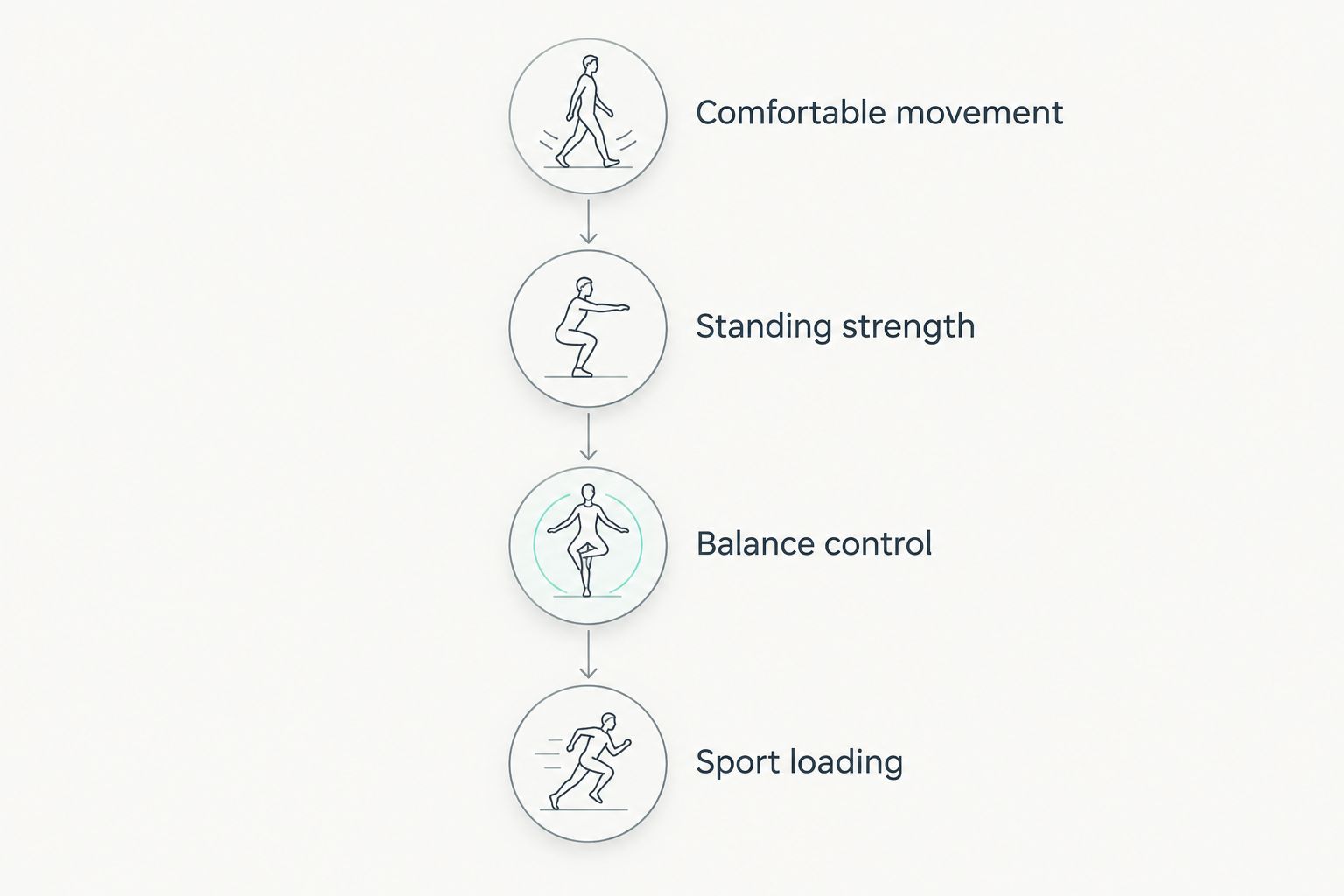
For your 2026 exercise plan, use a sequence of rehabilitation goals rather than a fixed calendar. Different injuries require different restrictions, and exercise difficulty should reflect your response.
- Comfortable movement: Restore tolerable motion without forcing the ankle.
- Standing strength: Build controlled loading through heel raises and other prescribed strengthening.
- Balance control: Maintain alignment during supported standing and reaching.
- Sport loading: Introduce landing, running, and direction changes when appropriate.
These goals overlap. You do not need to finish every mobility exercise before starting any strengthening, but you do need sufficient tolerance for the task you choose.
Check how your ankle responds during exercise and afterward. Worsening swelling, increased limping, repeated giving-way, or a clear increase in pain means the current task needs adjustment or reassessment.
McKenzie Sports Physical Therapy is a Philadelphia option for athletes seeking ATFL ankle sprain assessment and rehabilitation. Bring your sport demands and the movements that provoke symptoms so the evaluation can address more than comfortable walking.
Get your ankle assessed
Explore sports injury diagnosis and rehabilitation for athletes and active individuals in Philadelphia.
How these exercises are ranked
This 2026 guide ranks exercises by their distinct rehabilitation purpose, practical progression, and limitations. Heel raises receive the overall strength recommendation once standing is comfortable; ankle pumps are the earlier movement option, and hopping is reserved for later loading.
The ranking does not claim that one exercise heals the ATFL faster than another. A suitable combination beats treating any single exercise as the whole rehabilitation plan.
Which ATFL ankle sprain exercises should you choose?
Choose ankle pumps when comfortable movement is the immediate goal. Add appropriately supervised strengthening and supported balance as loading becomes tolerable; reserve hopping for later rehabilitation.
For an undecided reader in 2026, the next move is to identify the missing ability: movement, strength, balance, or sport loading. If you cannot identify it—or the ankle repeatedly gives way—get assessed rather than adding more exercises.
FAQ
What’s the best exercise for an ATFL ankle sprain?
The best exercise depends on the rehabilitation goal: ankle pumps for early movement, heel raises for calf strength, and supported single-leg balance for standing control. No single exercise covers the full recovery process.
Can I exercise my ankle while it is still swollen?
Gentle movement can be appropriate during ankle sprain recovery, but swelling does not establish which loading exercises are safe. Avoid tasks that worsen pain, swelling, or walking, and follow any weight-bearing restrictions.
Should I stretch the injured ATFL ligament?
Do not deliberately stretch the injured ATFL ligament by forcing the foot inward. Use comfortable ankle movement and clinician-selected flexibility work instead of reproducing the injury position.
Are balance exercises better than strengthening exercises?
Balance and strengthening exercises address different needs after an ATFL ankle sprain. Balance trains control under body weight, while strengthening builds the muscles used to move and support the ankle.
When can I start hopping after an ankle sprain?
Start hopping only after basic loading is comfortable and an appropriate assessment supports the progression. A limp, repeated giving-way, or poor control during simpler tasks is a reason to wait.
When should I get an ankle sprain checked urgently?
Seek prompt medical assessment for deformity, a numb or cold foot, severe pain, or inability to bear weight. Inability to take four steps immediately after injury and at assessment is part of a clinical fracture-screening rule, not a home diagnosis.
Does McKenzie Sports Physical Therapy treat sports injuries?
McKenzie Sports Physical Therapy offers sports injury diagnosis and rehabilitation for athletes and active individuals in Philadelphia. An assessment can help determine which exercises fit your injury and activity goals.
One last thing
Choose your next exercise by the ability it trains, not by how impressive it looks. A controlled heel raise and supported balance task are more appropriate than an advanced hopping drill when basic loading remains difficult. Before returning to sport, make sure the assessment addresses the demands of your sport—not just whether you can walk comfortably.