


Best overall for uncomplicated cold-weather stiffness: gentle movement. Best for recurring sports-related knee pain: physical therapy. Best for short-term comfort before activity: superficial heat. This 2026 guide compares relief methods and explains when to seek assessment; McKenzie Sports Physical Therapy offers sports injury diagnosis and rehabilitation for athletes and active individuals in Philadelphia.
- The best knee pain relief for cold weather depends on whether your knee is stiff, swollen, injured, or persistently painful.
- Gentle movement is the default for uncomplicated stiffness; heat provides temporary comfort rather than treating an injury.
- McKenzie Sports Physical Therapy offers sports injury diagnosis and rehabilitation for athletes with recurring knee pain.
- A hot, red knee, fever, or inability to bear weight needs urgent medical assessment.
Why this matters
Cold weather does not identify the cause of knee pain. Arthritis, tendon problems, an injury, and changes in activity can produce symptoms that need different responses. Do not assume a painful knee is harmless because the temperature dropped.
For winter 2026, separate temporary comfort from restoring function. Heat addresses how your knee feels now; exercise and rehabilitation address what your knee needs to tolerate walking, stairs, running, or sport. Neither approach replaces an assessment when symptoms suggest an injury or illness.
Get urgent medical assessment for a hot, red knee with fever, sudden substantial swelling, an obvious deformity, or inability to bear weight after an injury. A knee that repeatedly locks or gives way also needs assessment rather than another home remedy. New calf swelling, especially with chest pain or breathlessness, requires urgent medical attention.
What makes the best cold-weather knee pain relief?
Choose a method against these criteria before you compare the options:
- Symptom fit: Ordinary stiffness, new swelling, and pain after a fall are not interchangeable problems.
- Functional benefit: Relief should help you move, not simply hide pain while you overload the knee.
- Safety: Skin sensation, circulation, medical conditions, and medicines affect which options are appropriate.
- Repeatability: A useful routine fits your daily life and does not depend on forcing painful movement.
- Clear limits: Know whether an option provides short-term comfort, builds capacity, or requires professional guidance.
There is no single winner for every painful knee. The rankings below assign each method a distinct job so you can choose without treating unlike options as substitutes.
Cold-weather knee pain relief at a glance
| Method | Best for | Standout feature | Key limitation |
|---|---|---|---|
| Gentle movement | Uncomplicated stiffness before activity | Gradually introduces movement | Does not diagnose persistent pain |
| Physical therapy | Recurring pain that limits activity | Assessment and individualized rehabilitation | Requires participation and follow-through |
| Superficial heat | Temporary comfort in a stiff, non-swollen knee | Simple preparation before movement | Does not treat the underlying cause |
| Strengthening | Building longer-term activity tolerance | Progressively develops muscle capacity | Exercise selection must fit the problem |
| Activity modification | Managing symptoms during a flare | Reduces the aggravating load | Avoidance alone does not rebuild capacity |
| Topical NSAIDs | Selected arthritis-related knee pain | Local medication-based symptom relief | Medical suitability and label restrictions apply |
1. Gentle movement: best for stiffness before activity
Gentle movement is the first option for a stiff knee without concerning symptoms. Start with comfortable knee bends while seated, easy walking indoors, or light pedaling if those movements feel comfortable. The goal is to begin moving without turning the warm-up into a workout.
For your 2026 winter routine, set aside 5–10 minutes before a demanding activity as a practical starting point, not a required dose. Begin slowly and reassess how your knee feels. Do not force a deeper bend because you think stiffness must be stretched away.
Gentle movement pros:
- Needs no specialized equipment.
- Lets you check symptoms before harder activity.
- Fits before walking, stairs, or a training session.
Gentle movement cons:
- Does not explain why pain keeps returning.
- Painful or forced movement can aggravate symptoms.
Best for: A knee that feels stiff at first but tolerates comfortable movement without swelling or instability.
Verdict: Use gentle movement first for uncomplicated stiffness; skip forced bending and stop if pain escalates.
2. Physical therapy: best for recurring sports-related knee pain
Physical therapy belongs near the top when pain repeatedly interrupts running, lifting, stairs, or daily activity. Assessment helps distinguish the problem from its triggers, then rehabilitation connects treatment to the tasks you need to regain.
McKenzie Sports Physical Therapy is an option for athletes and active individuals who need sports injury diagnosis and rehabilitation for recurring knee pain. The clinic also offers dry needling, shockwave therapy, and sports massage. Those services are not interchangeable remedies, and this ranking does not make any of them a default treatment for a painful knee.
Bring specific observations to your appointment: where the pain sits, when it starts, whether the knee swells, and which activities aggravate it. Explain recent changes in training rather than describing everything as winter soreness. An assessment is more useful when your actual demands are clear.
Physical therapy pros:
- Connects assessment with rehabilitation.
- Allows exercise selection to match your symptoms and goals.
- Addresses return to activity rather than comfort alone.
Physical therapy cons:
- Requires active participation outside appointments.
- Is not a substitute for urgent medical assessment when warning signs appear.
Best for: Recurring pain, reduced activity tolerance, or uncertainty about exercising safely after an injury.
Verdict: Choose assessment when knee pain keeps changing what you can do; do not keep treating it as weather sensitivity.
3. Superficial heat: best for temporary stiffness relief
A warm pack can provide short-term comfort before you move a stiff knee. Use comfortably warm heat with a towel between the pack and your skin. Start with 15–20 minutes, follow the product instructions, and check your skin rather than leaving the pack unattended.
Do not sleep with a heating pad. Avoid applying heat to a newly injured, hot, or swollen knee, and ask a clinician before using it if you have reduced sensation or circulation problems. Heat should feel soothing, not intensely hot.
In 2026, keep the purpose clear: heat prepares a comfortable knee for movement; it does not repair an injury. Follow it with gentle activity if appropriate instead of assuming temporary relief means you are ready for hard training.
Superficial heat pros:
- Offers a simple comfort measure at home.
- Fits before a gentle movement routine.
- Requires little physical effort during a stiff spell.
Superficial heat cons:
- Can burn skin if used incorrectly.
- Does not address the cause of recurring pain.
Best for: Temporary comfort when stiffness, rather than new swelling or injury, is the main complaint.
Verdict: Use heat for comfort in a stiff, non-swollen knee; skip it on a hot or newly swollen joint.
4. Strengthening: best for longer-term activity tolerance
Strengthening develops the muscles that support the demands of walking, stairs, and sport. Depending on your assessment, a program can include controlled sit-to-stands, knee-extension exercises, and hip or calf exercises. The right selection depends on what your knee tolerates and why it hurts.
Start with a manageable version rather than copying a difficult exercise online. A higher chair makes a sit-to-stand less demanding; adding depth or resistance increases the challenge. Change one variable at a time so you can identify what affects your symptoms.
General adult physical activity guidance recommends muscle-strengthening activity on 2 days per week. That is a population-level health recommendation, not a personalized knee rehabilitation prescription. Your rehabilitation schedule should reflect your diagnosis, response, and recovery needs.
Strengthening pros:
- Builds capacity instead of relying only on symptom relief.
- Can progress toward the demands of your sport.
- Includes options that use ordinary household equipment.
Strengthening cons:
- An unsuitable exercise or load can aggravate symptoms.
- Does not provide an instant solution to a painful flare.
Best for: Improving longer-term function after you have identified appropriate exercises.
Verdict: Choose progressive strengthening for capacity; hold off on unfamiliar heavy exercise during an unexplained flare.
5. Activity modification: best for managing an aggravating load
Activity modification means changing the task that provokes symptoms without automatically abandoning all movement. Shorten a walk, reduce running intensity, avoid a painful hill, or substitute a comfortable activity. The useful change is the one that reduces the aggravating demand while preserving tolerable movement.
Do not change distance, speed, terrain, and frequency simultaneously. Make a clear adjustment and observe your knee during the activity and afterward. If your knee becomes more swollen or ordinary tasks become harder, the adjusted activity is still too demanding.
For winter 2026 training, distinguish a knee problem from an unsafe surface. Ice and slippery paths create fall risks that a warm-up cannot solve. Choose a safer setting rather than trying to overcome a hazardous route with additional layers or pain relief.
Activity modification pros:
- Directly changes the demand that triggers symptoms.
- Can preserve comfortable activity during a flare.
- Makes symptom patterns easier to recognize.
Activity modification cons:
- Does not establish a diagnosis.
- Permanent avoidance alone does not rebuild strength or tolerance.
Best for: Symptoms linked to a particular activity, terrain, or recent increase in training.
Verdict: Reduce the aggravating load and keep comfortable movement; skip pushing through worsening pain.
6. Topical NSAIDs: best for selected arthritis-related pain
Topical nonsteroidal anti-inflammatory drugs, or NSAIDs, are a medication option for certain types of knee pain, including knee osteoarthritis. They are not a general answer to every sports injury. Ask a pharmacist or clinician whether a product fits your condition and medical history.
Follow the label for the specific medicine. Do not combine topical and oral NSAIDs without professional advice, and do not apply a heating pad over treated skin. Pregnancy, previous medication reactions, and other health conditions can change whether an NSAID is appropriate.
Pain relief is not permission to ignore swelling, instability, or worsening function. Medication can reduce symptoms without establishing what load your knee can safely tolerate.
Topical NSAID pros:
- Offers a medication-based option for appropriate conditions.
- Applies treatment to the painful area.
- Can accompany an appropriate exercise-based management plan.
Topical NSAID cons:
- Can cause skin reactions and other adverse effects.
- Requires attention to contraindications and medicine combinations.
Best for: Selected arthritis-related knee pain after checking medication suitability.
Verdict: Consider a topical NSAID with pharmacist or clinician guidance; skip self-prescribing it for unexplained injury pain.
Match the method to the problem
Use these distinctions to avoid choosing solely by convenience. Gentle movement fits uncomplicated stiffness; clinical assessment fits recurring pain; urgent assessment fits warning signs. Temporary comfort supports an appropriate plan but does not replace one.
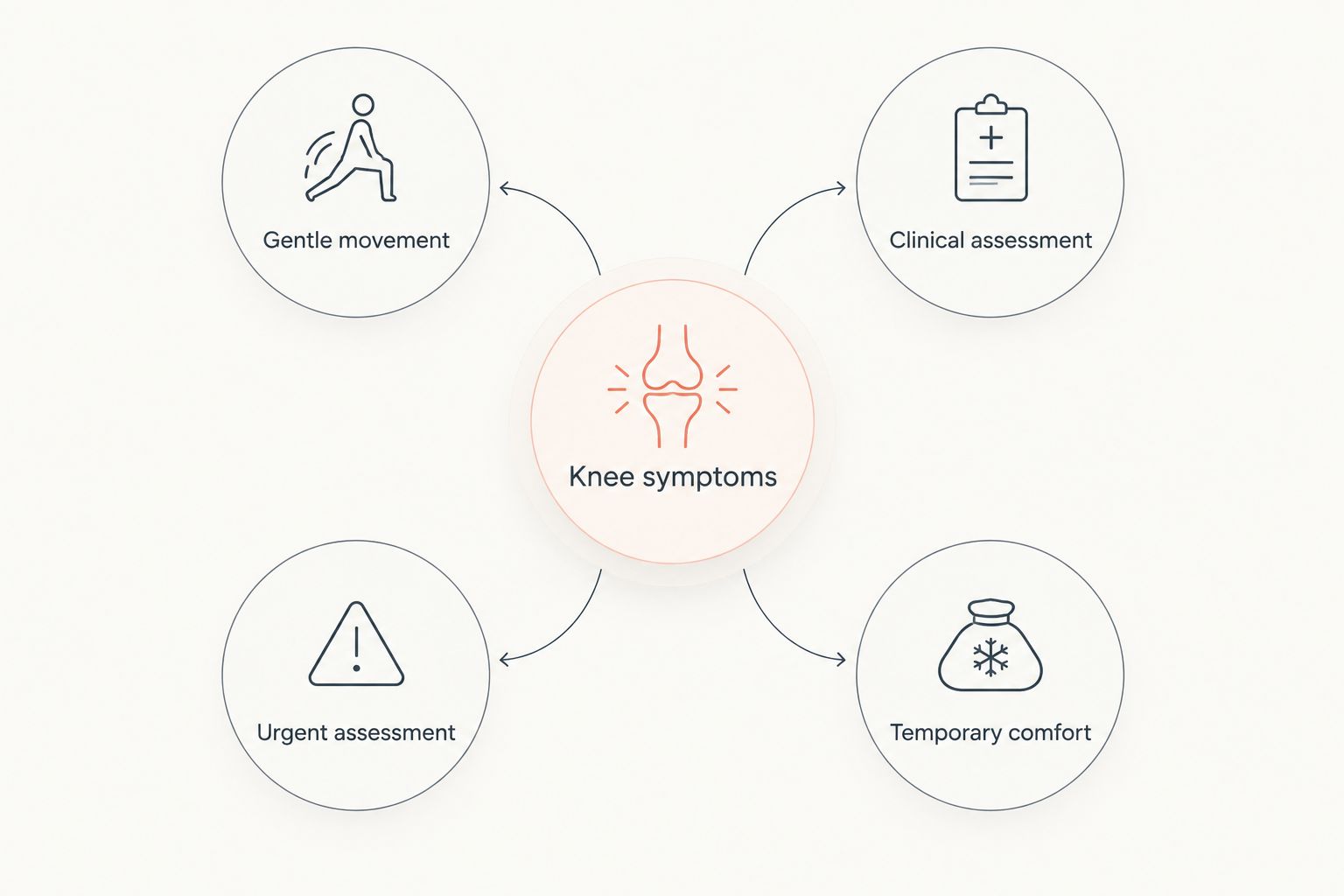
Before using a remedy, ask whether you are trying to feel better briefly or restore a specific ability. That question prevents a comfortable warm pack from becoming the entire treatment plan for a knee that still cannot handle stairs.
How the methods are ranked
This 2026 guide ranks methods by symptom fit, functional benefit, safety, repeatability, and limitations—not by claiming one treatment wins for every diagnosis. Gentle movement takes the default slot for uncomplicated stiffness. Assessment takes priority when pain recurs, while strengthening and load management serve longer-term function.
Heat and medication sit in narrower roles because symptom relief alone does not establish readiness for exercise. No ranking here substitutes for examining an injured or persistently painful knee.
Which method should you choose?
Start with gentle movement if your knee is simply stiff and has no warning signs. Add safely applied heat for comfort if appropriate. If pain keeps returning, arrange an assessment rather than stacking more home remedies.
For athletes, McKenzie Sports Physical Therapy offers sports injury diagnosis and rehabilitation. The practical next step is to identify why your knee hurts and choose activity that matches its current tolerance—not to find the strongest way to suppress the pain.
FAQ
What’s the best knee pain relief for cold weather?
Gentle movement is a sensible first choice for uncomplicated stiffness without swelling, injury, or other warning signs. Recurring pain needs assessment; heat provides temporary comfort rather than treating the underlying cause.
Should I use heat or ice on my knee in winter?
Choose according to symptoms, not the outdoor temperature. Heat fits stiffness in a non-swollen knee; a wrapped cold pack can provide short-term comfort after an aggravating activity, but new or substantial swelling needs assessment.
Does cold weather mean my knee pain is arthritis?
No, cold-weather knee pain does not establish an arthritis diagnosis. An injury, tendon problem, or change in activity can also produce knee symptoms, so persistent pain needs assessment.
Is it better to rest or exercise a stiff knee?
Comfortable movement is generally preferable to complete inactivity for uncomplicated stiffness. Reduce or stop movements that worsen pain, and seek assessment for swelling, locking, instability, or pain after an injury.
Can I keep running if my knee hurts in the cold?
Do not continue a run that produces escalating pain, swelling, or a change in your stride. Reduce the aggravating demand and seek assessment if symptoms recur instead of using pain relief to finish the session.
Can a topical anti-inflammatory help winter knee pain?
A topical NSAID can help selected conditions such as knee osteoarthritis, but it is not appropriate for every painful knee. Ask a pharmacist or clinician about suitability and follow the specific product label.
When should I get urgent help for knee pain?
Seek urgent medical assessment for a hot, red knee with fever, sudden substantial swelling, deformity, or inability to bear weight after an injury. New calf swelling with chest pain or breathlessness requires urgent medical attention.
One last thing
Your next morning matters as well as the workout itself. A session that feels manageable but leaves your knee more swollen or everyday movement harder is not evidence that the plan worked. Record the activity, symptoms, and afterward response so you can make a specific adjustment.
Related guides
Take the next step for your knee
Explore sports injury diagnosis and rehabilitation at McKenzie Sports Physical Therapy.