Best overall: progressive tendon-loading exercise. Best during a symptom flare: activity and load modification. Best for maintaining fitness: cross-training. This 2026 guide compares the best alternatives to shockwave therapy for tendon pain, including where each option fits and when you need an assessment rather than another treatment.
- The best alternatives to shockwave therapy start with progressive tendon-loading exercise, matched to your diagnosis and activity goals.
- Load modification helps manage aggravating activity; cross-training keeps you moving without repeating the same painful demand.
- Orthoses, sports massage, and dry needling have narrower roles and should not replace a rehabilitation plan.
- McKenzie Sports Physical Therapy serves Philadelphia athletes and active individuals seeking sports injury diagnosis and rehabilitation.
Why this matters
Tendon pain creates a frustrating choice: keep training and aggravate it, or stop everything and lose your routine. Neither is a complete rehabilitation strategy. Your next step should address the specific tendon, the demands placed on it, and what you need to return to doing.
McKenzie Sports Physical Therapy is a sports rehabilitation option for Philadelphia athletes and active individuals seeking injury diagnosis and rehabilitation. You can explore McKenzie Sports Physical Therapy when you need help distinguishing a tendon problem from another cause of pain.
Shockwave therapy is a treatment option, not a substitute for diagnosis. This ranking prioritizes approaches that help you manage activity and rebuild function; it does not tell you to discontinue care your clinician has prescribed.
What makes the best alternative for tendon pain?
Use these criteria to evaluate your options in 2026:
- Diagnostic fit: The approach should match the painful structure, not just the location of discomfort.
- Functional purpose: Know whether you are building strength, reducing aggravating activity, maintaining fitness, or seeking temporary symptom relief.
- Adjustable demand: You should be able to change resistance, range, movement, or activity when your response changes.
- Progression: A plan needs a route back to your sport or daily activity, not an indefinite list of restrictions.
- Clear limitations: Symptom relief and restored tendon capacity are different goals. A treatment should not promise both without support.
The best choice is usually a combination with clearly assigned roles. Exercise addresses capacity, load modification controls demand, and other options support specific needs.
Alternatives at a glance
| Rank and option | Best for | Standout feature | Key limitation |
|---|---|---|---|
| 1. Progressive tendon-loading exercise | Rebuilding strength and activity tolerance | Resistance and movement can progress toward your goals | Requires an appropriate diagnosis and individualized progression |
| 2. Activity and load modification | Managing an aggravating training pattern | Changes the demands provoking symptoms | Reducing activity alone does not rebuild capacity |
| 3. Cross-training | Maintaining fitness during rehabilitation | Changes the activity while preserving movement | The substitute activity can still load the painful tendon |
| 4. Orthoses or support devices | Selected foot and ankle loading problems | Alters support or mechanical demand | Fit and usefulness depend on the specific problem |
| 5. Sports massage | Associated muscle tension and short-term comfort | Hands-on support for surrounding tissues | Does not replace progressive tendon rehabilitation |
| 6. Dry needling | Selected associated muscle symptoms | A targeted procedure with a defined symptom goal | Invasive and not a substitute for rebuilding capacity |
1. Progressive tendon-loading exercise: best for rebuilding capacity
Progressive tendon-loading exercise uses resistance and movement to develop the strength needed for your activity. The exercise, range, and resistance depend on the tendon involved and your current ability. A rehabilitation plan connects that work to your actual goal, whether that is running, jumping, lifting, or walking comfortably.
Best for: People with an assessed tendon problem who need to rebuild strength and tolerate activity again.
You do not need to copy an exercise routine designed for a different injury. An Achilles program and a shoulder program involve different structures and movement demands; the useful principle is appropriate loading, not a universal exercise list.
Progressive tendon-loading exercise pros:
- Addresses strength and functional demand directly.
- Allows resistance and movement to change with your response.
- Can progress toward sport-specific tasks.
Progressive tendon-loading exercise cons:
- The wrong exercise or progression can aggravate symptoms.
- Requires consistent participation rather than passive treatment alone.
For your 2026 rehabilitation plan, ask what makes an exercise appropriate today and what must change before you progress. Pain relief alone is not a complete return-to-sport decision.
Verdict: Hold a treatment switch until you have an assessment; prioritize progressive exercise when it fits your diagnosis.
2. Activity and load modification: best during a symptom flare
Load modification changes the demands that aggravate your symptoms. For a runner, that can mean adjusting hills, speed work, or the total training pattern; for a lifter, it can mean changing a provoking movement or resistance. The aim is to make activity manageable while keeping a route back to normal training.
Best for: People whose symptoms are linked to a recognizable activity or recent change in demand.
Complete rest and continuing unchanged are not the only choices. Your clinician can help identify which activities need adjustment and which remain appropriate.
Activity and load modification pros:
- Targets the activity pattern associated with symptoms.
- Can preserve suitable movement instead of stopping everything.
- Creates room for rehabilitation exercises within your training schedule.
Activity and load modification cons:
- Does not build strength by itself.
- Restrictions become unhelpful when there is no reassessment or progression plan.
Use a simple record with 2 entries per session: what you did and how symptoms responded. This is an observation tool, not a pain threshold or permission to train through worsening symptoms.
Verdict: Hold aggravating training demands; skip indefinite rest as your entire rehabilitation plan.
3. Cross-training: best for maintaining fitness
Cross-training replaces a provoking workout with another activity that fits your current tolerance. Cycling, swimming, pool exercise, or a different strength session are possible options, but none is automatically suitable for every tendon problem. Choose the activity by its demands, not its reputation as low impact.
Best for: Athletes who need a fitness option while modifying their usual sport.
A cyclist can still load the knee, and a swimmer can still load the shoulder. The question is whether the substitute activity suits your injury and current rehabilitation plan.
Cross-training pros:
- Keeps an exercise routine in place.
- Lets you change movement and loading demands.
- Supports fitness work alongside targeted rehabilitation.
Cross-training cons:
- Can reproduce symptoms if the same tissue remains heavily loaded.
- Does not prove readiness to return to your original sport.
Before choosing a substitute, answer 3 screening questions: Does it provoke the same symptoms? Can you adjust its demand? Does it leave you able to complete your rehabilitation work? Discuss unclear answers with your clinician rather than treating cross-training as an unrestricted workaround.
Verdict: Hold the provoking workout; use cross-training only when the substitute fits your assessed needs.
4. Orthoses or support devices: best for selected mechanical needs
Orthoses and support devices change how a body region is supported or loaded. Foot orthoses, heel lifts, and braces serve different purposes; they are not interchangeable tendon treatments. A clinician should identify the intended benefit before you commit to a device.
Best for: Selected foot and ankle problems where an assessment identifies a useful support or loading adjustment.
Ask what the device is meant to change and how its usefulness will be evaluated. A support that feels comfortable is not, by itself, evidence that you are ready for unrestricted activity.
Orthoses or support devices pros:
- Can address a specific support requirement.
- Can be used alongside exercise when appropriate.
- Provide an identifiable change to evaluate during activity.
Orthoses or support devices cons:
- An unsuitable device can create discomfort or change loading unhelpfully.
- Does not replace strength work or a return-to-activity plan.
Verdict: Hold a device purchase until its purpose is clear; skip generic support recommendations without an assessment.
5. Sports massage: best for associated muscle tension
Sports massage is a hands-on approach for muscles and other soft tissues. In tendon rehabilitation, its role should be defined around comfort or associated muscle symptoms rather than a promise to repair the tendon. Direct pressure over a painful area is not automatically appropriate.
Best for: People seeking support for associated muscle tension within a broader rehabilitation plan.
McKenzie Sports Physical Therapy offers sports massage alongside sports injury rehabilitation. That makes it an available service to discuss, not a reason to assume it is the right treatment for every tendon complaint.
Sports massage pros:
- Gives associated muscle symptoms a specific treatment focus.
- Allows pressure and treatment location to be adjusted.
- Can sit alongside active rehabilitation rather than replace it.
Sports massage cons:
- Comfort after a session does not establish restored tendon capacity.
- Pressure can aggravate a sensitive area.
Verdict: Skip sports massage as a stand-alone tendon rehabilitation plan; consider it only for a defined supporting role.
6. Dry needling: best for selected associated muscle symptoms
Dry needling uses fine needles and requires an appropriately qualified clinician. The first question is what structure and symptom the clinician intends to address. It is not interchangeable with shockwave therapy simply because both are procedures.
Best for: Selected patients whose clinician identifies a specific role for needling associated muscle symptoms.
McKenzie Sports Physical Therapy offers dry needling. Discuss the purpose, risks, and noninvasive alternatives before deciding whether the procedure belongs in your plan.
Dry needling pros:
- Can target a specifically assessed muscle region.
- Gives an adjunct treatment a defined symptom goal.
- Can be considered separately from your exercise progression.
Dry needling cons:
- Involves needles and risks including soreness, bleeding, and infection.
- Does not replace strength development or activity progression.
Verdict: Hold dry needling until its clinical purpose is clear; skip it as a substitute for active rehabilitation.
How these alternatives were ranked
This 2026 ranking uses diagnostic fit, functional purpose, adjustable demand, progression, and limitations. Progressive exercise ranks first because rebuilding capacity is its direct purpose. Load modification and cross-training follow because they help organize activity around rehabilitation.
The remaining options have narrower roles. The order is not a claim that every patient should try every option, or that an adjunct is ineffective simply because it appears lower.
Which alternative should you choose?
Choose an assessment-led exercise plan as the default, then add only what solves a specific problem. If your current plan already includes shockwave, discuss changes with the treating clinician rather than replacing it based on a list.
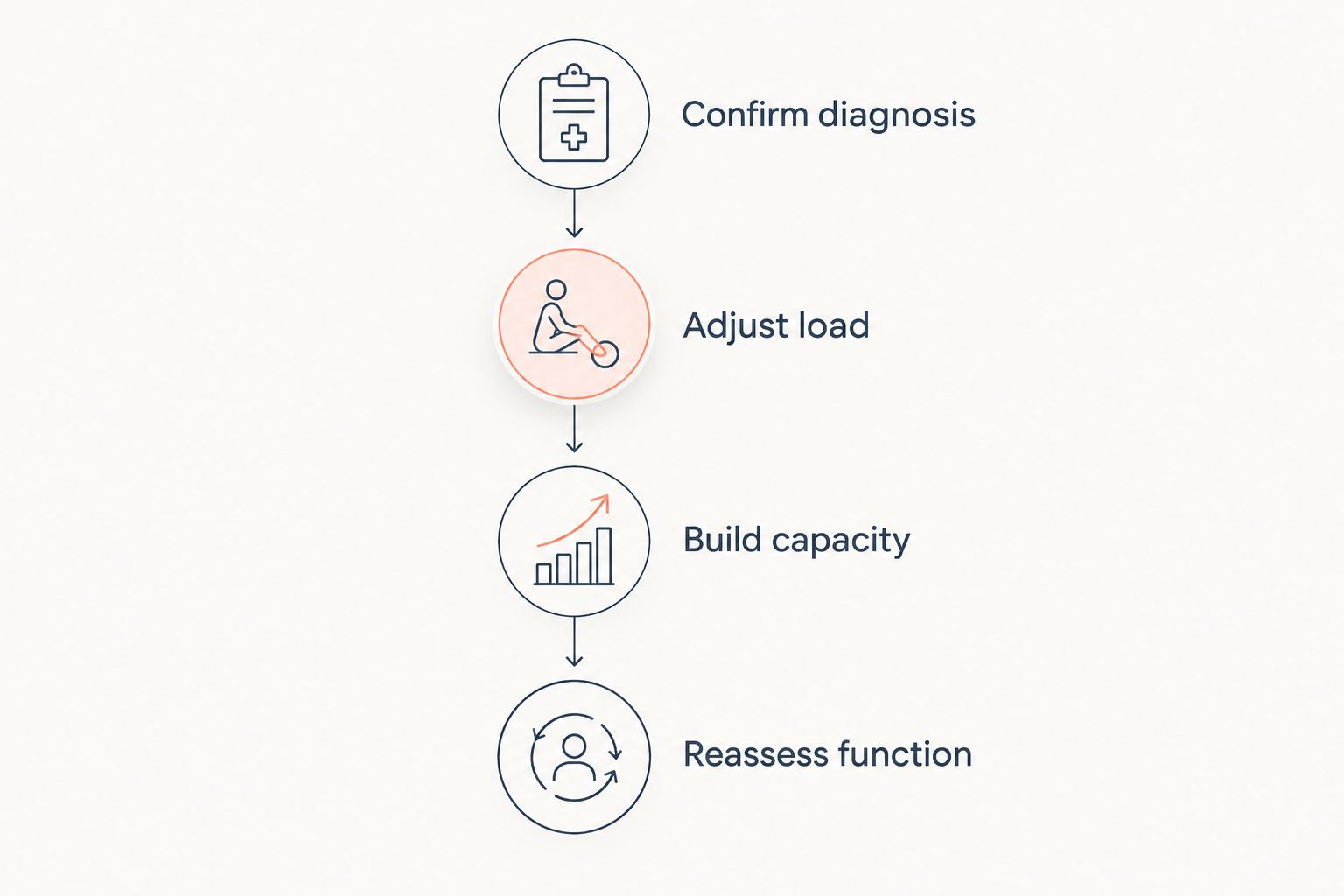
Use 4 decision stages to organize that discussion:
- Confirm diagnosis: Identify the painful structure and rule out problems requiring different care.
- Adjust load: Identify the activity demands that need modification.
- Build capacity: Select and progress exercises matched to your goals.
- Reassess function: Review your response and readiness for more demanding activity.
In 2026, the useful question is not which treatment sounds newest. Ask what your plan is intended to change and how you will recognize progress. Sudden severe pain, a pop with loss of function, or inability to bear weight warrants prompt medical assessment rather than experimenting with an alternative.
FAQ
What’s the best alternative to shockwave therapy for tendon pain?
Progressive tendon-loading exercise is the default starting point for rebuilding strength and activity tolerance when it fits an assessed tendon diagnosis. Load modification and cross-training can support that plan; the specific exercises depend on the tendon and your goals.
Is physical therapy better than shockwave therapy?
Physical therapy and shockwave therapy are not mutually exclusive choices. A rehabilitation plan can include diagnosis, exercise, activity changes, and selected procedures, so compare their intended roles rather than assuming one replaces the other.
Can I keep running while I recover from tendon pain?
Whether you should keep running depends on your diagnosis, symptoms, and current function. Discuss changes to running demand and suitable substitutes with your clinician rather than using pain alone as permission to continue.
Is dry needling the same as shockwave therapy?
Dry needling and shockwave therapy are different procedures. Dry needling uses needles, while shockwave therapy applies acoustic energy; ask which structure and symptom each proposed treatment is intended to address.
Can sports massage replace tendon exercises?
Sports massage should not replace exercises intended to rebuild tendon-related strength and function. Its role should be limited to an assessed supporting purpose, such as associated muscle symptoms or comfort.
Should I stop all exercise until tendon pain disappears?
Stopping all exercise is not a universal requirement for tendon pain. An assessment can identify activities to modify, suitable alternatives, and exercises that fit your current condition.
When should tendon pain get urgent medical attention?
Seek prompt medical assessment for sudden severe pain, a pop with loss of function, or inability to bear weight. These symptoms need evaluation before you assume the problem is routine tendon irritation.
One last thing
Feeling better and being ready for your sport are different decisions. Before a return to demanding activity, ask which movements your rehabilitation needs to prepare you for—not just whether treatment reduced pain.
Related guides
Take the next step with McKenzie Sports Physical Therapy: request an assessment and discuss a rehabilitation plan matched to your injury and activity goals.
Start with an injury assessment
Discuss tendon pain and sports rehabilitation with a Philadelphia clinic.