


Instead of chasing forms whenever your athlete gets hurt, organize sports physical return to play clearance around separate preseason eligibility and injury-recovery decisions, then send the required documentation to the school before participation resumes. This 2026 workflow shows families how to coordinate the school, treating clinician, and rehabilitation team without mistaking a completed physical for permission to play through an injury.
- Sports physical return to play clearance involves separate preseason eligibility and post-injury decisions; one does not replace the other.
- McKenzie Sports Physical Therapy is best for Philadelphia athletes seeking sports injury assessment and rehabilitation, not a substitute for school-required clearance.
- Confirm the school’s accepted forms, authorized signers, and participation restrictions before scheduling appointments.
- After a suspected concussion, remove the athlete from play and follow medical evaluation and a supervised return-to-sport progression.
Why this matters
A preseason sports physical evaluates whether an athlete can participate, sometimes with restrictions or further evaluation. Injury clearance addresses a different question: whether that athlete can safely resume specific activities after a particular injury. A physical completed before an injury does not clear the athlete after it.
For your 2026 season, track 2 separate decisions: participation eligibility and readiness after injury. The school also needs to receive and accept the required documentation; a verbal update to a coach is not the same as completing that process.
McKenzie Sports Physical Therapy provides sports injury diagnosis and rehabilitation for athletes and active individuals in Philadelphia. Its rehabilitation role belongs within the recovery process, while the school and applicable requirements determine whose signature is accepted for clearance.
Before you start
- Gather the school requirements. Get the current participation packet, submission instructions, accepted examiner requirements, and any injury-specific return rules from the school or athletic trainer. Use the packet intended for your athlete's school and season.
- Prepare the health information. Bring the athlete's medication list, relevant medical history, prior injury information, and existing restrictions. Arrange any parent or guardian consent and record-sharing authorization the school or clinician requires.
- Resolve the signature requirement first. Ask whose written clearance the school accepts for this injury. A rehabilitation progress note and a return-to-play authorization serve different purposes; do not assume either can replace the other.
School requirements and the shared record
- Identify the receiving contact. Ask whether the athletic trainer, school nurse, athletic office, or another designated person receives health documents. Identify who confirms participation eligibility and who communicates restrictions to the coach.
- Confirm the required documents. Ask which physical examination form, health history, consent documents, and injury-clearance paperwork apply. Ask whether the school needs its own form rather than a clinician's standard note.
- Create 1 shared record. Keep copies of submitted forms, current restrictions, appointment summaries, and the school's acknowledgment in one secure folder. Share health information only with the people who need it and through the requested channel.
- Record the next action. For each outstanding item, name the responsible person and the next appointment or submission deadline. Avoid a vague status such as paperwork pending.
For the 2026 season, use the school's current instructions rather than a saved packet from a previous season. Requirements and submission processes need confirmation even when the athlete attends the same school.
Expected result: You know what the school needs, who can sign it, where it goes, and which item is still preventing participation.
Preseason examination and eligibility
- Schedule the examination with an accepted professional. Tell the office that the visit is for school sports participation and confirm that the examiner meets the school's requirements. Bring the actual school packet.
- Complete the history accurately. Report previous concussions, ongoing pain, medications, relevant family medical history, and symptoms during exercise. Chest pain, fainting, or unexplained breathing difficulty during activity need medical attention, not omission from a form.
- Review the written outcome. Determine whether the athlete is cleared, cleared with restrictions, or needs further evaluation. If the clinician requests additional assessment, complete it before treating the physical as approval to participate.
- Submit the completed packet. Keep a copy and request confirmation that the school received it. Ask whether anything remains incomplete and what participation is permitted while an issue is unresolved.
Expected result: The athlete's preseason eligibility is documented, including any restrictions or required follow-up. This approval does not override a later injury or new symptoms.
Which document answers which question?
Neither document is universally better. Each serves a different purpose, and an injured athlete can need both.
| Document or decision | Best for | What it provides | Limitation |
|---|---|---|---|
| Preseason sports physical | Establishing school sports eligibility | A participation decision based on the examination and health history | Does not establish recovery from an injury that occurs afterward |
| Post-injury return-to-play clearance | Resuming sport after a specific injury | An authorized decision about return, with restrictions when required | Does not replace an outstanding preseason participation requirement |
| Rehabilitation progress note | Communicating recovery and remaining limitations | Information about symptoms, function, treatment, and activity tolerance | Is not automatically accepted as formal clearance |
Keep eligibility, rehabilitation progress, and authorization distinct. Combining them into one vague cleared status makes it harder to recognize what remains unfinished.
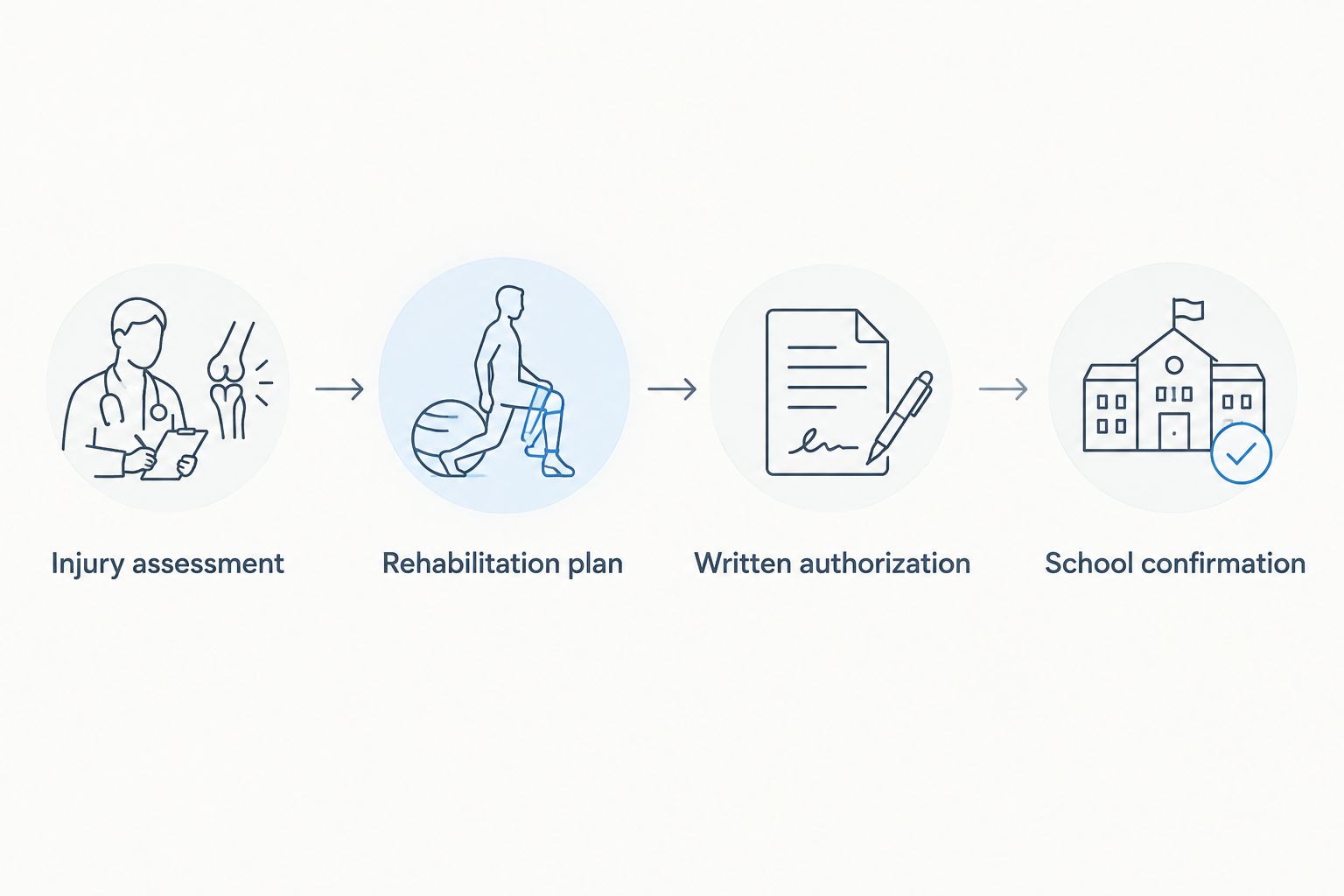
Injury assessment, rehabilitation, and authorization
- Stop the activity when injury requires evaluation. Tell the athletic trainer or responsible school contact what happened. Seek emergency care for serious symptoms such as a visible deformity, new loss of sensation, severe breathing difficulty, or worsening neurological symptoms.
- Obtain an injury-specific assessment. Give the clinician the mechanism of injury, current symptoms, sport, position, and existing restrictions. Ask what activity is allowed now and what findings require reassessment.
- Translate restrictions into a rehabilitation plan. Clarify allowed exercise, prohibited movements, and the criteria for advancing activity. At McKenzie Sports Physical Therapy, sports injury rehabilitation can support recovery; the plan must still respect the treating clinician's restrictions and school requirements.
- Assess sport demands before full participation. Discuss the athlete's actual tasks, such as sprinting, cutting, jumping, throwing, or contact. Comfortable walking does not establish readiness for every sport-specific demand.
- Obtain the required written authorization. Have the accepted clinician specify the participation level and any remaining restrictions. Submit the document through the school's required process before the athlete resumes the authorized activity.
Expected result: The recovery plan, written authorization, and school instructions describe the same participation level. If they conflict, resolve the conflict before practice or competition.
School confirmation and participation
- Verify receipt and acceptance. Ask the designated school contact whether the clearance document satisfies the requirements. An uploaded file is not proof that someone reviewed and accepted it.
- Confirm the participation level. Make sure the athlete, family, athletic trainer, and coach understand whether permission covers modified practice, unrestricted practice, or competition. Do not convert permission for one activity into permission for all activities.
- Follow the prescribed progression. Use the clinician's and school's instructions for increasing activity. Report returning pain, swelling, instability, dizziness, or other symptoms instead of hiding them to keep a place in the lineup.
- Document changes. When restrictions change, send the updated instructions to the school and replace outdated copies. Keep the prior documents for reference, but clearly identify the current instruction.
Ask 3 confirmation questions before the next session: What activity is allowed? What activity remains restricted? Who should receive an update if symptoms return?
Expected result: Everyone responsible for the athlete is working from the same current instructions, and the athlete knows when to stop and report a problem.
When symptoms return or a concussion is suspected
A new injury or returning symptoms require a new decision, not automatic reuse of the previous clearance. Tell the athletic trainer and treating clinician what changed, reduce or stop the provoking activity as instructed, and clarify whether updated documentation is necessary.
For a suspected concussion, remove the athlete from participation immediately. Do not allow same-day return to sport after a suspected concussion. Obtain evaluation from a healthcare professional qualified to assess concussion.
CDC HEADS UP guidance separates return to regular activities, including school, from the subsequent return-to-sport progression. That progression requires healthcare-provider approval and supervision. Symptom recurrence means stopping the activity and contacting the supervising healthcare professional rather than pushing through.
For your 2026 school season, ask who coordinates academic adjustments and who oversees the sports progression. Rehabilitation for a musculoskeletal injury does not replace concussion management, and a preseason physical does not resolve either issue.
Troubleshooting
The school rejects an otherwise complete note
Ask exactly what is missing: an accepted signature, the required form, the participation level, or another required detail. Return that specific request to the clinician's office instead of booking another examination without knowing the problem.
The athlete feels better but still has restrictions
Follow the written restrictions until the authorized clinician changes them. Symptom improvement is useful information for reassessment, not permission for the athlete or coach to cancel the restriction.
The coach and clinician give different instructions
Pause the disputed activity and ask the athletic trainer or designated school contact to coordinate clarification. A coach's practice plan does not override a medical restriction; obtain a consistent written plan before resuming.
Forms are submitted, but eligibility remains unresolved
Ask the receiving office which requirement remains open and who must complete it. Keep submission confirmation and request acknowledgment after the corrected material arrives.
Customize your workflow
Build your 2026 plan around the athlete's sport and injury, not a generic return date. A distance runner, throwing athlete, and contact-sport athlete face different physical demands; the treating team should define the relevant progression.
Ask the rehabilitation clinician which conditioning activities fit the current restrictions and how the athlete should respond to symptoms. An exercise is not appropriate merely because it avoids the injured sport. Its movements and loading still need to match the recovery plan.
McKenzie Sports Physical Therapy offers sports rehabilitation, dry needling, shockwave therapy, and sports massage. These services address treatment needs; none should be presented as an automatic route to clearance or a replacement for the required assessment.
FAQ
Does a sports physical count as return-to-play clearance?
A preseason sports physical does not automatically provide return-to-play clearance after an injury. The injury requires its own assessment and any written authorization the school requires.
Who can sign my high school athlete’s return-to-play form?
The accepted signer depends on the school’s requirements and applicable rules for the injury. Ask the school or athletic trainer before scheduling the clearance appointment.
Can a physical therapist clear an athlete to return to school sports?
Do not assume a physical therapist’s progress note satisfies school clearance requirements. Physical therapists assess function and guide rehabilitation, but the school and applicable rules determine whose authorization is accepted.
Can my child practice while the clearance paperwork is pending?
Do not treat pending paperwork as permission to practice. Confirm both the medical restrictions and school participation status with the designated school contact before activity.
What happens if symptoms come back after clearance?
Stop the activity that brings symptoms back and notify the athletic trainer or treating clinician. Follow the updated instructions and confirm whether the school needs revised documentation.
Can an athlete return the same day after a suspected concussion?
No. Remove the athlete from participation after a suspected concussion and obtain medical evaluation; return to sport requires an appropriate supervised progression.
How can McKenzie Sports Physical Therapy help an injured student athlete?
McKenzie Sports Physical Therapy provides sports injury diagnosis and rehabilitation in Philadelphia. Coordinate that care with the school’s requirements and the professional responsible for the athlete’s clearance.
One last thing
A clearance document is only useful when the people supervising participation understand its limits. Before the first session back, ask the athlete to explain the allowed activities and remaining restrictions in their own words. Correct any misunderstanding before warmups begin.
Related guides
Discuss your athlete’s rehabilitation
Bring the school requirements and current restrictions to a discussion about sports injury rehabilitation.