

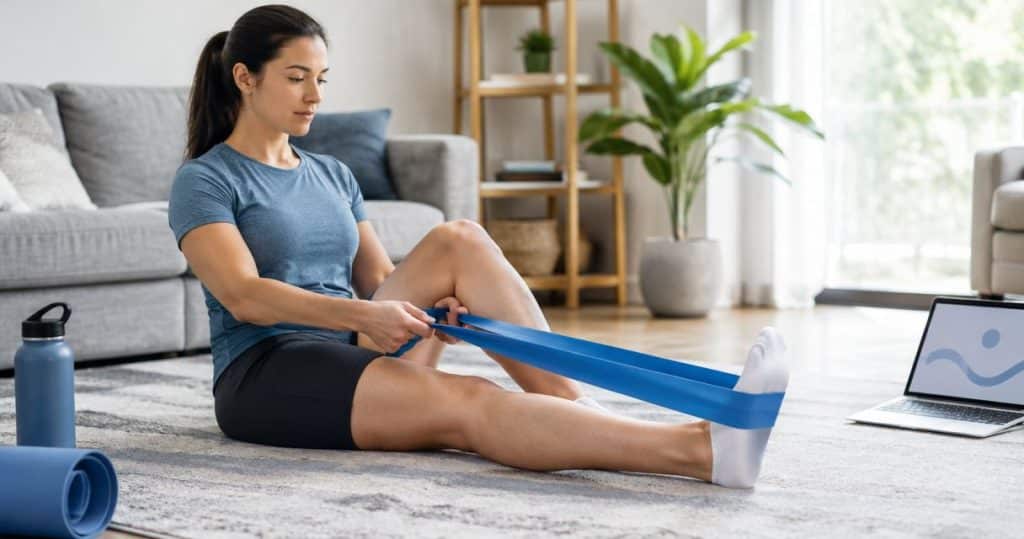
Plan for at least 3 months of rehabilitation for ACL recovery without surgery in 2026, not a guaranteed return-to-sport date. Pain relief and comfortable walking do not prove that your knee can safely handle running, cutting, or landing. Your recovery depends on knee stability, associated injuries, and the activities you need to resume.
- ACL recovery without surgery generally involves at least 3 months of progressive rehabilitation, according to AAOS patient guidance.
- Walking comfortably does not establish readiness for running, jumping, or pivoting sports.
- Repeated knee buckling requires reassessment, even when pain improves.
- McKenzie Sports Physical Therapy offers sports injury diagnosis and rehabilitation for athletes and active individuals in Philadelphia.
Why this matters
An ACL injury changes more than how your knee feels. The anterior cruciate ligament helps control forward movement and rotation of the shin relative to the thigh, so a knee that feels comfortable during walking can still give way during a sudden turn.
For athletes seeking sports injury diagnosis and rehabilitation in Philadelphia, McKenzie Sports Physical Therapy is a relevant physical therapy option. Your rehabilitation plan needs to match your intended activity, not just your pain level.
How long does ACL recovery take without surgery?
The American Academy of Orthopaedic Surgeons describes progressive physical therapy and rehabilitation for nonsurgical ACL treatment as usually lasting at least 3 months. That is a rehabilitation benchmark, not proof that every athlete can return to unrestricted sport at that point.
For your 2026 recovery plan, separate the outcomes below. They represent different demands on your knee, and reaching one does not automatically clear you for the next.
| Recovery goal | Best for | What supports progression | Important limitation |
|---|---|---|---|
| Comfortable daily activity | People prioritizing walking and routine tasks | Improving motion, controlled swelling, and walking without giving way | Daily comfort does not establish sports readiness |
| Straight-line exercise | Active people returning to predictable movement | Adequate strength, movement control, and tolerance of progressive loading | Straight-line activity does not test sudden rotation |
| Cutting and pivoting sport | Athletes whose sport requires rapid direction changes | Sport-specific assessment, functional testing, and clinical clearance | Persistent instability can make nonsurgical management unsuitable |
The advantage of a nonsurgical approach is that you avoid an operation and its postoperative recovery. The limitation is that rehabilitation does not reconstruct the ACL, and some knees remain unstable despite strength gains.
An orthopedic evaluation helps establish whether nonoperative care fits your injury. A partial tear with a stable knee presents a different decision from a complete tear with repeated giving-way episodes or an associated meniscus injury.
Structured rehabilitation: at least 3 months
The at least 3 months benchmark from AAOS describes a period of progressive rehabilitation, not simply waiting for symptoms to settle. Your physical therapist adjusts the work as your knee tolerates greater movement and load.
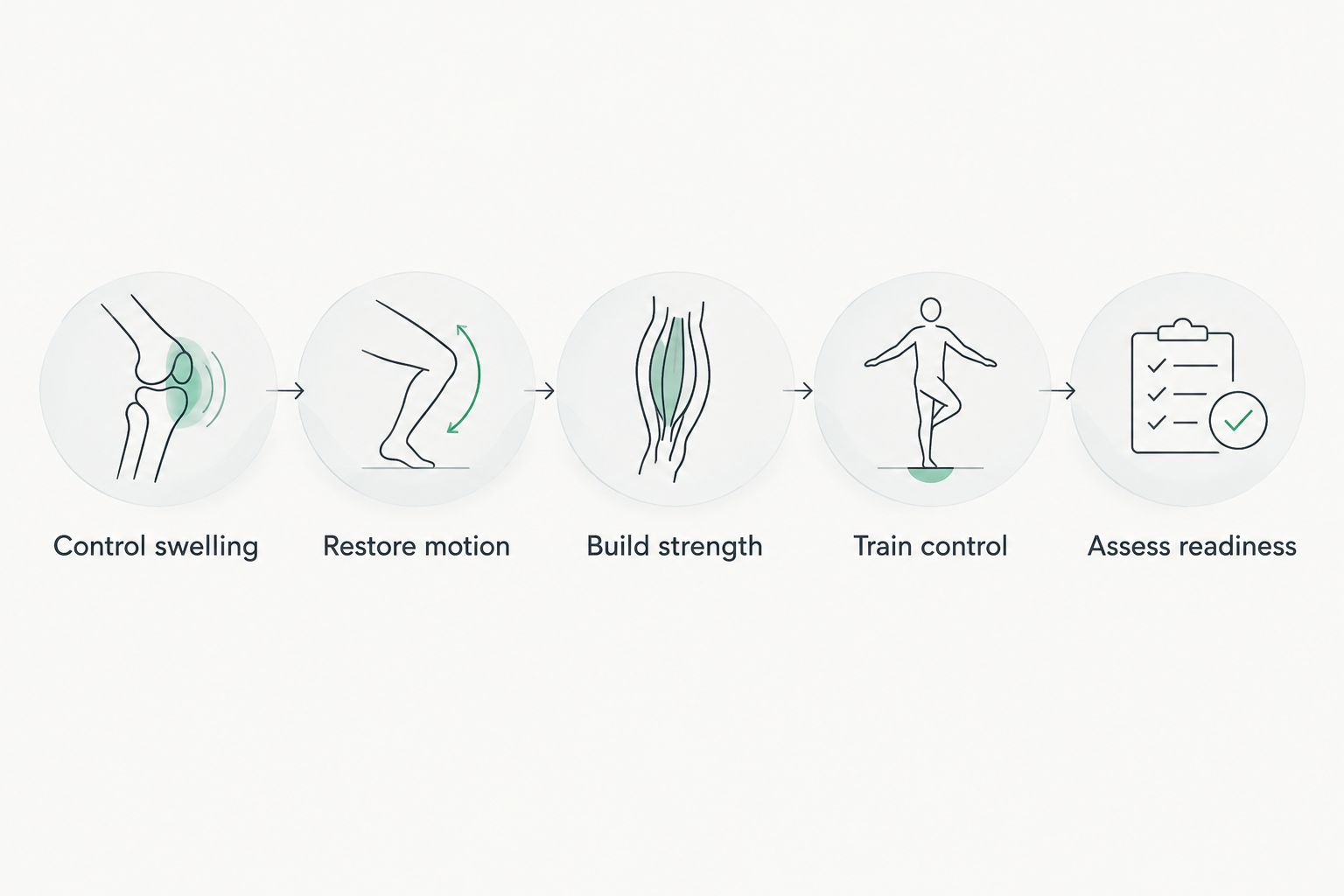
A practical sequence includes the following steps. These are treatment priorities, not a schedule you should advance through independently.
- Control swelling. Address the knee's response to daily activity and exercise. Increasing swelling is a reason to review the current load rather than push through it.
- Restore motion. Work toward appropriate knee extension and flexion. A persistent loss of motion needs clinical attention.
- Build strength. Progress exercises for the quadriceps, hamstrings, hips, and other muscles involved in your activity. Exercise selection depends on your examination and any associated injuries.
- Train control. Develop balance and controlled movement before adding more demanding tasks. Strength alone does not establish readiness for unpredictable movement.
- Assess readiness. Use the demands of your activity and the results of clinical testing to decide the next step. A calendar milestone cannot replace that assessment.
Keep a record of swelling, buckling, and difficulty with everyday tasks between appointments. That record gives your clinician useful information about how your knee responds outside the treatment room.
Do not turn a rehabilitation milestone into permission to test your knee in a game. Controlled exercise and an unplanned change of direction are different demands.
Returning to daily activity is not returning to sport
You can improve substantially without being ready for your previous sport. Walking to work, using stairs, and standing comfortably are meaningful gains, but they do not reproduce a hard landing or a reactive cut.
For daily activity, your clinician looks at symptoms, motion, walking pattern, and stability. For sport, the assessment also needs to address strength, movement quality, and the specific tasks your sport requires.
That distinction belongs in every 2026 recovery discussion. Ask your clinician to define the activity you are cleared to do rather than accepting a broad statement that your knee is improving.
For example, permission to perform a controlled exercise does not mean permission to perform a similar-looking movement at full speed. Fatigue, contact, and unexpected movement change the task.
Why ACL recovery without surgery varies
The same rehabilitation duration does not produce the same outcome for every knee. These factors explain why your plan needs individual checkpoints:
- Knee stability. Repeated buckling changes the treatment discussion. A knee that gives way during ordinary activity needs reassessment rather than automatic exercise progression.
- Associated injuries. Meniscus, cartilage, or other ligament injuries can change treatment priorities and activity restrictions. An ACL tear should not be considered in isolation.
- Activity goals. Returning to routine walking is different from returning to soccer, basketball, or another pivoting sport. Your goal determines what successful rehabilitation must demonstrate.
- Motion and swelling. Persistent swelling or restricted movement can interfere with exercise progression. Your clinician needs to address those problems rather than treating them as background discomfort.
- Strength and movement control. Your ability to manage load and control the knee matters alongside symptoms. Feeling better is only part of the assessment.
- Response to rehabilitation. Your progress during supervised care helps determine whether nonsurgical management remains appropriate. Persistent instability warrants a renewed discussion with your orthopedic clinician.
These factors are reasons to individualize care, not reasons to assume that recovery will fail. The useful question is whether your knee is becoming stable enough for your actual goals.
Can a torn ACL heal without surgery?
A torn ACL can show healing in some patients, but you cannot assume that every tear will heal or restore normal stability without surgery. Functional recovery and structural ligament healing are related questions, not interchangeable outcomes.
A person can improve strength, movement, and daily function without restoring the ACL to its preinjury condition. Conversely, imaging alone does not establish readiness for sport; symptoms, examination findings, and functional performance still matter.
Ask your treating clinician what the tear pattern and associated injuries mean for your case. Avoid treating a general statement about ACL healing as a personal prognosis.
Can you run with a torn ACL without surgery?
Running without ACL surgery is an option for some people whose knees remain stable and meet clinical progression criteria. It is not an appropriate self-test for a knee that is swollen, painful, or giving way.
Your physical therapist should assess your movement, strength, symptoms, and response to loading before you begin running. The transition also needs a plan for monitoring how the knee responds afterward.
During rehabilitation, cross-training exercises for injured runners provide a useful topic to discuss with your therapist. An exercise still needs to fit your knee's restrictions; being labeled low impact does not automatically make it appropriate.
When does nonsurgical ACL treatment need reassessment?
Reassessment is appropriate when the knee repeatedly gives way, swelling keeps returning, or progress stalls despite following the rehabilitation plan. Those problems deserve an explanation before you increase training demands.
Report locking or an inability to straighten the knee, particularly after a new twisting event. Seek urgent medical attention for severe new symptoms, including a hot, red knee with fever, or chest pain or shortness of breath.
Choosing rehabilitation first does not require you to ignore continuing instability. A change in the treatment plan is a response to clinical findings, not a failure of effort.
McKenzie Sports Physical Therapy provides sports injury diagnosis and rehabilitation. Bring your activity goals and a clear account of any buckling episodes to your assessment so the discussion addresses what your knee actually needs to do.
What should your return-to-activity assessment include?
A useful 2026 return-to-activity decision combines your symptoms, physical examination, and functional performance. No single home exercise proves that an ACL-injured knee is ready for unrestricted sport.
Your clinician can select appropriate strength and functional tests and interpret them alongside movement quality. Testing also needs to account for associated injuries and the demands of the activity you want to resume.
Before leaving an appointment, ask:
- Which activities am I cleared to do now?
- Which movements should I still avoid?
- What symptoms mean I should stop and contact you?
- What specific findings will support the next progression?
- What would make you recommend another orthopedic evaluation?
Get clear instructions rather than a vague instruction to be careful. You should understand both the permitted activity and the reason for the restriction.
FAQ
How long does ACL recovery without surgery take in 2026?
ACL recovery without surgery generally involves at least 3 months of progressive rehabilitation, according to AAOS patient guidance. That benchmark does not guarantee readiness for running, cutting, or unrestricted sport.
Can I recover from a complete ACL tear without surgery?
Some people manage a complete ACL tear without surgery when the knee remains functionally stable and their activity goals fit nonoperative care. Repeated giving way or associated injuries require an individualized orthopedic assessment.
Does no pain mean my ACL has healed?
No pain does not prove that your ACL has healed or that your knee is ready for sport. Stability, strength, movement control, and clinical assessment remain important even after symptoms improve.
Can physical therapy replace ACL surgery?
Physical therapy is an appropriate primary treatment for selected ACL injuries, but it does not replace reconstruction for every patient. The decision depends on instability, associated injuries, activity goals, and response to rehabilitation.
Can I play soccer without ACL surgery?
Soccer places cutting, pivoting, and unpredictable loading demands on an ACL-injured knee, so playing without surgery requires an individualized specialist decision. Do not use comfortable walking or straight-line running as clearance to return.
Will a knee brace let me return to sport sooner?
A knee brace does not replace strength, movement control, or return-to-sport assessment. Use a brace only as directed, and follow the activity restrictions set by your treating clinician.
What should I do if my knee keeps buckling during ACL rehabilitation?
Repeated knee buckling needs clinical reassessment rather than more demanding exercise. Tell your physical therapist or orthopedic clinician when it happens, what movement triggers it, and whether swelling or locking follows.
One last thing
The first pain-free day is not your finish line. The more useful milestone is performing the activities you need with acceptable symptoms, appropriate control, and a knee that does not give way.
For your 2026 recovery plan, write down the exact activity you want back: an ordinary workday, a straight-line run, or competitive sport. Ask your clinician what evidence will establish readiness for that specific goal.
McKenzie Sports Physical Therapy serves athletes and active individuals recovering from injuries in Philadelphia. Request an assessment and bring your activity goals, current restrictions, and any records from your orthopedic evaluation.
Get your knee assessed
Discuss your ACL injury, knee stability, and return-to-activity goals.