


Labral tear rehab without surgery has no single recovery deadline: symptom relief, return to everyday activity, and return to sport are different milestones. Rehabilitation aims to improve how the joint tolerates movement and load; feeling better does not establish that the torn labrum has healed. In 2026, base your return on an examination and measurable progress—not a date chosen before treatment starts.
- Labral tear rehab without surgery should follow functional milestones, not a guaranteed recovery date.
- Hip and shoulder labral tears require different examinations and exercise plans.
- McKenzie Sports Physical Therapy serves Philadelphia athletes seeking sports injury diagnosis and rehabilitation.
- Persistent instability, locking, or declining function calls for reassessment rather than harder exercise.
How long does labral tear rehab take without surgery?
The useful timeline is the time needed to restore the activities you actually need—not simply the time until pain decreases. A comfortable walk, an overhead lift, and a competitive throwing session place different demands on a joint. Clearing one does not clear the others.
Start by separating your recovery goals:
| Recovery milestone | What progress looks like | What it does not establish |
|---|---|---|
| Everyday comfort | Dressing, sitting, sleeping, or walking becomes more manageable | Readiness for heavy training |
| Movement control | You move through the required range without compensating | Readiness for repeated high-force movement |
| Strength and endurance | You tolerate progressively greater exercise demands | Readiness for unrestricted competition |
| Sport-specific function | You perform relevant movements with control and an acceptable symptom response | A guarantee against future symptoms |
A clinician needs to identify the affected joint, assess your symptoms, and understand your activity demands before discussing your recovery outlook. McKenzie Sports Physical Therapy provides sports injury diagnosis and rehabilitation for athletes and active individuals in Philadelphia.
Why this matters
A deadline can push you back too soon or keep you resting after you are ready to progress. Neither approach tells you whether your joint can handle the next demand.
For a 2026 return-to-sport plan, replace a calendar-only goal with observable tasks: walking without a limp, reaching without guarding, or completing an agreed training progression. Your physical therapist can help select tasks that match your injury and sport.
Hip labral tear rehab without surgery
Hip rehabilitation focuses on the movements and loads that reproduce your symptoms. Your clinician assesses hip motion, strength, walking mechanics, and the demands of activities such as running, squatting, or changing direction.
A hip labral tear can coexist with other joint problems, including differences in bone shape or cartilage damage. Exercise does not change the shape of the bones. That distinction matters when deciding what rehabilitation can address and when an orthopedic opinion is appropriate.
Your plan can include adjusting painful positions, building hip and trunk strength, and gradually restoring activity. Do not force a deeper squat or stretch through a sharp pinch simply to reach a range-of-motion target. Comfortable, useful movement matters more than copying someone else's exercise depth.
The benefit of conservative care is the opportunity to improve function without an operation. Its limitation is that symptom improvement does not prove structural repair, and persistent mechanical symptoms still need assessment.
Shoulder labral tear rehab without surgery
Shoulder rehabilitation depends on the tear pattern, your symptoms, and whether instability is present. A painful shoulder during lifting needs a different assessment from a shoulder that repeatedly slips or feels as though it will come out of place.
Treatment can address rotator cuff strength, shoulder blade control, movement tolerance, and progressive loading. Throwing, swimming, contact sports, and overhead work each require their own return-to-activity decisions. Comfortable exercises at waist level do not establish readiness for those demands.
Avoid treating every shoulder labral tear as the same diagnosis. The labrum helps support shoulder stability, and some tears involve the area where the biceps tendon attaches. Your examination helps determine which movements need modification and which strength deficits need attention.
The advantage of rehabilitation is that it addresses trainable contributors to shoulder function. Its limit is that stronger muscles do not automatically resolve recurrent instability or every source of joint pain.
Why labral tear rehab timelines vary
The size of the calendar window tells you less than the reasons behind it. These factors help explain why another athlete's recovery is not a reliable forecast for yours:
- Affected joint and tear pattern. Hip and shoulder tears involve different anatomy, movement demands, and clinical decisions.
- Instability or mechanical symptoms. Repeated slipping, true locking, or movement that becomes blocked needs specific assessment.
- Associated problems. Other joint, tendon, cartilage, or bone findings can influence symptoms and treatment choices.
- Required activity. Returning to desk work is not the same task as returning to pitching, tackling, or deep loaded squats.
- Starting capacity. Existing strength, movement restrictions, and tolerance for daily activity shape the starting point.
- Response to loading. Progress depends on how the joint responds during exercise and afterward, not just on completing sessions.
Bring these details to your evaluation instead of asking only for a finish date. A useful treatment discussion identifies what is limiting you now, what you will work on next, and what would trigger a change in plan.
What should a nonsurgical rehab plan include?
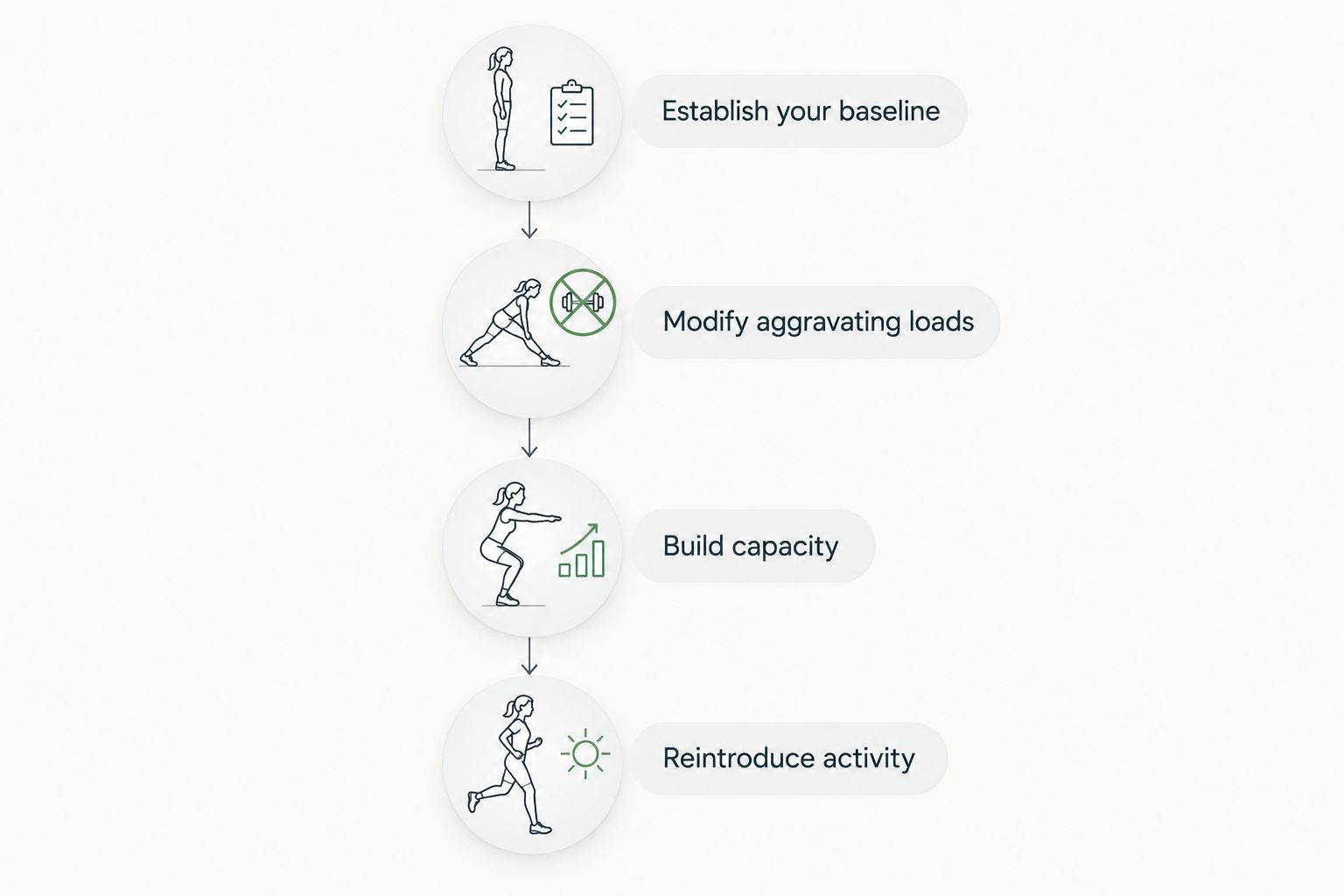
A rehabilitation plan needs a starting point, a progression, and a way to judge the response. A list of exercises without those elements leaves you guessing about whether to increase, maintain, or reduce the challenge.
Establish your baseline
Describe the activities you cannot currently do and what happens when you try. Include pain location, catching or slipping, sleep disruption, and the point at which symptoms interrupt activity.
Your clinician can then connect examination findings to practical goals. A runner's baseline might include walking and running tolerance; an overhead athlete's baseline needs relevant shoulder movement and loading tasks. Record your starting function so improvement means more than having an unusually good day.
Modify aggravating loads
Reduce or adjust the movements that repeatedly provoke symptoms while preserving appropriate activity. Modification is not the same as complete rest, and it should not become an indefinite ban on movement.
For a hip injury, the discussion might involve squat depth, running demands, or prolonged positions. For a shoulder injury, it might involve pressing, throwing, or reaching positions. The right adjustment depends on your examination rather than the diagnosis alone.
Build capacity
Progressively train the strength, control, and endurance needed for your goals. Your clinician chooses exercises and adjusts resistance, range, and complexity according to your response.
An exercise is not automatically useful because it feels difficult. It needs to address a relevant limitation without repeatedly provoking unacceptable symptoms. Ask what each exercise is intended to improve and how you will know when to progress it.
Reintroduce activity
Practice the demands you are preparing to resume before attempting unrestricted participation. Introduce changes deliberately so you can tell which demand your joint tolerates and which still needs work.
A return plan should address what happens after activity as well as during it. Completing a session is not enough if the joint becomes substantially more painful or daily function deteriorates afterward. Agree on acceptable responses with your treating clinician.
What should you track between appointments?
Track repeatable activities rather than checking the joint constantly. Choose examples that matter to your daily life and sport, and describe them consistently when you report back.
Useful observations include whether you can sleep comfortably, how you tolerate stairs or reaching, and whether an exercise causes lingering symptoms. Record episodes of locking, giving way, or slipping separately from ordinary soreness. Those are different experiences and deserve a clear description.
In your 2026 training log, record changes in activity alongside changes in symptoms. A better day after reducing every demand does not establish that your previous training load is safe. Conversely, increased activity with stable symptoms can represent meaningful progress even before every sensation disappears.
Can you keep training during labral tear rehab?
You can discuss continued training with your clinician, but the activity needs to match your current capacity. The goal is to preserve useful fitness without repeatedly aggravating the injured joint.
For injured runners, cross-training exercises provide a starting point for that discussion. No alternative exercise is automatically suitable for every labral tear: a movement that avoids impact can still irritate a hip or load a painful shoulder.
Choose training by its effect on your joint, not by its reputation as a low-impact option. Your clinician can help adjust the movement, position, resistance, or duration. Stop using an activity as a substitute when it consistently worsens symptoms or changes how you move.
When should you reconsider the treatment plan?
Reassessment is appropriate when function is not improving, exercises repeatedly aggravate symptoms, or instability and mechanical symptoms persist. That does not automatically mean surgery. It means the current explanation and plan need review.
Ask whether the diagnosis still fits, whether your loading plan needs adjustment, and whether further medical assessment is appropriate. A scan finding alone does not describe your full functional problem, but persistent symptoms should not be dismissed because you have already started physical therapy.
Seek urgent medical assessment after a new injury if you have an obvious deformity, a suspected dislocation, new significant weakness or numbness, or an inability to bear weight. Do not try to exercise through those changes or put a dislocated joint back yourself.
How do you choose help for nonsurgical rehabilitation?
McKenzie Sports Physical Therapy is best for Philadelphia athletes seeking sports injury diagnosis and rehabilitation. The clinic's stated services match that need; the decision about your treatment still depends on your individual assessment.
When choosing care, ask how your clinician will measure progress and decide when to modify the plan. You need an explanation that connects the examination to your goals, not a promise that every tear responds to the same schedule.
Be equally clear about the limitations. Rehabilitation cannot promise that a torn labrum will heal, that symptoms will disappear, or that surgery will never be appropriate. A useful plan makes room for reassessment rather than treating continued symptoms as a failure of effort.
Does less pain mean the labral tear has healed?
Less pain means your symptoms have improved; it does not establish that the torn labrum has healed. Strength, movement changes, and adjusted loading can improve function without proving a change in the tear itself.
Use that improvement, but test the next demand gradually. Returning immediately to the activity that first caused trouble skips the opportunity to assess whether your capacity has actually changed.
Is surgery necessary if physical therapy is slow?
Slow progress alone does not determine whether you need surgery. Your clinician considers symptoms, function, examination findings, relevant imaging, and your response to an appropriate rehabilitation plan.
Ask for a clear reassessment rather than choosing between endless exercise and an immediate operation. The next decision should address why progress has stalled and what treatment is intended to change.
FAQ
How long does labral tear rehab without surgery take?
Labral tear rehab without surgery has no single recovery deadline. The affected joint, instability, associated problems, activity demands, and response to rehabilitation determine the progression.
Can a labral tear get better without surgery?
Symptoms and function can improve without surgery. Improvement does not establish that the torn labrum has healed, and persistent instability or mechanical symptoms need reassessment.
Can I run with a hip labral tear?
Running needs an individual assessment when you have a hip labral tear. Your clinician should consider your symptoms, walking and running mechanics, and response during and after activity.
Should I stretch through hip pinching?
Do not force stretching through sharp hip pinching. Ask your clinician to assess the movement and adjust the range or exercise.
Can I lift weights with a shoulder labral tear?
Weight training needs to match your shoulder’s current stability and loading tolerance. A comfortable exercise does not automatically clear you for overhead lifting, throwing, or contact sports.
What should my 2026 return-to-sport plan measure?
Your 2026 return-to-sport plan should measure relevant movement, strength, control, and tolerance of sport-specific demands. Pain relief alone does not establish readiness for unrestricted participation.
When should I ask for another medical assessment?
Ask for reassessment when function declines, rehabilitation repeatedly aggravates symptoms, or locking and instability persist. New deformity, suspected dislocation, significant weakness or numbness, or inability to bear weight after injury warrants urgent assessment.
One last thing
The finish line is the activity you need to perform, not an exercise sheet you have completed. Before returning to unrestricted training in 2026, ask which specific task demonstrates readiness and what response would mean you should step back.
Contact McKenzie Sports Physical Therapy to discuss an assessment and the next step for your labral tear rehabilitation.
Discuss your next rehab step
Get your symptoms and activity goals assessed before setting a return-to-sport deadline.