

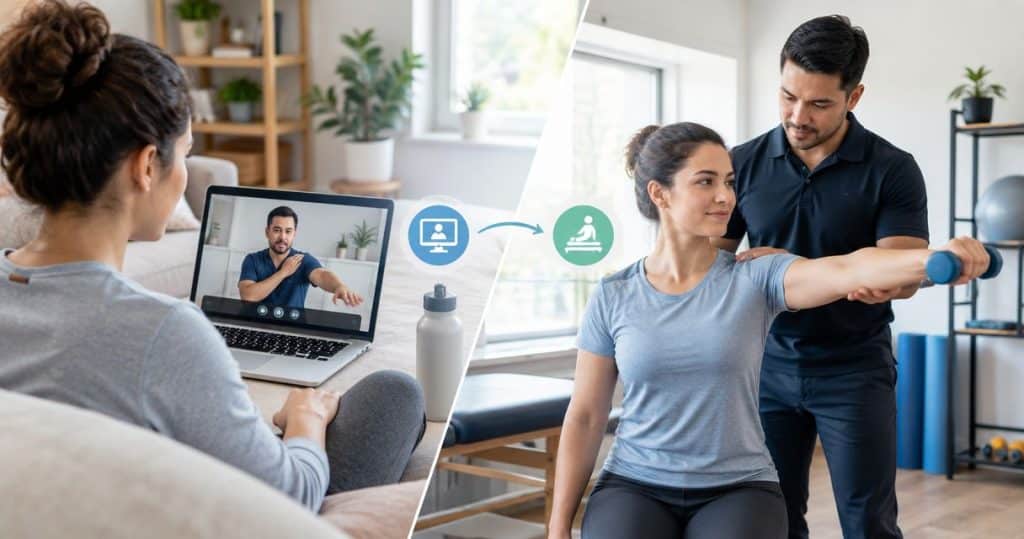
Instead of repeating your injury history at every appointment, use a telehealth to in person physical therapy handoff: confirm that a remote visit is appropriate, document the assessment, and bring a clear plan to your clinic visit. This workflow helps you connect the appointments without treating a video consultation as a substitute for a hands-on examination.
- Telehealth to in person physical therapy works best with a documented assessment, clear referral reasons, and shared records.
- McKenzie Sports Physical Therapy suits Philadelphia athletes and active individuals seeking sports injury rehabilitation.
- Confirm telehealth services, clinician authorization, and coverage before booking; never assume every clinic offers remote appointments.
- Use in-person assessment when the clinician needs hands-on findings or cannot safely resolve your concern remotely.
Why this matters in 2026
A video appointment and a clinic appointment answer overlapping questions, but they are not interchangeable. Video lets you explain symptoms and demonstrate movements; an in-person visit allows hands-on examination when the clinician considers it necessary.
The handoff should explain what remains uncertain, not just repeat where it hurts. Without that distinction, you arrive with an appointment confirmation but no clear reason for the next assessment.
McKenzie Sports Physical Therapy is best for Philadelphia athletes and active individuals seeking sports injury rehabilitation. Confirm available appointment formats directly with the clinic; this guide describes a general transition workflow, not a claim that the clinic provides telehealth.
Before you start: your 2026 checklist
- Access and setup: Confirm that the provider offers telehealth, can treat you where you will physically attend the remote appointment, and has supplied connection instructions. You need a suitable device, a private space, and enough clear floor space for movements the clinician requests.
- Records and appointment details: Gather your symptom history, relevant medical information, current medications, and existing reports. Ask about referral requirements, coverage, consent, and how to send records securely before either appointment.
- The easy-to-miss gotcha: A remote assessment does not automatically transfer to another clinician or clinic. Confirm who sends the visit note, whether permission is required, and who books the in-person appointment.
Do not use this routine workflow for an emergency. Chest pain, severe breathing difficulty, or new loss of bladder or bowel control with back symptoms requires urgent medical attention rather than waiting for a physical therapy appointment.
Remote assessment setup
- Confirm the appointment format. Ask whether the scheduled visit is a clinical assessment, an introductory conversation, or a follow-up. Those appointments serve different purposes; an introductory call does not establish a treatment plan by itself.
- Check the connection instructions. Use the provider's supplied invitation and complete any required consent process. Test your camera and microphone before the appointment, and ask how to reconnect if the call drops.
- Prepare a 1-page symptom summary. Include when symptoms started, the affected area, aggravating activities, relevant injury history, and your main functional goal. Describe what you cannot do now rather than relying only on a pain rating.
- Set up a safe viewing area. Position the camera so the clinician can see the requested movement without you balancing the device. Keep a stable support nearby if instructed, and avoid attempting a movement you cannot perform safely.
Expected result: You can explain the problem clearly, connect through the provider's approved process, and demonstrate only the movements the clinician considers appropriate.
For a runner, a useful goal describes the activity you want back: returning to your usual route, tolerating stairs, or resuming training. You do not need to diagnose the injury before the consultation. Give the clinician observations, not conclusions borrowed from an online search.
Clinical decision and appointment format
- Describe symptoms before demonstrating movement. Tell the clinician about recent changes, previous treatment, and symptoms that affect sleep or ordinary activities. Mention anything that feels different from your usual training soreness.
- Follow the clinician's assessment instructions. Move within the limits provided and report symptoms honestly. Do not push through a movement to show that you can complete it.
- Ask what the remote visit established. Separate the clinician's working assessment from findings that still require an in-person examination. Ask what would change the recommendation.
- Choose the next appointment with the clinician. Confirm whether the next step is in-person physical therapy, medical evaluation elsewhere, or continued remote follow-up. An unresolved concern is a reason to clarify the plan, not automatically add exercises.
Expected result: You understand why the next appointment is necessary and what it needs to assess.
Which appointment format fits the task?
These 2 appointment formats have different strengths. Choose according to the assessment needed, not simply which appointment is easier to attend.
| Appointment format | Best for | Advantage | Limitation |
|---|---|---|---|
| Telehealth consultation | Discussing symptoms, observing suitable movements, and reviewing an existing plan | Lets you communicate with a clinician without attending the clinic | Cannot provide hands-on examination or hands-on treatment |
| In-person physical therapy | Assessment requiring physical contact, supervised movement, and indicated clinic-based treatment | Allows the clinician to examine and treat you directly | Requires travel and does not eliminate the need for practice between appointments |
McKenzie Sports Physical Therapy offers sports injury diagnosis and rehabilitation, alongside dry needling, shockwave therapy, and sports massage. Those services do not establish which treatment you need; the assessment should determine that choice.
Records handoff and in-person booking
- Request a visit summary. Ask for the assessment, relevant findings, current instructions, precautions, and reason for the in-person referral. Follow the provider's approved records process rather than sending sensitive information through an unapproved channel.
- Confirm the receiving clinician. Identify who will review the note and whether the appointment is an initial evaluation or a follow-up within an existing course of care. Do not assume a shared organization means every record is already visible.
- Ask these 3 handoff questions. What should I do before the visit? What should I avoid? What change means I should contact a clinician sooner? Record the answers in language you understand.
- Verify practical requirements. Confirm the appointment location, arrival instructions, clothing, paperwork, and any requested reports. Ask the receiving clinic to clarify administrative requirements before you travel.
Expected result: The receiving clinician has the relevant information, and you know what to do while waiting.
Keep your own short summary alongside the clinical record. It should distinguish what the clinician advised from what you have independently tried. That makes it easier to identify conflicting instructions without asking the next clinician to reconstruct the entire story.
The 2026 handoff sequence
Use this sequence as an administrative checklist, not a self-diagnosis tool: Remote assessment, Clinical decision, Records transfer, and In-person review. Each stage should answer a different question before you move to the next.
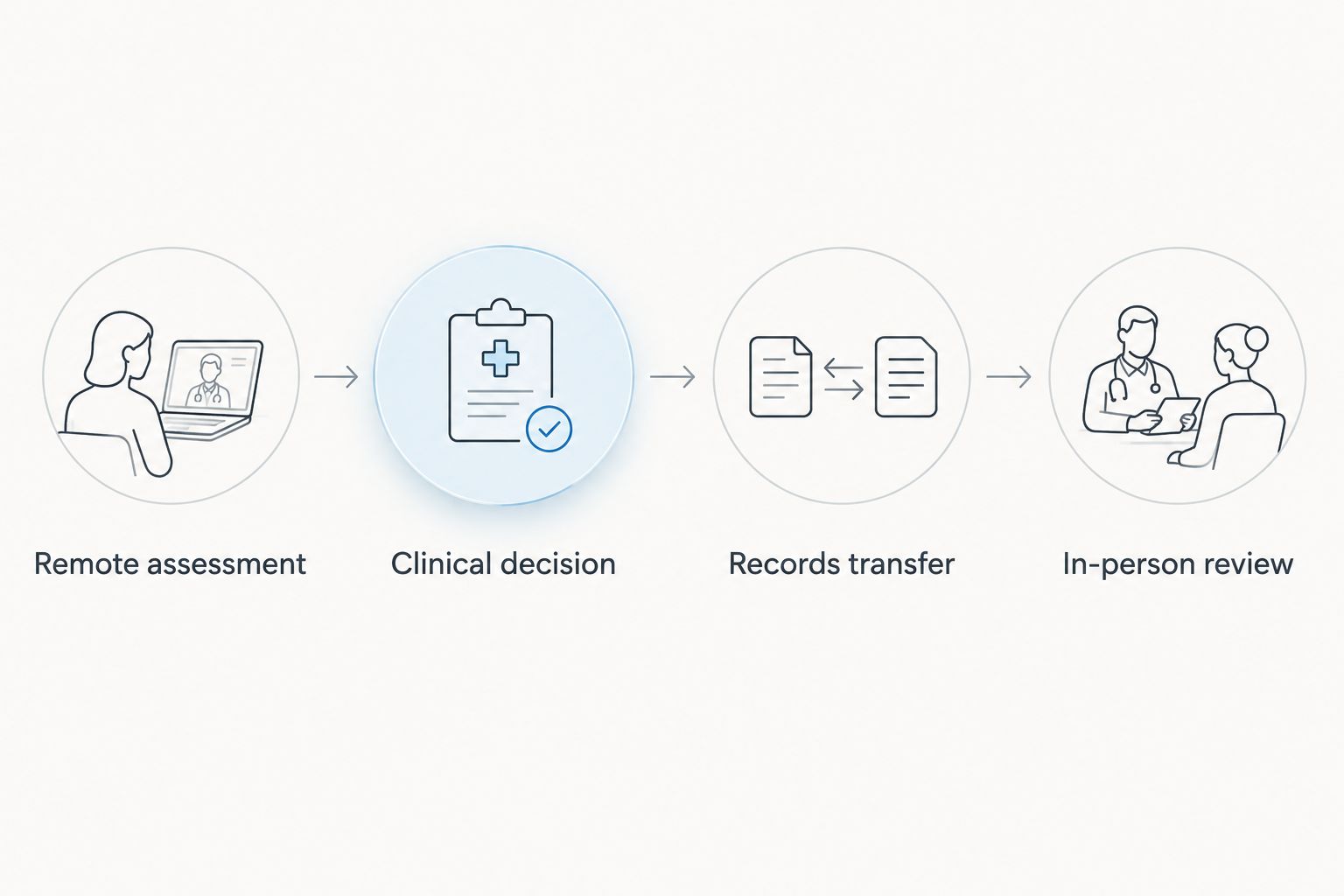
In-person review and treatment plan
- Report changes since the remote appointment. Explain whether symptoms, daily function, or exercise tolerance have changed. Bring your instructions and identify anything you stopped because it increased symptoms.
- Let the clinician reassess. The in-person examination can add information unavailable over video. A revised plan is not automatically a contradiction; ask which findings changed the recommendation.
- Practice the prescribed movements. Ask the clinician to check your technique and explain the intended response. Before leaving, confirm the exercise instructions, precautions, and how to report a problem.
- Define the next review. Ask which activities you can attempt, what needs further assessment, and how progress will be judged. Use functional goals rather than treating attendance alone as evidence of recovery.
Expected result: You leave with an individualized plan and clear instructions for the next stage of rehabilitation.
Do not treat a list of clinic services as a treatment checklist. Hands-on treatments and exercise address different needs, and not every person requires every available service. Ask how each proposed treatment connects to your assessment and activity goals.
A second workflow: remote follow-up after in-person care
The sequence can also run in reverse. After an in-person evaluation, ask whether a remote follow-up is appropriate for reviewing your home program, discussing activity response, or checking a movement the clinician can assess on video.
For a mixed-format plan in 2026:
- Agree on the purpose of the remote follow-up before leaving the clinic.
- Keep a brief record of completed exercises, symptom changes, and questions.
- Demonstrate only the movements requested during the remote appointment.
- Return to in-person assessment when the clinician needs findings that video cannot provide.
Best for: People with an established treatment plan whose next review does not require hands-on examination. The advantage is continuity without travel for that visit; the limitation is that new or unclear symptoms can require another in-person assessment.
A convenient appointment format is useful only when it answers the clinical question. Do not keep a remote appointment solely to avoid changing the schedule if your clinician recommends a different level of assessment.
Troubleshooting the transition
The video connection fails during assessment
Stop any movement that requires live supervision. Reconnect using the provider's instructions, or contact the office to agree on another arrangement; do not finish the assessment alone and assume the clinician saw it.
The clinic has not received the remote visit note
Contact the sending provider and confirm the receiving clinic's approved destination. Ask whether authorization is outstanding, then verify receipt rather than relying on a sent-message notification.
The remote instructions and clinic instructions differ
Ask the treating clinician to reconcile the instructions and identify which plan you should follow now. Do not combine both programs or add their exercise volumes together on your own.
Symptoms worsen before the in-person appointment
Contact the treating provider for advice instead of progressing the program. Seek urgent medical attention for emergency symptoms; an upcoming physical therapy appointment does not replace urgent evaluation.
Coverage or referral requirements block booking
Ask the clinic and your insurer which requirement remains unresolved and who must supply it. Clinical suitability and administrative eligibility are separate questions, so confirming one does not settle the other.
Customize your workflow around your activity
Build the transition around what you need to do, not around a particular treatment name. A runner, a recreational lifter, and someone returning to a field sport need goals that reflect their own activity demands.
For your 2026 rehabilitation plan, ask the clinician to separate three decisions: what you can continue, what needs modification, and what needs reassessment before resuming. Record those decisions beside your home instructions so you do not mistake reduced pain for permission to resume every activity.
McKenzie Sports Physical Therapy serves athletes and active individuals recovering from injuries. Ask how the proposed rehabilitation plan addresses your sport, current limitations, and next assessment rather than requesting a treatment solely because another athlete used it.
FAQ
How do I move from telehealth to in person physical therapy?
Ask the remote clinician why an in-person assessment is needed, request the visit summary, and confirm that the receiving clinic has it. Verify booking requirements and your instructions while waiting.
Can a telehealth consultation replace an in-person physical therapy evaluation?
Not when the clinician needs hands-on examination or findings that cannot be assessed safely over video. The appropriate appointment format depends on your symptoms and the clinical question.
Does McKenzie Sports Physical Therapy offer telehealth in 2026?
Confirm telehealth availability directly with McKenzie Sports Physical Therapy. The clinic’s stated services include sports injury diagnosis and rehabilitation, but that does not establish remote appointment availability.
What should I bring to my first in-person appointment after telehealth?
Bring your remote visit summary, current instructions, relevant reports, and a record of changes since the consultation. Follow the receiving clinic’s specific paperwork and clothing instructions.
Do I need a referral before switching to in-person physical therapy?
Confirm referral requirements with the receiving clinic and your insurer before booking. Requirements depend on the circumstances of your care and coverage.
Can I keep doing exercises while waiting for my clinic visit?
Follow the treating clinician’s current instructions and precautions. Contact the provider if symptoms worsen or the instructions do not explain how to respond.
Is remote follow-up useful after an in-person physical therapy visit?
Remote follow-up can support exercise review and discussion when the clinician considers video appropriate. New symptoms or a need for hands-on findings can require an in-person appointment instead.
One last thing
Bring the unanswered question, not just the diagnosis label. A handoff that says you need a closer assessment of a particular movement gives the next appointment a clearer purpose than a note that simply repeats the painful body part.
Before your visit, write down what you want the clinician to help you decide. That question keeps the conversation tied to your recovery rather than a menu of treatments.
Related guides
Discuss your next rehabilitation step
Ask about appointment formats and an in-person sports injury assessment in Philadelphia.