
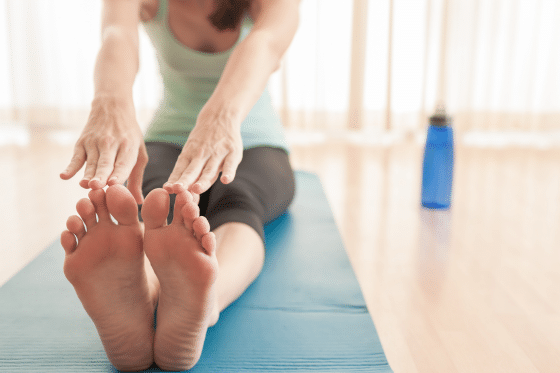
It is one of the few physical tests almost everybody has done.
Stand up, bend forward, see how far down you get. People have been measuring themselves against it since school, and a surprising number carry a quiet sense of failure about it decades later.
It also comes up constantly in conversations about back pain, usually in the form of somebody assuming that if they could just touch their toes, their back would be fine.
The reality is more interesting, and considerably less demanding than most people assume.
What is actually limiting you
A forward bend is not one movement. It is several things happening together, and any of them can be the limiting factor.
Your hamstrings lengthen as you bend. This is the one everybody assumes is responsible, and it is frequently part of the picture rather than the whole of it.
Your lower back flexes. Spinal flexion contributes a considerable amount of a forward bend, and people with stiff or guarded backs lose range here.
Your hips rotate forward over your legs. Hip mobility is a major contributor and it gets far less attention than hamstrings do.
Your calves influence it too, since they affect how far your weight can shift.
And your nerves have to tolerate being lengthened, which is a separate issue from muscle length and which is the reason some people get a pulling or tingling sensation rather than a muscular stretch.
On top of all that, your proportions matter. Limb and torso length vary considerably between people, and somebody with long legs and a short torso has further to travel than somebody built the other way around.
Which means two people with identical flexibility can finish in different places, and neither has done anything wrong.
Does it actually matter
Here is the part that tends to relieve people.
Being able to touch your toes is not a health requirement. It is not a meaningful marker of back health, and plenty of people who cannot do it have perfectly comfortable backs while plenty who can do it have persistent pain.
There is no good reason to treat it as a target in itself.
What matters more is whether you have enough range for the things you actually need to do. Picking something up off the floor. Getting into a car. Putting on shoes. Reaching down to a low shelf. Gardening.
If you can do those comfortably, the fact that your fingertips stop at your shins is not a problem to be solved.
When it is worth paying attention to
That said, a few situations where a limited forward bend is worth looking at.
If it has changed. A back that used to bend further and now does not, particularly if the change happened over weeks rather than years, is worth assessing.
If it is markedly asymmetrical. Bending forward and feeling something pull sharply on one side only is different from general tightness.
If bending produces pain rather than a stretch sensation, particularly pain that travels into the leg.
If it produces tingling, numbness or an electrical quality, which points toward nerve involvement rather than muscle length.
If it is limiting things you need to do.
And if you play a sport that genuinely requires it, in which case it becomes a performance question rather than a health one.
Why stretching frequently does not fix it
People who cannot touch their toes usually try the same thing. They stretch their hamstrings, daily, for months, and get very little for it.
A few reasons that happens.
The limiting factor may not be the hamstrings. If your hips or your lower back are the restriction, stretching the back of your thighs addresses the wrong thing.
The sensation may not be muscular. If what you feel is pulling, tingling or an electrical quality down the back of the leg, that is more likely to be nerve related, and aggressive stretching tends to aggravate it rather than help.
And protective guarding is frequently involved. A back that has been painful tends to limit how far it will bend, as a protective response rather than a tissue restriction. You cannot stretch your way out of that, and forcing it tends to reinforce it.
Which is why an assessment that works out what is limiting you is worth considerably more than another month of the same stretch.
What actually helps
Depends on the limiting factor, which is the point.
If it is genuinely muscle length, then loaded lengthening tends to work better than passive stretching. Movements that take the muscle through range under some load, such as Romanian deadlifts performed within a comfortable range, build both length and strength.
If it is hip mobility, hip specific work addresses it.
If it is a stiff or guarded lower back, gradual exposure to bending in a non threatening way is the route, and that frequently means loading it rather than stretching it.
If it is nerve related, the approach is specific and gentler, and vigorous stretching makes it worse.
And if it is proportions, nothing changes it and nothing needs to.
The more useful question
Rather than how far down you can reach, ask whether you can bend comfortably and confidently.
A great many people with back pain can physically bend further than they do. What stops them is not range, it is a learned caution after a previous episode, and the resulting stiffness becomes self sustaining.
If you find yourself squatting down to pick up a sock rather than bending, or bracing yourself before leaning into the trunk of a car, that is worth noticing. Those adaptations are reasonable after an episode of pain and they are worth unwinding once things have settled, because avoidance of bending tends to leave you less tolerant of it over time.
Bending is not dangerous. A back that bends regularly is generally more comfortable than one that does not.
A reasonable way to work on it
If you want to improve it, which is a perfectly fine goal.
Work on it most days, briefly, rather than occasionally and hard.
Include loaded movement rather than only passive stretching.
Address hips and back as well as hamstrings.
Go to the point of mild tension rather than significant pain.
Expect it to take months, since this moves slowly.
And stop measuring it against somebody else, since their proportions are not yours.
When to get it looked at
Seek emergency care for numbness in the groin, genitals or inner thighs, new difficulty controlling your bladder or bowels, or weakness in both legs.
Contact your doctor promptly for pain traveling below the knee with numbness, tingling or weakness, progressive weakness in a leg or foot, back pain with fever, unexplained weight loss or night sweats, severe unrelenting night pain, or back pain following a significant fall.
And get assessed for a sudden loss of movement, a marked difference between sides, or bending that produces pain rather than a stretch.
Find out what is actually limiting you
If you have been stretching your hamstrings for six months with nothing to show for it, the most likely explanation is not that you need to stretch harder.
McKenzie Sports Therapy offers a free discovery visit at no cost and no obligation. You will get a thorough assessment of your hips, back, hamstrings and nerve mobility, a clear explanation of what is actually restricting you, and a plan that targets it.
And if the honest answer is that your range is fine and the number does not matter, we will tell you that too.