

Most people with neuropathy have noticed this without ever explaining it.
You take a flight, or a long drive, and by the time you arrive your feet are worse than they were. More burning. More tingling. More swollen. And it takes a couple of days to settle again.
Then you get home and the same thing happens in reverse.
There are specific reasons for it, most of them are manageable, and a few of the things people do to cope actually make it worse.
What travel does
Several things stack up on a long journey.
You sit still for hours. Movement is what keeps circulation moving through your legs, and sitting removes it. Fluid pools in the lower legs and feet, which is why almost everybody’s feet swell on a flight and why it is more noticeable if your feet are already a problem.
Your position is fixed. Knees bent, hips bent, feet in one place, for hours. Nerves do not love sustained positions at the best of times.
Cabin pressure and the dry air contribute to fluid shifts and to general dehydration.
You tend to drink less, partly because of the inconvenience of getting to the bathroom.
And you walk a great deal more than usual at the other end, frequently in shoes you have not broken in, on surfaces you are not used to.
So the journey itself irritates things and the destination demands more of your feet than home does.
What to do on the journey
Move your ankles. Regularly, deliberately, throughout. Point and flex your feet, circle your ankles, press your feet into the floor and release. A minute every half hour makes a genuine difference to circulation and it costs you nothing.
Get up when you can. On a flight, walk the aisle periodically. On a drive, stop more often than you would otherwise. Even two minutes helps.
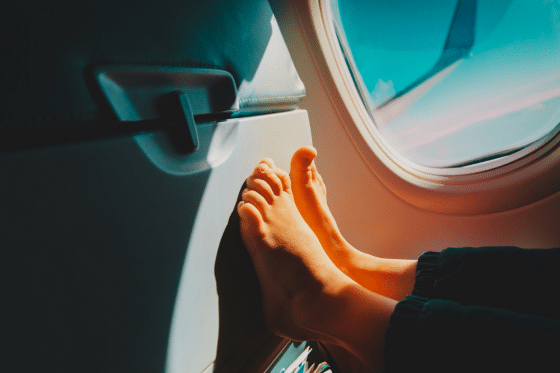
Keep your shoes on. This is one of the big ones and it gets ignored constantly, because feet swell and shoes feel tight so people take them off.
The trouble is twofold. Feet swell further once they are out, which makes getting them back on harder. And an aircraft cabin or a service station floor is not somewhere to have bare or sock covered feet when you cannot reliably feel what you are stepping on.
Wear shoes that accommodate swelling rather than removing them, which is a footwear choice you make before you leave rather than a problem you solve on board.
Drink enough. Dehydration does not help anything here.
And consider compression socks for longer journeys. That is worth asking your doctor about rather than assuming, particularly if you have circulation concerns, but for many people they help considerably with travel swelling.
Airport security
A specific one that catches people out.
Being asked to remove your shoes, and then walking across a floor you did not choose, in socks or bare feet, is a genuine risk if your feet cannot report what they are standing on.
A few practical things.
Wear socks, always, so you are never actually barefoot.
Tell the staff. You can explain that you have a medical condition affecting your feet and ask about alternative screening. Policies vary by country and airport, and staff deal with this more often than you would think.
In the United States, a medical notification card can be carried to communicate a condition discreetly to screening staff, which some people find makes the conversation easier.
And check your feet once you are through, before you put your shoes back on.
Packing
A few things worth having with you rather than in a case you cannot reach.
A spare pair of socks, so you can change if yours become damp.
Something to check your feet with if you cannot see the soles easily, such as a small mirror.
Footwear you have already broken in. A trip is not the moment for new shoes, and new shoes plus considerably more walking than usual is one of the more reliable ways to produce a blister you will not feel.
Any medication in your hand luggage rather than checked, in the amounts and packaging you need.
And something for minor foot care, though with the caveat below.
At the other end
The daily habits matter more when you are away, not less.
Check your feet every day. People stop doing this on vacation, which is precisely when their feet are under the most unusual demands.
Never go barefoot. Hotel rooms, pool areas, beaches, bathrooms. Water shoes for anything involving sand or water.
Watch the temperature. Hot sand, hot pool decks, hot car floors and unfamiliar bathwater are all hazards when you cannot feel temperature accurately. Test water with your elbow or a thermometer rather than your feet.
Pace the walking. Sightseeing frequently involves far more walking than an ordinary day at home, and it is worth building in sitting breaks rather than discovering the limit afterward.
Change out of damp socks promptly.
And keep your feet dry and moisturized, since different climates affect skin in different ways.
The thing not to do while away
Do not attempt any foot treatment yourself.
Corns, calluses, hard skin, an ingrown nail. The temptation when something is bothering you on a trip is to deal with it with whatever you have, and that is how minor problems become serious ones.
Leave it. Protect it with a dressing if needed and get it looked at properly when you are back, or sooner if it is causing concern.
Know where to get help before you need it
Worth five minutes before you travel.
Find out what medical facilities are available where you are going.
Check your travel insurance covers your condition and that you have declared it.
Carry a list of your medications and your conditions, including anything your doctor would want somebody else to know.
And know what you would do if you found a wound. For most people with neuropathy, a foot wound while away is the situation that most needs a plan.
When to get medical help while traveling
Any wound, blister, burn, cut or ulcer on a foot with reduced sensation, however small, needs attention rather than waiting until you are home.
Redness spreading, warmth, swelling or discharge.
A red, hot, swollen foot, with or without pain, which needs same day assessment.
Any darkened tissue.
Fever or feeling generally unwell alongside a foot problem.
And calf pain with swelling, warmth or redness, particularly after a long flight, which needs urgent assessment since it can indicate a clot. Seek emergency care if that comes with breathlessness or chest pain.
When you get back
The couple of days after a trip are worth paying attention to.
Check your feet thoroughly, including the soles and between the toes.
Expect some swelling that settles over a day or two. Swelling that does not settle, or that affects one leg more than the other, is worth raising.
And if anything is sore, tender or marked, get it looked at rather than assuming it will resolve now that you are home.
Travel is worth doing
None of this is an argument for staying put.
The point of managing a condition like this is to keep doing the things you want to do, and travel is high on most people’s list. It simply needs a bit more planning than it used to.
McKenzie Sports Therapy offers a free discovery visit at no cost and no obligation. You will get a thorough assessment of your feet, balance, walking and footwear, plus practical guidance for managing travel and anything else that is currently limiting what you do.
We work alongside your doctor, not instead of them.