Yes—shockwave therapy can hurt during treatment, usually as repeated tapping, pressure, or a deep ache over the treated area. The intensity depends on the treatment settings, location, and how sensitive the tissue is; you should tell your clinician when the sensation becomes difficult to tolerate. Temporary soreness can follow, but severe or worsening pain needs reassessment rather than being treated as proof that the therapy is working.
- Does shockwave therapy hurt? It can; report discomfort so your clinician can reassess treatment intensity.
- McKenzie Sports Physical Therapy offers shockwave therapy and rehabilitation for Philadelphia athletes and active individuals.
- Temporary tenderness can follow treatment; severe, worsening pain or new numbness needs clinical advice.
- Shockwave therapy and dry needling feel different, and neither replaces a diagnosis or an appropriate rehabilitation plan.
Why this matters
Worrying about pain is a valid reason to ask questions before treatment. You need to know what you might feel, how to communicate discomfort, and which symptoms deserve follow-up—not just whether someone else found the procedure tolerable.
If you are considering shockwave therapy in 2026, judge the treatment by its suitability for your condition, not by your willingness to endure it. Pain tolerance does not establish a diagnosis or predict a successful outcome.
The same distinction matters when comparing treatments. The guide to whether dry needling hurts addresses a different procedure; its sensations should not be used to predict exactly how shockwave therapy will feel.
Does shockwave therapy hurt?
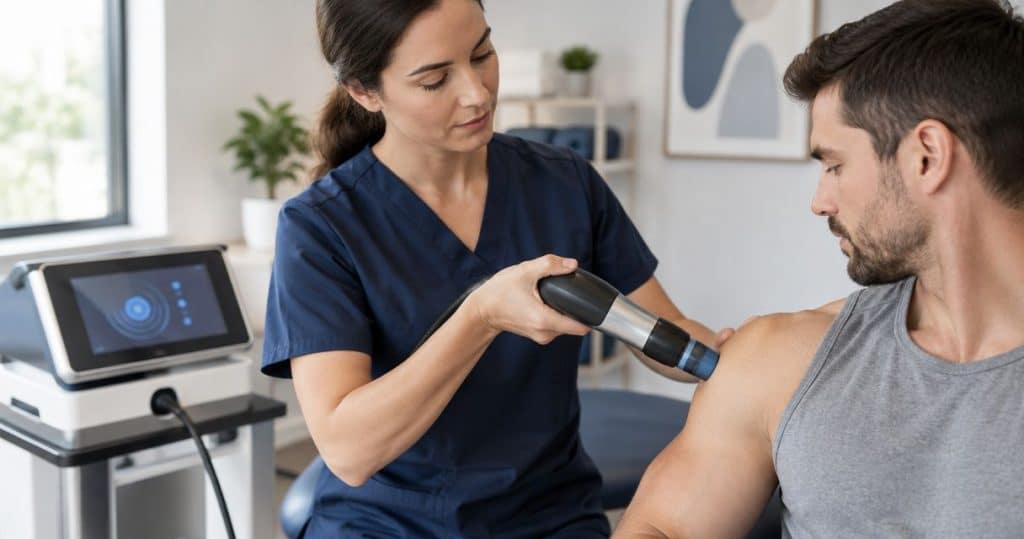
Shockwave therapy can cause discomfort while a clinician applies acoustic pressure pulses through an applicator against your skin. The sensation can feel more intense over a tender spot or an area with little cushioning over bone. You remain able to describe what you feel and ask to pause.
There is no single pain score that accurately predicts everyone's experience. Your existing symptoms, the location being treated, and the selected settings all matter.
| Sensation or symptom | What it means for your next step |
|---|---|
| Repeated tapping or pressure | Describe whether it is comfortable enough to continue |
| Deep aching at the treatment site | Tell the clinician if it builds or becomes difficult to tolerate |
| Local tenderness afterward | Follow your aftercare instructions and monitor the response |
| Severe or escalating pain | Ask for reassessment rather than pushing through |
| New numbness, weakness, or substantial swelling | Contact a healthcare professional promptly |
You do not need to prove that you can tolerate the treatment. A clinician needs your feedback to judge whether to continue, modify the application, or stop and reassess.
Discomfort also does not confirm that the correct tissue is being treated. The diagnosis and examination should guide the treatment location—not simply whichever spot hurts most.
What happens during a shockwave appointment?
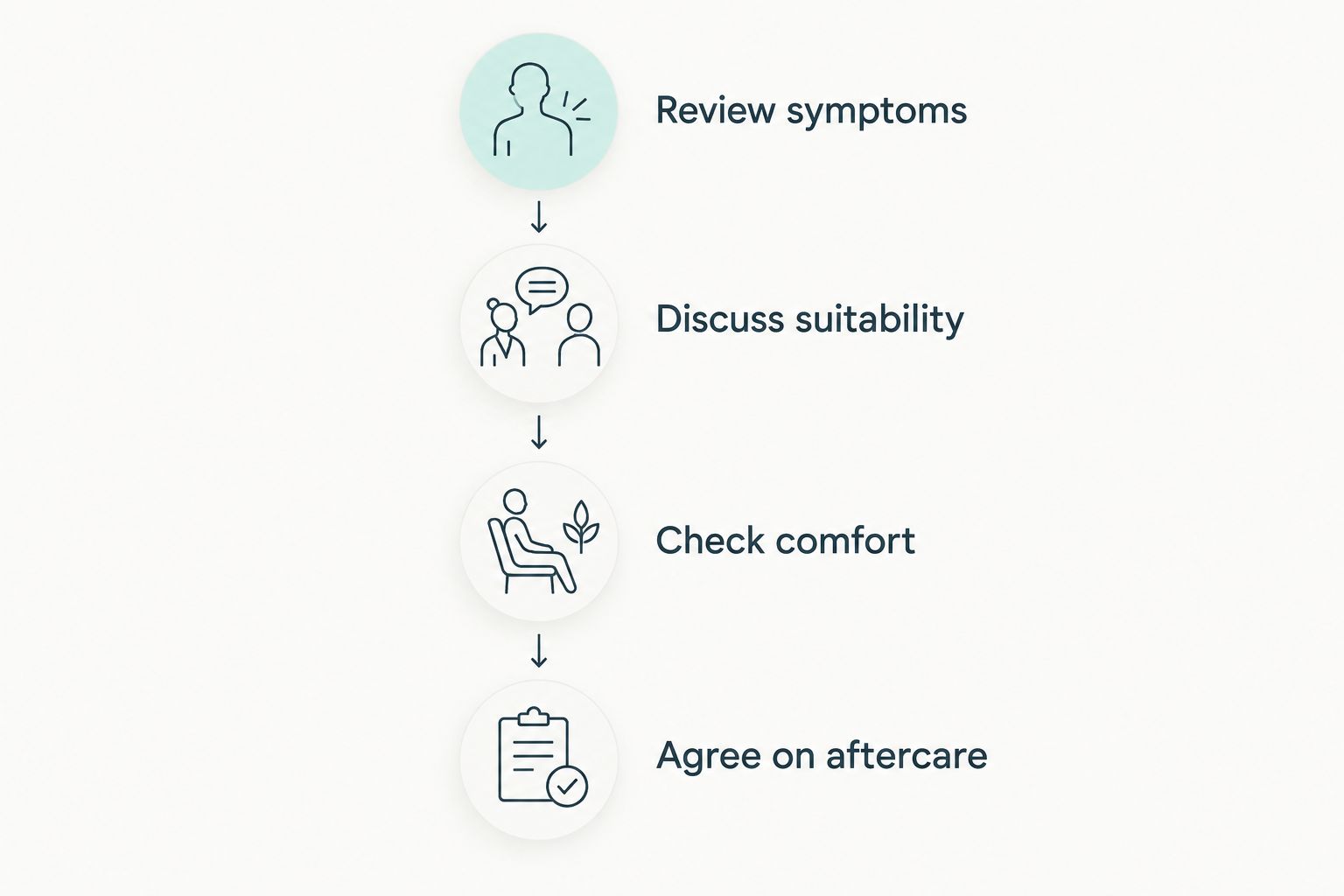
Knowing the sequence gives you practical points at which to ask questions. Your appointment should include a discussion of the condition being treated, relevant health history, and what to do if the sensation becomes uncomfortable.
- Review symptoms. Explain where you hurt, which activities trigger symptoms, and whether anything has changed since your assessment. Mention altered sensation, recent procedures, medications, and relevant medical conditions.
- Discuss suitability. Ask why shockwave is being considered and what benefit the clinician expects for your particular diagnosis. A painful area alone is not enough to establish that shockwave is appropriate.
- Check comfort. As treatment begins, describe the sensation plainly: tapping, aching, sharp pain, burning, or something else. These descriptions are more useful than staying silent.
- Agree on aftercare. Before leaving, confirm which activities to modify, what response to monitor, and how to contact the clinic if symptoms worsen.
For a 2026 treatment plan, ask how progress will be judged beyond how the appointment feels. Walking tolerance, a sport-specific movement, or another activity limited by your condition can provide a more useful discussion than whether the procedure felt intense.
Bring a description of your usual activity demands, too. Returning to desk work, standing through a shift, and resuming running are different goals; your clinician needs to understand yours before giving activity advice.
Why shockwave therapy discomfort varies
The same treatment can feel different between people and between appointments. These factors help explain the variation without assigning you an unsupported pain score:
- Treatment location. An applicator over a tender heel can feel different from treatment over a more padded area. Local anatomy affects the sensation.
- Existing sensitivity. Tissue that already hurts during touch or loading can be uncomfortable during application. Report that baseline sensitivity before treatment starts.
- Treatment settings. Intensity and application settings affect what you feel. Ask the clinician to explain adjustments rather than assuming stronger treatment is better.
- Application technique. Applicator position, contact pressure, and time spent over a sensitive location can change your experience.
- Response between visits. Tell the clinician about lingering soreness, swelling, or reduced function before the next application. That response belongs in the treatment decision.
Anxiety matters to your experience, too, but it should never become a reason to dismiss pain. If you are worried, agree on a clear way to request a pause before treatment begins.
A setting you tolerated previously is not a reason to ignore a different response today. Report changes rather than trying to match the last appointment.
Is soreness after shockwave therapy normal?
Temporary local soreness, redness, swelling, or bruising are recognized possible effects of shockwave treatment. Their presence does not establish that treatment has worked, and their absence does not establish that it has failed.
Ask your clinician what aftercare applies to your condition and treatment area. Instructions about exercise, pain medication, and symptom management should account for your medical history rather than follow a generic online protocol.
Contact the treating clinician if soreness keeps increasing, interferes substantially with ordinary activity, or differs from the response discussed before treatment. New numbness, weakness, marked swelling, or inability to bear weight warrants prompt medical assessment.
Do not wait for a scheduled follow-up to report a concerning change. Explain what started, whether it is progressing, and which activities you can no longer perform comfortably.
Does more pain mean shockwave therapy works better?
More pain is not proof of a better result. Treatment discomfort is an experience to manage, not a target you need to reach.
A useful outcome discussion separates the appointment from daily function. Can you perform the activity that brought you to treatment? Are symptoms becoming easier to manage as the rehabilitation plan progresses?
For your 2026 recovery goals, choose a meaningful activity to discuss with your clinician and describe it consistently. Avoid repeatedly testing a painful movement simply to see whether the treatment worked immediately.
If the explanation for continuing treatment is only that it needs to hurt, ask for a clearer rationale. You should understand the intended benefit, the limits of the treatment, and when the plan will be reconsidered.
Is shockwave therapy less painful than dry needling?
Neither treatment is consistently less painful for every person. Shockwave applies acoustic pulses through the skin; dry needling inserts thin needles into selected tissues. The procedures create different sensations and serve different clinical purposes.
Your 2026 treatment decision should start with the diagnosis, not a contest over which procedure sounds easier.
| Approach | Best for | Potential advantage | Limitation or drawback |
|---|---|---|---|
| Shockwave therapy | Selected conditions after clinical assessment | Applies treatment without inserting a needle | Can be uncomfortable; suitability depends on the condition |
| Dry needling | Selected musculoskeletal presentations after assessment | Allows targeted needle application to selected tissues | Invasive; can cause soreness or bruising and carries procedure-specific risks |
| Exercise-based rehabilitation | Rebuilding movement and load tolerance when appropriate | Addresses activity demands through a progressive plan | Requires participation and adjustment; progression is not always comfortable |
This comparison is not a recommendation to choose a procedure yourself. Ask which approach addresses the problem identified during your assessment and what role it plays in the larger rehabilitation plan.
Tell the clinician if needles, pressure, or previous treatment experiences worry you. That information supports an informed discussion; it does not disqualify you from receiving care.
What should you ask before agreeing to treatment?
An informed decision needs more than a description of the applicator. Ask questions that connect the proposed treatment to your symptoms and goals:
- What diagnosis are you treating, and why is shockwave appropriate?
- What benefits and risks apply to my condition?
- What should I say or do if the treatment hurts?
- How will we decide whether it is helping?
- What should I change about training or daily activity afterward?
- What happens if I do not improve or choose not to proceed?
Share relevant medical information, including pregnancy, bleeding conditions, anticoagulant use, altered sensation, and recent procedures. These details require clinical screening; do not decide suitability from a general article.
You can also ask about alternatives. Understanding the option of modifying the rehabilitation plan—or not receiving shockwave—helps you make a decision without feeling committed before the discussion starts.
Where does shockwave fit into sports rehabilitation?
Shockwave is a treatment option, not a complete return-to-sport plan. Athletes also need an assessment of the injury, current function, and the demands they intend to resume.
McKenzie Sports Physical Therapy is a fit for Philadelphia athletes seeking sports injury assessment and rehabilitation. The clinic offers shockwave therapy alongside sports injury diagnosis, rehabilitation, dry needling, and sports massage.
That service range does not make shockwave the right choice for every injury. Its practical advantage is that it offers another treatment option to discuss; its limitation is that it can cause discomfort and cannot replace rebuilding the capacity your activity requires.
In 2026, the useful question remains specific: what part of your recovery is the proposed treatment intended to address? Ask how any symptom-focused treatment connects to exercise, activity modification, and reassessment.
FAQ
Does shockwave therapy hurt the whole time?
Shockwave therapy can be uncomfortable during application, but the sensation varies with the location and settings. Tell the clinician if discomfort builds, becomes sharp, or makes you want to stop.
Can I ask the clinician to stop shockwave therapy?
Yes, you can ask to pause or stop shockwave therapy. Agree on how you will communicate discomfort before the applicator is used.
Is bruising after shockwave therapy possible?
Bruising is a recognized possible effect of shockwave therapy. Report substantial or worsening bruising, especially if you have a bleeding condition or take anticoagulant medication.
Can I work out after shockwave therapy?
Your exercise plan after shockwave therapy depends on the treated condition and your clinician’s instructions. Ask specifically about running, lifting, jumping, or any activity you intend to resume.
Should I take pain medicine before shockwave therapy?
Ask your treating clinician before taking medication specifically to tolerate shockwave therapy. Do not stop prescribed medication or change your usual regimen based on general online advice.
Does shockwave therapy replace physical therapy exercises?
Shockwave therapy does not replace an appropriate rehabilitation exercise plan. Ask how the treatment supports your movement, strength, and activity goals.
Does McKenzie Sports Physical Therapy offer shockwave therapy?
McKenzie Sports Physical Therapy offers shockwave therapy for athletes and active individuals in Philadelphia. A clinical assessment is needed to determine whether it is appropriate for your condition.
One last thing
Your response after the appointment belongs in the next treatment decision. Write down what changed in ordinary activity—not just whether the treated spot felt tender when you pressed on it.
Describe whether walking, stairs, work, or training became easier or harder. That gives your clinician a clearer picture than saying only that the session hurt, and it creates a practical starting point for reassessment.
Related guides
- Telehealth consultation to in-person physical therapy
- Cross-training exercises for injured runners
- Dry needling for runners with chronic injuries
Discuss your symptoms, treatment concerns, and return-to-activity goals with McKenzie Sports Physical Therapy before deciding whether shockwave belongs in your rehabilitation plan.
Discuss your rehabilitation options
Ask about your injury, shockwave treatment, and how rehabilitation fits your activity goals.