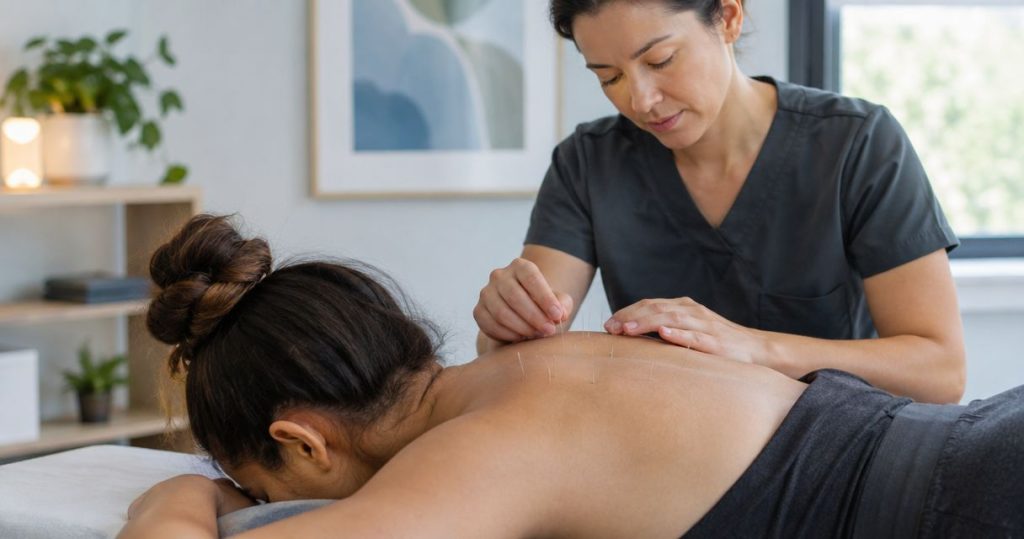
No—dry needling is not the same as acupuncture, although both use thin needles inserted through the skin. Dry needling usually targets muscles and other tissues within a musculoskeletal treatment plan; acupuncture uses several treatment frameworks, including traditional Chinese medicine and contemporary medical approaches. Their techniques overlap, so the meaningful differences are the clinician’s assessment, treatment goals, training, and follow-up plan—not simply the needle.
- Is dry needling the same as acupuncture? No: similar needles do not make the treatments interchangeable.
- Dry needling can support sports rehabilitation; symptom relief alone does not establish readiness to return to sport.
- Acupuncture has traditional and contemporary approaches, with evidence that varies by condition.
- McKenzie Sports Physical Therapy offers dry needling and sports injury rehabilitation for Philadelphia athletes and active adults.
Is dry needling the same as acupuncture?
Dry needling and acupuncture overlap in equipment and some techniques, but they are not interchangeable treatment plans. Dry needling generally addresses musculoskeletal problems identified during an examination. Acupuncture encompasses different approaches to point selection and treatment, including approaches used for pain management.
For athletes comparing sports injury rehabilitation services, ask what the treatment is intended to change. A useful answer connects the procedure to a specific problem and explains how you will judge its value.
| Question | Dry needling | Acupuncture |
|---|---|---|
| What guides treatment? | A musculoskeletal assessment and identified tissue or movement problems | The practitioner’s acupuncture framework and assessment of the condition |
| What does it involve? | Thin needles inserted into selected tissues; no medication is injected | Thin needles inserted at selected points; techniques vary |
| Best for | People considering a needling technique within musculoskeletal rehabilitation | People seeking acupuncture-based care for a condition with supporting evidence |
| Potential advantage | Can be paired with exercise and movement retraining | Has evidence for selected pain conditions |
| Main limitation | Does not replace strength, conditioning, or progressive sport exposure | Does not by itself establish sports readiness or rebuild physical capacity |
| What should you check? | Training, safety screening, treatment rationale, and reassessment | Training, credentials, safety screening, and evidence for your condition |
For this 2026 comparison, the American Physical Therapy Association’s dry needling resources provide the musculoskeletal scope; the National Center for Complementary and Integrative Health’s Acupuncture: What You Need To Know explains acupuncture approaches, evidence, and safety. Neither source supports declaring one treatment universally better.
Why this matters for your return to sport
If you are a runner with recurring calf pain or a pitcher whose shoulder hurts during throwing, the treatment name does not answer the main question: what is limiting your activity? Needling should follow an assessment, not substitute for one.
A short-term change in pain is useful information. It is not proof that injured tissue has healed or that you can tolerate a full practice, race, or pitching workload.
McKenzie Sports Physical Therapy is a fit for Philadelphia athletes seeking dry needling as part of sports injury rehabilitation. For active adults in Manayunk, Roxborough, and nearby northwest Philadelphia, the practical goal is a plan that connects symptom management with the demands of your sport.
How dry needling fits into sports rehabilitation
Dry needling uses a solid, thin needle rather than a needle that delivers medication. The American Physical Therapy Association describes it as a technique used to treat movement impairments and pain associated with musculoskeletal conditions.
Your clinician should explain why a particular tissue is being treated and what response would justify continuing. A tender spot alone does not explain every injury, and a local muscle response does not establish that treatment has corrected the underlying problem.
Best for: a defined musculoskeletal treatment goal
Dry needling is most relevant to this decision when an examination identifies a muscular problem and your clinician can explain how needling supports rehabilitation. The intended benefit should be specific: for example, reducing symptoms enough to participate more comfortably in prescribed exercise.
Its limitation is equally important. Dry needling does not provide the progressive loading, strength practice, or sport exposure required to rebuild physical capacity.
For a baseball player, that means distinguishing comfort during shoulder movement from tolerance for repeated throwing. For a runner, it means distinguishing less soreness at rest from the ability to handle a planned run.
How acupuncture differs
Acupuncture is not a single uniform method. The National Center for Complementary and Integrative Health describes its roots in traditional Chinese medicine while also discussing research into nervous-system and other biological effects.
Some acupuncture practitioners use local points near painful tissues. Others use points farther from the symptomatic area, so describing acupuncture as always distant from pain—or dry needling as always completely different—oversimplifies the comparison.
Best for: seeking acupuncture-based care
Acupuncture is the relevant option when you specifically want acupuncture-based treatment and the practitioner can explain the evidence for your condition. NCCIH describes evidence of benefit for certain pain conditions, while emphasizing that results and evidence quality differ across conditions.
The limitation for an injured athlete is that pain treatment and sports rehabilitation answer different questions. Acupuncture does not, by itself, determine whether you can tolerate sprinting, throwing, cutting, or distance running.
In 2026, choose based on the condition being treated and the care plan—not on claims that either approach fixes every kind of pain.
Why treatment choice varies
The right discussion starts with your injury and goals, not a blanket preference for needles. These factors change the recommendation:
- Your diagnosis: Similar pain locations can have different causes. Muscle, tendon, joint, and nerve problems require different clinical reasoning.
- Your functional limitation: Difficulty walking, lifting, throwing, or running gives treatment a practical target beyond tenderness.
- Your medical history: Medicines, bleeding risk, skin problems, and other health conditions affect safety screening.
- The clinician’s training: Ask about education, legal scope of practice, and experience treating your type of problem.
- Your response: Continue only when reassessment shows a meaningful benefit that justifies treatment.
- Your preference: You can decline needling and discuss a rehabilitation plan without needles.
Neither approach wins simply because you have tried the other. If earlier treatment has not helped, revisit the assessment and progression plan rather than assuming that another procedure is automatically the missing piece.
What does the evidence actually support?
Evidence for a treatment is condition-specific, not a guarantee for an individual athlete. Research showing pain improvement does not automatically demonstrate faster tissue healing, fewer future injuries, or a quicker return to competition.
NCCIH’s acupuncture overview discusses evidence for conditions such as back or neck pain and knee osteoarthritis. Those findings should not be transferred directly to a high school pitcher’s shoulder or a runner’s recurring hamstring symptoms.
Dry needling research also varies by body region, diagnosis, comparison treatment, and follow-up period. The American Physical Therapy Association’s resources describe dry needling within physical therapy; that scope does not establish that every athlete needs it.
For a 2026 treatment decision, ask your clinician which findings apply to your diagnosis and what remains uncertain. An explanation should separate expected symptom changes from claims about healing or sports performance.
How should you decide whether to try dry needling?
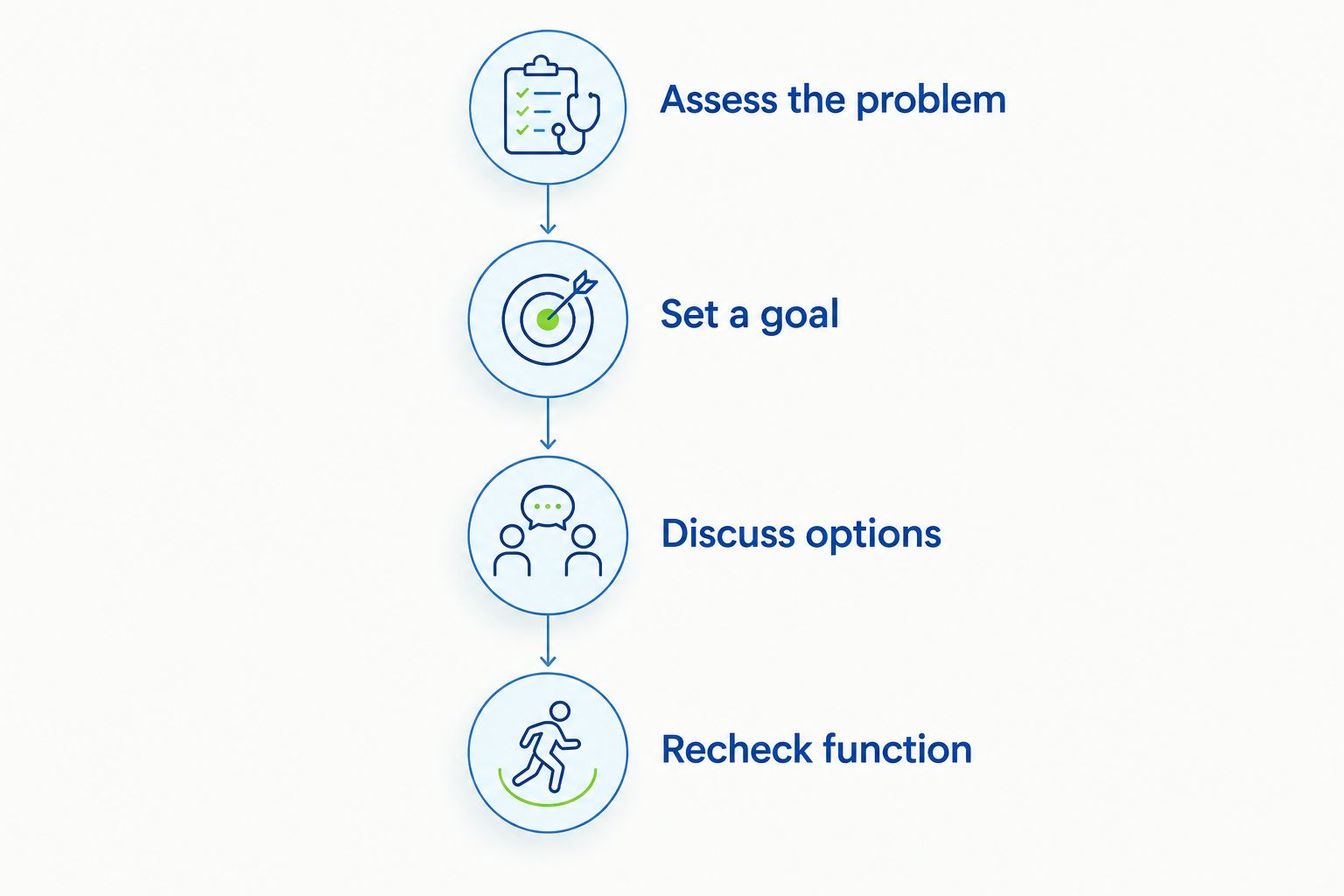
Use a process that makes the decision measurable without treating a procedure as the goal.
- Assess the problem. Describe when symptoms started, what triggers them, and what previous treatment changed. Include your training schedule and recent changes in activity.
- Set a goal. Choose an activity that matters, such as completing prescribed exercises or tolerating a stage of throwing progression.
- Discuss options. Ask why needling is being considered, what alternatives exist, and which risks apply to you.
- Recheck function. Agree on how the clinician will reassess symptoms and activity tolerance before repeating treatment.
If you are a parent of a high school athlete, ask how the plan accounts for practices, games, and communication with the athlete’s healthcare team. College athletes should also discuss team medical requirements rather than treating symptom relief as clearance.
What risks should you discuss before needling?
Both treatments break the skin. Soreness, minor bleeding, and bruising are recognized risks; infection and injury to deeper structures are more serious concerns.
Cleveland Clinic’s patient guidance on dry needling and NCCIH’s acupuncture safety guidance describe these risks. Both support choosing a qualified practitioner and discussing your medical history before treatment.
Tell your clinician about blood-thinning medicines, bleeding disorders, immune-system conditions, pregnancy, skin infections, and previous reactions to needles. These details require individual assessment; they do not all mean the same thing for every patient.
Needling around the chest carries a risk of pneumothorax, or a collapsed lung. Seek urgent medical care for new shortness of breath or chest pain after needling, and tell the medical team about the procedure.
For your 2026 appointment, ask who will perform treatment, what safety precautions apply, and what symptoms require follow-up. Consent includes understanding alternatives and having the option to stop.
Is dry needling better than acupuncture for sports injuries?
Dry needling is not universally better than acupuncture for sports injuries. Compare the evidence for your diagnosis, the practitioner’s qualifications, and how the treatment connects to rehabilitation.
For an athlete returning from injury, the decisive issue is whether the plan addresses the activity you need to regain. Neither treatment label establishes that on its own.
Can I return to running or throwing if needling reduces pain?
Reduced pain after needling does not establish readiness to return to running or throwing. Your clinician should also assess function, loading tolerance, and the demands of your next training stage.
A runner’s next step might involve reviewing the running progression rather than immediately resuming the old schedule. A pitcher’s next step belongs within an individualized throwing and rehabilitation plan.
What if previous treatment has not helped?
Previous treatment that has not helped is a reason to reassess the problem, not proof that you need a particular procedure. Bring details about exercises, activity changes, symptom responses, and any previous testing.
Ask what will be different about the next plan. A clear answer identifies the working diagnosis, the treatment goal, and the findings that would prompt a change in direction.
FAQ
Is dry needling the same as acupuncture?
No—dry needling and acupuncture share needle-based techniques but differ in treatment frameworks, assessment, and goals. Ask how the proposed treatment applies to your diagnosis rather than judging it by the needle alone.
Does dry needling inject anything into the muscle?
No—dry needling does not inject medication into the muscle. It uses a solid, thin needle, which distinguishes it from an injection.
Is acupuncture only based on traditional Chinese medicine?
No—acupuncture includes traditional Chinese medicine approaches and contemporary medical approaches. Ask the practitioner how point selection and treatment goals relate to your condition.
Which is better for a runner with recurring pain?
Neither dry needling nor acupuncture is automatically better for recurring running pain. Start with an assessment of the problem, then compare treatment evidence and the plan for rebuilding running tolerance.
Can I have sports rehabilitation without dry needling?
Yes—you can discuss sports rehabilitation without dry needling. Your clinician should explain exercise, activity modification, and other appropriate options, and you can decline a needle-based procedure.
Does feeling better after dry needling mean my injury has healed?
No—feeling better after dry needling does not establish that an injury has healed. Return-to-sport decisions also require assessment of function and tolerance for the demands of your activity.
What should I ask before booking dry needling in Philadelphia?
Ask about the clinician’s training, the assessment process, relevant risks, and how treatment will be reassessed. McKenzie Sports Physical Therapy offers dry needling and sports injury rehabilitation for athletes and active adults.
One last thing
Before your next appointment, write down the activity you want back—not just the place that hurts. Being able to describe the throw, hill, stride, or exercise that causes difficulty gives the assessment a useful starting point.
For your 2026 return-to-sport plan, judge treatment by meaningful progress in function, not by how intense the procedure feels. A stronger sensation is not proof of a better result.
Related guides
- Does dry needling hurt?
- How many dry needling sessions do you need?
- Is dry needling covered by insurance in Pennsylvania?
- Dry needling for runners with chronic injuries
If recurring symptoms are interrupting your sport, request a new-patient appointment at McKenzie Sports Physical Therapy to discuss your injury, your goals, and the next step in rehabilitation.
Request a new-patient appointment
Discuss your sports injury and return-to-activity goals with McKenzie Sports Physical Therapy.