Sports hernia recovery takes weeks to months, depending on the diagnosis, your sport’s demands, and whether treatment involves rehabilitation alone or surgery followed by rehabilitation. Pain relief is not the finish line: you also need to rebuild tolerance for running, cutting, throwing, or lifting before returning to unrestricted competition.
- Sports hernia physical therapy treatment should progress by movement tolerance and sport readiness, not a promised return date.
- McKenzie Sports Physical Therapy serves Philadelphia athletes seeking sports injury diagnosis and rehabilitation.
- Athletic pubalgia and a true inguinal hernia are different problems; the diagnosis determines the treatment.
- Returning to comfortable jogging does not establish readiness for sprinting, pitching, or changing direction.
How long does sports hernia recovery take?
Recovery generally unfolds over weeks to months, but there is no single safe return-to-sport deadline for every sports hernia. The American Academy of Orthopaedic Surgeons’ OrthoInfo guidance on sports hernia describes both nonsurgical rehabilitation and surgical treatment pathways. These pathways have different restrictions and should not share a generic countdown.
For your 2026 season, separate the recovery milestones below. Completing an earlier milestone does not automatically clear you for the next one.
| Recovery milestone | What it means | What it does not establish |
|---|---|---|
| Comfortable daily activity | Walking and routine movements are manageable | Readiness for running or abdominal loading |
| Controlled exercise | You tolerate prescribed strengthening and movement | Readiness for explosive efforts |
| Modified practice | You complete selected sport tasks within agreed limits | Readiness for unrestricted competition |
| Return to competition | Your treating team clears the relevant sport demands | A guarantee that symptoms cannot recur |
An initial assessment should establish which milestone you are working toward. The guide to how soon after an injury to see a physical therapist addresses when to seek help rather than continuing to train around symptoms.
Why this matters
A runner can feel comfortable walking but still develop groin pain when increasing pace. A pitcher can tolerate daily activities yet struggle with the stride and trunk rotation required to throw. Those differences matter more than the date of the original injury.
If previous treatment has not helped, ask for a fresh assessment of the diagnosis, exercise progression, and training demands. Repeating the same plan without checking why symptoms persist is not a return-to-sport strategy.
Rehabilitation without surgery: progress by function
Best for: athletes whose clinical assessment supports an initial nonsurgical approach. Rehabilitation focuses on restoring strength, movement control, and tolerance for the activities that provoke symptoms.
The benefit is a structured opportunity to rebuild capacity without an operation. The limitation is that rehabilitation does not resolve every cause of persistent groin pain, and continuing symptoms require reassessment rather than indefinite repetition of the same exercises.
A practical sports hernia physical therapy treatment plan connects exercises to your actual sport. Abdominal and hip exercises are preparation; they do not replace testing the running, rotation, acceleration, and deceleration you need on the field.
Ask your clinician to explain:
- Which findings support the working diagnosis.
- Which activities you should temporarily modify.
- What determines an increase in exercise difficulty.
- How your response after exercise affects the next session.
- What findings would prompt medical or surgical consultation.
For a 2026 return-to-sport plan, write down these decisions before focusing on a competition date. A clear progression gives you something more useful than an optimistic estimate: a way to judge whether treatment is moving toward your goal.
Rehabilitation after surgery: follow the procedure-specific plan
Best for: athletes whose treating specialist recommends surgery after evaluating the diagnosis and treatment options. Postoperative rehabilitation must follow the surgeon’s restrictions and account for the procedure performed.
Surgery addresses selected structural problems, but it does not replace conditioning or sport-specific rehabilitation. Its limitations include procedural risks, postoperative restrictions, and the possibility of persistent symptoms; the surgeon should explain these before treatment.
Do not borrow another athlete’s recovery schedule. A teammate’s operation, associated injuries, and sport demands can differ from yours even when both injuries are called a sports hernia.
Your surgeon and physical therapist should agree on what you can load, what remains restricted, and how clearance will work. Ask who makes the final return-to-play decision, especially when a school athletic trainer, team physician, and outside clinician are involved.
Why sports hernia recovery varies
Recovery time reflects more than pain severity. These factors explain why athletes with similar complaints can need different plans:
- The underlying diagnosis. Adductor-related, inguinal-related, pubic-related, and hip-related groin pain are not interchangeable. The Doha agreement on groin pain in athletes distinguishes these clinical categories.
- Associated problems. Hip symptoms or other contributing conditions can change the assessment and treatment priorities.
- The treatment pathway. Rehabilitation alone and postoperative rehabilitation involve different decisions and restrictions.
- Your sport’s demands. Jogging, sprinting, cutting, and pitching place different demands on the trunk, pelvis, and lower limbs.
- Your response to loading. Symptoms during exercise and afterward help the treating clinician decide whether to progress, hold, or adjust the plan.
- The training you continue outside treatment. Practice, lifting, conditioning, and competition all contribute to the total workload.
Clinical context for this 2026 guide comes from AAOS OrthoInfo’s sports hernia guidance and the Doha agreement’s classification of athlete groin pain. These sources explain treatment pathways and diagnostic distinctions; neither establishes your individual clearance date.
What should sports hernia physical therapy treatment include?
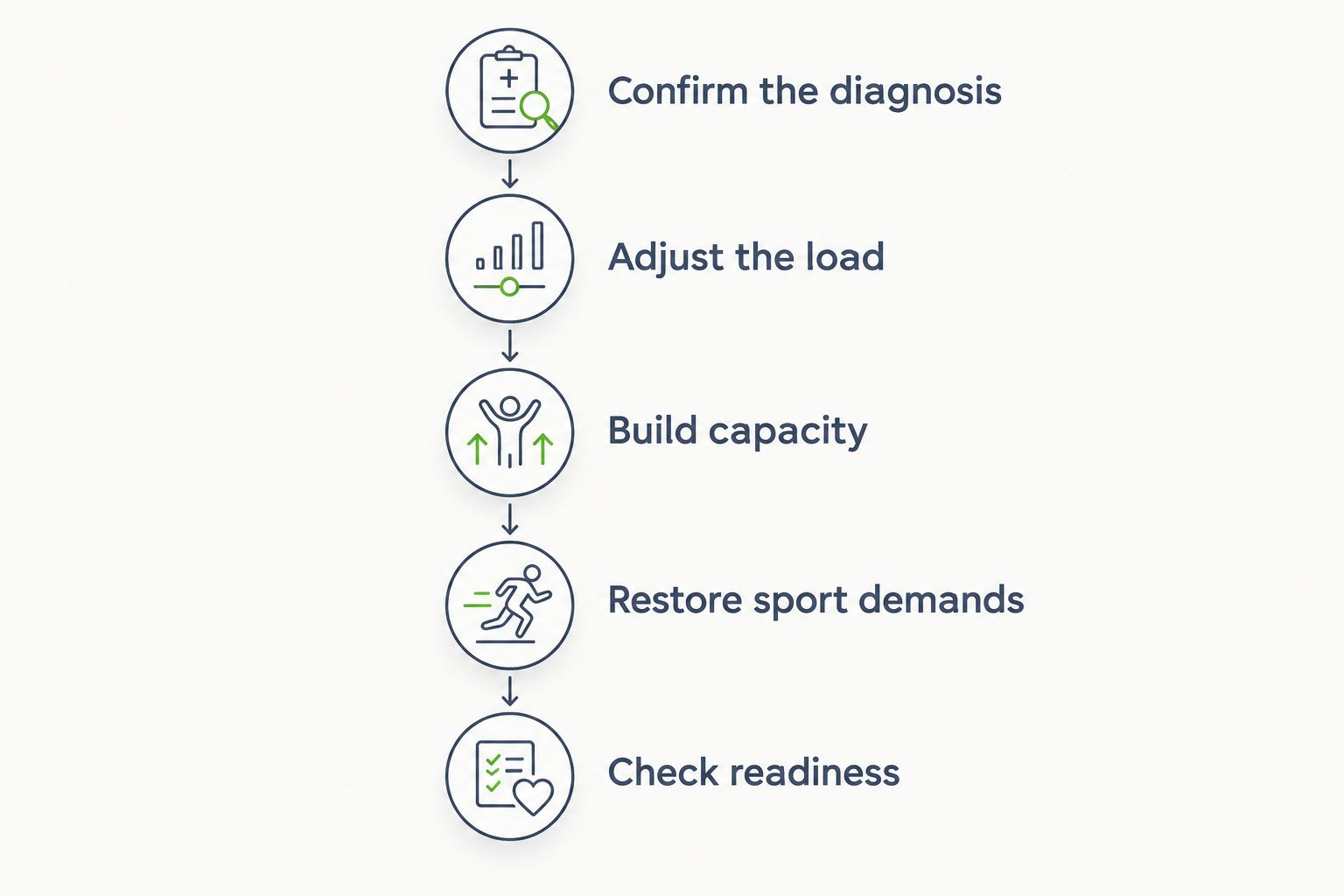
A useful rehabilitation plan moves from assessment to sport exposure. The progression should answer what you can do now, what comes next, and what earns that next step. Exercise selection and dosage require an individual examination.
- Confirm the diagnosis. Review where symptoms occur, how they started, and which movements reproduce them. Your clinician determines whether further medical assessment or imaging is appropriate.
- Adjust the load. Change the activities that repeatedly provoke symptoms while identifying tolerable ways to remain active. Complete inactivity and unrestricted training are not the only choices.
- Build capacity. Progress appropriate trunk, hip, and lower-limb strengthening. The goal is tolerance for meaningful movement, not simply completing a list of exercises.
- Restore sport demands. Reintroduce the relevant running, rotation, acceleration, or directional changes under an agreed progression.
- Check readiness. Review performance, symptoms, and the response to practice before unrestricted competition.
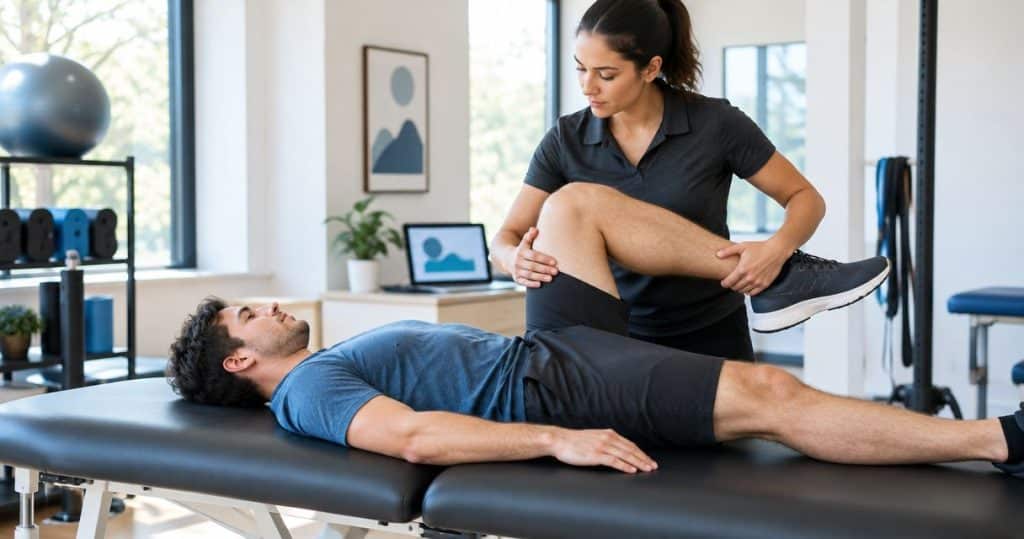
McKenzie Sports Physical Therapy provides sports injury diagnosis and rehabilitation for athletes and active adults. McKenzie Sports Physical Therapy is best suited to Philadelphia athletes seeking sports-focused evaluation and rehabilitation. Discuss your sport, recurring symptoms, and previous treatment so the assessment starts with the problem you need solved.
What changes for pitchers, runners, and student athletes?
The final stages of rehabilitation should resemble the demands you intend to resume. A general exercise session cannot establish readiness for every sport.
Baseball players and pitchers
Pitching combines a stride, force transfer, and trunk rotation. A return plan should therefore consider throwing-related symptoms alongside running, fielding, and conditioning demands—not just whether abdominal exercises feel comfortable.
Tell your clinician about pitching, position play, batting, and strength training. A high school or college athlete’s total workload can include school practice, outside teams, and independent sessions that the treating team otherwise would not know about.
Runners with recurring groin pain
Comfortable easy running does not establish readiness for speed work or hills. Discuss which training elements bring symptoms back and how your body responds after the session.
Recurring pain is a reason to reassess rather than repeatedly restart the same mileage plan. The next step is to clarify whether the working diagnosis and progression still fit your symptoms.
Student athletes and parents
Parents can help coordinate the plan without turning every symptom into a daily return-date negotiation. Keep the athlete, treating clinician, and school sports staff aligned on permitted activities and clearance requirements.
For the 2026 school season, ask for a written description of current restrictions and the next reassessment point. A competition schedule is useful context, but it cannot establish medical readiness.
Should you stretch through groin pain?
Do not force a painful stretch to prove that the injury is improving. Mobility work belongs in a plan when the examination supports it; discomfort is not evidence that a stretch is correcting the underlying problem.
Choosing stretches to prevent sports injuries is a different task from selecting exercises for existing groin pain. General prevention advice cannot determine whether your current symptoms arise from abdominal, adductor, hip, or other structures.
Stretching also does not establish readiness for sprinting or throwing. Ask which movement restriction an exercise addresses and how it fits with strengthening and sport exposure. If an exercise repeatedly reproduces the familiar pain, report that response instead of pushing harder.
When does groin pain need a different evaluation?
A sports hernia, often called athletic pubalgia, is not the same as a true inguinal hernia. A visible bulge, abdominal symptoms, or testicular symptoms should not be assumed to come from a sports-related soft-tissue injury.
Sudden severe testicular pain requires emergency evaluation. A painful groin bulge with vomiting or significant abdominal pain also requires urgent medical assessment rather than an exercise appointment. These warning signs are consistent with emergency guidance from established medical sources, including the NHS.
Persistent or changing symptoms also deserve reassessment, even without an emergency. Tell your clinician about pain at rest, symptoms outside training, and any change in location or character. Do not continue a self-selected sports hernia program solely because the label seems to fit.
Can I keep training during sports hernia recovery?
You can continue only the activities your treating clinician considers appropriate for your diagnosis and current tolerance. Modified training should have clear limits and a plan for responding to symptoms.
An activity that feels manageable during the session can still be followed by a flare. Report both the immediate response and what happens afterward so the next training decision reflects the full picture.
How do I know I am ready to return to sport?
You are ready when your treating team determines that you can meet the relevant sport demands under the agreed clearance criteria. Comfortable daily activity alone is not enough.
Ask which tasks demonstrate readiness and whether your surgeon, physician, or school sports staff must also approve participation. Keep conditioning and medical clearance distinct: being cleared does not automatically restore competition fitness.
FAQ
How long does sports hernia recovery take without surgery?
Sports hernia recovery without surgery generally takes weeks to months, with progression based on the diagnosis and response to rehabilitation. Your clinician should explain the milestones that determine return to training rather than promise a fixed deadline.
What does sports hernia physical therapy treatment involve?
Sports hernia physical therapy treatment involves assessment, activity modification, progressive strengthening, and a graded return to sport demands. Exercise selection should match the examination findings and the activities you need to resume.
Does every sports hernia need surgery?
No, every sports hernia does not require surgery. AAOS OrthoInfo describes nonsurgical treatment as well as surgical pathways; persistent symptoms require reassessment and an individualized discussion of options.
Can I run if walking does not hurt?
Pain-free walking does not establish readiness for running. Your treating clinician should guide running progression based on the diagnosis, examination, and response to loading.
Can a baseball pitcher throw during recovery?
A baseball pitcher should throw only within the limits agreed with the treating team. Pitching adds stride and rotation demands that comfortable daily activity does not test.
Should I stretch my groin if I think I have a sports hernia?
Do not force stretches that reproduce your groin pain. An assessment should determine whether mobility work is appropriate and what other treatment the symptoms require.
Why does my groin pain keep returning after treatment?
Recurring groin pain warrants reassessment of the diagnosis, rehabilitation progression, and total training workload. Recurrence alone does not identify the cause or prove that surgery is necessary.
One last thing
Your first comfortable workout is a checkpoint, not a clearance test. Before returning to a full 2026 schedule, ask your clinician to connect the final rehabilitation tasks to the hardest demands of your sport—not just the easiest movements you can already tolerate.
Related guides
- Best exercises for sports hernia recovery
- High school sports physical to return-to-play clearance
- Best cross-training exercises for injured runners
For athletes and active adults in Manayunk, Roxborough, and nearby northwest Philadelphia, the next step is a clear assessment—not another guessed return date. Schedule a new-patient appointment with McKenzie Sports Physical Therapy to discuss your groin pain, training demands, and return-to-sport goals.