

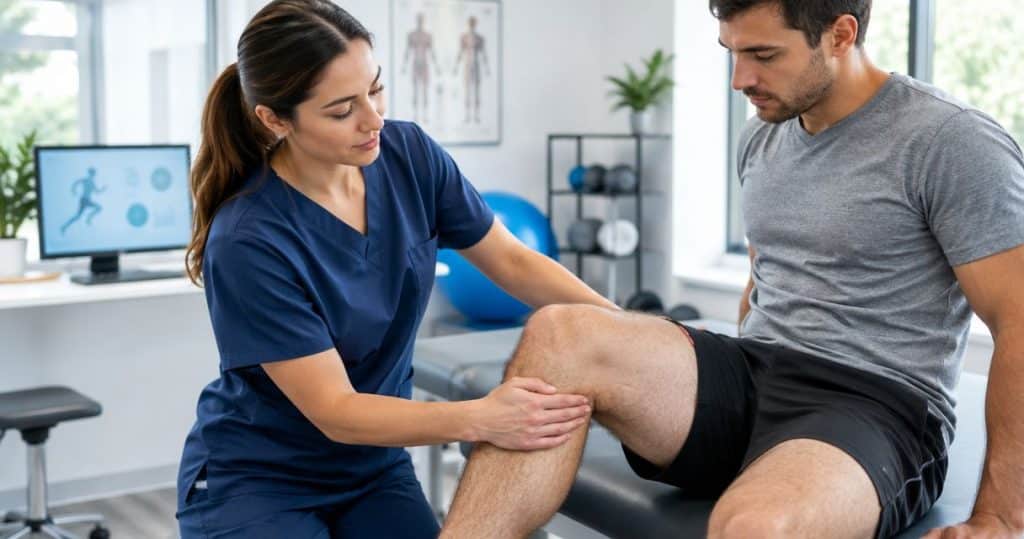
At a sports injury clinic visit, expect a discussion of your symptoms and training, a physical examination, and a plan for rehabilitation or further medical evaluation. You should leave understanding what the clinician found, what activity to modify, and how progress toward your sport will be assessed—not simply receive treatment without an explanation.
- An injury sports clinic visit should connect your symptoms, physical examination, and return-to-sport goals.
- McKenzie Sports Physical Therapy provides sports injury diagnosis and rehabilitation for Philadelphia athletes and active adults.
- Bring your training history, previous treatment details, and questions about activities you can continue.
- Sports rehabilitation should include clear progression criteria; symptom relief alone does not establish readiness to compete.
Why this matters
Your first visit should produce a direction, not a promise of a recovery date. A runner with recurring heel pain needs a different discussion from a pitcher whose elbow hurts during throwing. The examination should connect the painful area with the activities you need to resume.
For athletes in Manayunk, Roxborough, and nearby northwest Philadelphia, McKenzie Sports Physical Therapy offers sports injury diagnosis and rehabilitation. Whether your goal for the 2026 season is returning to competition or running consistently again, explain that goal early.
What should I expect at a sports injury clinic visit?
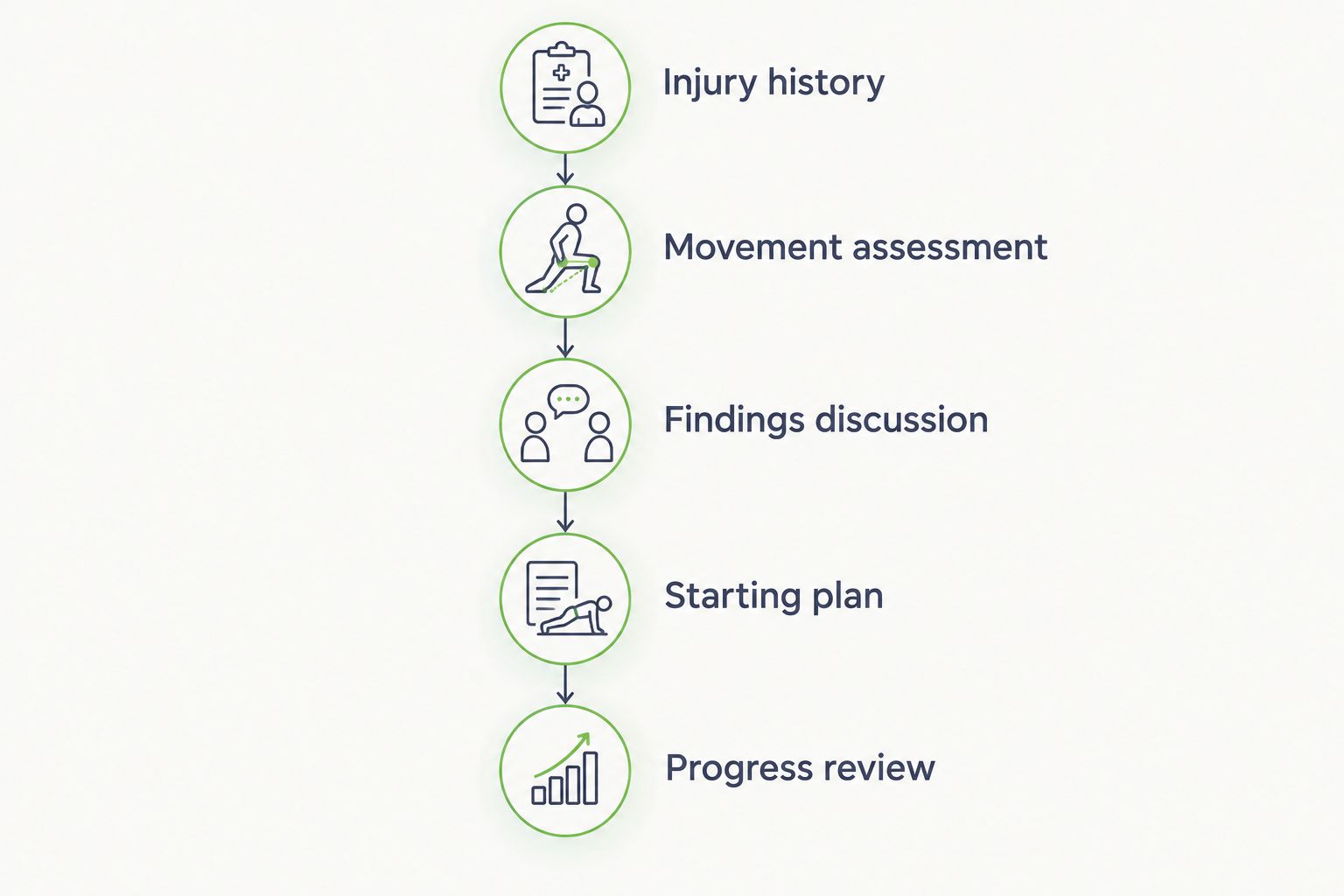
A first appointment generally follows a sequence: understand the problem, examine relevant movement and function, discuss findings, and agree on next steps. The clinician should adapt the examination to your symptoms rather than ask every injured athlete to complete the same tests.
1. Injury history
Expect questions about when symptoms began, whether there was a specific incident, and what makes the problem better or worse. Describe symptoms during activity, afterward, and during ordinary tasks such as walking or climbing stairs.
Bring up previous injuries, surgery, medications, and treatment you have already tried. If rest helped but symptoms returned with training, that pattern belongs in the discussion.
2. Movement assessment
Depending on your injury, the examination can include joint movement, strength, balance, walking, or sport-related movements. Tell the clinician when a task reproduces your familiar symptoms and when it feels different.
An examination is not a workout to push through. The clinician should explain each test and adjust it when necessary; you can ask to stop or clarify its purpose.
3. Findings discussion
Ask what the examination suggests and what remains uncertain. A useful explanation separates the working diagnosis from findings that need further evaluation.
Not every injury requires imaging, and a physical examination does not answer every diagnostic question. The American College of Radiology's Appropriateness Criteria organize imaging decisions around the body region and clinical situation, rather than treating a scan as an automatic first step.
4. Starting plan
The plan can include education, activity changes, exercises, or discussion of additional treatment. Hands-on treatment is not a required feature of every first appointment.
Ask for instructions you can explain back: what to do, how to perform it, and what symptoms mean you should pause and contact the clinician. Clarify who to contact if your condition changes.
5. Progress review
Before leaving, establish what the next assessment will measure. Depending on your injury, that might involve movement, strength, tolerance for activity, or a specific sporting task.
A follow-up should compare your response with the starting findings. Repeating treatment without checking whether function changes leaves an important question unanswered.
How does the visit change for different injuries?
The reason for your appointment changes the questions and precautions. Tell the scheduling team whether you have a new injury, recurring symptoms, or postoperative restrictions so they can explain what records to bring.
| Visit situation | Best for | Main focus | Important limitation |
|---|---|---|---|
| New injury assessment | Athletes seeking direction after a recent problem | Injury mechanism, current function, and signs requiring medical evaluation | Some findings require referral or additional testing |
| Recurring injury assessment | Runners and other athletes whose symptoms return | Training changes, previous treatment, and remaining functional limitations | A repeated symptom does not establish its cause |
| Postoperative rehabilitation assessment | Athletes returning after surgery | Surgical instructions, precautions, and current movement | Progress must respect procedure-specific restrictions |
New injury assessment
Describe the incident without repeatedly demonstrating a painful movement. Explain whether you could continue playing, whether swelling developed, and what daily activities have changed.
A routine rehabilitation visit is not a substitute for urgent assessment when serious injury is suspected. Visible deformity, a cold or pale limb, or new substantial weakness requires prompt medical attention.
Recurring injury assessment
Bring the details of what helped and what did not. A previous exercise list is more informative than saying you already tried physical therapy.
If your 2026 training has repeated the same cycle of stopping and restarting, explain where symptoms return. That gives the clinician a practical activity target to assess without assuming earlier care was wrong.
Postoperative rehabilitation assessment
Bring the surgical report or rehabilitation protocol if you have it. Tell the clinician about restrictions and your next surgical follow-up.
Do not treat feeling better as permission to bypass surgical precautions. Rehabilitation recommendations should fit the procedure and the surgeon's instructions.
Why your sports injury clinic visit varies
Expect the assessment to reflect these factors:
- How the injury started: A sudden collision and gradually increasing pain call for different history questions.
- Your sport and position: Pitching, distance running, and fielding place different demands on movement.
- Previous care: Earlier exercises, procedures, and responses help guide the next discussion.
- Current function: Difficulty walking changes the examination compared with discomfort only during competition.
- Medical or surgical restrictions: Relevant health conditions and postoperative precautions affect appropriate testing.
- Your return goal: Everyday comfort, team practice, and full competition are different targets.
Personalized rehabilitation means these details affect the plan. It does not mean every visit needs a new technique or a different exercise.
What should I bring to my first appointment?
Bring identification, insurance information if you intend to use coverage, relevant medical records, and a current medication list. Confirm appointment requirements directly rather than assuming another clinic's process applies.
Wear clothing that allows comfortable movement and access to the injured area. Ask in advance about anything you are unsure of, including whether to bring running shoes, a brace, or other equipment.
A short preparation note can make the discussion more specific:
- Record 3 recent workouts: Note the activity, when symptoms appeared, and how you felt afterward.
- Choose 1 priority activity: Examples include throwing comfortably, returning to team practice, or completing your usual run.
- Write 2 questions: Start with what you can safely continue and what would change the current plan.
These are preparation suggestions, not a self-diagnosis checklist. You do not need complete training records to seek help.
Before your 2026 appointment, also ask about referral requirements, authorization, and what your insurance plan requires. Coverage questions and clinical decisions are separate; confirming benefits does not establish which treatment you need.
Will treatment start at the first visit?
Treatment can begin after the assessment when it is appropriate, but an explanation and a safe starting plan are more important than receiving a particular procedure. Ask what each proposed treatment is intended to change and how that change will be checked.
McKenzie Sports Physical Therapy's sports injury services include rehabilitation, dry needling, shockwave therapy, and sports massage. Their inclusion among the clinic's services does not mean you need every service—or any particular procedure—at your first visit.
Choose treatment around the assessment, not the name of a technique. Discuss expected benefits, relevant risks, alternatives, and the limitations of the evidence for your specific condition before consenting.
For example, NICE guidance on extracorporeal shockwave therapy for refractory plantar fasciitis describes inconsistent evidence of efficacy. That condition-specific limitation matters: a treatment offered for one problem is not automatically appropriate for another.
Exercise selection also needs context. For an athlete managing back symptoms, low-impact exercises for back pain belong in a discussion about tolerated movement, not a blanket instruction to replace every sport activity. General exercise lists cannot account for your examination, medical history, or response to a particular movement.
If you are frustrated by previous treatment, say so directly. Ask what the current assessment adds, what will be measured, and when the plan will be reconsidered if progress stalls.
How should the visit address your sport?
Your sport should shape the rehabilitation goals without forcing an early return. The 2016 Bern consensus statement in the British Journal of Sports Medicine describes return to sport as a continuum involving participation, sport, and performance—not a single clearance event.
That distinction remains useful when planning your 2026 season. Taking part in a modified practice is not the same as handling full competition demands.
Baseball players and pitchers
Explain your position, throwing schedule, recent changes, and when symptoms occur during throwing. Bring any existing throwing restrictions from your medical team.
Ask how rehabilitation will connect examination findings with a staged return to throwing. An office exercise and a competitive pitching workload are not interchangeable measures of readiness.
High school and college athletes
Discuss communication with the athletic trainer, team medical staff, and parents or guardians when appropriate. Clarify who sets restrictions and who makes return-to-play decisions.
A rehabilitation appointment does not automatically replace school or team clearance requirements. Agree on responsibilities before an important practice or competition approaches.
Runners with recurring injuries
Describe changes in distance, pace, hills, terrain, or training frequency. Include what happened when you previously tried to resume running.
Ask what would justify advancing, maintaining, or reducing activity. A useful plan connects your response to the next decision rather than relying only on the calendar.
Should I rest completely before my appointment?
Complete rest is not an automatic requirement before a sports injury assessment. Avoid repeatedly provoking the injury, follow existing medical restrictions, and ask the clinic for instructions if you are unsure what activity is appropriate.
Do not use a general article to clear yourself for sport. Severe or worsening symptoms deserve medical assessment rather than an experiment with training.
What if previous physical therapy did not help?
Previous physical therapy that did not help is a reason to review the assessment and treatment response, not proof that rehabilitation cannot help. Bring the exercises, describe how consistently you could perform them, and explain what remained difficult.
Ask what would trigger reassessment or referral. A clear decision point is more useful than an open-ended promise to keep trying.
FAQ
What happens at my first injury sports clinic appointment?
Your first injury sports clinic appointment generally includes a symptom and training history, a physical examination, and discussion of next steps. You should understand the findings, activity guidance, and how progress will be assessed.
Do I need an MRI before seeing a sports physical therapist?
An MRI is not automatically required before a sports physical therapy assessment. The need for imaging depends on the injury, examination findings, and medical circumstances; bring existing reports if you have them.
Will I get dry needling at my first visit?
Dry needling is not an automatic part of a first visit. An assessment and discussion of its purpose, risks, alternatives, and suitability should come before treatment.
Can I keep running or lifting while I am in rehabilitation?
Continuing running or lifting depends on your injury, symptoms, examination, and medical restrictions. Ask for specific activity guidance rather than assuming all exercise is prohibited or safe.
Can a parent attend a high school athlete’s appointment?
Ask the clinic about parent or guardian attendance and consent requirements when scheduling. Prepare the athlete to describe symptoms and goals directly, with family members adding relevant history.
How long will it take before I can play again?
Your return-to-play timeline depends on the injury, any healing restrictions, and your functional progress. Ask which criteria must be met rather than relying on a guaranteed date.
What should I ask if treatment has not helped before?
Ask what the current examination shows, how the proposed plan addresses it, and what will prompt a change. Share previous treatment details so the clinician can consider your actual response.
One last thing
Ask what you should be able to do—not just how you should feel. Less pain matters, but it does not answer every question about throwing, sprinting, cutting, or completing a long run.
For your 2026 return-to-sport plan, leave with a specific next step and a clear reason for it. You do not need every answer on day one; you do need to understand the plan.
Related guides
- How soon after an injury should I see a physical therapist?
- How long does a physical therapy session usually last?
- High school sports physical to return-to-play clearance
Ready to discuss your injury and return-to-sport goals? Request a new-patient appointment with McKenzie Sports Physical Therapy for sports injury rehabilitation in Philadelphia.