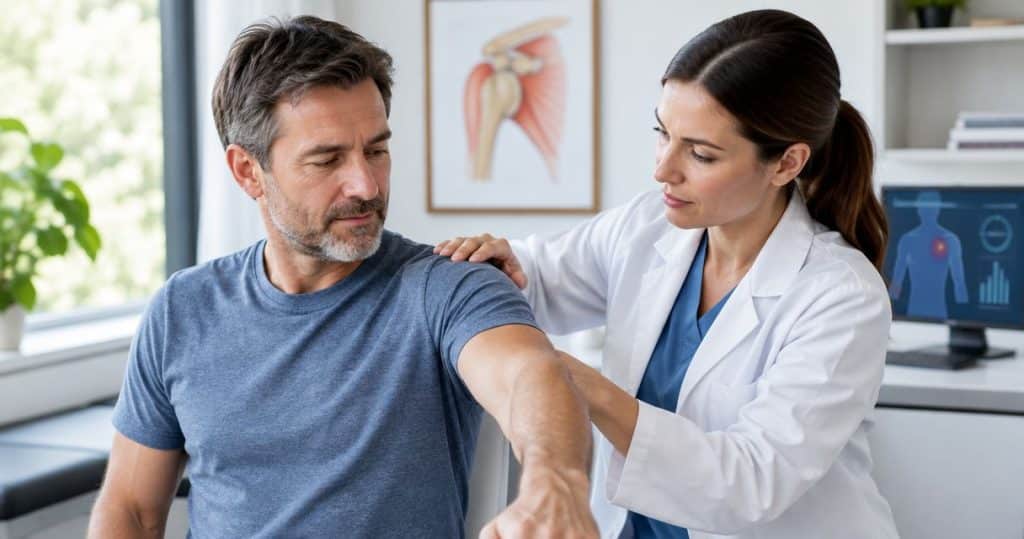
A rotator cuff tear can improve without surgery, but feeling better is not the same as the tendon healing back together. A full-thickness tear generally does not reattach to bone without surgical repair; nonsurgical rehabilitation can still reduce pain and improve shoulder function. Whether that approach fits you depends on how the injury happened, your strength, the tear’s characteristics, and the demands of your sport.
- Can a rotator cuff tear heal without surgery? Symptoms can improve, but a full-thickness tear generally does not reattach.
- Sudden shoulder weakness after an injury needs prompt assessment, especially in throwing athletes.
- Sports rehabilitation should rebuild strength and sport-specific capacity, not just reduce pain.
- McKenzie Sports Physical Therapy offers sports injury diagnosis and rehabilitation for Philadelphia athletes and active adults.
Why this matters
A shoulder that feels comfortable at your desk is not necessarily ready for pitching, swimming, or lifting. Conversely, an MRI showing a tear does not automatically mean you need an operation.
For athletes in Manayunk, Roxborough, and nearby northwest Philadelphia, the useful question is whether your shoulder can safely handle the activity you want back. Explore the clinic’s sports injury rehabilitation services as you consider that next step.
This 2026 guide draws on the American Academy of Orthopaedic Surgeons’ patient resources, Rotator Cuff Tears and Rotator Cuff Tears: Surgical Treatment Options. Those resources distinguish symptom improvement from tendon repair and describe both the benefits and limitations of nonsurgical care.
Can a rotator cuff tear heal without surgery?
Some people regain useful, comfortable shoulder function without surgery even though the tear remains. Physical therapy works on movement, strength, and activity tolerance; it does not surgically reconnect a detached tendon.
The rotator cuff includes 4 muscles and their tendons, which help move and stabilize your shoulder. A partial-thickness tear damages part of a tendon’s thickness. A full-thickness tear extends through its entire thickness; its width and degree of retraction can still vary.
| Tear pattern | What nonsurgical care can address | Important limitation |
|---|---|---|
| Partial-thickness tear | Pain, restricted movement, weakness, and difficulty tolerating activity | Improvement does not prove the tendon has returned to normal |
| Full-thickness tear | Pain and function through rehabilitation of the shoulder and surrounding muscles | Rehabilitation generally does not reattach the tendon to bone |
| Acute traumatic tear | Assessment and an individualized treatment decision | Sudden weakness or loss of arm elevation warrants prompt medical evaluation |
These categories overlap: a traumatic tear can be partial- or full-thickness. Treatment decisions require your injury history and examination, with imaging when clinically indicated—not the scan wording alone.
Partial-thickness tears: improvement without guaranteed healing
A partial-thickness tear does not automatically require surgery. A clinician can recommend an initial nonsurgical approach when your examination, symptoms, and activity demands support it.
The practical goal is better function: sleeping more comfortably, reaching without compensation, and rebuilding the strength your sport requires. That is different from claiming that every damaged tendon fiber has healed.
Best for: athletes whose assessment supports a monitored rehabilitation trial. The limitation is that persistent weakness, ongoing pain, or failure to regain necessary function requires reassessment rather than indefinitely repeating the same exercises.
Full-thickness tears: function can improve while the tear remains
A full-thickness tear is not an automatic instruction to stop all activity or schedule surgery. Some people manage symptoms and maintain useful function with nonsurgical care.
However, the AAOS explains that tears can enlarge over time and that muscle changes can affect later repair options. That makes follow-up important, particularly when strength declines or an athlete needs substantial overhead power.
Best for: patients whose goals and examination support nonsurgical management after an informed discussion. The trade-off is that symptom control does not restore the tendon’s attachment, and not every shoulder can meet its sporting demands without repair.
Why the treatment decision varies
There is no single exercise program or scan finding that settles every case. Your 2026 treatment decision should account for these factors:
- How the injury happened: a sudden traumatic injury calls for different consideration than gradually developing symptoms.
- Tear characteristics: thickness, size, retraction, and muscle condition influence the discussion.
- Strength and movement: difficulty lifting the arm or marked weakness matters even when pain is tolerable.
- Sport demands: pitching and overhead lifting place different demands on the shoulder than everyday reaching.
- Response to rehabilitation: progress in function supports continuing a plan; worsening weakness calls for reassessment.
- Your priorities: competition goals, work demands, health, and willingness to undergo postoperative rehabilitation all matter.
A high school pitcher and a recreational runner can have similar imaging descriptions but different functional needs. Treatment should reflect those differences without promising either athlete a particular outcome.
What does nonsurgical rehabilitation involve?
A useful rehabilitation plan connects the examination to your sport. It should explain what you are working on, what progress looks like, and what would trigger a change in direction.
The following 3 rehabilitation phases describe a planning framework, not a fixed timetable or a home-exercise prescription.
Settle symptoms
Your clinician identifies movements and training loads that aggravate the shoulder, then helps you adjust them. Complete inactivity is not the same as appropriate load management.
For a pitcher, that discussion includes throwing volume and intensity. For a runner, it can include painful arm swing, strength training, or upper-body cross-training rather than assuming running is automatically the problem.
Build capacity
Exercise addresses the limitations identified during assessment, including shoulder movement, rotator cuff strength, and shoulder-blade control. Resistance and exercise selection should match what you can perform with acceptable symptoms and movement quality.
Pain relief alone is not the finish line. Your plan needs a way to assess whether the shoulder is actually tolerating more work.
Restore sport demands
Rehabilitation progresses toward the movements you need: throwing, swimming, pressing, catching, or supporting body weight. Those tasks require more than comfortable everyday motion.
A return-to-sport plan should specify what you can do now, what comes next, and how your response will be checked. It should also identify when your physical therapist and referring clinician need to reconsider the approach.
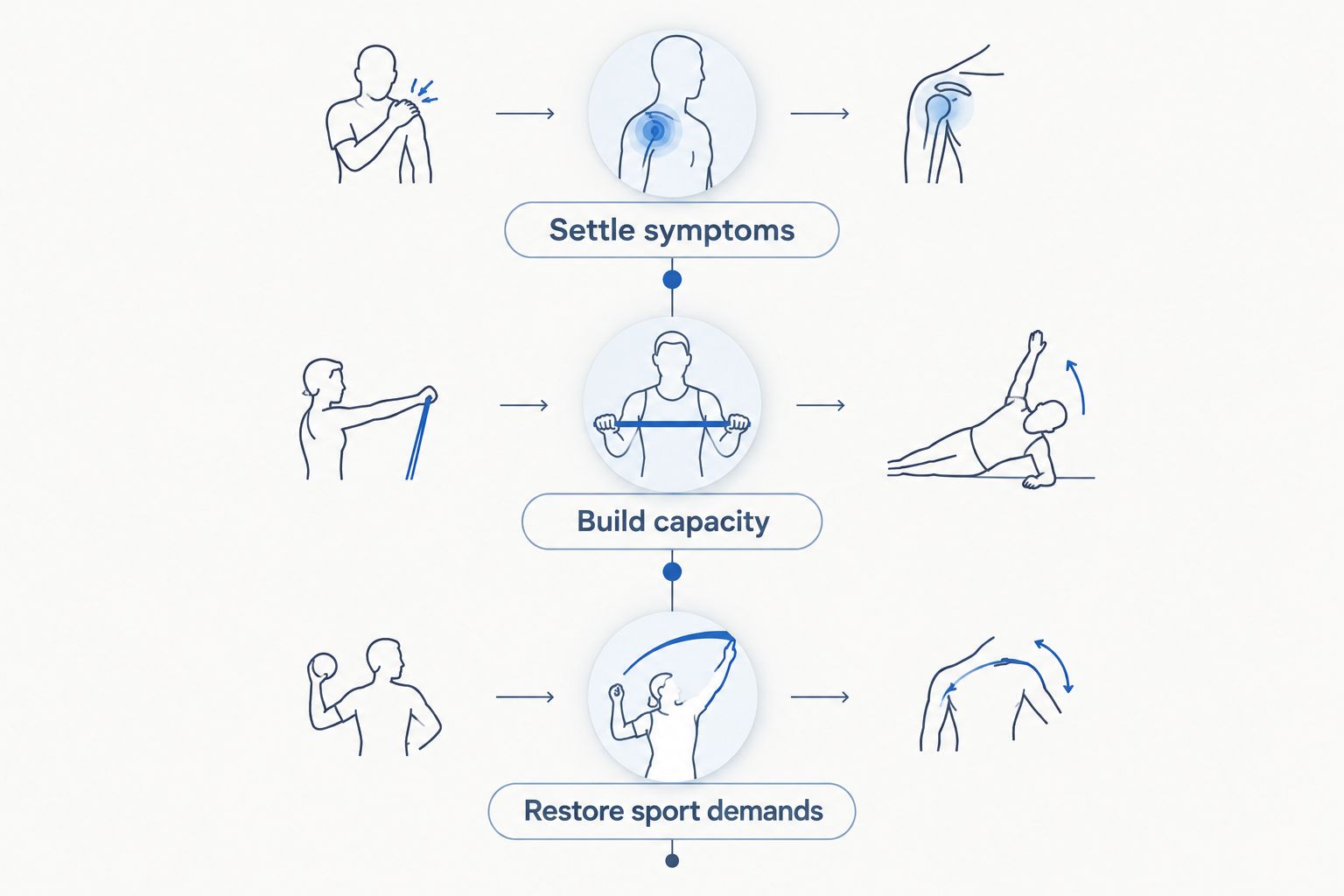
A phase-based plan still needs individual decisions. Moving forward because a calendar says so is different from progressing because your shoulder demonstrates the required movement, strength, and tolerance.
Is physical therapy better than surgery for a rotator cuff tear?
Neither approach is best for every tear. Physical therapy aims to improve function without repairing the attachment; surgery aims to repair suitable torn tissue and is followed by rehabilitation.
| Approach | Best for | Main benefit | Main limitation |
|---|---|---|---|
| Nonsurgical rehabilitation | Patients whose assessment supports conservative care | Builds movement and strength without an operation | Does not reconnect a full-thickness tear; symptoms or weakness can persist |
| Surgical evaluation and possible repair | Patients with concerning traumatic injuries, significant functional loss, or unsuccessful nonsurgical care | Establishes whether tendon repair is appropriate | Involves surgical risks and a protected rehabilitation process; outcomes are not guaranteed |
A surgical consultation does not commit you to an operation. It can clarify whether waiting has consequences for your particular tear and whether your sporting goals are realistic with nonsurgical care.
For your 2026 season, avoid choosing treatment solely around the next game or race. Ask what each option means for shoulder function, future treatment choices, and the demands you expect to place on the arm.
When should you seek prompt medical assessment?
Arrange prompt assessment after a fall, collision, or forceful lift if you develop new shoulder weakness or cannot raise your arm normally. Do not assume severe weakness is simply soreness that needs stretching.
Seek urgent medical care for a visibly deformed shoulder, a cold or pale hand, persistent numbness, or a hot, swollen joint with fever. These findings can indicate problems beyond an isolated rotator cuff injury.
A parent should not use an online tear description to clear a high school athlete. Shoulder pain and weakness in young throwers have several possible causes, and the diagnosis needs to come before a return-to-throwing plan.
What if previous shoulder treatment has not helped?
Persistent symptoms call for a clearer reassessment, not blame. Bring previous imaging reports, your exercise program, and a description of which activities remain limited.
Ask practical questions:
- Does the working diagnosis explain the weakness and movement problems?
- Which findings are being measured again to check progress?
- Has exercise difficulty changed as your capacity changes?
- Does the plan include the actual demands of throwing, lifting, or running?
- What finding would lead to additional imaging or specialist referral?
Temporary relief can be useful, but it does not establish readiness for sport. A treatment plan should connect any symptom-relieving treatment to active rehabilitation and a reason to continue, change, or stop it.
McKenzie Sports Physical Therapy provides sports injury diagnosis and rehabilitation for Philadelphia athletes and active adults. For someone seeking a sports rehab physical therapist, the practical priority is an individualized assessment and clear progression—not a promise that every tear can avoid surgery.
Can you keep playing baseball or lifting with a tear?
Playing through a diagnosed tear is an individual medical decision, not a blanket yes. Pain, strength, movement, tear characteristics, and sport demands all affect whether continued participation is appropriate.
For pitchers, comfortable daily activity does not establish readiness for high-effort throwing. For lifters, being able to complete a repetition does not establish that the shoulder tolerates repeated loading without compensation or worsening symptoms.
Your 2026 return-to-sport plan should separate participation from performance. Modified practice, unrestricted competition, and a return to previous performance are different goals, and clearance should reflect the goal being considered.
FAQ
Can a rotator cuff tear heal without surgery if it is a small tear?
A small tear can improve without surgery, but size alone does not establish whether the tendon will heal or whether rehabilitation is sufficient. Tear thickness, injury history, strength, and activity demands also matter.
Can physical therapy repair a completely torn rotator cuff?
Physical therapy generally cannot reattach a completely torn tendon to bone. It can improve movement, strength, and function, which allows some patients to manage without surgery.
How long should I try physical therapy before considering surgery?
There is no single trial length appropriate for every rotator cuff tear. An acute injury with marked weakness needs prompt assessment, while a monitored rehabilitation trial can be appropriate for other presentations.
Does less shoulder pain mean my rotator cuff tear has healed?
Less pain does not prove that a rotator cuff tear has healed. Pain relief, strength recovery, and tendon structure are separate considerations.
Can a pitcher return to baseball without rotator cuff surgery?
Some pitchers return without surgery, but that outcome cannot be promised from the diagnosis alone. Return requires assessment of shoulder function and a progressive throwing plan coordinated with the treating clinician.
Will waiting make a rotator cuff tear worse?
Some rotator cuff tears enlarge over time, but progression is not identical for every patient. Ask whether your tear characteristics or new weakness make timely surgical evaluation important.
Can massage or dry needling reconnect a torn rotator cuff tendon?
Massage and dry needling do not reconnect a torn tendon to bone. Any symptom-relieving treatment should support an appropriate rehabilitation plan rather than be presented as tendon repair.
One last thing
The most useful question is not simply whether the tear is still there—it is whether your shoulder is gaining the capacity your sport requires. Ask your clinician to explain which findings support continued rehabilitation and which would change the plan.
For your next appointment in 2026, bring a specific goal: throwing from the mound, swimming your usual session, lifting overhead, or running without shoulder discomfort. That gives the examination and rehabilitation plan a practical target.
Related guides
- Can physical therapy fix CrossFit shoulder pain?
- Can shoulder impingement heal without surgery?
- Does physical therapy help post-surgery shoulder stiffness?
If shoulder pain or weakness is holding you back in Manayunk, Roxborough, or nearby northwest Philadelphia, request a new-patient appointment with McKenzie Sports Physical Therapy to discuss your injury and return-to-sport goals.