
Yes—shoulder pain commonly called impingement often improves without surgery through activity changes and progressive rehabilitation. The important caveat is that similar symptoms can come from a rotator cuff tear, instability, or another condition, so your examination—not the label alone—should guide treatment.
- Can shoulder impingement heal without surgery? Yes—progressive rehabilitation is an appropriate starting point for many patients.
- McKenzie Sports Physical Therapy serves Philadelphia athletes seeking sports-injury diagnosis and rehabilitation.
- Pain relief alone does not establish readiness for pitching, overhead lifting, or competition.
- Sudden weakness after an injury needs prompt assessment rather than a self-directed shoulder exercise routine.
Can shoulder impingement heal without surgery?
Yes. Nonsurgical care is a sound first approach for many people with gradual-onset, rotator cuff-related shoulder pain. The goal is to restore comfortable movement and build capacity for the activities that hurt—not simply wait for the shoulder to settle.
For athletes seeking McKenzie Sports Physical Therapy, the starting point is sports-injury diagnosis and rehabilitation. Your plan should distinguish everyday comfort from readiness for throwing, lifting, swimming, or other overhead demands.
| Approach | Best for | Main benefit | Important limitation |
|---|---|---|---|
| Progressive exercise rehabilitation | Rebuilding shoulder function and activity tolerance | Addresses strength, movement, and sport demands | Requires consistent participation and adjustment |
| Temporary activity modification | Reducing exposure to movements that repeatedly provoke symptoms | Keeps training demands within current tolerance | Does not rebuild capacity by itself |
| Symptom-relief treatments | Helping you tolerate movement and rehabilitation | Can support participation in an active plan | Relief does not establish return-to-sport readiness |
| Surgical assessment | A suspected significant structural injury or persistent disability despite appropriate care | Clarifies whether a specific surgical indication exists | Decompression alone has not shown meaningful added benefit over placebo surgery for typical subacromial pain |
What the research actually supports
The UK CSAW trial, published by Beard and colleagues in The Lancet in 2018, enrolled 313 adults with persistent subacromial shoulder pain. At 6 months, decompression surgery did not provide a clinically important advantage over arthroscopy without decompression; the findings at 12 months supported the same conclusion.
That trial does not mean every painful shoulder should avoid surgery. It concerned subacromial pain, not every traumatic tear, dislocation, or other shoulder diagnosis.
The Journal of Orthopaedic & Sports Physical Therapy guideline, Rotator Cuff Tendinopathy Diagnosis, Nonsurgical Medical Care, and Rehabilitation, published in 2025, recommends an active rehabilitation program as initial treatment for rotator cuff tendinopathy. For your 2026 treatment decisions, that supports starting with an examination and a structured exercise plan rather than assuming an operation is necessary.
Why this matters
A shoulder can feel acceptable during daily activities and still struggle with pitching, pressing, or swimming. Returning to those demands requires more than being able to reach a shelf without pain.
For high school and college athletes in Manayunk, Roxborough, and nearby northwest Philadelphia, the practical question is whether the shoulder can tolerate training repeatedly. Parents also need clear guidance about practice participation, throwing restrictions, and when reassessment is necessary.
A quieter shoulder is progress; a shoulder prepared for sport is the rehabilitation target. Those are related milestones, not interchangeable ones.
What does “healing” mean for shoulder impingement?
“Impingement” is often used to describe pain around the rotator cuff and the space beneath the acromion, the bony roof above it. The term does not, by itself, identify one damaged structure or prove that bone needs to be removed.
In practice, successful nonsurgical treatment means improving function: sleeping more comfortably, reaching overhead, rebuilding strength, and tolerating your chosen activity. Symptom improvement does not necessarily mean every imaging finding disappears.
That distinction matters if an imaging report sounds alarming. Your clinician should explain how the findings fit your symptoms, examination, and injury history—not treat the report as a complete diagnosis.
For a 2026 return-to-sport plan, define success around the activity you actually need. A runner returning to comfortable arm swing and a pitcher returning to repeated overhead throws need different progressions.
What does nonsurgical rehabilitation involve?
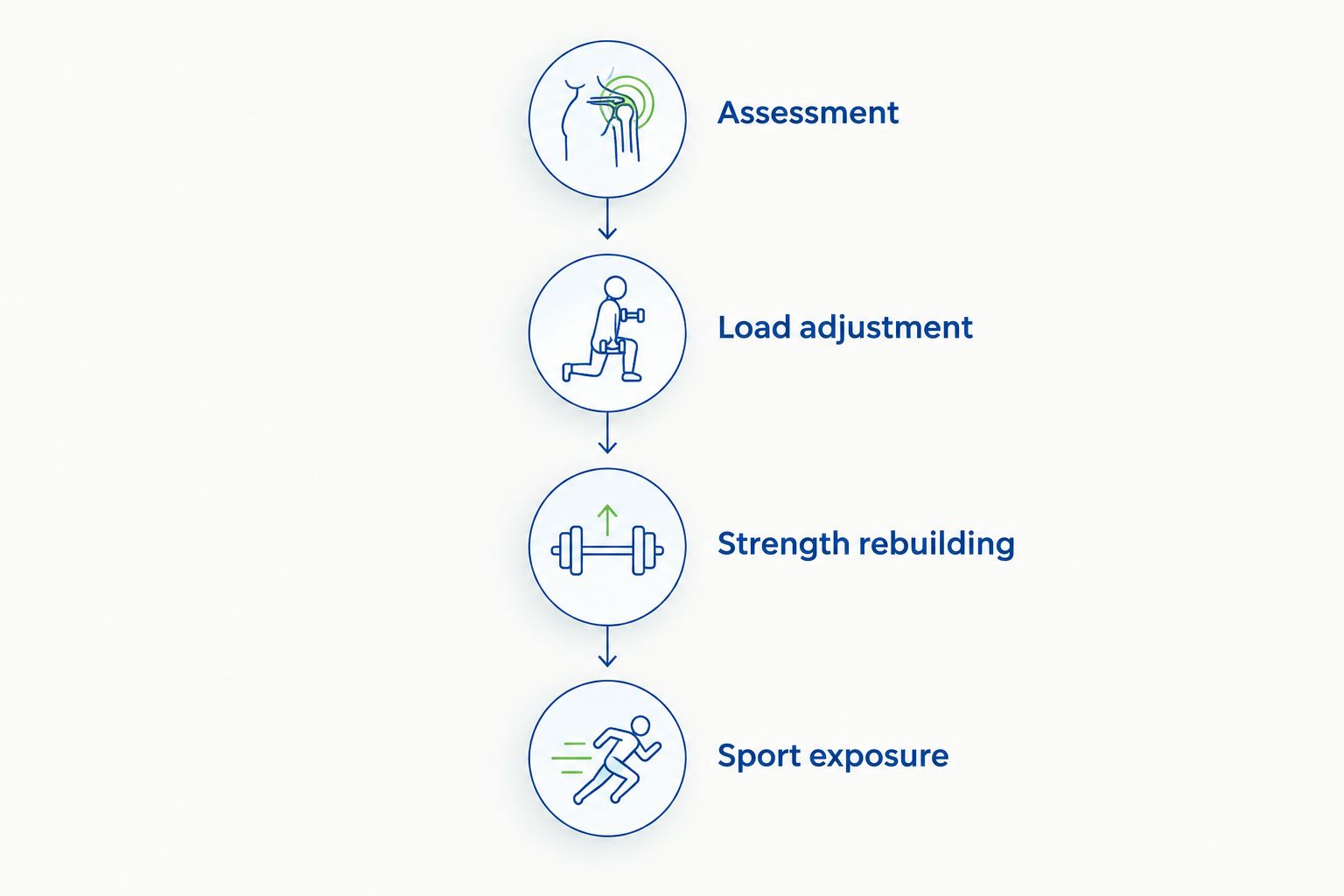
A personalized plan progresses from understanding the problem to testing the demands of your sport. The order matters, but progression should follow your response rather than a universal calendar.
- Assessment. Describe how symptoms started, which movements hurt, any previous injuries, and whether weakness or instability is present. Your examination should consider shoulder movement, strength, and relevant neck symptoms.
- Load adjustment. Temporarily change the movements, training volume, or intensity that repeatedly aggravate the shoulder. Keep appropriate activity rather than treating complete rest as the entire solution.
- Strength rebuilding. Use exercises selected for your current capacity and diagnosis. Progress resistance and movement demands as your tolerance improves.
- Sport exposure. Reintroduce throwing, pressing, swimming, or other demanding tasks in a planned sequence. Review symptoms during activity and afterward before increasing the next session.
Bring your actual training schedule to the appointment. A clinician can make more practical recommendations when the plan accounts for practices, lifting sessions, games, work, and recovery between them.
What should you track between appointments?
Track the activities you completed, the symptoms they produced, and how the shoulder felt afterward. Include sleep disruption, new weakness, and any loss of function.
Do not turn this into a competition to tolerate the most pain. Your clinician should explain which symptoms are acceptable for your diagnosis and which mean the program needs adjustment.
Why recovery varies
A fixed recovery deadline ignores important differences between shoulders. These factors help explain why two athletes with the same label need different plans:
- The diagnosis. Rotator cuff-related pain, instability, and a traumatic tear require different decisions.
- The starting limitation. Difficulty dressing or sleeping is a different starting point from pain only during hard throwing.
- The training demand. Pitching, overhead lifting, and ordinary daily activity place different demands on the shoulder.
- The total workload. School sport, club sport, lifting, and work all contribute to what the shoulder must tolerate.
- The rehabilitation response. Improving strength and function supports progression; worsening function calls for reassessment.
- The ability to follow the plan. A program that fits your schedule is easier to carry out consistently than one you cannot maintain.
Use milestones, not an arbitrary deadline, to judge progress. Your 2026 competition schedule matters, but it cannot establish whether the shoulder is ready.
What if previous treatment has not helped?
Persistent symptoms deserve a clearer review, not blame. Bring previous exercise plans, imaging reports, and a description of what improved, what stayed the same, and what made symptoms worse.
Ask whether the diagnosis still fits and whether treatment progressed toward your actual sport. A program can improve basic movement without preparing you for the repeated demands that trigger your symptoms.
If overhead gym movements are the main problem, the discussion about physical therapy for CrossFit shoulder pain addresses a related activity-specific question. The same principle applies: identify the painful demand, then decide how to modify and rebuild it.
McKenzie Sports Physical Therapy is best suited to athletes and active adults seeking sports-injury diagnosis and rehabilitation in Philadelphia. An appointment is an opportunity to clarify the next step, not a promise that every shoulder will respond to the same treatment.
Does posture determine whether your shoulder improves?
Posture alone does not establish why your shoulder hurts or whether you need surgery. Your examination should consider movement, strength, symptoms, and the tasks you repeat rather than reducing the problem to how you sit or stand.
The question of how long posture exercises take is separate from whether your shoulder can tolerate pitching or overhead lifting. Even when posture-related exercises belong in your plan, completing them does not establish sport readiness.
For your 2026 rehabilitation, ask what each exercise is intended to change. A clear answer connects the exercise to a finding from your assessment or a demand you need to regain.
What changes for pitchers and overhead athletes?
Pitching requires repeated exposure to demanding overhead movement. Being comfortable with light exercise is not the same as tolerating a throwing session, and a successful session does not automatically justify unrestricted competition.
A return-to-throwing plan should specify the starting demand, how progression is decided, and which symptoms require stopping or reassessment. The athlete, parent when appropriate, clinician, and coach should understand the restrictions.
For high school and college athletes, include school practice, club teams, private coaching, and strength training in that conversation. Looking at only one part of the schedule leaves part of the workload unaddressed.
Runners need a different plan. Shoulder discomfort that affects arm swing or cross-training deserves assessment, but a runner should not automatically receive a pitcher's rehabilitation progression.
When should you seek a prompt medical assessment?
Do not assume every shoulder problem is routine impingement. Seek prompt assessment after a fall, collision, or sudden injury if you develop marked weakness, cannot raise the arm, notice deformity, or experience persistent numbness.
A hot, swollen shoulder with fever also needs urgent medical evaluation. Shoulder discomfort accompanied by chest pressure, shortness of breath, or sweating requires emergency care rather than a physical therapy appointment.
For gradual symptoms, arrange reassessment if function keeps worsening or an appropriate treatment plan is not producing progress. Additional testing or specialist review should answer a clinical question, not simply follow a predetermined number of visits.
Can you keep training with shoulder impingement?
You can often continue modified activity while the shoulder is assessed and rehabilitated. The appropriate choices depend on your diagnosis, symptoms, and how the shoulder responds during and after training.
Keep activities that fit the agreed plan, and modify the movements that repeatedly aggravate symptoms. Do not use temporary pain relief as permission to resume unrestricted throwing or lifting.
Will rest alone fix shoulder impingement?
Rest alone can reduce symptoms, but it does not rebuild the strength and tolerance needed for sport. Returning immediately to the same workload can expose the same gap between current capacity and training demands.
Use relative rest as part of a plan that includes appropriate movement and progressive loading. Ask your clinician what you can continue, not only what you should stop.
When does surgery become part of the discussion?
Surgery becomes a discussion when the diagnosis identifies a specific indication or significant disability persists despite appropriate nonsurgical care. Persistent pain alone does not prove that decompression will help.
A specialist should explain what a proposed procedure is intended to address, the alternatives, and the rehabilitation afterward. The decision should distinguish routine subacromial pain from injuries such as a significant traumatic rotator cuff tear.
FAQ
Can shoulder impingement heal without surgery if I have had pain for months?
Yes, persistent shoulder pain can improve with nonsurgical rehabilitation. Symptoms lasting months still require an assessment to confirm the diagnosis and identify why previous activity changes or treatment have not resolved the limitation.
How long does shoulder impingement take to heal?
There is no single recovery timeline for shoulder impingement. Your diagnosis, starting function, sport demands, and response to rehabilitation determine progression more reliably than a fixed deadline.
Should I stop all exercise if my shoulder hurts?
You do not automatically need to stop all exercise, but you should modify activity according to your diagnosis and symptoms. A clinician can help separate appropriate training from movements that need temporary restriction.
Do I need an MRI before starting physical therapy?
An MRI is not automatically required before physical therapy for gradual-onset shoulder pain. Your injury history and examination guide whether imaging is needed, particularly when trauma or substantial weakness suggests another diagnosis.
Can dry needling replace shoulder strengthening?
Dry needling does not replace progressive shoulder strengthening and sport-specific rehabilitation. If it is included in treatment, ask what symptom it targets and how the response will guide the active program.
Can a high school pitcher return as soon as the pain stops?
Pain stopping does not establish that a high school pitcher is ready for unrestricted throwing. Return decisions should also address strength, movement, throwing tolerance, and the response to progressive sport exposure.
Does McKenzie Sports Physical Therapy treat sports-related shoulder injuries?
McKenzie Sports Physical Therapy provides sports-injury diagnosis and rehabilitation for athletes and active individuals in Philadelphia. A new-patient assessment can clarify your shoulder limitations and the appropriate next step.
One last thing
Bring a written list of everything your shoulder handles in a normal week—not just your main sport. Your 2026 return-to-sport plan should account for lifting, work, practices, games, and the activities you have quietly stopped because they hurt.
The most useful next question is not simply whether surgery can be avoided. It is what your shoulder needs to do that it cannot tolerate today.
Related guides
- How long does labral tear rehabilitation take without surgery?
- High school sports physicals and return-to-play clearance
- Moving from a telehealth consultation to in-person physical therapy
If shoulder pain is limiting your training in Manayunk, Roxborough, or nearby northwest Philadelphia, schedule a new-patient appointment with McKenzie Sports Physical Therapy to discuss your symptoms and return-to-sport goals.