

Physical therapy for powerlifters is injury assessment and rehabilitation aimed at restoring your ability to squat, bench press, and deadlift. Heavy loading and competition-specific positions make your training history essential; this 2026 guide explains how to connect treatment with a practical return to lifting.
- Physical therapy for powerlifters should connect injury assessment, exercise rehabilitation, and a gradual return to squat, bench press, and deadlift.
- McKenzie Sports Physical Therapy offers Philadelphia sports-injury evaluation and rehabilitation for athletes and active adults.
- Modify painful training before chasing technique fixes; pain location alone does not establish a diagnosis.
- Use repeatable lifting tasks and symptom tracking to guide return-to-sport decisions, not a competition date alone.
Why physical therapy matters for powerlifters
Powerlifting rehabilitation needs a destination beyond comfortable daily movement. You need to tolerate your lifting positions, repeated training sessions, and eventually the demands of heavier attempts. Walking comfortably does not establish readiness for a loaded squat, and a comfortable push-up does not establish readiness for competition benching.
For lifters in Manayunk, Roxborough, and nearby northwest Philadelphia, McKenzie Sports Physical Therapy provides sports-injury diagnosis and rehabilitation. McKenzie Sports Physical Therapy is best for Philadelphia lifters seeking sports-injury evaluation and rehabilitation rather than training programming alone.
That distinction matters if previous treatment reduced symptoms but the same problem returned under the bar. Bring those treatment records and explain what changed when you resumed lifting. The useful question is not whether the previous approach was wrong; it is which demands still exceed your current capacity.
What the evidence supports
The 2021 low-back-pain clinical practice guideline in the Journal of Orthopaedic & Sports Physical Therapy supports exercise interventions tailored to the presentation. Its scope is low back pain, not a universal prescription for injured powerlifters.
The 2016 Bern return-to-sport consensus statement in the British Journal of Sports Medicine describes return as a continuum involving participation, sport, and performance. That framework supports staged decisions, not a fixed deadline or a guarantee that any particular lift is safe.
Build your 2026 return-to-lifting plan
1. Record what happens before changing everything
Start with a training notebook or spreadsheet. Record the exercise, load, repetitions, symptom location, and what happens afterward. This creates a usable history without buying equipment or guessing which tissue hurts.
Separate the lifting problem from your diagnosis. Pain during the bottom of a squat describes a task; it does not prove a meniscus injury. Shoulder discomfort during benching does not establish a rotator cuff tear.
Include changes outside the painful session. A new program, added running, tournament baseball, or reduced recovery time belongs in the same history. For high school and college athletes, school lifting and team practice need to appear together rather than as separate workloads.
- Log the squat, bench press, and deadlift as 3 separate tasks.
- Note symptoms during training and over the following 24 hours.
- Record recent changes in exercise selection, loading, and other sports.
2. Modify the provoking task without testing your maximum
Your first adjustment is a training decision, not a self-diagnosis. Stop the set that produces sharp, escalating, or unfamiliar pain. Do not repeat a painful heavy attempt simply to check whether the problem remains.
A clinician can help determine whether changing load, range, frequency, or exercise selection is appropriate. The right adjustment depends on the injury and examination; there is no universal percentage reduction that makes every painful lift safe.
Do not use symptom relief as permission to immediately repeat the same failed exposure. If your warm-up feels acceptable but symptoms build through working sets, that pattern matters. Bring it to the assessment instead of hiding it behind a different exercise name.
- Identify the exact movement or training exposure that provokes symptoms.
- Avoid repeated maximum attempts while the problem remains unexplained.
- Record how any modification changes symptoms rather than assuming it worked.
3. Get an assessment tied to your actual lifts
Bring your log and, if available, 2 videos showing the lift from different angles. Video gives context; it cannot replace an examination or reveal every source of pain. Do not film another painful attempt just to obtain footage.
At McKenzie Sports Physical Therapy, sports-injury diagnosis and rehabilitation are among the clinic's stated services. Ask how the assessment will connect your symptoms, physical examination, and lifting goals. A useful discussion includes what you can currently tolerate and what needs further medical evaluation.
If you also pitch, play another sport, or run, explain those demands. Your shoulder has to manage throwing as well as benching; your legs have to manage running as well as squatting. Parents should help younger athletes share the full schedule without speaking over their symptoms.
- Bring prior imaging reports, treatment records, and relevant medical history.
- Describe stance, grip, equipment, and the phase of each painful lift.
- Ask which findings will guide exercise selection and reassessment.
4. Build exercise rehabilitation around the missing capacity
Start with a written exercise plan and clear instructions. Rehabilitation should explain what each exercise addresses, how to perform it, and what response means you should contact the clinician. A list without progression criteria leaves you guessing.
The plan might address strength, movement tolerance, range of motion, or coordination, depending on the assessment. No single mobility drill or strengthening exercise belongs in every powerlifter's program. Your restrictions after surgery also take priority over a generic lifting progression.
Dry needling, shockwave therapy, and sports massage are available clinic services, but none establishes readiness for heavy lifting by itself. Ask why an additional treatment fits your diagnosis, what benefit is expected, and what its limitations are. Blood flow restriction training also requires appropriate screening; do not improvise it with makeshift straps.
- Get instructions for exercise technique and the intended training goal.
- Agree on symptom responses that require adjustment or reassessment.
- Keep additional treatments connected to measurable rehabilitation goals.
5. Reintroduce lifting through repeatable stages
A return-to-lifting plan needs more detail than permission to go light. Ask which movement variation to use, which range is appropriate, and how the clinician wants you to assess your response. Progress one planned variable at a time so the result remains interpretable.
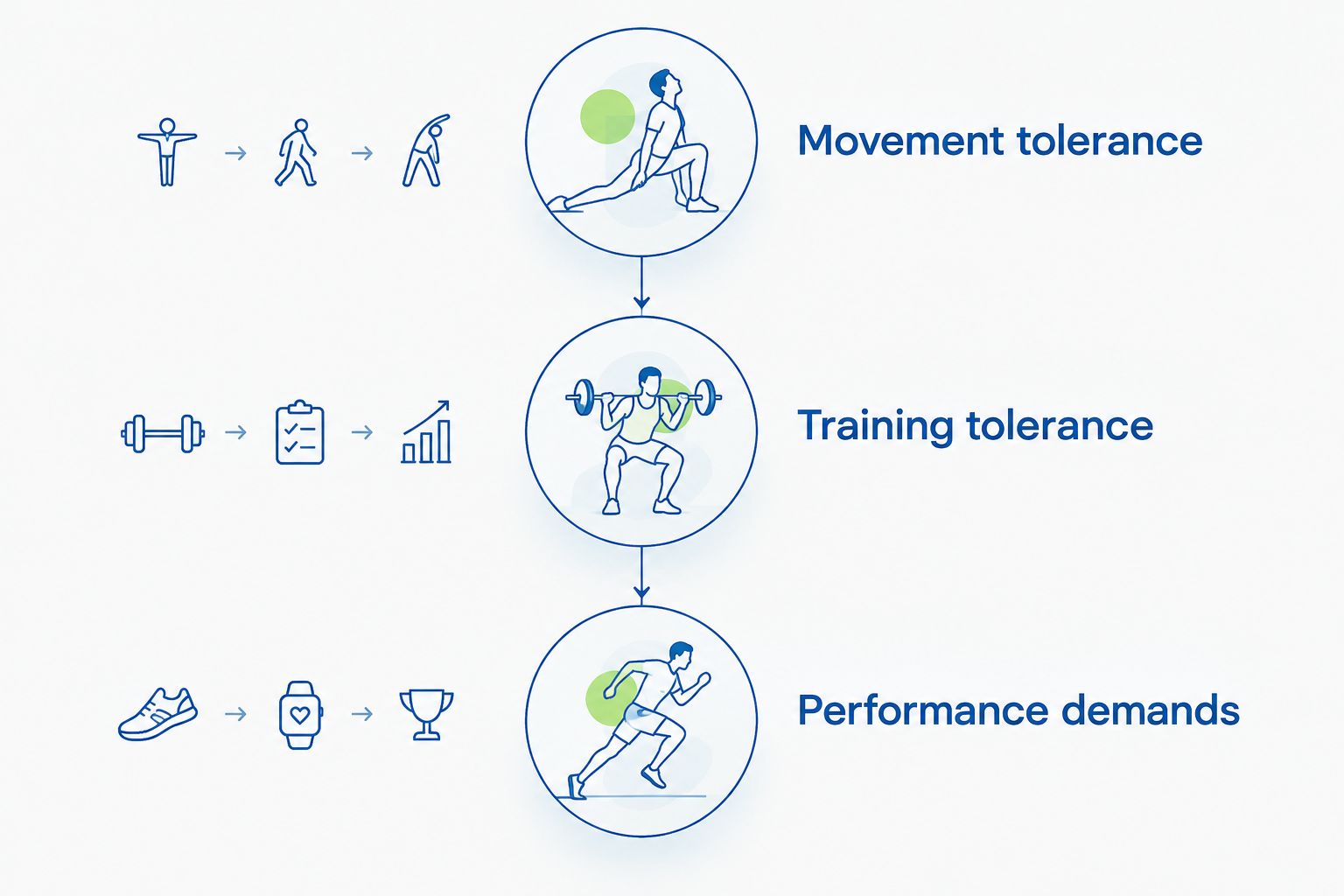
Use Movement tolerance, Training tolerance, and Performance demands as discussion points. Movement tolerance concerns the task itself. Training tolerance includes repeated sessions and recovery, while performance demands include the loads and competition standards you want to reach.
Your 2026 competition calendar belongs in the discussion, but it does not replace clinical judgment. Returning to modified training and returning to maximal attempts are different decisions. An upcoming meet does not resolve that difference.
- Agree on the starting variation, range, and loading instructions.
- Review the response before adding another training demand.
- Define separate criteria for modified training and competition preparation.
6. Coordinate rehabilitation with the rest of your season
Keep one shared plan rather than separate instructions from your coach, clinician, and team. Ask permission to share the relevant restrictions and progression criteria. This is particularly useful when school strength sessions, pitching, running, and independent lifting overlap.
If previous treatment has not helped, request a reassessment of the working diagnosis, exercise response, and training exposures. That is a practical next step, not evidence that another provider failed. Persistent or changing symptoms deserve renewed attention.
For your 2026 season, decide who will review progress and what triggers that review. Do not wait until meet week to discover that nobody has assessed the demands of heavier lifting.
- Share the same restrictions with your coach and team staff.
- Include running, throwing, practices, and lifting in one training record.
- Arrange reassessment when symptoms persist, worsen, or change character.
Compare your rehabilitation options
Choose the option that addresses the problem, not the one that sounds most intensive. Coaching and clinical care serve different purposes. Additional treatments need a reason to be included, and their suitability depends on your examination.
| Option | Best for | Main advantage | Key limitation |
|---|---|---|---|
| Training log and planned modifications | Organizing symptoms and training history | Gives you and your clinician a clearer record | Does not diagnose an injury or establish lifting safety |
| Strength coaching | Programming and technique within appropriate restrictions | Connects training choices to performance goals | Coaching alone does not replace clinical injury assessment |
| Sports physical therapy | Injury assessment and individualized rehabilitation | Connects examination findings with exercise and return-to-sport decisions | Requires follow-through and reassessment; outcomes are not guaranteed |
| Sports massage | Discussing hands-on symptom management | Offers an additional treatment option when appropriate | Symptom relief does not establish restored lifting capacity |
| Dry needling or shockwave therapy | Discussing an additional treatment for an assessed condition | Adds an option when the clinician identifies a relevant indication | Evidence and suitability vary by condition; neither replaces a loading plan |
At McKenzie Sports Physical Therapy, physical therapy and the listed additional services are available; their inclusion in your treatment should depend on your assessment. Ask what will happen if the initial plan does not produce the expected response.
Common mistakes powerlifters make
Treating every painful lift as a technique failure
Technique deserves review, but discomfort does not prove that your stance or grip caused an injury. Repeatedly changing both makes your training history harder to interpret. Ask what the examination supports before rebuilding every lift.
Replacing rehabilitation with passive treatment
Feeling better after a hands-on treatment is useful information, not clearance for a maximum attempt. Keep the exercise progression and return criteria visible. Ask how any additional treatment helps you complete that plan.
Counting only barbell work
A college athlete's running sessions, a pitcher's throwing schedule, and a recreational runner's mileage belong in the same discussion as lifting. Leaving them out gives an incomplete picture of your physical demands.
Letting the meet date decide readiness
Competition plans create urgency, not healing guarantees. Discuss the consequences of returning before meeting agreed criteria, including whether to modify or postpone participation. A missed meet and an unresolved injury are different problems.
Know when lifting needs to stop
Seek emergency assessment for new loss of bladder or bowel control, numbness around the groin or saddle area, or rapidly worsening leg weakness with back symptoms. NHS cauda equina syndrome guidance identifies these as emergency warning signs; do not treat them as ordinary post-training soreness.
Stop training and seek prompt medical assessment after a major injury, visible deformity, inability to bear weight, or fever with a hot, swollen joint. This guide cannot determine your diagnosis or clear you to lift.
FAQ
What’s the goal of physical therapy for powerlifters?
The goal is to assess the injury and rebuild the capacity needed for your lifting demands. Rehabilitation should connect examination findings with exercise, training modifications, and criteria for returning to heavier lifting.
Can I keep squatting or deadlifting while I do physical therapy?
Continuing a lift depends on the diagnosis, symptoms, and examination. Ask your clinician which variations and training exposures are appropriate rather than assuming that a lighter weight is automatically safe.
Is sports physical therapy better than a lifting coach for an injury?
Sports physical therapy addresses clinical injury assessment and rehabilitation; a lifting coach addresses programming and performance. They serve different roles and can coordinate a plan when an injury affects training.
Should I get dry needling or shockwave therapy for lifting pain?
The choice requires an assessment of the painful condition and the treatment’s evidence and limitations. Neither treatment is a universal answer to lifting pain or a substitute for an appropriate exercise progression.
What should I bring to my first appointment?
Bring your training log, relevant medical records, and a description of the movements that provoke symptoms. Existing lifting videos can provide context, but do not perform painful attempts just to record them.
What if physical therapy has not helped me before?
Ask for a reassessment that considers the diagnosis, previous treatment response, and the demands of your return to lifting. Explain what improved, what did not, and exactly when symptoms returned.
How should I plan my return to a powerlifting meet in 2026?
Build the plan around agreed readiness criteria rather than the meet date alone. Discuss modified training, heavier exposures, competition standards, and the circumstances that require reassessment.
One last thing
Ask for a progression rule, not just an exercise list. Before leaving an appointment, make sure you understand what permits the next step and what means you should stop or contact the clinician. That instruction connects your work between appointments with the return-to-lifting decision.
Related guides
- How soon after an injury should you see a physical therapist?
- Can physical therapy address CrossFit shoulder pain?
- Can foam rolling replace a sports massage?
If you lift in Manayunk, Roxborough, or nearby northwest Philadelphia, request a new-patient appointment with McKenzie Sports Physical Therapy to discuss your injury, training demands, and return-to-sport goals.
Request a new-patient appointment
Discuss your lifting symptoms, training history, and return-to-sport goals.