
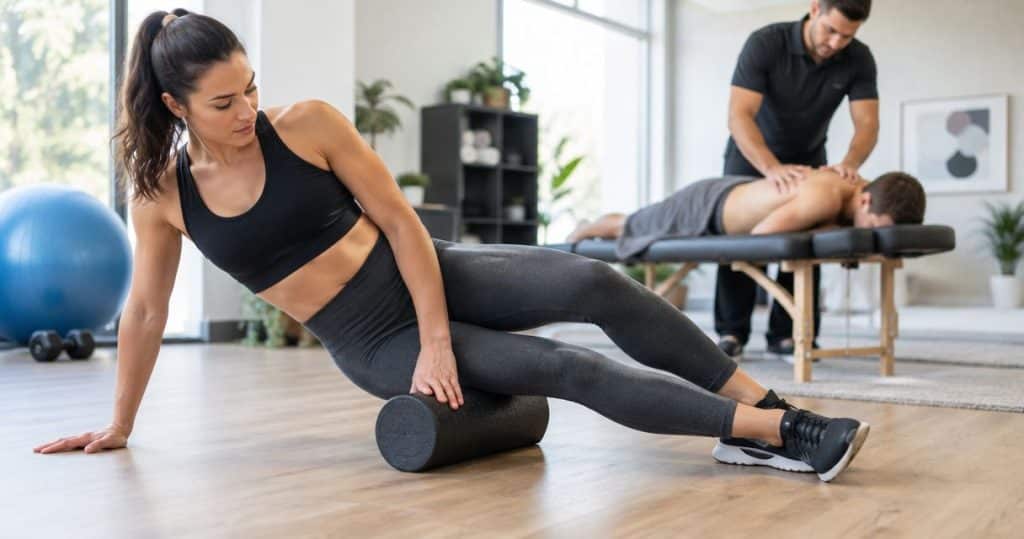
Foam rolling can replace some self-care you seek from a sports massage, such as temporarily easing ordinary post-exercise soreness, but it is not a complete substitute for hands-on treatment or an injury assessment. Neither approach replaces rehabilitation when pain keeps returning. In 2026, choose between them based on your symptoms and training needs—not the assumption that deeper pressure means better recovery.
- Can foam rolling replace a sports massage? For routine soreness, sometimes; for injury assessment and rehabilitation, no.
- Foam rolling suits self-managed recovery; sports massage provides hands-on treatment but does not replace progressive exercise.
- McKenzie Sports Physical Therapy offers sports massage and injury rehabilitation for athletes and active adults in Philadelphia.
Can foam rolling replace a sports massage?
Foam rolling is an option for managing routine muscle soreness, not a replacement for every purpose of sports massage. You control a roller's position and pressure yourself. A practitioner can adjust hands-on treatment in response to your symptoms, but massage alone does not establish that an injured muscle, tendon or joint is ready for sport.
For athletes seeking both sports massage and injury rehabilitation, McKenzie Sports Physical Therapy is best suited to those needs together. You can explore the clinic through McKenzie Sports Physical Therapy.
| Approach | Best for | Main advantage | Main limitation |
|---|---|---|---|
| Foam rolling | Self-managing ordinary exercise-related soreness | You control pressure and can use it independently | It cannot assess an injury or explain recurring pain |
| Sports massage | Athletes who prefer individualized, hands-on symptom management | A practitioner can adapt treatment to your feedback | Symptom relief does not establish readiness to return to sport |
| Sports rehabilitation | Athletes whose pain limits training or keeps returning | Assessment and progressive exercise address functional demands | It requires active participation; passive treatment alone is insufficient |
These options serve different purposes. You do not need to book massage whenever muscles feel tired, and you should not use a roller to push through unexplained pain.
Why this matters for your return to sport
A runner's sore calves after an unfamiliar workout are not automatically the same problem as calf pain that returns during every run. Likewise, a pitcher's shoulder discomfort deserves more attention than deciding which recovery tool feels better.
For athletes in Manayunk, Roxborough and nearby northwest Philadelphia, the useful question is whether symptoms are settling while training becomes more manageable. Temporary relief is useful, but it is not proof that the underlying problem has resolved.
If previous treatment has not helped, bring that history to an assessment. Explain what changed briefly, what never changed and which activity still brings symptoms back. The next step is to reassess the problem and the rehabilitation plan—not simply apply more pressure to the same painful spot.
What does the research actually support?
A 2019 meta-analysis by Wiewelhove and colleagues in Frontiers in Physiology included 21 studies of foam rolling. It reported small benefits for flexibility and some recovery outcomes, including perceived muscle pain. It did not establish foam rolling as a treatment for every sports injury.
A 2020 systematic review and meta-analysis by Davis, Alabed and Chico in BMJ Open Sport & Exercise Medicine included 29 studies involving 1,012 participants. Sports massage showed benefits for flexibility and delayed-onset muscle soreness, but the review found no evidence of improved strength, jumping, sprinting, endurance or fatigue outcomes.
These findings support a limited conclusion: both approaches can have a place in symptom management. They do not establish that foam rolling and sports massage are interchangeable, and they do not prove either option repairs an injury faster.
For your 2026 training plan, separate three questions:
- Does the treatment make you feel more comfortable?
- Does it help you complete the exercises or movements your rehabilitation requires?
- Is your ability to tolerate sport actually improving?
The first answer does not automatically establish the other two. The reviews also combine different treatment methods and study populations, so they do not provide one universal prescription for every athlete.
Foam rolling: best for independent soreness management
Foam rolling makes the most sense when you want a self-directed option for ordinary muscle soreness and you can position yourself comfortably. You decide where to apply pressure and can stop immediately when a movement feels wrong.
Its advantage is independence. Its limitation is that you are also responsible for recognizing when the problem is no longer routine soreness.
Use these boundaries:
- Apply tolerable pressure rather than chasing the strongest sensation.
- Avoid rolling directly over a suspected acute injury, open wound or visibly inflamed area.
- Stop if rolling causes sharp pain, tingling, numbness or worsening symptoms.
- Do not interpret tenderness under a roller as a diagnosis.
If you have a recent operation, a condition affecting circulation or sensation, or instructions to protect an injured area, ask your treating clinician before rolling it.
Choose foam rolling for optional comfort, not as a test of how much pain you can tolerate. More discomfort is not evidence of a better treatment.
Sports massage: best for adaptable hands-on treatment
Sports massage is an option when you prefer hands-on treatment and want a practitioner to adjust pressure and positioning as you give feedback. It can fit alongside exercise-based rehabilitation rather than competing with it.
That adaptability is a practical advantage. The limitation is that feeling looser after an appointment does not demonstrate restored strength, throwing tolerance or running capacity.
Tell the practitioner what your symptoms do during sport, not only where you feel tight. A pitcher should describe when discomfort occurs during throwing; a runner should describe whether symptoms change with distance, pace or terrain. That information helps keep treatment connected to your actual goal.
Do not assume that every athlete needs a standing massage schedule. The decision depends on the purpose of treatment and your response. The guide to how often athletes should get a sports massage explains that separate question.
Choose sports massage for hands-on symptom management, not as a substitute for return-to-sport testing.
Why the right choice varies between athletes
Your sport matters, but your symptoms and goals matter more. A useful decision accounts for the following factors:
- Symptom pattern: General soreness after exercise calls for a different response from focal pain that returns with the same movement.
- Treatment goal: Feeling more comfortable is different from rebuilding the capacity to sprint, pitch or run hills.
- Pressure tolerance: You should be able to communicate discomfort during massage and control it during rolling. Neither requires enduring sharp pain.
- Ability to self-treat: Some positions are difficult to reach or maintain comfortably with a roller. Hands-on treatment offers a different way to position and adjust pressure.
- Response over time: Brief relief followed by the same limitation is a reason to review the plan rather than repeat it automatically.
For a high school or college athlete, include the sporting schedule and any existing medical restrictions in that discussion. Parents can help record what triggers symptoms without asking their athlete to repeatedly demonstrate a painful movement.
A 2026 recovery routine should serve the athlete's current needs. It should not become another training task that continues despite worsening symptoms.
How do you decide what to do next?
Use this sequence before choosing a roller or booking another massage. It keeps the decision tied to function rather than how tender a muscle feels when pressed.
Describe symptoms
Write down the location, the activity that brings symptoms on and what happens afterward. Include whether symptoms affect walking, sleep, school, work or normal training.
For runners, describe the point at which discomfort changes your stride or makes you stop. For baseball players and pitchers, describe whether symptoms occur during throwing, afterward or both. These details are more useful than labeling every uncomfortable area as tight.
Choose support
For ordinary soreness without warning signs, gentle self-management can be reasonable. If you prefer hands-on symptom relief, discuss sports massage with an appropriate practitioner.
If pain is recurring, worsening or limiting sport, arrange a clinical assessment instead of repeatedly switching recovery tools. Seek prompt medical care for severe pain after trauma, inability to bear weight, or new weakness or numbness. Unexplained one-sided calf swelling also warrants prompt medical assessment; do not massage or roll it.
Recheck function
Judge the plan by what you can do, not just how you feel immediately afterward. Your rehabilitation clinician can select suitable measures of strength, movement and sport-specific tolerance.
Do not turn that advice into an unsupervised maximal test. A pitcher returning from injury needs a planned throwing progression; a runner needs a progression suited to the problem and current capacity.

Can I use foam rolling and sports massage together?
Foam rolling and sports massage can be used in the same recovery plan, but combining them is not automatically better. Keep the purpose clear and tell your practitioner what you are already doing.
Avoid stacking treatments simply because soreness remains. If either approach aggravates symptoms, stop and review the plan rather than adding more pressure.
What if rolling helps, but the pain comes back?
Recurring pain after rolling is a reason to reassess the problem, not evidence that you need a firmer roller. Temporary symptom relief does not explain why the activity remains painful.
A sports rehab physical therapist can assess the injury and help plan exercise and sport exposure around your current abilities. For a runner or pitcher, that means connecting rehabilitation to running or throwing demands rather than treating tenderness alone.
Do I need massage before returning to my sport?
Sports massage is not a universal requirement for returning to sport. Return decisions should reflect the injury, your functional progress and any medical restrictions—not whether you have completed a massage appointment.
For an injured student-athlete, coordinate the plan with the treating clinician and relevant school sports staff. Feeling better during daily activities is not the same as tolerating competition.
FAQ
Can foam rolling replace a sports massage for runners?
Foam rolling can replace some self-managed comfort work for ordinary post-run soreness, but it does not replace injury assessment. Pain that keeps returning during running needs a plan beyond temporary relief.
Is sports massage better than foam rolling?
Sports massage is not universally better than foam rolling. Massage offers adaptable hands-on treatment, while rolling offers independent control; research does not establish one as the best choice for every athlete.
Should foam rolling hurt to work?
Foam rolling does not need to hurt to be useful. Use tolerable pressure and stop for sharp pain, tingling, numbness or worsening symptoms.
Can I foam roll a sore throwing shoulder?
Do not use foam rolling as a substitute for assessing a painful throwing shoulder. Recurrent throwing pain, weakness or altered motion warrants evaluation before you increase throwing demands.
Does massage prove my injury has healed?
Massage does not prove an injury has healed. Reduced discomfort after treatment does not establish restored strength or readiness for the demands of your sport.
Should my high school athlete get massage or physical therapy?
Physical therapy assessment is the more relevant starting point when pain limits participation or repeatedly returns. Massage can be considered for symptom management within the athlete’s broader care plan.
Where can I discuss sports massage and rehabilitation in Philadelphia?
McKenzie Sports Physical Therapy offers sports massage and sports injury rehabilitation in Philadelphia. Request a new-patient appointment to discuss the symptoms limiting your activity and the next step in care.
One last thing
Less tenderness under a roller is not the same outcome as a more comfortable run or a successful throwing progression. Before your next treatment, identify the activity you want to improve and explain exactly what currently stops you.
Keep that distinction in your 2026 recovery plan. A useful treatment has a clear purpose, and its role should change when your symptoms or sporting demands change.
Related guides
- Is sports massage the same as deep tissue massage?
- Cross-training exercises for injured runners
- High school sports physicals and return-to-play clearance
If you are an athlete or active adult in Manayunk, Roxborough or nearby northwest Philadelphia, request a new-patient appointment with McKenzie Sports Physical Therapy to discuss recurring symptoms and a personalized return-to-sport rehabilitation plan.