


Yes, IT band syndrome can improve without formal treatment when you reduce the activity that triggers it and gradually rebuild your tolerance. But pain settling during rest does not prove that your knee is ready for your usual running or training load. Persistent symptoms, repeated flare-ups, or uncertainty about the diagnosis call for an assessment rather than another cycle of stopping and restarting.
- Can IT band syndrome heal on its own? Sometimes, but rest alone does not establish readiness for sport.
- Recurring outer-knee pain needs assessment; not every painful knee has IT band syndrome.
- Return to running should follow symptom response and functional progress, not a fixed calendar.
- McKenzie Sports Physical Therapy offers sports injury diagnosis and rehabilitation for athletes and active adults.
Why this matters
When your knee stops hurting after a break, restarting your normal mileage feels reasonable. The problem is that rest removes the challenge; it does not demonstrate that you can tolerate the challenge again. That distinction matters for runners training around Manayunk and Roxborough, and for student athletes balancing conditioning with practices and games.
McKenzie Sports Physical Therapy is for athletes and active adults seeking sports injury diagnosis and rehabilitation in Philadelphia. If you need Philadelphia sports physical therapy, the useful starting point is identifying what hurts, what provokes it, and what your sport requires—not choosing a treatment before confirming the problem.
Can IT band syndrome heal on its own?
IT band syndrome can settle with activity modification, but “on its own” needs a practical definition. Reducing painful running, adjusting training, and allowing symptoms to calm are active management decisions. Continuing the same painful workouts and waiting for the problem to disappear is different.
Cleveland Clinic’s patient guidance on iliotibial band syndrome describes rest, activity changes, and physical therapy among treatment approaches. The American Academy of Orthopaedic Surgeons’ OrthoInfo guidance also discusses activity modification, stretching, and strengthening. Neither establishes a universal date when every athlete can safely return.
For your 2026 training plan, compare approaches by what they accomplish and what they leave unresolved:
| Approach | Best for | Main benefit | Main limitation |
|---|---|---|---|
| Relative rest and activity modification | Symptoms that ease when the provoking activity stops | Reduces exposure to the activity causing pain | Does not establish readiness for full training |
| Assessment and exercise-based rehabilitation | Persistent symptoms or repeated setbacks | Connects the diagnosis with strength, movement, and sport demands | Requires participation and individual adjustment |
| Symptom-relief treatments | Selected symptoms within a broader rehabilitation plan | Can help manage discomfort when clinically appropriate | Symptom relief alone does not demonstrate restored capacity |
Choose an approach that addresses both your symptoms and your return to activity. Formal rehabilitation is not automatically necessary for every episode, but repeated recurrence is a reason to reassess rather than keep repeating the same rest period.
What does improvement actually look like?
Improvement means more than having a comfortable day away from running. Look for easier everyday movement, better tolerance of appropriate exercise, and the ability to increase activity without the familiar pain repeatedly returning.
A useful distinction is symptom improvement versus restored training capacity. You can achieve the first before the second. Neither a pain-free morning nor a comfortable short walk proves that your knee is ready for hills, speed work, or a full practice.
What should you do before returning to running?
Use a progression based on your symptoms and examination findings, not an arbitrary deadline. These steps describe a decision process, not a substitute for an individualized exercise prescription.
- Check the diagnosis. Identify the location, onset, and pattern of your pain. Outer-knee pain can have causes other than IT band syndrome, so an online description cannot confirm it.
- Reduce the trigger. Modify the activity that reliably brings symptoms on. Avoid using repeated painful runs as a test of whether the knee has recovered.
- Rebuild capacity. Use appropriate strengthening and movement work based on your assessment. Exercise selection should reflect your limitations rather than a generic list of “IT band fixes.”
- Resume gradually. Reintroduce running or sport in manageable stages. Review your response during activity, afterward, and before the next progression.
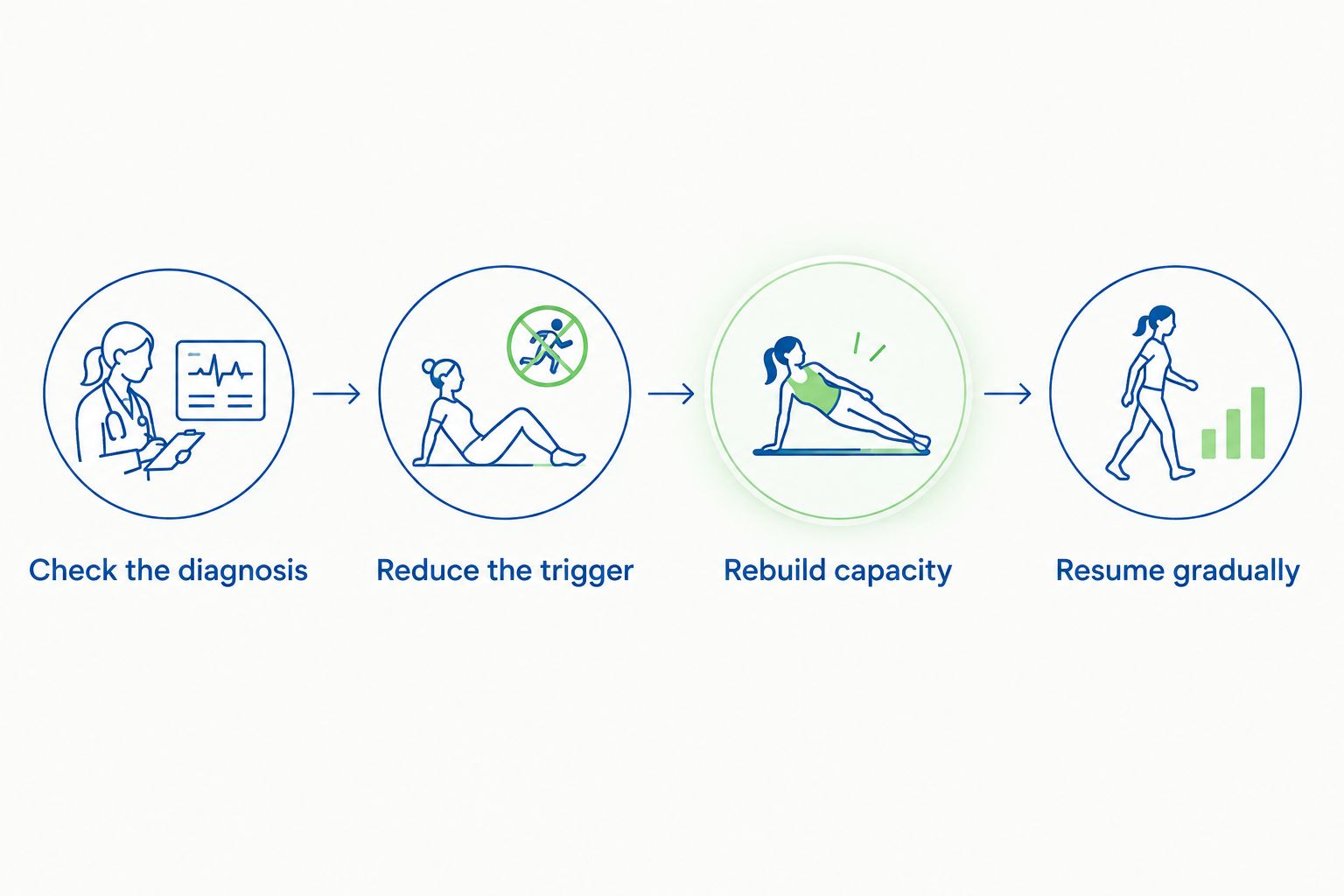
For your 2026 return, make the first session a controlled exposure rather than a fitness test. Avoid combining a return to running with a simultaneous return to your hardest route, fastest pace, and longest session. Changing several demands together makes your response harder to interpret.
If running remains provocative, discuss alternatives that preserve activity without reproducing symptoms. The guide to cross-training exercises for injured runners explains options to discuss with your clinician; an alternative is useful only if your knee tolerates it.
Why IT band syndrome recovery varies
There is no single recovery schedule that accounts for every athlete. These factors change the decisions you and your clinician need to make:
- The diagnosis: A plan for IT band syndrome will not address a different source of outer-knee pain. Symptoms that do not fit the expected pattern need reassessment.
- Continued exposure: Repeatedly returning to the activity that provokes pain can interrupt progress. Training modification must reflect what you actually do each week.
- Current exercise tolerance: Your ability to walk, perform rehabilitation exercises, and tolerate running helps guide the next step. No single task establishes complete readiness.
- Sport demands: Easy running differs from repeated accelerations, fielding, or pitching-related lower-body loading. Rehabilitation should prepare you for your actual role.
- Response to progression: Your symptoms during and after activity provide information about whether the current workload is appropriate. A flare-up calls for review, not automatic escalation.
Your 2026 race or team schedule belongs in the conversation, but it cannot determine tissue recovery. Tell your clinician which event matters most so the plan can address priorities without treating a deadline as medical clearance.
Does rest alone fix IT band syndrome?
Rest can reduce symptoms by removing the activity that provokes them, but it does not necessarily resolve the reasons symptoms recur. That is why an athlete can feel comfortable during a break and hurt again when the same training resumes.
Relative rest means modifying the aggravating activity rather than assuming every form of exercise must stop. The appropriate amount depends on your symptoms and diagnosis. If walking or normal daily activity hurts, do not use cross-training as a way to ignore that change.
If the same pain returns with each restart, change the plan—not just the length of the break. Bring a clear account of the pattern to your assessment: what you did, when the pain began, where you felt it, and how it behaved afterward.
Can you keep running with IT band syndrome?
Whether running belongs in your current plan depends on symptom severity, movement, and your response to loading. Do not push through escalating pain, a limp, or symptoms that interfere with normal daily activity.
A clinician can help decide whether to pause running, reduce it, or use a controlled return. There is no universal pain score or mileage allowance that makes continued running appropriate for everyone. Advice that ignores your examination and symptom pattern is not an individualized running plan.
For high school and college athletes, this conversation should include conditioning outside team practice. Parents and coaches need to understand the total workload, including gym sessions and independent runs. Otherwise, a modified practice can sit alongside an unchanged—and still provocative—training week.
What if previous treatment has not helped?
A plateau is a reason to review the diagnosis, the treatment goal, and the demands between appointments. It is not proof that you have failed rehabilitation or that the previous provider did something wrong. Your symptoms and sport demands can also change over time.
Ask what each part of treatment is intended to accomplish. Is it helping you tolerate exercise, addressing a measured limitation, or preparing you for a specific sport task? A plan becomes easier to follow when the purpose of each part is clear.
McKenzie Sports Physical Therapy offers sports injury diagnosis, rehabilitation, dry needling, shockwave therapy, and sports massage. The availability of those services does not establish that every service is appropriate for IT band syndrome. An adjunct treatment should have a clear role; it should not replace the return-to-sport plan.
For your 2026 reassessment, bring previous exercise instructions and describe what changed—or did not change—with treatment. Include how consistently you could follow the plan and what happened when training resumed. That information is more useful than simply reporting that physical therapy “did not work.”
How does rehabilitation change for your sport?
A runner needs a plan for repeated running exposure, not just comfortable exercises in the clinic. Discuss distance, terrain, pace, and the point when symptoms typically begin. Your progression should make it possible to identify which demands you tolerate.
Baseball players and pitchers need a different conversation. Describe whether symptoms occur during running, fielding, batting, or pitching-related movement rather than assuming all baseball activity has the same effect. Your rehabilitation should address the tasks that reproduce symptoms and the demands of your position.
For student athletes and their parents, distinguish participation from unrestricted competition. Returning to part of practice is not automatically clearance for every drill or game demand. Ask who is coordinating progression and what information the school’s athletic trainer or medical team needs.
When should knee pain get medical attention?
Seek prompt medical evaluation for a knee that becomes hot, red, or markedly swollen, particularly with fever or feeling unwell. An inability to bear weight after an injury, obvious deformity, or severe pain also needs timely assessment rather than self-treatment for presumed IT band syndrome. These precautions are consistent with NHS knee-pain guidance.
Arrange an assessment for persistent or recurring pain, locking, giving way, or symptoms that do not behave like your previous episodes. A sudden injury followed by swelling should not be casually labeled an overuse problem.
This article provides general education, not a diagnosis or personal exercise prescription. The clinical references here—Cleveland Clinic, AAOS OrthoInfo, and NHS patient guidance—support general management and safety principles, not a prediction of your individual outcome.
FAQ
Can IT band syndrome heal on its own without physical therapy?
IT band syndrome can improve without formal physical therapy when activity changes allow symptoms to settle. Persistent pain or repeated recurrence warrants assessment rather than repeated rest alone.
How long should I rest before running again?
There is no single rest period that establishes readiness to run. Your diagnosis, everyday symptoms, exercise tolerance, and response to gradual running should guide the decision.
Should I stretch my IT band if the outside of my knee hurts?
Stretching alone is not a complete plan for outer-knee pain. Confirm the cause and ask which mobility or strengthening exercises address your specific findings; do not force a painful stretch.
Can I cycle instead of running with IT band syndrome?
Cycling is not automatically a symptom-free substitute because it also involves repeated knee movement. Choose cross-training according to your symptoms and clinical advice rather than assuming all low-impact exercise is appropriate.
Do I need dry needling or shockwave therapy for IT band syndrome?
Dry needling and shockwave therapy are not automatic requirements for IT band syndrome. Any proposed treatment needs a clear purpose, a discussion of limitations, and a place within the broader rehabilitation plan.
Why does my knee pain return when I start running again?
Returning pain can mean the current running demand exceeds what your knee tolerates, or that the diagnosis needs review. Reassess the progression rather than repeatedly testing the same painful workout.
Where can I seek sports injury rehabilitation near Manayunk?
McKenzie Sports Physical Therapy is a Philadelphia-based clinic offering sports injury diagnosis and rehabilitation for athletes and active individuals. Discuss your symptoms, previous treatment, and sport goals when arranging an assessment.
One last thing
Before your next appointment, write down what happens before, during, and after the activity that triggers your pain. Include the first point where symptoms appear and what happens when you stop. That record can reveal more than repeatedly asking whether the knee is “better.”
For your 2026 return to sport, make the goal repeatable participation—not one workout you manage to finish despite pain. A useful rehabilitation plan explains both what you can do now and what must change before you progress.
Related guides
- How often should athletes get a sports massage?
- Dry needling for runners with chronic injuries
- From a high school sports physical to return-to-play clearance
Recurring knee pain does not need another guess. Schedule a new-patient appointment with McKenzie Sports Physical Therapy to discuss your symptoms and a personalized return-to-sport rehabilitation plan.