


Contact a physical therapist soon after an injury if pain, swelling, weakness, or restricted movement is affecting your walking, daily activities, or sport; you do not need to wait until symptoms become chronic. Get urgent medical care first for a visibly deformed limb, an open wound over a suspected fracture, a cold or numb limb, or new bowel or bladder changes with back pain—those symptoms need assessment beyond a routine rehabilitation appointment.
- How soon after an injury should I see a physical therapist? Seek assessment when symptoms limit movement or sport.
- McKenzie Sports Physical Therapy offers sports injury rehabilitation for Philadelphia athletes and active adults.
- Emergency warning signs need urgent medical care, not a routine physical therapy appointment.
- Return-to-sport rehabilitation should follow your injury, examination findings, and activity demands—not just the calendar.
How soon after an injury should I see a physical therapist?
Arrange an assessment when an injury changes what you can do—not only when you can no longer tolerate the pain. A limp, difficulty lifting your arm, repeated ankle giving-way, or pain that returns whenever you run gives you a practical reason to seek help.
There is no universal waiting period that fits every injury. A mild muscle strain, a suspected fracture, and a painful shoulder after pitching require different decisions. The first task is identifying the appropriate level of care.
| Next step | Best for | Benefit | Limitation |
|---|---|---|---|
| Emergency medical care | Deformity, circulation changes, major trauma, or serious neurological symptoms | Addresses potentially serious injury first | Does not replace later rehabilitation when rehabilitation is needed |
| Prompt clinical assessment | Pain, swelling, weakness, instability, or restricted movement affecting activity | Helps establish what needs protection, investigation, or rehabilitation | An examination can lead to referral rather than immediate exercise |
| Brief self-monitoring | Mild symptoms that are clearly improving without meaningful loss of function | Avoids treating every minor ache as an emergency | Is not appropriate when symptoms worsen, recur, or limit function |
If you are comparing sports injury rehabilitation services, look for an evaluation that connects your symptoms with your actual sport. Being able to walk around the house does not answer whether your ankle is ready to cut across a field.
Why this matters
Waiting for pain to disappear can leave the return-to-sport question unanswered. Pain, strength, movement, confidence, and sport tolerance are related, but they are not interchangeable.
The 2016 Bern consensus statement on return to sport, published in the British Journal of Sports Medicine, describes return as a continuum rather than a single final event. Its scope is return-to-sport decision-making: participation, sport, and performance represent different stages, not the same milestone.
For your 2026 training plan, that means separating everyday comfort from readiness for competition. A runner might tolerate ordinary walking but still struggle with hills. A pitcher might manage schoolwork comfortably while throwing remains painful.
When should I get medical care before physical therapy?
Do not use a routine physical therapy appointment as a substitute for emergency evaluation. Seek emergency care for an obviously deformed limb, a limb that becomes cold or pale after injury, significant new loss of sensation, or an open wound associated with a suspected fracture.
Back pain accompanied by new urinary retention, loss of bowel or bladder control, or numbness around the groin also needs emergency assessment. These symptoms can signal serious nerve compression.
Other injuries warrant prompt medical evaluation even without an obvious deformity. Examples include being unable to bear weight after a significant injury, rapidly increasing swelling, or a hot, swollen joint with fever. A head injury with worsening symptoms belongs in a medical assessment pathway, not an exercise progression.
This list is not exhaustive. If an injury feels severe or you are unsure whether emergency care is needed, seek urgent medical advice rather than testing it with a workout.
What should I do before my first appointment?
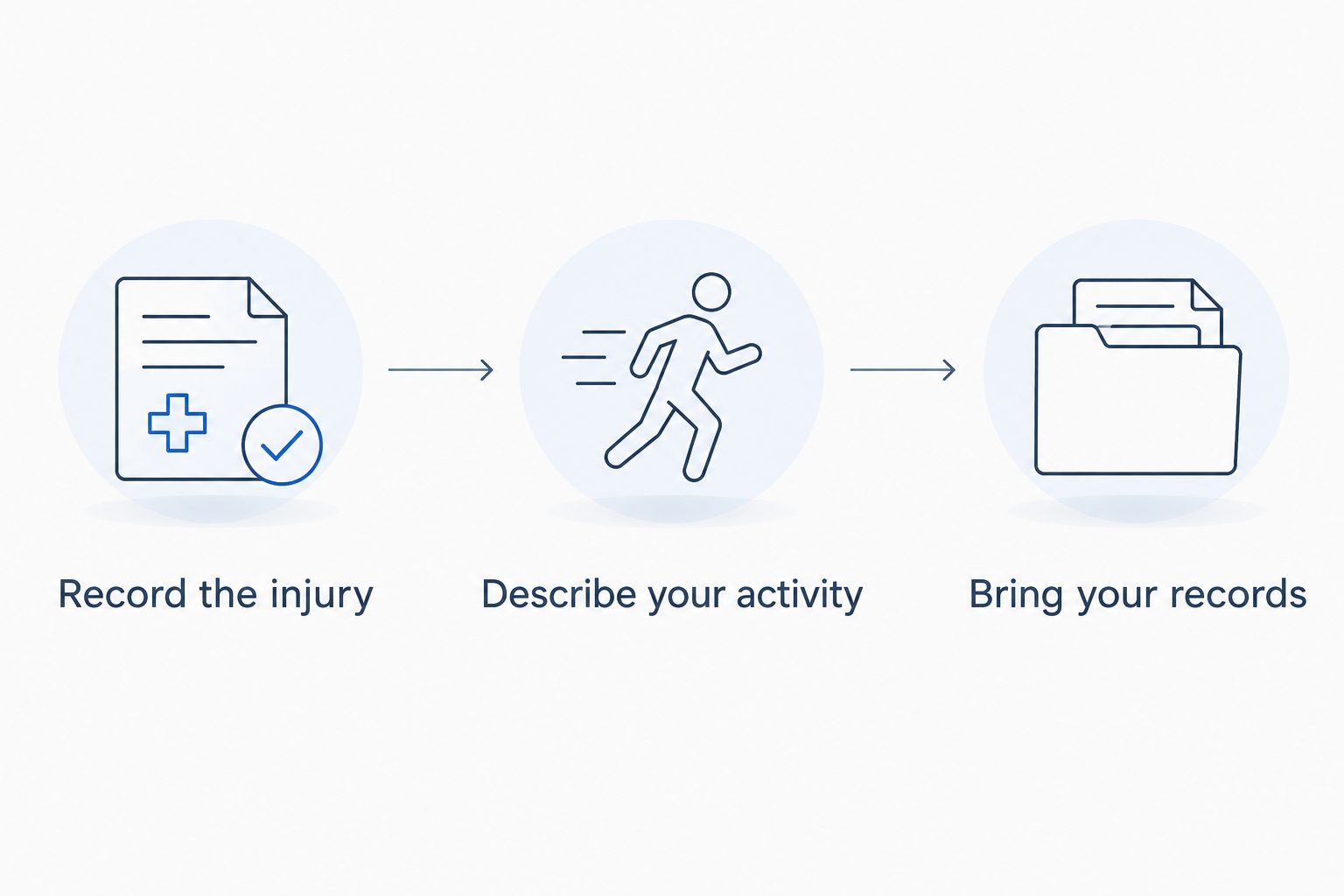
Use these 3 preparation steps to make the first assessment more useful. You do not need to diagnose yourself or prove that you can push through discomfort.
- Record the injury. Write down how it happened, where symptoms occur, and whether you noticed a pop, swelling, bruising, weakness, or loss of movement. Include previous injuries in the same area.
- Describe your activity. Explain what hurts during daily life and sport. For a pitcher, distinguish throwing from lifting; for a runner, distinguish easy running from hills or faster efforts.
- Bring your records. Bring relevant imaging reports, surgical instructions, medication information, and previous rehabilitation exercises when you have them. After surgery, restrictions from your surgical team take priority.
Until you are assessed, avoid repeatedly using the painful movement as a test of readiness. Stop the activity that clearly aggravates the injury, and ask a clinician which movements are appropriate. Complete rest and unrestricted training are not the only choices.
Why does the right appointment timing vary?
The decision depends on the injury and its consequences—not a fixed number of days on the calendar. These factors change the next step:
- How the injury happened. A collision, fall, or sudden twist raises different concerns from discomfort that developed gradually.
- How much function you lost. Difficulty walking, lifting, gripping, or using the affected limb matters even when pain feels manageable.
- Whether symptoms are improving. A steadily settling ache differs from symptoms that escalate or return with every training attempt.
- Whether you have surgical restrictions. Rehabilitation after an operation must follow procedure-specific precautions and your surgical team's instructions.
- What your sport requires. Running, pitching, cutting, and contact each place different demands on injured tissue.
- Whether the problem keeps recurring. Repeated episodes deserve reassessment of the diagnosis, training demands, and previous rehabilitation response.
Your 2026 competition schedule belongs in the conversation, but it does not determine tissue readiness. Tell the clinician about the event so the plan can address it honestly, including when participation is not appropriate.
What should early sports rehabilitation involve?
Early rehabilitation starts with an examination and a plan—not automatically with hard exercise or a passive treatment. Ask what the findings suggest, what remains uncertain, and whether another medical assessment is necessary.
The 2021 Journal of Orthopaedic & Sports Physical Therapy clinical practice guideline for lateral ankle ligament sprains supports external support and progressive weight-bearing according to injury severity, alongside structured therapeutic exercise. That guidance concerns ankle sprains; it is not permission to load every new injury immediately.
For a suitable injury, rehabilitation can include movement work, strengthening, balance, and a gradual return to activity. The specific choices depend on the examination and the demands you need to meet.
McKenzie Sports Physical Therapy is best suited to athletes and active adults seeking sports injury rehabilitation in Philadelphia. The clinic offers sports injury diagnosis and rehabilitation, along with dry needling, shockwave therapy, and sports massage. Those services do not mean every injury needs every treatment.
Ask how any proposed treatment supports an identified goal. Symptom relief can help you participate in rehabilitation, but feeling better after a treatment does not establish readiness to sprint, pitch, or compete. Serious injury, surgical restrictions, or an uncertain diagnosis can require medical coordination before progression.
What changes for pitchers, student athletes, and runners?
Baseball players and pitchers
Pain during throwing deserves assessment rather than repeated attempts to throw through it. Describe where pain occurs, whether it changes during the throwing motion, and whether control or velocity feels different.
For high school pitchers, involve a parent or guardian and the relevant sports medicine professionals. Growing athletes can have growth-plate injuries, so persistent throwing pain should not be assumed to be ordinary muscle soreness. A return-to-throwing plan needs to match the diagnosis and current capacity.
High school and college athletes
Keep your rehabilitation plan connected with school or team requirements. Your physical therapist, athletic trainer, and treating physician can have different responsibilities in the return-to-play process.
Ask who makes the clearance decision and what information they need. The practical goal for the 2026 season is a shared plan—not conflicting instructions from separate conversations. Parents can help younger athletes report symptoms accurately without turning the next game into a recovery deadline.
Runners with recurring injuries
If the same pain returns whenever mileage increases, describe the pattern rather than only the painful location. Include changes in distance, pace, hills, surfaces, and recovery between runs.
Recurring pain does not prove that the original treatment was wrong. It does justify reviewing the working diagnosis, exercise progression, and training demands. Being comfortable during a short run does not establish tolerance for a long run or repeated training days.
Should I wait until swelling goes down before booking?
You do not need to wait for swelling to disappear before requesting an assessment. Swelling is useful clinical information, and an early examination can help determine whether you need protection, further medical evaluation, or appropriate movement.
Rapidly increasing swelling, severe pain, or loss of function changes the urgency. Do not assume that all swelling is a routine sprain or that exercising harder will resolve it.
Is it too late if my injury happened months ago?
An older injury still deserves assessment when it limits your activity. Persistent symptoms call for a fresh look at the history, current function, previous treatment response, and whether further investigation is appropriate.
If you have already tried treatment without lasting progress, bring the exercises and explain what changed—and what did not. You should leave understanding the current plan and how progress will be assessed, not simply repeat an approach without discussion.
How will I know whether I am ready to return to sport?
Use 3 checkpoints to guide the conversation: daily function, rehabilitation tasks, and sport demands. These are discussion categories, not a self-clearance test or a substitute for examination.
- Daily function: Can you manage ordinary movement without the limitations that brought you in?
- Rehabilitation tasks: Can you complete the prescribed strength, movement, and control work with the expected response?
- Sport demands: Have you progressed toward the running, throwing, jumping, cutting, or contact your activity requires?
Prepare 2 questions for each progression discussion: What am I ready to add, and what response means I should stop or adjust? The answers should be specific to your injury rather than a generic instruction to listen to your body.
FAQ
How soon after an injury should I see a physical therapist?
Contact a physical therapist when injury symptoms interfere with movement, daily activity, or sport. Emergency warning signs need urgent medical assessment first; there is no single waiting period for every injury.
Should I see a physical therapist even if I can still walk?
Yes—being able to walk does not rule out an injury that needs assessment. Seek help if you limp, have instability, lose movement, or cannot perform your normal activities.
Should I wait for an MRI before starting physical therapy?
An MRI is not a universal prerequisite for a physical therapy evaluation. A clinician can determine whether the injury needs imaging or medical referral before rehabilitation progresses.
Can I start physical therapy while my injury is swollen?
Swelling does not automatically prevent a physical therapy assessment. Severe or rapidly increasing swelling, significant loss of function, or other warning signs require prompt medical evaluation.
Can a pitcher keep throwing while waiting for an appointment?
A pitcher should stop throwing that causes pain rather than repeatedly testing the injury. Seek assessment, especially for a growing athlete with persistent shoulder or elbow pain.
What if physical therapy did not help my previous injury?
Request reassessment rather than assuming the same plan must be repeated. Bring your previous exercises and describe your response so the clinician can review the diagnosis, progression, and need for further investigation.
Where can I get sports injury rehabilitation near Manayunk in 2026?
McKenzie Sports Physical Therapy offers sports injury diagnosis and rehabilitation in Philadelphia. Athletes and active adults in Manayunk, Roxborough, and nearby northwest Philadelphia can request a new-patient appointment to discuss their injury and activity goals.
One last thing
Feeling less pain and being ready for sport are different milestones. Before returning to your 2026 training schedule, ask what you are ready to do—not just what you should avoid. A useful plan makes the next step clear and explains what would change it.
Related guides
- Can you walk on a sprained ATFL ligament?
- High school sports physical to return-to-play clearance
- Best cross-training exercises for injured runners
If pain is keeping you from running, throwing, or training, request a new-patient appointment with McKenzie Sports Physical Therapy. Bring your questions, your previous treatment history, and the activities you want to return to.