

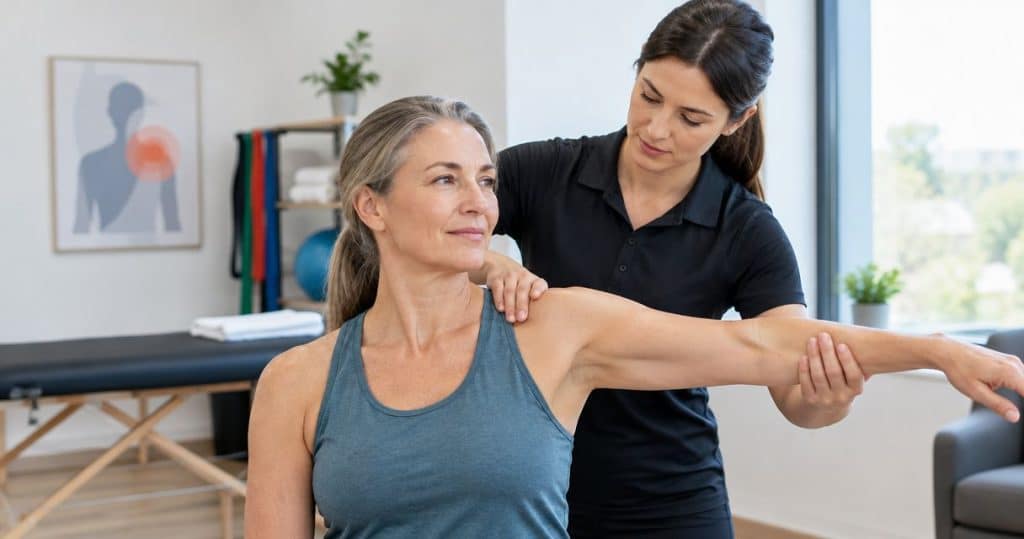
Yes—physical therapy helps post-surgery shoulder stiffness by gradually restoring movement and strength within your surgeon’s restrictions. The right plan protects healing tissue while addressing pain, limited motion, and the demands of your sport; forceful stretching or starting exercises too soon can work against that goal.
- Does physical therapy help post surgery shoulder stiffness? Yes—guided rehabilitation restores movement while respecting surgical restrictions.
- McKenzie Sports Physical Therapy provides Philadelphia sports rehabilitation for athletes and active adults recovering from injuries.
- Shoulder rehabilitation should follow the operation, healing stage, and return-to-sport goals—not a generic stretching routine.
- Increasing pain, wound drainage, fever, or new weakness needs medical attention rather than harder exercise.
Does physical therapy help post-surgery shoulder stiffness?
Yes. Physical therapy is a standard part of rehabilitation after many shoulder operations, but the exercises and their timing must match the procedure. A repaired rotator cuff, a repaired labrum, and a shoulder replacement do not share an interchangeable exercise plan.
The American Society of Shoulder and Elbow Therapists’ 2016 consensus statement on rehabilitation after arthroscopic rotator cuff repair describes staged rehabilitation that balances tissue protection with progressive movement and loading. Its scope is rotator cuff repair—not every shoulder operation—and it does not support unrestricted stretching immediately after surgery.
Your sports rehabilitation plan should connect the surgical instructions to what you need to do next: reach a shelf, dress comfortably, run with a relaxed arm swing, or eventually throw a baseball. Getting the arm higher is useful only if the movement is appropriate for the repair and your current stage.
What does physical therapy actually change?
A physical therapist assesses your permitted shoulder movement, muscle function, pain response, and everyday limitations. Treatment then addresses the restrictions that are safe to work on, with home exercises that fit the same boundaries.
That distinction matters when your shoulder feels stuck. Stiffness can reflect postoperative protection, pain-related guarding, or restricted joint movement; an examination helps separate those issues rather than treating every limitation as something to stretch harder.
Why this matters for your return to sport
For your 2026 return-to-sport plan, distinguish comfortable daily movement from readiness for athletic loading. Reaching a cabinet does not demonstrate readiness to pitch, serve, lift overhead, or absorb contact.
A pitcher needs more than shoulder flexibility. Rehabilitation also considers strength, endurance, movement control, and the progression back to throwing. High school and college athletes—and their parents—need clear instructions about what is permitted, what remains restricted, and who provides clearance.
Runners face a different problem: feeling ready to exercise does not remove postoperative restrictions. Ask about arm swing, fall risk, and the surgeon’s guidance before restarting running or using an exercise machine that loads the operated arm.
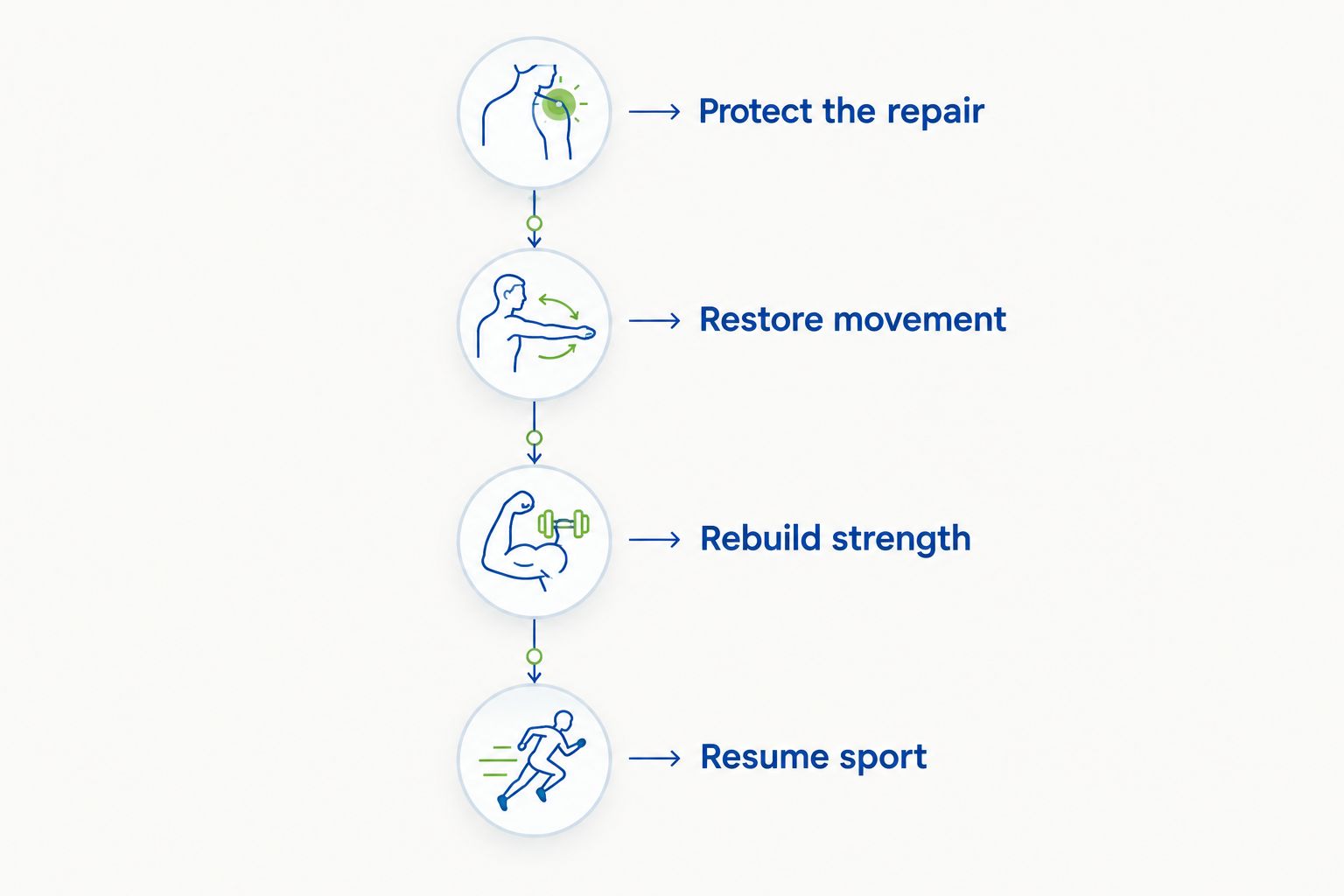
How shoulder rehabilitation progresses: 4 steps
These are decision stages, not a self-directed exercise prescription. Your surgeon’s protocol determines when each stage begins, and some stages overlap.
1. Protect the repair
Best for: the period when surgical restrictions control activity. Your therapist reviews the operation, sling instructions, permitted movement, and precautions before selecting exercises. Do not copy a teammate’s program simply because both operations involved a shoulder.
Protection has a trade-off: it limits activity while tissues heal. That does not mean doing nothing indefinitely; it means using only the movement and activity your surgical team permits.
2. Restore movement
Best for: restricted motion that your surgical team has cleared you to address. Rehabilitation progresses through the appropriate forms of assisted and active movement without forcing the shoulder beyond its restrictions.
A useful question is whether you can complete the prescribed movement with the intended technique. Hiking the shoulder, leaning your trunk, or pushing through escalating pain can hide the limitation rather than resolve it.
3. Rebuild strength
Best for: rebuilding capacity once loading is permitted. Strength work progresses according to the repair, symptoms, technique, and clinician assessment—not simply because you can tolerate an exercise once.
The limitation is equally important: a shoulder can feel better before it is ready for unrestricted resistance. Feeling comfortable does not override a restriction on lifting, pushing, pulling, or weight-bearing.
4. Resume sport
Best for: athletes who have met the criteria to begin sport-specific loading. Rehabilitation connects restored movement and strength to the actual demands of throwing, swimming, lifting, or other activity.
Sport progression is not a promise of clearance. Your therapist and surgical team determine the appropriate next steps, including any restrictions that still apply.
Which treatments help—and what are their limits?
The central question is not which treatment feels most intense. It is which treatment addresses your current limitation without violating the repair’s precautions.
| Approach | Best for | Practical benefit | Limitation |
|---|---|---|---|
| Guided movement exercises | Restoring permitted motion | Provides a repeatable way to practice movement | Range and timing must follow the surgical protocol |
| Progressive strengthening | Rebuilding capacity after loading is cleared | Prepares the shoulder for increasing demands | Starting prematurely can conflict with tissue protection |
| Hands-on treatment | Selected pain or movement restrictions | Can support participation in rehabilitation | Does not replace exercise or surgical precautions |
| Sport-specific progression | Returning to throwing, lifting, or other sport tasks | Connects rehabilitation to your actual activity | Requires readiness assessment and appropriate clearance |
Hands-on treatment is not permission to force a stiff shoulder. Any manual treatment must respect the procedure and stage of healing, just as exercise does.
Dry needling, shockwave therapy, and massage are also not automatic next steps for postoperative stiffness. Whether an additional treatment belongs in your plan requires a specific clinical reason and attention to surgical precautions. Do not substitute an add-on treatment for an appropriate postoperative assessment.
Why post-surgery shoulder stiffness varies
Your shoulder’s progress depends on more than effort. These factors shape what rehabilitation can safely ask of you:
- The operation performed: Different repairs protect different tissues and require different precautions.
- The stage of healing: An exercise that belongs later in rehabilitation is not automatically appropriate earlier.
- Pain and guarding: Pain can limit movement and change how you perform an exercise.
- Movement before surgery: Your starting function provides context for postoperative goals and measurements.
- Your activity demands: Daily reaching and competitive pitching require different levels of capacity.
- Your response to the program: Symptoms, movement quality, and measured progress guide adjustments.
There is no single 2026 recovery timetable that applies to every stiff postoperative shoulder. Your operation and clinical findings matter more than the calendar year or another athlete’s experience.
How long does it take to loosen a stiff shoulder after surgery?
There is no universal recovery deadline for post-surgery shoulder stiffness. The procedure, healing restrictions, initial motion, and clinical findings determine the progression.
Ask your therapist what change is expected at your present stage and how it will be measured. A useful answer identifies a movement or functional goal, explains the current restriction, and sets a point for reassessment rather than promising an exact return date.
Should I stretch through pain to get my shoulder moving?
Do not force a postoperative shoulder through sharp, escalating, or unexpected pain. Follow the specific movement and symptom guidance provided by your therapist and surgeon.
Discomfort does not tell you, by itself, whether an exercise is safe or effective. Report where symptoms occur, what movement brings them on, and whether they settle or persist afterward so your clinician can adjust the plan.
What if physical therapy has not helped my stiffness?
Persistent stiffness calls for reassessment, not an automatic increase in exercise intensity. Your therapist should review the procedure, precautions, technique, symptom pattern, and progress, then coordinate with the surgeon when needed.
If previous treatment has felt repetitive or disconnected from your sport, bring that concern directly to the appointment. You need an explanation of what the current exercises address and what must change before the next stage—not criticism of another provider.
Track progress with 3 checkpoints
For a practical 2026 rehabilitation review, ask your clinician to track these checkpoints together. Pain alone does not describe everything your shoulder needs to do.
- Movement: Which permitted shoulder motions are improving, and where does restriction remain?
- Function: Which everyday tasks are easier without compensating or breaking precautions?
- Capacity: When loading is allowed, what strength, control, or endurance still limits progression?
Use the same meaningful tasks when discussing progress. Reaching for clothing, washing your hair, or preparing for throwing each tells your therapist something different.
A pain-free reach is encouraging, but it does not establish readiness for repeated overhead effort. Ask how your measured progress connects to the next activity you want to resume.
When should you contact your surgeon?
New or worsening symptoms after surgery deserve attention, particularly fever, wound drainage, increasing redness, or worsening pain. New numbness, marked weakness, or a sudden loss of function also requires prompt medical assessment rather than a harder home program.
The American Academy of Orthopaedic Surgeons’ patient guidance on shoulder surgery and postoperative care identifies infection symptoms and emphasizes following the surgeon’s instructions. That general guidance cannot determine the cause of your symptoms remotely; use the contact instructions supplied by your surgical team.
For severe symptoms such as chest pain or difficulty breathing, seek emergency care. Do not wait for a routine physical therapy appointment.
Make your Philadelphia rehabilitation appointment useful
McKenzie Sports Physical Therapy is best for athletes and active adults seeking Philadelphia sports rehabilitation after an injury. For postoperative shoulder concerns, start by sharing your procedure and restrictions so the appointment discussion stays specific to your situation.
Bring 2 documents if available: your surgeon’s rehabilitation protocol and your operative report. Also bring your current exercise instructions and describe what you want to return to, whether that is pitching, school sports, recreational lifting, or running.
For athletes in Manayunk, Roxborough, and nearby northwest Philadelphia, the goal is practical: understand the current limitation and the next appropriate step. Personalized rehabilitation should connect those findings to your sport without promising a recovery outcome.
FAQ
Does physical therapy help post surgery shoulder stiffness?
Yes—physical therapy helps restore shoulder movement and strength after surgery while respecting the repair’s restrictions. The exercises and timing must match the procedure and your surgeon’s protocol.
Can I start shoulder stretches before my surgeon clears them?
Do not start unapproved shoulder stretches after surgery. A movement that is appropriate for one operation or healing stage can be restricted for another.
Is a stiff shoulder after surgery always frozen shoulder?
No—postoperative stiffness is not automatically frozen shoulder. A clinician needs to assess the movement restriction, symptoms, and surgical history before assigning a diagnosis.
Should my shoulder hurt during physical therapy?
Your therapist should explain the acceptable symptom response for your specific program. Sharp, escalating, or unexpected pain warrants stopping the exercise and contacting your treating clinician for guidance.
Can I return to pitching when my shoulder stops hurting?
Pain relief alone does not establish readiness to pitch. Return-to-throwing decisions also consider surgical clearance, movement, strength, control, and tolerance of progressive throwing demands.
What should I do if my shoulder stops improving?
Ask your therapist to reassess your progress and coordinate with your surgeon when needed. Do not increase stretching intensity or resistance on your own to force a breakthrough.
What should I bring to a postoperative shoulder appointment in 2026?
Bring your surgical rehabilitation protocol, operative report if available, current exercise instructions, and activity goals. Tell the clinician about symptom changes and any instructions your surgeon has updated.
One last thing
A shoulder that moves farther is not automatically ready to handle more load. Keep those decisions separate in your 2026 recovery plan: permission to reach farther is not necessarily permission to lift heavier or start throwing.
Related guides
- Physical therapy for CrossFit shoulder pain
- Physical therapy for swimmer’s shoulder
- High school sports and return-to-play clearance
Ready to discuss your stiff shoulder and return-to-sport goals? Request a new-patient appointment with McKenzie Sports Physical Therapy.