


Physical therapy can help swimmer’s shoulder by improving shoulder strength, movement control, and tolerance for swimming, but it cannot guarantee a cure or repair every structural injury. The right plan starts with identifying what is causing your pain, adjusting the swimming that aggravates it, and rebuilding your ability to train rather than simply waiting for soreness to disappear.
- Can physical therapy fix swimmers shoulder? Often, but the diagnosis and response to progressive rehabilitation determine the next step.
- McKenzie Sports Physical Therapy serves Philadelphia athletes seeking sports-injury rehabilitation and a personalized return-to-sport plan.
- Exercise and training adjustments address swimming demands; symptom relief alone does not establish readiness to return.
- Sudden weakness, traumatic injury, or a shoulder that slips out needs medical assessment before routine swimming rehabilitation.
Can physical therapy fix swimmer’s shoulder?
Physical therapy is a reasonable first-line treatment for many overuse-related swimming shoulder problems, not a promise that every painful shoulder will recover without other care. Swimmer’s shoulder describes a pattern of symptoms rather than one confirmed diagnosis. Rotator cuff pain, instability, and other shoulder conditions require different decisions.
For athletes comparing Philadelphia physical therapy options, McKenzie Sports Physical Therapy offers sports-injury diagnosis and rehabilitation. The useful starting point is an assessment of your shoulder and your sport, not choosing a treatment technique before the problem is understood.
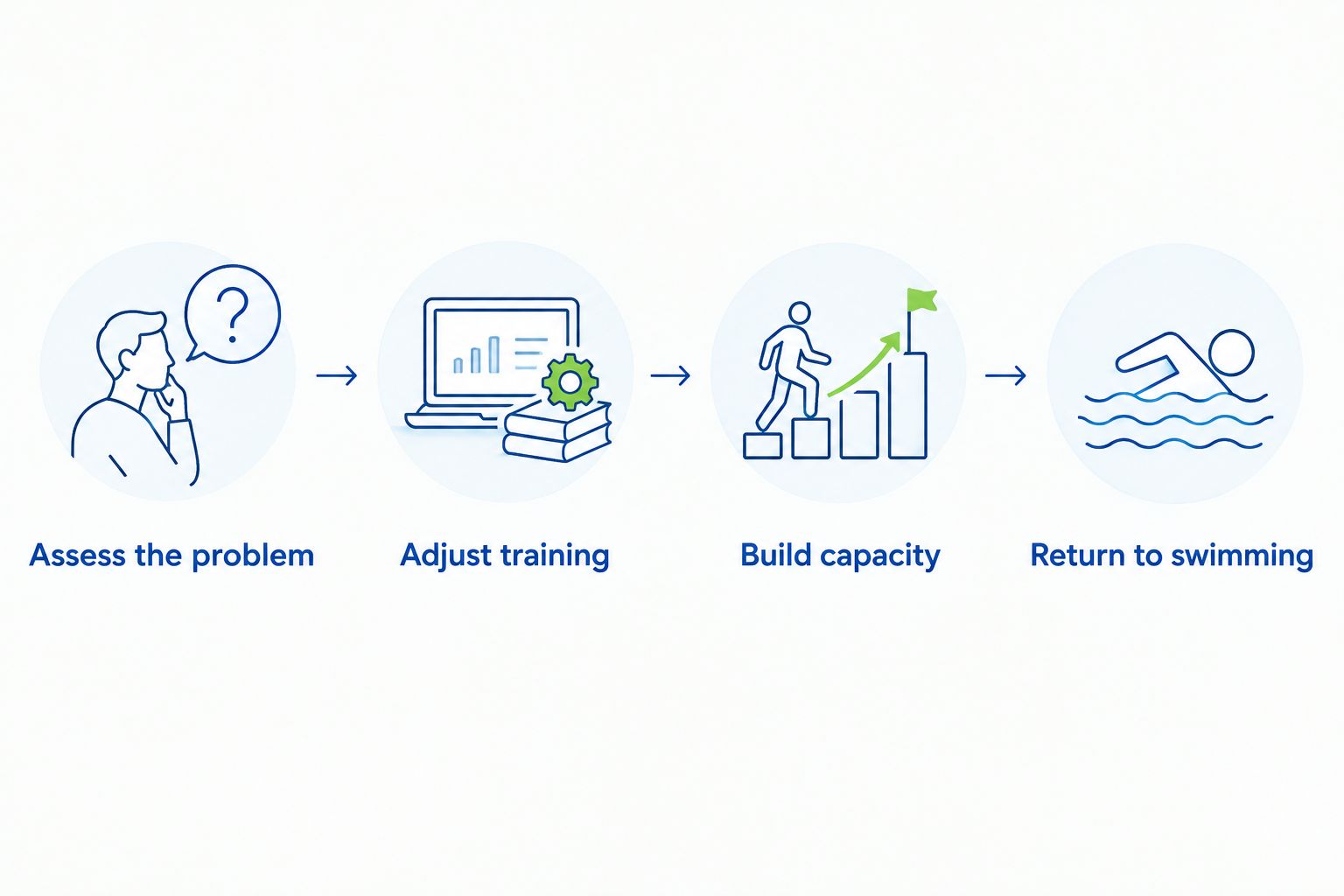
A practical rehabilitation process follows these steps:
- Assess the problem. Review how pain started, examine shoulder movement and strength, and identify findings that require further medical assessment.
- Adjust training. Change the swimming demands that provoke symptoms while identifying activity you can tolerate.
- Build capacity. Progress exercises that address the strength, endurance, and movement limitations found during assessment.
- Return to swimming. Reintroduce swimming demands according to your response, with communication between the athlete, clinician, and coach when appropriate.
These stages overlap. You do not need a completely inactive period before every strengthening exercise, and completing exercises does not automatically mean you are ready for unrestricted practice.
Why this matters
A shoulder that feels comfortable during daily life can still struggle with repeated overhead strokes. Swimming asks your shoulder to repeat a demanding movement under fatigue. Rehabilitation therefore needs to assess more than whether you can raise your arm in the treatment room.
For a high school swimmer in Roxborough or a college athlete returning home to Manayunk, meet schedules and team expectations add pressure. Your 2026 competition calendar should inform the plan, not replace the clinical criteria for progressing it. Tell your clinician about upcoming meets, other sports, and any pressure to keep practicing through pain.
Parents can help by describing changes they have noticed without answering every question for the athlete. The swimmer’s own account of pain, fatigue, confidence, and training tolerance matters when deciding what to change.
What does effective swimmer’s shoulder rehabilitation involve?
Assessment: identify what needs treatment
Expect questions about your strokes, training changes, dryland workouts, previous injuries, and when symptoms appear. Pain during the first lengths presents a different training problem from discomfort that develops only as you fatigue, although neither pattern establishes a diagnosis by itself.
A clinician can assess shoulder motion, strength, and relevant neck or nerve symptoms. Depending on your history and examination, the next step is rehabilitation, further medical evaluation, or a combination. Imaging is not automatically necessary for every painful swimming shoulder; the examination helps determine whether it would change care.
Bring 1 week of recent training notes, if available. This is a practical preparation step, not a required diagnostic window: include swimming, lifting, throwing, and other activities that load the shoulder.
Training adjustments: reduce irritation without guessing
Training modification is more specific than being told to rest. Your clinician and coach can discuss which parts of practice reproduce symptoms and what to change. That might involve reducing demanding swim work or temporarily removing a clearly aggravating drill.
Do not assume that a kickboard, paddles, or a different stroke automatically protects the shoulder. Each changes the task, and the shoulder’s response still matters. Keep any alternative activity within the boundaries agreed upon after assessment.
Record symptoms at 3 checkpoints: before, during, and after swimming. Add a note about how the shoulder feels the following morning so the plan reflects more than the sensation immediately after practice.
Progressive exercise: match the examination findings
Rehabilitation commonly includes exercises for shoulder strength, endurance, and movement control. The selection should follow your assessment rather than a generic online list. A swimmer with restricted movement and a swimmer with excessive joint motion do not necessarily need the same stretching program.
Use a 0–10 pain scale to describe symptoms consistently, but ask your clinician what response is acceptable for your situation. There is no single pain score that makes every exercise safe or unsafe across all shoulder diagnoses.
Your 2026 rehabilitation plan should explain how exercises progress and what would trigger a change. More repetitions, heavier resistance, or harder swim sessions are not automatically better when the current workload is not tolerated.
Return to swimming: test the demands you need
Return-to-sport decisions should consider symptoms, examination findings, strength, endurance, confidence, and the demands of swimming. A comfortable warm-up does not establish that your shoulder can tolerate a full practice or race effort.
Progress training deliberately rather than increasing every demand together. When the shoulder reacts poorly, identify what changed before deciding that rehabilitation has failed. The goal is a repeatable level of function, not one unusually good session.
Is exercise better than rest or hands-on treatment?
Active rehabilitation addresses the capacity needed for swimming; rest and hands-on treatment serve different purposes. These approaches are not interchangeable, and an appropriate plan can include more than one.
| Approach | Best for | Practical benefit | Limitation |
|---|---|---|---|
| Progressive exercise | Swimmers rebuilding shoulder capacity | Targets assessed strength, endurance, and movement limitations | Requires appropriate progression and consistent participation |
| Training modification | Swimmers whose current workload aggravates symptoms | Reduces exposure to provoking demands while the plan develops | Does not rebuild shoulder capacity by itself |
| Hands-on treatment | Selected athletes needing help with symptoms or movement | Can support participation in an active rehabilitation plan | Symptom relief does not prove readiness for unrestricted swimming |
Sports massage or dry needling should not become the entire return-to-swimming strategy. Ask what problem an additional treatment is intended to address and how its effect will be assessed. A treatment that helps you feel better still needs to connect with the activity you want to resume.
McKenzie Sports Physical Therapy offers sports-injury rehabilitation alongside sports massage and dry needling. Those services are options to discuss after assessment, not evidence that every swimmer needs every available treatment.
Why does recovery from swimmer’s shoulder vary?
Your 2026 recovery plan should follow your findings and progress rather than a fixed deadline borrowed from another athlete. These factors change the clinical decisions:
- Underlying condition: Tendon-related pain, instability, traumatic injury, and referred symptoms do not all follow the same treatment pathway.
- Current training demands: Pool sessions, strength training, baseball throwing, and other overhead activity contribute to the workload being assessed.
- Strength and endurance: The ability to perform one comfortable movement differs from sustaining repeated strokes under fatigue.
- Movement needs: Restricted motion and excessive motion require different considerations; more stretching is not always the answer.
- Response to progression: Symptoms and function during and after a workload change help determine whether to advance, maintain, or revise the plan.
- Consistency and coordination: A workable home program and clear communication with coaches help keep rehabilitation and training from pulling in opposite directions.
A baseball player who also swims needs both sports included in the discussion. Likewise, a runner using swimming while another injury heals should explain why swimming has become part of the training plan. The shoulder does not experience those activities in isolation.
Can I keep swimming while my shoulder hurts?
Some athletes can continue modified swimming during rehabilitation; others need to stop the provoking activity while the shoulder is assessed. Do not use this article as clearance to swim through pain. The appropriate decision depends on the cause, symptom behavior, and examination findings.
Stop treating the session as routine if pain escalates, your stroke changes to protect the shoulder, or you develop new weakness. Discuss the pattern with your clinician instead of repeatedly testing the same painful workload. If a clinician has already restricted swimming, follow that guidance until reassessed.
For students, give the coach a clear description of permitted activity rather than a vague instruction to take it easy. Specific boundaries make it easier to participate without turning each practice into an argument about effort.
Why has my previous shoulder treatment not helped?
Persistent pain deserves reassessment, not blame. A previous plan might have reduced symptoms without fully rebuilding swimming tolerance, or the diagnosis and current training demands might need another look. That does not mean your previous provider did something wrong.
Bring your exercise program, any imaging reports, and a description of what improved and what did not. Ask whether the next plan changes the working diagnosis, exercise progression, or swimming workload. Repeating the same approach without discussing its results gives you little basis for judging progress.
McKenzie Sports Physical Therapy is best suited to Philadelphia athletes seeking sports-injury assessment and personalized return-to-sport rehabilitation. Ask for an explanation you can use: what is being treated, what you should do between visits, and how readiness for swimming will be assessed.
When does shoulder pain need medical attention?
Seek prompt medical assessment after a traumatic injury with substantial weakness, visible deformity, or inability to use the arm normally. A shoulder that appears dislocated needs urgent care; do not try to relocate it yourself.
New or persistent numbness, progressive weakness, fever with a hot or swollen joint, or severe unexplained pain also warrants medical evaluation. Shoulder discomfort accompanied by chest pressure, shortness of breath, or other possible heart-attack symptoms requires emergency care.
Night pain alone does not identify a particular injury. Tell your clinician about it, especially when it is worsening or accompanied by other concerning symptoms.
What evidence supports this approach in 2026?
The Journal of Orthopaedic & Sports Physical Therapy clinical practice guideline, Rotator Cuff Tendinopathy Diagnosis, Nonsurgical Medical Care, and Rehabilitation, supports active rehabilitation for adults with rotator cuff tendinopathy. Its scope matters: it does not establish that every swimmer’s painful shoulder is a rotator cuff problem or that every athlete needs the same exercises.
The Bern Consensus Statement on Shoulder Injury Prevention, Rehabilitation, and Return to Sport supports assessing multiple aspects of readiness rather than relying on time alone. It is expert guidance for shoulder rehabilitation and sport participation, not a guarantee of a particular outcome for an individual swimmer.
For decisions made in 2026, use these principles alongside an individual clinical examination. Exercise choices, training restrictions, and referral decisions still require clinical judgment, particularly for adolescents, traumatic injuries, or suspected instability.
FAQ
Can physical therapy fix swimmer’s shoulder without surgery?
Physical therapy can improve many overuse-related swimming shoulder problems without surgery, but the diagnosis determines the treatment pathway. Traumatic injuries, significant instability, and symptoms that do not improve require reassessment.
How long does physical therapy take for swimmer’s shoulder?
There is no single recovery timeline for swimmer’s shoulder. Your diagnosis, training demands, examination findings, and response to progressive rehabilitation determine when swimming can advance.
Should I stop swimming completely if my shoulder hurts?
You should stop the provoking activity and seek assessment when pain is escalating, your stroke changes, or you develop weakness. Some athletes can continue modified training after assessment; others need a temporary restriction.
Is stretching enough to fix swimmer’s shoulder?
Stretching alone does not address every cause of swimmer’s shoulder. Strength, endurance, movement control, and training demands also need assessment, and a shoulder with excessive motion does not necessarily need more stretching.
Does feeling better after massage mean I can race?
Feeling better after massage does not establish readiness to race. Return-to-swimming decisions should also consider function, strength, endurance, and your response to swimming demands.
What should parents bring to a swimmer’s physical therapy appointment?
Parents should bring relevant medical records, existing exercise instructions, and recent training information. Let the athlete explain when symptoms occur and how the shoulder affects swimming and daily activities.
Can McKenzie Sports Physical Therapy assess an athlete with swimming shoulder pain?
McKenzie Sports Physical Therapy offers sports-injury diagnosis and rehabilitation for athletes and active individuals in Philadelphia. A new-patient appointment is the starting point for discussing shoulder symptoms and return-to-sport goals.
One last thing
A pain-free day is useful information, not a return-to-sport test. Before your next progression, ask what your shoulder has demonstrated under the demands that matter to your swimming. That question is more useful than comparing your recovery with a teammate’s calendar.
Related guides
- Can shoulder impingement heal without surgery?
- How long does labral tear rehabilitation take without surgery?
- High school sports physicals and return-to-play clearance
For a shoulder assessment and a practical discussion of returning to swimming, request a new-patient appointment. Athletes and active adults in Manayunk, Roxborough, and nearby northwest Philadelphia are invited to bring their training goals and questions.