

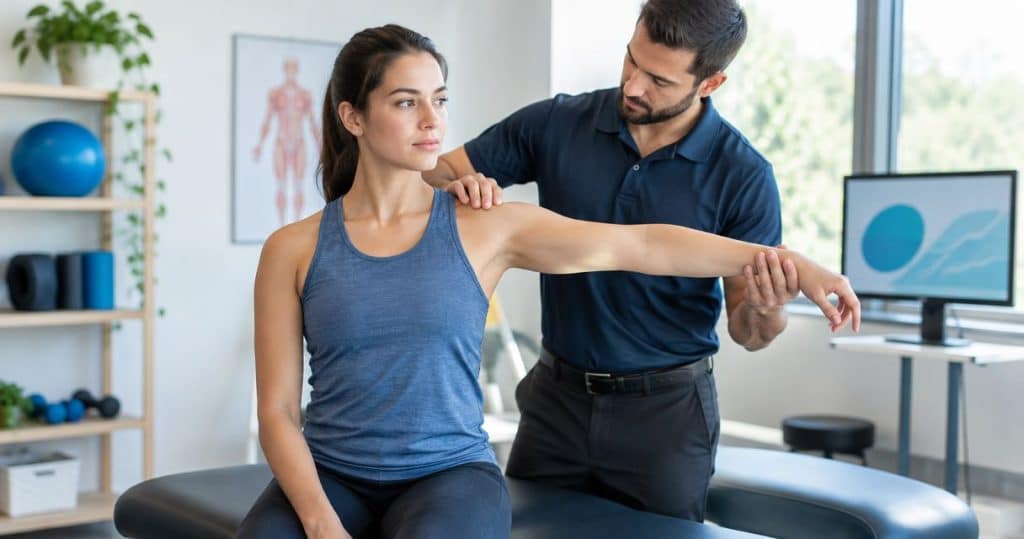
A shoulder labral tear can improve without surgery, but relief of pain and restoration of function do not necessarily mean the torn tissue has reattached. Physical therapy for labral tear in shoulder injuries builds strength, movement control, and tolerance for activity; recurrent dislocations, persistent instability, or unsuccessful rehabilitation require orthopedic reassessment.
- Physical therapy for labral tear in shoulder injuries can improve function without surgically repairing the tear.
- Recurrent shoulder dislocations require orthopedic assessment, not an exercise-only plan.
- Pitchers need a graded throwing progression before returning to competition.
- McKenzie Sports Physical Therapy provides sports injury rehabilitation for Philadelphia athletes and active adults.
Can a labral tear in the shoulder heal without surgery?
Yes, symptoms and function can improve without surgery. Anatomical healing is a separate question. Rehabilitation strengthens the muscles that help control the shoulder rather than mechanically reattaching a detached labrum.
The American Academy of Orthopaedic Surgeons describes nonsurgical treatment as the initial approach for many SLAP injuries. The National Athletic Trainers’ Association recommends an initial 3–6 months of nonoperative management for overhead athletes with SLAP injuries. That recommendation applies to a particular injury group, not every shoulder labral tear.
For the practical timeline, read how long labral tear rehab takes without surgery. The calendar matters less than whether your shoulder becomes stronger, more stable, and better able to tolerate your sport.
| Treatment approach | Best suited to | Main benefit | Main limitation |
|---|---|---|---|
| Nonsurgical rehabilitation | Patients whose examination supports an initial rehabilitation trial | Addresses strength, mobility, load tolerance, and movement control without an operation | Does not surgically reattach torn tissue; symptoms or instability can persist |
| Surgical evaluation and treatment | Patients with recurrent instability, associated injuries, or persistent limitations despite appropriate care | Assesses whether structural treatment is needed | Surgery has risks and still requires rehabilitation; return to sport is not guaranteed |
These are not competing shortcuts. A clinician helps you decide which pathway matches your injury, examination, and goals.
Why this matters
For a Manayunk pitcher, a Roxborough lifter, or a college athlete trying to finish a season, the useful question is not simply whether the MRI still shows a tear. It is whether the shoulder can safely handle the demands placed on it.
In 2026, a responsible treatment decision still requires matching imaging findings with your symptoms and examination. A scan describes structure; it does not independently establish your need for surgery or your readiness to compete.
If previous treatment has not helped, you do not need blame or another generic exercise sheet. You need a reassessment of the diagnosis, rehabilitation progression, training demands, and reasons your shoulder remains limited.
SLAP tears: overhead activity changes the rehabilitation goal
A SLAP tear involves the upper part of the shoulder labrum near the attachment of the long head of the biceps tendon. Repeated overhead loading and traumatic injuries are recognized causes.
A pitcher needs more than comfortable daily movement. Rehabilitation must address the shoulder demands of throwing, including motion, strength, endurance, and the contribution of the trunk and lower body.
The NATA recommendation of 3–6 months describes an initial nonsurgical management period for overhead athletes with SLAP injuries. 3 months is the lower end of that recommendation, and 6 months is the upper end—not a promised return-to-play date. Progress and clinical findings determine the next decision.
For a high school athlete and parent planning a 2026 season, ask what must improve before throwing resumes. A target date without clearance criteria is not a return-to-sport plan.
Instability-related tears: repeated slipping changes the decision
Some labral injuries occur when the shoulder dislocates or partially slips out of place. These injuries require particular attention to instability, associated damage, and the demands of contact or overhead sport.
Repeated slipping or dislocation deserves orthopedic assessment. Stronger muscles help shoulder control, but exercise does not guarantee that a structurally unstable shoulder will remain in place during competition.
If your shoulder looks deformed after an injury, remains out of place, or develops new numbness or a cold hand, seek urgent medical care. Do not attempt to relocate it yourself or test it with stretches.
What personalized physical therapy should include
A useful rehabilitation plan connects your examination findings to the activities you want back. It should also explain how progress will be measured and what would trigger a change in treatment.
McKenzie Sports Physical Therapy is a local option for athletes and active adults seeking shoulder injury rehabilitation in Philadelphia. Its sports injury rehabilitation services are relevant to patients returning to throwing, lifting, and other demanding activities.
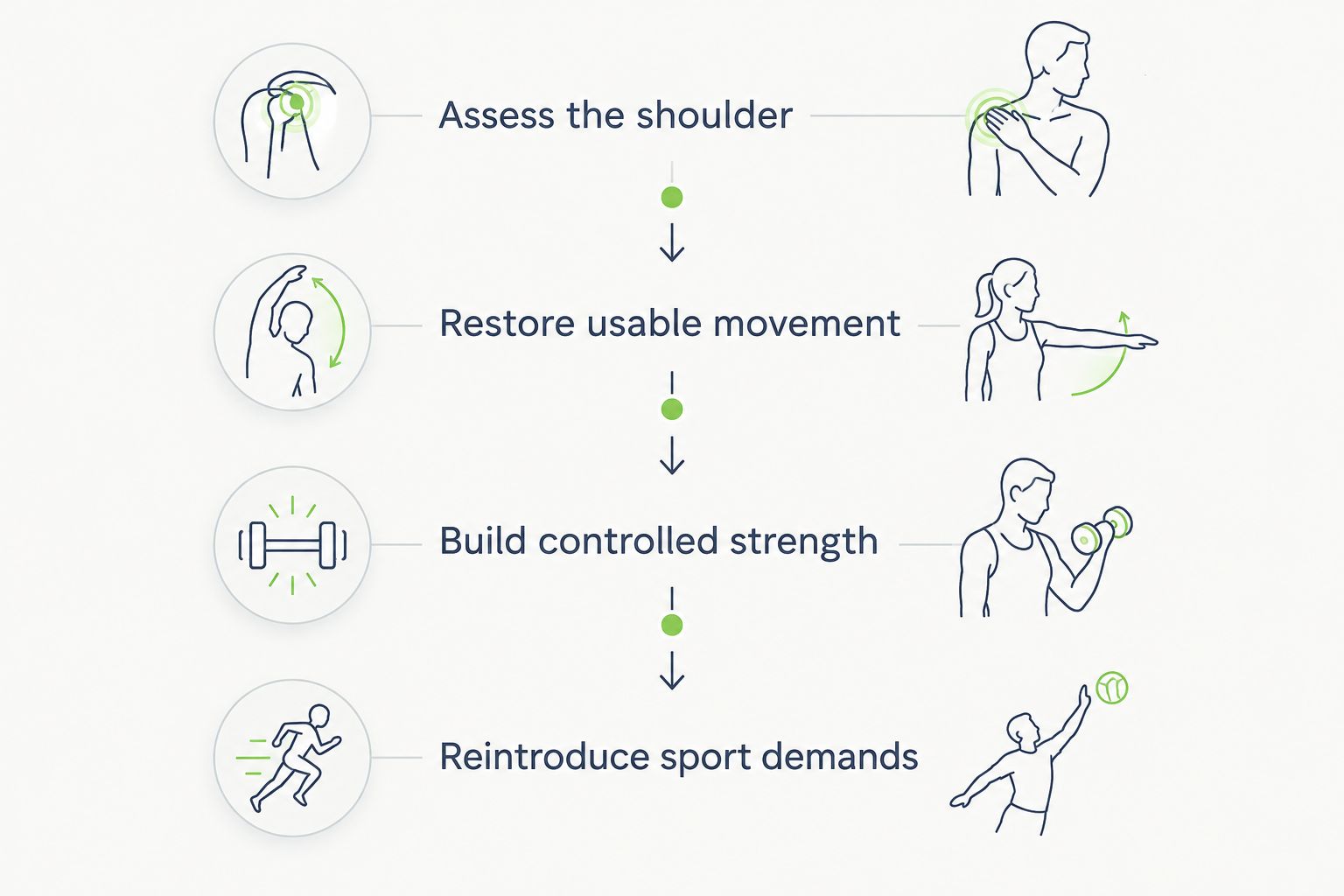
Assess the shoulder
Bring your imaging reports, injury history, previous exercises, and a description of the movements that cause trouble. Explain whether the shoulder hurts, catches, feels weak, or seems to slip; those experiences are not interchangeable.
An assessment should consider shoulder motion, strength, instability symptoms, neck involvement, and sport-specific demands. No single symptom or home test reliably identifies the full problem.
Restore usable movement
Your clinician identifies which movements are restricted and which positions provoke symptoms or instability. The goal is useful motion—not stretching every shoulder as far as possible.
A stiff shoulder and a shoulder that already moves excessively need different instructions. Avoid forcing overhead stretches or deep shoulder positions simply because an exercise helped a teammate.
Build controlled strength
Rehabilitation commonly addresses rotator cuff strength, shoulder blade control, and progressive loading. Exercise selection and resistance should match your findings rather than follow a universal labral-tear routine.
For pitchers, the trunk and legs also matter because throwing is a whole-body task. For lifters, rehabilitation should eventually address the specific pressing, pulling, or overhead movement you need to resume.
Reintroduce sport demands
Sport-specific rehabilitation gradually adds the tasks that ordinary strengthening does not reproduce. A throwing athlete needs a planned return to throwing; comfortable resistance-band exercises do not establish mound readiness.
For high school and college athletes, coordinate restrictions and progression with the treating clinician and relevant sports medical staff. Parents and coaches should understand what the athlete is cleared to do, not just what the athlete hopes to do.
Why the response to nonsurgical treatment varies
The label labral tear does not describe the whole injury. These factors change how your clinician interprets symptoms and plans rehabilitation:
- Tear location and associated injuries: A superior labral injury and a dislocation-related injury do not present the same treatment questions.
- Instability: Recurrent slipping or dislocation changes the need for orthopedic input.
- Sport demands: Pitching, contact sport, recreational lifting, and everyday reaching place different demands on the shoulder.
- Motion and strength deficits: Rehabilitation must address the limitations found during your examination.
- Response to progressive loading: Your ability to tolerate harder tasks helps determine whether treatment is moving toward your goals.
Your 2026 rehabilitation plan should name the factors that apply to you. A generic list of shoulder exercises cannot substitute for that explanation.
What if previous physical therapy did not help?
Unsuccessful treatment deserves a review, not an assumption that you failed rehabilitation. Tell your clinician which exercises you performed, how they progressed, what improved, and which activities remained impossible.
Ask whether the earlier plan restored everyday comfort but stopped before sport-specific loading. Also ask whether persistent instability, an associated injury, or a different pain source requires further evaluation.
Do not keep repeating an unchanged plan when your function is not improving. Reassessment can lead to different exercise selection, revised activity demands, additional diagnostic work, or an orthopedic consultation. None of those outcomes guarantees surgery or rules it out.
Can massage or dry needling repair a torn labrum?
Massage and dry needling do not reattach a torn shoulder labrum. They should not be described as substitutes for structural repair or as proof that a shoulder is ready for sport.
McKenzie Sports Physical Therapy offers sports massage and dry needling, but the relevant question is whether an adjunct addresses a specific finding in your examination. Any discussion should explain the intended symptom target, limitations, and how the treatment fits with active rehabilitation.
For this 2026 treatment decision, separate symptom management from return-to-sport preparation. A shoulder feeling looser after a session does not establish stability, strength, or throwing tolerance.
When should you discuss surgery?
Discuss orthopedic reassessment when the shoulder repeatedly slips, pain remains limiting despite appropriate rehabilitation, or you cannot progress toward necessary activities. Associated injuries and examination findings also affect that decision.
An orthopedic consultation is an assessment, not a commitment to an operation. Ask what the proposed procedure would address, what nonsurgical options remain, and what rehabilitation would follow.
For a pitcher, ask specifically about returning to pitching rather than simply returning to exercise. For a runner whose shoulder hurts with arm swing or strength training, explain those demands instead of borrowing a throwing athlete’s goals.
What should you ask at a shoulder evaluation in 2026?
Bring questions that make the plan concrete. You should leave knowing what the working diagnosis means, what activities to modify, and how the clinician will judge progress.
- What findings suggest the labrum is contributing to my symptoms?
- Is my shoulder unstable, stiff, weak, or limited by another problem?
- Which activities should I stop or modify now?
- What should improve before I resume throwing, pressing, or contact?
- What findings would prompt referral or a different treatment plan?
Clinical sources and their limits
The clinical guidance in this 2026 article draws on the American Academy of Orthopaedic Surgeons’ OrthoInfo resources, including SLAP Tears and Chronic Shoulder Instability, and the National Athletic Trainers’ Association position statement on overhead athletes with SLAP injuries.
AAOS describes injury patterns and treatment options. The NATA statement addresses evaluation, nonsurgical management, and return-to-sport considerations in overhead athletes. Its management recommendations are not individualized clearance criteria and do not establish outcomes for every type of labral tear.
FAQ
Can physical therapy heal a shoulder labral tear without surgery?
Physical therapy can improve pain and function without surgery, but that does not prove the torn labrum has reattached. An examination helps determine whether nonsurgical care is appropriate and whether instability needs orthopedic assessment.
How long should I try physical therapy for a SLAP tear?
The National Athletic Trainers’ Association recommends an initial 3–6 months of nonoperative management for overhead athletes with SLAP injuries. That is not a universal timeline for every labral tear or a guaranteed return-to-sport date.
Can I keep pitching with a shoulder labral tear?
Do not use pain tolerance alone to decide whether to keep pitching. Your clinician should assess symptoms, stability, motion, strength, and readiness for a graded throwing progression.
Does a labral tear on an MRI mean I need surgery?
A labral tear on an MRI does not automatically mean you need surgery. Treatment decisions also depend on symptoms, examination findings, instability, associated injuries, and activity goals.
Should I stretch a shoulder with a labral tear?
Stretching should target a documented movement restriction, not automatically increase every shoulder’s range. Forceful stretching can be inappropriate when instability is part of the problem.
What if my shoulder feels better but still clicks?
Clicking alone does not determine whether rehabilitation has succeeded or surgery is necessary. Report painful catching, slipping, weakness, or loss of function so your clinician can reassess.
When should I get urgent care for a shoulder injury?
Seek urgent care for an obvious deformity, a shoulder that remains out of place, or new numbness or a cold hand after injury. Do not attempt to put the shoulder back into place yourself.
One last thing
Ask for return-to-sport criteria, not just permission to stop therapy. Comfortable daily life and competitive pitching are different goals, and your rehabilitation plan should make that distinction explicit.
Related guides
- Can physical therapy fix CrossFit shoulder pain?
- How long does recovery take after labral tear surgery?
- High school sports physical to return-to-play clearance
If you live in Manayunk, Roxborough, or nearby northwest Philadelphia, schedule a new-patient appointment with McKenzie Sports Physical Therapy to discuss your shoulder symptoms and a personalized return-to-sport rehabilitation plan.