

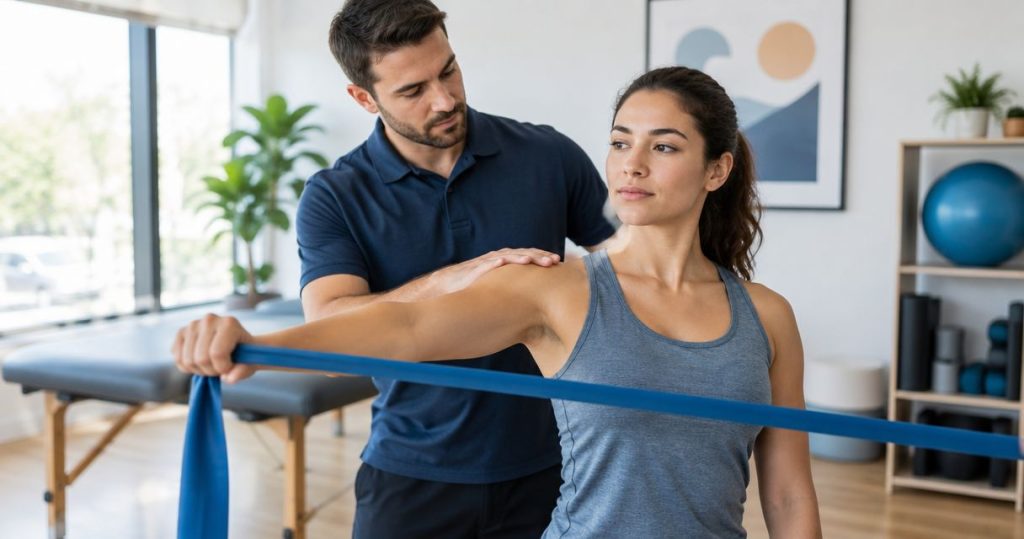
Best starting option: external-rotation isometrics for a shoulder that tolerates gentle resistance. Best for progressive cuff strengthening: side-lying external rotation. Best equipment-free option: wall slides. Physical therapy for rotator cuff impingement syndrome combines selected exercises with an assessment of your shoulder and the demands of your sport—not a universal routine.
- Physical therapy for rotator cuff impingement syndrome should match your symptoms, strength, and sport—not follow a fixed exercise list.
- External-rotation isometrics offer a controlled starting option; side-lying external rotation adds movement and resistance.
- McKenzie Sports Physical Therapy offers sports injury diagnosis and rehabilitation for Philadelphia athletes and active adults.
- Pitchers need a return-to-throwing plan; comfortable band exercises alone do not establish readiness.
Why this matters
Shoulder pain can interrupt pitching, lifting, swimming, or even putting on a jacket. The term impingement describes a familiar shoulder-pain presentation, but it does not establish exactly which tissue hurts or identify the right exercise by itself.
McKenzie Sports Physical Therapy provides sports rehabilitation for Philadelphia athletes and active adults recovering from injury. For readers in Manayunk, Roxborough, and nearby northwest Philadelphia, the next move is to connect exercise choices to an assessment, not collect more exercises. Explore the clinic’s sports injury rehabilitation services when planning that next step.
This 2026 guide ranks exercises by their practical role, not by evidence that one movement outperforms every alternative. Clinical references include the Journal of Orthopaedic & Sports Physical Therapy guideline on rotator cuff tendinopathy and the American Academy of Orthopaedic Surgeons’ Shoulder Conditioning Program. These support individualized exercise and progressive strengthening; neither establishes a universal winner for every painful shoulder.
What makes the best rotator cuff exercises?
- Symptom tolerance: You can perform the movement without sharp pain, catching, or a worsening response afterward.
- Adjustable resistance: You can change effort, range, or resistance without abandoning the exercise.
- Controlled movement: Your neck, trunk, and shoulder position remain steady rather than compensating for the load.
- Relevant progression: The exercise supports a path toward reaching, lifting, running, or throwing.
- Clear limitations: You understand what the movement trains—and what it cannot establish about recovery.
A useful exercise does not have to look athletic. In 2026, the practical priority remains matching the challenge to your current capacity and then progressing toward your actual activity.
Rotator cuff exercises at a glance
| Exercise | Best for | Standout feature | Key limitation |
|---|---|---|---|
| External-rotation isometric | Introducing controlled cuff effort | Effort changes without moving the arm | Does not train strength through a moving range |
| Side-lying external rotation | Progressive cuff strengthening | Resistance during outward rotation | Excess load encourages trunk rotation |
| Wall slide | Practicing supported arm elevation | Wall support helps control the movement | Overhead movement can remain irritating |
| Resistance-band row | Shoulder-blade and pulling strength | Adjustable pulling resistance | Does not replace direct cuff work |
| Scaption raise | Rebuilding controlled arm lifting | Trains elevation in the shoulder-blade plane | Longer arm leverage increases the challenge |
These exercises are options, not instructions to complete every row. An examination determines which belong in your program and whether another diagnosis needs attention first.
1. External-rotation isometric: best for controlled cuff effort
An external-rotation isometric asks your shoulder muscles to work without rotating your arm. Stand beside a wall with your elbow bent about 90 degrees and your upper arm resting near your side; gently press the back of your hand outward into the wall without moving your body.
Keep the effort controlled rather than maximal. A clinician can select the effort and hold duration based on your symptoms, injury history, and examination.
External-rotation isometric pros:
- You can adjust effort immediately.
- The movement requires no exercise equipment.
- Keeping the arm still makes compensation easier to notice.
External-rotation isometric cons:
- Static effort does not train the full moving range.
- Pressing harder can aggravate an irritable shoulder.
- It does not test readiness for pitching or overhead lifting.
Best for: Someone who tolerates gentle cuff effort better than repeated shoulder movement.
Do not interpret temporary comfort as proof that the exercise has corrected the cause of pain. Isometrics are a loading option, not a diagnostic test or guaranteed pain-relief technique.
Verdict: Hold higher-effort resistance until gentle pressure is controlled and tolerated.
2. Side-lying external rotation: best for progressive cuff strengthening
Lie on your side with the affected shoulder facing upward. Bend the upper elbow about 90 degrees, keep it near your ribs, and rotate your forearm upward without rolling your trunk backward.
Begin with the resistance your clinician selects, including no added weight when appropriate. Stop the movement where you lose control rather than forcing the hand farther upward.
Side-lying external rotation pros:
- It directly challenges outward shoulder rotation.
- Resistance and range can be adjusted separately.
- The side-lying position makes trunk compensation noticeable.
Side-lying external rotation cons:
- Excess resistance encourages rolling or elbow movement.
- Getting into position can be uncomfortable.
- It does not reproduce the speed or coordination of throwing.
Best for: Building rotator cuff strength through a controlled moving range.
If you have already done this exercise without improvement, the answer is not automatically more repetitions. Recheck technique, resistance, overall training load, and whether the working diagnosis still fits.
Verdict: Hold increases in resistance until the current movement stays controlled without a worsening symptom response.
3. Wall slide: best for supported arm elevation
Face a wall and place your hands or forearms against it. Slide upward through a comfortable range, allowing your shoulder blades to move naturally rather than pinning them down.
Keep your ribs from flaring and avoid leaning backward to create extra reach. The goal is controlled arm elevation, not touching the highest possible point.
Wall slide pros:
- Wall support helps you practice reaching.
- You can shorten the range immediately.
- The movement requires no specialized equipment.
Wall slide cons:
- Raising the arm can still provoke symptoms.
- Back arching can hide limited shoulder movement.
- The exercise provides limited resistance for later-stage strength work.
Best for: Reintroducing supported reaching when your shoulder tolerates elevation.
A wall slide is not a stretch to push through. If you repeatedly meet a painful catch, stop forcing that section of the movement and have the shoulder reassessed.
Verdict: Hold the painful range; practice only the controlled range selected for your shoulder.
4. Resistance-band row: best for pulling strength
Secure an exercise band to a stable anchor and pull your elbows backward while keeping your neck relaxed. Let the shoulder blades move with the pull rather than squeezing them together as hard as possible.
Return slowly without snapping the band forward. Inspect the band and anchor before use, and choose resistance that does not require leaning backward.
Resistance-band row pros:
- Resistance changes with band selection and position.
- It trains pulling muscles around the shoulder blade.
- It provides a practical bridge toward gym pulling movements.
Resistance-band row cons:
- It does not replace direct rotator cuff strengthening.
- Heavy resistance encourages shrugging or trunk movement.
- A poorly secured band creates an avoidable safety risk.
Best for: Restoring controlled pulling strength alongside cuff-specific exercises.
Rows belong in a broader plan, particularly when your sport also requires reaching overhead. Strong pulling alone does not establish that your shoulder tolerates pressing, serving, or pitching.
Verdict: Hold heavier pulling until you can row without shrugging, leaning, or increasing symptoms.
5. Scaption raise: best for rebuilding arm-lifting strength
Scaption means lifting your arm in the plane of your shoulder blade—approximately 30 degrees forward of directly sideways. Keep your thumb pointing upward and lift through the range your clinician recommends.
Start without added weight when needed. A straighter arm creates a longer lever, so even a small resistance change can make this exercise noticeably harder.
Scaption raise pros:
- It trains controlled arm elevation.
- Range and resistance can progress independently.
- It connects more directly to reaching than an elbow-at-side exercise.
Scaption raise cons:
- Elevation can irritate a sensitive shoulder.
- Shrugging can substitute for controlled lifting.
- It does not reproduce high-speed throwing demands.
Best for: Progressing toward lifting and reaching after simpler loading is tolerated.
Avoid turning the movement into a test of how high you can lift despite pain. The useful endpoint is the range you can control within your prescribed symptom limits.
Verdict: Hold overhead progression until lower-range lifting is controlled and tolerated.
How these exercises are ranked
The order moves from easily adjustable static effort toward moving resistance and arm elevation. It reflects symptom tolerance, control, progression, and practical use—not a claim that every patient should follow the same sequence.
For this 2026 guide, the central distinction is between an exercise’s role and its ranking. A wall slide can be the right first choice for one shoulder and inappropriate for another.
Turn the list into a return-to-sport plan
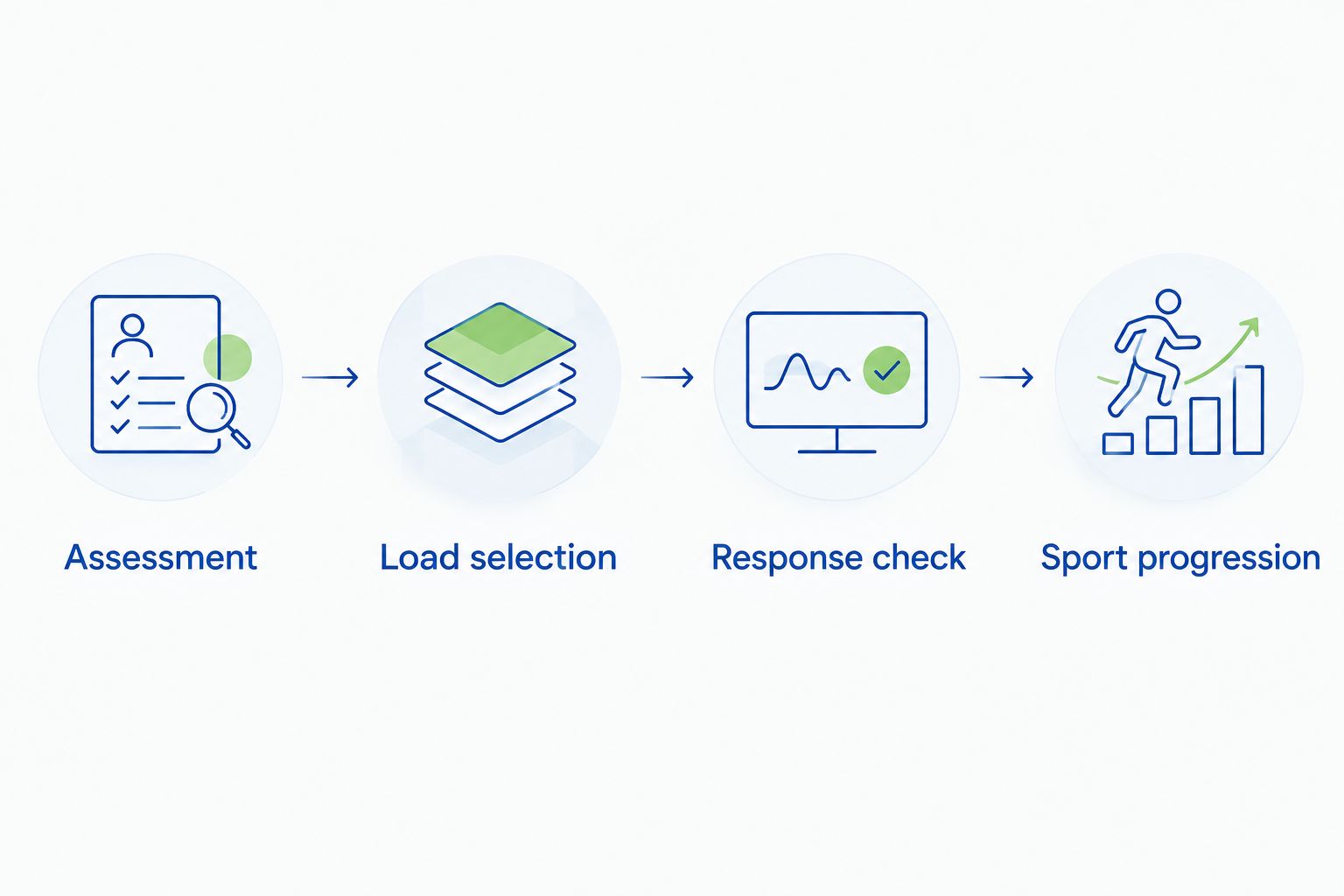
Physical therapy for rotator cuff impingement syndrome needs more than an exercise menu. Your plan should connect the shoulder examination to a progression you can explain in plain language.
- Assessment: Identify painful tasks, strength limitations, movement restrictions, and relevant injury history.
- Load selection: Choose exercises and resistance that fit your current presentation.
- Response check: Review symptoms during exercise, afterward, and before the next session.
- Sport progression: Build toward the speed, repetition, and positions your sport requires.
A baseball pitcher needs a different endpoint from a runner whose shoulder aches during arm swing. For high school and college athletes, the plan should also account for practice, competition, strength training, and communication with the relevant sports staff.
Parents should ask what the athlete must demonstrate before progressing—not simply when the next game is. A calendar date does not establish throwing readiness.
If previous treatment has not helped, bring the exercise list and explain what changed during the program. At McKenzie Sports Physical Therapy, sports injury diagnosis and rehabilitation provide the context for discussing those unresolved limitations without dismissing your previous care.
When exercises should wait
Seek prompt medical assessment after trauma with substantial weakness, visible deformity, or inability to raise the arm. A red, hot, swollen shoulder with fever also needs medical attention rather than a home exercise trial.
Shoulder discomfort accompanied by chest pressure, shortness of breath, or other possible heart-attack symptoms requires emergency care. New numbness, worsening weakness, or persistent symptoms also deserve assessment before you keep increasing resistance.
Which exercise should you choose?
Choose the exercise that addresses an assessed limitation and produces a tolerable response—not the exercise with the highest ranking. External-rotation isometrics offer an adjustable starting option; side-lying external rotation adds moving resistance; wall slides address supported reaching.
For a 2026 return to baseball, lifting, or running, the default recommendation is assessment followed by progressive rehabilitation. Do not treat completion of this list as clearance for sport.
FAQ
What’s the best exercise for rotator cuff impingement?
There is no single best exercise for every shoulder. External-rotation isometrics, side-lying external rotation, and wall slides serve different purposes; an examination helps determine which fits your symptoms and limitations.
Should rotator cuff exercises hurt?
Do not push through sharp pain, catching, or a worsening symptom pattern. Your clinician should define acceptable symptoms and explain when to reduce resistance, shorten the range, or stop.
Should I do shoulder rehabilitation exercises every day?
Exercise frequency depends on the exercise, resistance, and your response. Strengthening and mobility work do not necessarily need the same schedule, so follow an individualized prescription rather than repeating the whole list daily.
Can I keep pitching with shoulder impingement?
Painful pitching requires assessment and a workload decision, not clearance from a home exercise list. Return to throwing should address symptoms, strength, movement, and a graded throwing progression.
Is physical therapy useful if previous treatment did not help?
Persistent symptoms justify reassessment of the diagnosis, exercise dose, and sporting demands. Bring your previous program and describe what improved, what worsened, and which activities remain limited.
Are dry needling or sports massage substitutes for strengthening?
Dry needling and sports massage do not replace progressive exercise or sport-specific rehabilitation. McKenzie Sports Physical Therapy offers these services, but their role depends on the assessment and treatment plan.
How long does physical therapy for rotator cuff impingement syndrome take?
Recovery time varies with the diagnosis, symptom duration, physical demands, and response to rehabilitation. Ask for measurable progression criteria rather than a guaranteed completion date.
One last thing
Less pain during a band exercise does not prove that your shoulder can tolerate a full practice. Before returning, ask which task will demonstrate readiness for your sport—and how that task will progress without an abrupt workload jump.
Related guides
- Can shoulder impingement heal without surgery?
- Can a rotator cuff tear heal without surgery?
- Can physical therapy fix CrossFit shoulder pain?
Ready for a shoulder plan matched to your sport? Request a new-patient appointment with McKenzie Sports Physical Therapy to discuss your injury, previous treatment, and return-to-sport goals.