

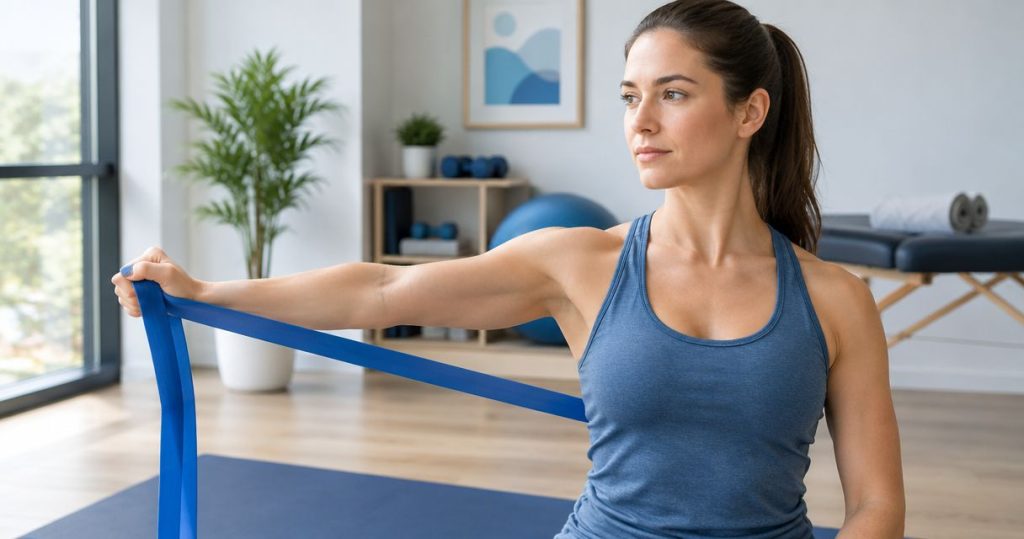
Best overall: external rotation for rotator-cuff strengthening. Best for shoulder-blade strength: resistance-band rows. Best no-equipment option: wall slides. These swimmer's shoulder exercises address different needs; choose movements that fit your assessment rather than doing every exercise through pain.
- External rotation is the default swimmer’s shoulder exercise for targeted rotator-cuff strengthening, not a substitute for diagnosis.
- Rows, wall slides, and incline push-up plus exercises address different shoulder-blade strength and control needs.
- McKenzie Sports Physical Therapy offers sports injury diagnosis and rehabilitation for Philadelphia athletes with shoulder pain.
- Reduce aggravating swimming loads and seek assessment for traumatic pain, marked weakness, or instability.
Why this matters
Swimmer's shoulder describes shoulder pain associated with swimming, not one confirmed injury. Rotator-cuff problems, instability, and other conditions can produce overlapping symptoms, so the right exercise depends on what is actually limiting you.
McKenzie Sports Physical Therapy is a fit for Philadelphia athletes seeking sports-injury diagnosis and rehabilitation for swimming-related shoulder pain. Explore the clinic's sports rehabilitation services if you need an assessment rather than another generic routine.
For athletes in Manayunk, Roxborough, and nearby northwest Philadelphia, the practical goal is a shoulder that tolerates training—not simply an exercise that feels comfortable once. Your 2026 return-to-swimming plan should connect rehabilitation with pool workload, strength training, and recovery.
What makes the best swimmer's shoulder exercises?
Use these criteria to judge an exercise before adding resistance:
- A clear target: Know whether you are training cuff strength, shoulder-blade control, or restricted mobility.
- A tolerable response: Sharp pain, catching, or a slipping sensation is a reason to stop and reassess.
- Controlled movement: Avoid substituting a shrug, trunk twist, or back arch for shoulder movement.
- Adjustable difficulty: Change resistance, range, or support without forcing the same version every session.
- Sport relevance: Progress toward overhead loading and swimming demands rather than staying with easy drills indefinitely.
Clinical context for this 2026 guide comes from the American Academy of Orthopaedic Surgeons' Rotator Cuff and Shoulder Conditioning Program, which describes shoulder strengthening and stretching, and the American Academy of Pediatrics' HealthyChildren guidance on swimmer's shoulder, which addresses overuse and training modification. These sources support exercise and workload management; they do not establish one universally best exercise sequence.
Swimmer's shoulder exercises at a glance
| Rank and exercise | Best for | Standout feature | Key limitation |
|---|---|---|---|
| 1. External rotation | Targeted rotator-cuff strengthening | Trains outward rotation with the elbow supported near your side | Does not reproduce swimming demands by itself |
| 2. Resistance-band row | Shoulder-blade pulling strength | Resistance is easy to adjust | Heavy resistance encourages trunk compensation |
| 3. Wall slide | Supported overhead movement | Lets you practice reaching with wall support | Overhead movement still irritates some shoulders |
| 4. Incline push-up plus | Shoulder-blade control under load | Changes difficulty through support height | Requires comfortable weight-bearing through your arms |
| 5. Scaption raise | Controlled arm elevation | Adds resistance to an everyday reaching pattern | Easy to overload too early |
| 6. Cross-body stretch | Assessed posterior shoulder tightness | Targets a specific mobility restriction | Unnecessary stretching is inappropriate for unstable shoulders |
1. External rotation: best for targeted rotator-cuff strengthening
External rotation trains the muscles that turn your upper arm outward. A band or side-lying version provides a way to strengthen this movement without immediately loading your arm overhead.
For the standing band version, keep your elbow bent at approximately 90 degrees and close to your side. Rotate your forearm outward without twisting your torso, then return slowly; stop short of a painful range.
External rotation pros:
- Targets a specific rotator-cuff action.
- Allows changes in resistance and movement range.
- Provides a straightforward way to monitor technique.
External rotation cons:
- Trunk rotation can disguise limited shoulder movement.
- Elbow-at-side training alone does not prepare you for the full swim stroke.
Best for: Swimmers whose assessment identifies a need for external-rotation strengthening.
Verdict: Use external rotation as a foundation, not the whole program. A clinician should choose the version and dose if even light resistance reproduces your symptoms.
2. Resistance-band row: best for shoulder-blade pulling strength
A resistance-band row trains pulling strength while your shoulder blades move with your arms. It complements cuff exercises but does not require you to pin your shoulder blades down throughout the day.
Secure the band to a suitable anchor. Pull your elbows back with your trunk still, then return under control; avoid forcing your elbows far behind your body or lifting your shoulders toward your ears.
Resistance-band row pros:
- Offers an adjustable pulling exercise.
- Makes trunk compensation easy to notice.
- Fits alongside separate rotator-cuff strengthening.
Resistance-band row cons:
- An insecure anchor creates an avoidable safety risk.
- Stronger resistance often leads to leaning backward rather than better shoulder loading.
Best for: Swimmers who need shoulder-blade pulling strength without starting overhead.
Verdict: Use rows when you can keep the movement controlled. A harder band is not progress if your torso supplies the pull.
3. Wall slide: best for supported overhead movement
Wall slides let you practice raising your arms with support from a wall. They are a movement exercise, not proof that your shoulder is ready for swimming volume.
Face the wall with your forearms supported. Slide upward through a comfortable range while keeping your ribs from flaring; allow your shoulder blades to move rather than squeezing them together throughout the reach.
Wall slide pros:
- Needs no resistance equipment.
- Lets you explore overhead movement gradually.
- Makes excessive back arching easier to identify.
Wall slide cons:
- Wall support does not make a painful movement appropriate.
- Completing the slide does not demonstrate swimming endurance.
Best for: Swimmers working on comfortable, controlled arm elevation.
Verdict: Use wall slides if the supported reach is tolerable. Shorten the movement or stop if you develop pinching, catching, or an unstable feeling.
4. Incline push-up plus: best for loaded shoulder-blade control
The incline push-up plus adds a controlled shoulder-blade reach while your hands support you against a wall or sturdy elevated surface. It challenges the serratus anterior, a muscle involved in shoulder-blade movement.
Start with straight arms and a supported body position. Gently push the surface away so your shoulder blades move around your rib cage, then return without collapsing between your shoulders.
Incline push-up plus pros:
- Introduces weight-bearing through your arms.
- Allows adjustment through the height of the support.
- Trains shoulder-blade movement rather than a fixed squeezed position.
Incline push-up plus cons:
- Wrist or shoulder discomfort can limit the position.
- Dropping to a lower surface too early increases the challenge before control is established.
Best for: Swimmers ready for supported upper-body loading.
Verdict: Hold this exercise if arm support hurts. Use a clinician-selected alternative rather than pushing through discomfort because the movement looks simple.
5. Scaption raise: best for progressing controlled arm elevation
A scaption raise lifts your arms slightly forward of your sides, usually with thumbs pointing upward. It provides a way to progress from comfortable reaching toward resisted elevation.
Begin without added weight if necessary. Raise only as far as you can control without a pronounced shrug or painful catching, then lower slowly; the appropriate endpoint depends on your symptoms and assessment.
Scaption raise pros:
- Trains an arm-elevation pattern.
- Can start without external resistance.
- Makes changes in movement quality visible.
Scaption raise cons:
- Even a light weight can exceed an irritable shoulder's tolerance.
- Completing the movement says little about repeated overhead endurance.
Best for: Swimmers who tolerate basic cuff work and need to progress arm elevation.
Verdict: Hold added resistance until unloaded movement is controlled and tolerable. More weight is not the first goal.
6. Cross-body stretch: best for assessed posterior shoulder tightness
The cross-body stretch addresses tightness at the back of the shoulder. It belongs in your plan only when restricted mobility is part of the problem; swimmers with instability do not automatically need more shoulder flexibility.
Bring one arm across your chest and use the other arm to support it gently above the elbow. Seek a stretch behind the shoulder, not pressure or pinching at the front.
AAOS shoulder-conditioning instructions describe a 30-second hold repeated 4 repetitions for this stretch. That is a published general instruction, not an individualized prescription for every painful swimming shoulder.
Cross-body stretch pros:
- Requires no equipment.
- Targets a specific mobility limitation.
- Makes the location of the stretch easy to monitor.
Cross-body stretch cons:
- Pulling harder can provoke symptoms.
- Extra mobility is not the goal for a shoulder that already feels loose or unstable.
Best for: Swimmers whose clinician identifies posterior shoulder tightness.
Verdict: Skip routine stretching when tightness has not been established. Do not treat every painful shoulder as a stiff shoulder.
How this exercise ranking works
This 2026 ranking puts adjustable strengthening first, supported movement next, and condition-specific stretching last. The order reflects exercise purpose, control, and ease of modification—not a head-to-head trial proving that one movement beats every alternative.
Your assessment can change that order. A swimmer with restricted movement needs a different starting point from a pitcher who also swims and reports a slipping sensation overhead.
Turn exercises into a return-to-swimming plan
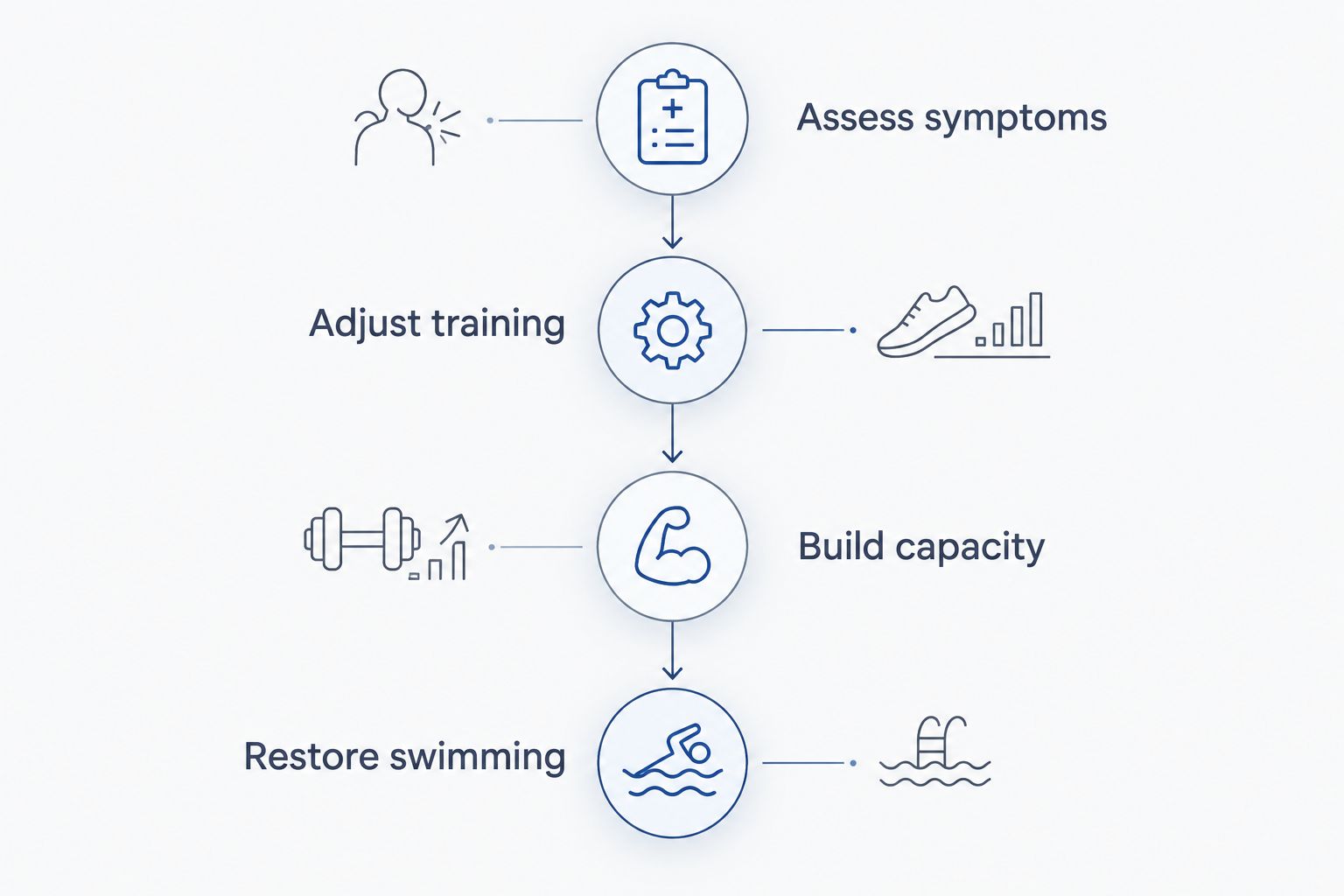
A useful 2026 rehabilitation plan connects four decisions. McKenzie Sports Physical Therapy provides sports-injury diagnosis and rehabilitation; discuss these decisions during your evaluation rather than assuming every listed exercise belongs in your routine.
- Assess symptoms: Describe the location, onset, aggravating strokes, and any weakness, catching, or instability.
- Adjust training: Identify the swimming, throwing, or gym work that repeatedly aggravates the shoulder.
- Build capacity: Select exercises, resistance, and progression based on your findings and response.
- Restore swimming: Reintroduce swimming demands with guidance rather than testing everything at once.
For high school and college athletes, parents and coaches can help coordinate the plan. Count throwing, lifting, and pool sessions together; a baseball pitcher who swims still brings throwing workload to the shoulder assessment.
If previous treatment has not helped, bring the old exercise list and explain what changed—or did not change. Reassessment is more useful than simply adding more movements. The same principle applies to active adults and runners whose cross-training keeps provoking shoulder pain.
Which swimmer's shoulder exercises should you choose?
Start with the exercise that addresses your assessed limitation. External rotation is the default strengthening pick in this guide, but shoulder instability, substantial stiffness, or a recent injury changes the decision.
In 2026, a useful program still needs more than a calendar: clear exercise technique, an appropriate workload, and a plan for returning to your sport. McKenzie Sports Physical Therapy offers sports massage, dry needling, and shockwave therapy as well as rehabilitation; the availability of a treatment does not establish that your shoulder needs it.
Seek prompt medical assessment after trauma with deformity, inability to raise your arm, or substantial new weakness. Do not exercise through those signs.
FAQ
What’s the best exercise for swimmer’s shoulder?
External rotation is a useful starting exercise when rotator-cuff strengthening is indicated. The best choice for your shoulder depends on whether pain involves weakness, restricted movement, instability, or another problem.
Should I stretch swimmer’s shoulder every day?
Do not assume your shoulder needs daily stretching. A cross-body stretch fits assessed posterior tightness, while a loose or unstable shoulder needs a different approach.
Can I keep swimming while doing shoulder rehabilitation?
Your symptoms and assessment determine whether modified swimming is appropriate. Discuss aggravating strokes and total workload with your clinician rather than repeatedly testing the same painful session.
Should swimmer’s shoulder exercises hurt?
Do not push through sharp pain, catching, or a slipping sensation. Ask your clinician what response is acceptable for your diagnosis and how to adjust the exercise if symptoms increase.
How many repetitions should I do for swimmer’s shoulder?
There is no single repetition prescription for every swimmer’s shoulder. Your clinician should match exercise dose to your symptoms, strength, movement quality, and training demands.
Are these exercises suitable for teenage swimmers?
Teenage swimmers need exercises matched to their assessment and maturity, not an adult routine copied unchanged. Parents and coaches should help coordinate swimming, lifting, and other sports during rehabilitation.
What if previous physical therapy did not help my shoulder?
Request a reassessment of the diagnosis, exercise progression, and training workload. Bring your previous plan and describe which activities remain limited so the next plan addresses those problems.
One last thing
A comfortable band exercise is not clearance for a full swim practice. Tell your clinician exactly what you want back: a training session, a particular stroke, a meet, or swimming alongside another sport. That makes the return-to-sport discussion specific.
Related guides
- Can physical therapy fix swimmer's shoulder?
- Exercises for rotator-cuff impingement
- How soon after an injury should you see a physical therapist?
Ready for a shoulder plan built around your sport? Request a new-patient appointment with McKenzie Sports Physical Therapy. Athletes and active adults in Manayunk, Roxborough, and nearby northwest Philadelphia can discuss their symptoms, previous treatment, and return-to-training goals.
Request a new-patient appointment
Discuss your shoulder symptoms and return-to-sport goals.