
Best for rebuilding push-off: calf raises. Best for early movement: protected ankle pumps. Best for late-stage impact preparation: progressive hopping. The best physical therapy exercises for high ankle sprain depend on ankle stability, weight-bearing restrictions, and your current abilities—not a universal routine. This 2026 guide explains where each exercise fits and when to wait.
- Physical therapy exercises for high ankle sprain require a stability assessment before loading or stretching.
- Protected ankle pumps support early movement; calf raises rebuild push-off after weight-bearing clearance.
- Balance exercises and step-ups address control; hopping belongs in later return-to-sport rehabilitation.
- McKenzie Sports Physical Therapy provides sports injury diagnosis and rehabilitation for Philadelphia athletes and active adults.
Why this matters
A high ankle sprain affects the syndesmosis: the ligament complex connecting the tibia and fibula, your lower-leg bones. It differs from the more familiar sprain on the outside of the ankle. Treatment depends on whether that connection remains stable and whether a fracture or other injury is present.
McKenzie Sports Physical Therapy is a Philadelphia sports rehabilitation option for athletes and active adults recovering from injury. Its sports injury rehabilitation services include diagnosis and rehabilitation; your exercise plan should follow the findings of an individual assessment.
For athletes in Manayunk, Roxborough, and nearby northwest Philadelphia, the practical question is not simply whether you can walk. It is whether your ankle can tolerate the demands of running, pitching, landing, or changing direction.
What makes the best high ankle sprain exercises?
Use these criteria to evaluate a rehabilitation plan in 2026:
- Stability first: Exercise selection respects the diagnosis, surgical instructions, and any boot or weight-bearing restrictions.
- A clear purpose: Each exercise addresses movement, strength, balance, or sport demands—not just fatigue.
- Controlled loading: Resistance and difficulty match your current ability without forcing painful rotation.
- A measurable progression: Better walking, movement quality, strength, and task tolerance guide advancement.
- Sport relevance: The later stages prepare you for your actual position, event, or training demands.
The clinical foundation is Williams and Allen’s Rehabilitation of Syndesmotic (High) Ankle Sprains, published in Sports Health in 2010. That review describes 3 rehabilitation phases: acute protection, subacute restoration, and advanced training. It also identifies limitations in the evidence; this ranking organizes exercise purposes rather than claiming one exercise outperforms every alternative.
High ankle sprain exercises at a glance in 2026
| Exercise | Best for | Standout feature | Key limitation |
|---|---|---|---|
| Protected ankle pumps | Early movement | Gentle movement without standing | Must stay within prescribed restrictions |
| Ankle isometrics | Initial muscle activation | Muscle effort without visible ankle movement | Direction and force need individual selection |
| Calf raises | Rebuilding push-off | Progression from seated to standing loading | Standing versions require loading clearance |
| Supported balance | Restoring standing control | Adjustable hand support and stance | Does not establish running readiness |
| Step-ups | Controlled single-leg loading | Links strength to everyday stepping | Height and technique change ankle demand |
| Progressive hopping | Late-stage impact preparation | Introduces takeoff and landing demands | Inappropriate during protected healing |
1. Protected ankle pumps: best for early movement
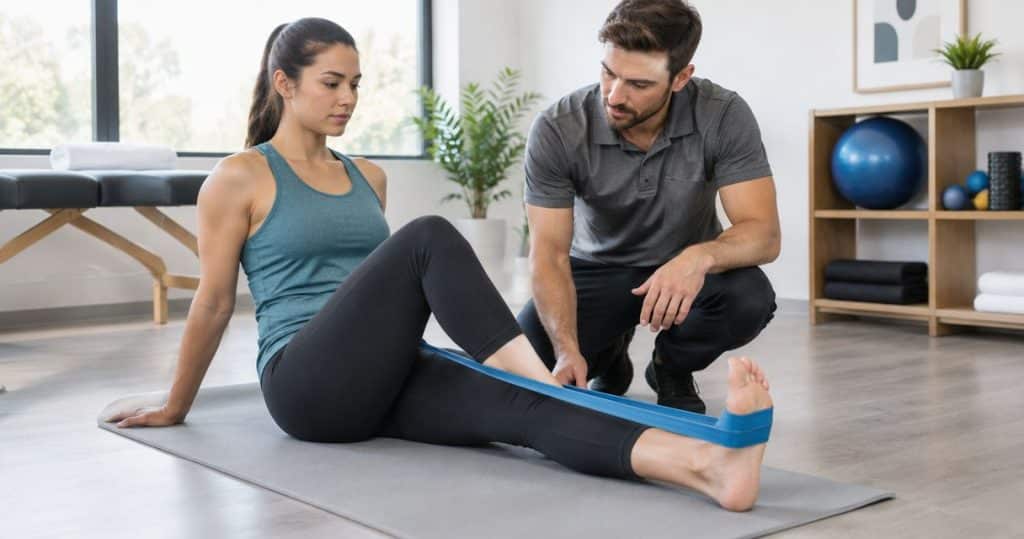
Protected ankle pumps involve gently pointing your foot down and bringing it back toward you while seated or lying down. Your clinician determines whether you should remove a boot and how much movement is appropriate. Do not force the ankle upward or add outward twisting to make the movement feel stronger.
Best for: Athletes cleared for gentle ankle movement who are not ready for substantial standing exercise.
Ankle pump pros:
- Introduce movement without requiring standing.
- Make it easy to notice which direction provokes symptoms.
- Fit into a protected rehabilitation phase when permitted.
Ankle pump cons:
- Do not rebuild the strength needed for running.
- Forced upward motion can stress an injured syndesmosis.
Move smoothly rather than chasing a stretch. If your instructions require immobilization, those instructions take priority over this exercise list.
Verdict: Hold within the clinician-approved movement range; skip forced stretching.
2. Ankle isometrics: best for initial muscle activation
An isometric exercise contracts a muscle without visible joint movement. For an ankle exercise, that can mean gently pressing the foot against a fixed surface while keeping the ankle still. Your physical therapist should select the direction, resistance, and position.
Best for: Early strengthening when movement or loading remains restricted but muscle contraction is permitted.
Ankle isometric pros:
- Allow muscle effort without repeated ankle movement.
- Offer adjustable resistance.
- Help separate controlled muscle activation from painful motion.
Ankle isometric cons:
- A motionless ankle does not guarantee a stress-free ligament.
- Isometrics alone do not restore strength through a movement range.
Avoid improvising strong outward or twisting resistance. If an exercise produces pain above the ankle joint, stop and have the setup reviewed rather than pressing harder.
Verdict: Hold at the prescribed effort; wait for clearance before adding resistance.
3. Calf raises: best for rebuilding push-off strength
Calf raises train the muscles that lift your heel and contribute to walking and running push-off. Rehabilitation can progress from seated heel raises to supported standing versions, then more demanding loading. That sequence is not permission to advance independently.
Best for: Rebuilding calf strength after your clinician clears the relevant level of weight bearing.
Calf raise pros:
- Connect directly to the push-off demands of walking and running.
- Offer seated, supported, and single-leg variations.
- Make compensations such as shifting away from the injured side visible.
Calf raise cons:
- Standing versions can exceed an early loading restriction.
- Successful heel raises do not prove readiness for cutting or landing.
Keep the movement controlled and avoid rolling the foot outward to finish. A runner with recurring symptoms needs more than the ability to complete the movement; loading tolerance and technique both matter.
Verdict: Wait for loading clearance, then progress calf raises rather than rushing to single-leg repetitions.
4. Supported balance: best for restoring standing control
Balance exercises challenge your ability to maintain alignment over the foot. Start with the stance and hand support your clinician selects, using a stable surface. A wobble board is not automatically better than the floor.
Best for: Athletes rebuilding standing control after weight bearing is permitted.
Supported balance pros:
- Allow difficulty changes through hand support and stance.
- Reveal excessive gripping, swaying, or avoidance of the injured side.
- Prepare for more demanding single-leg tasks.
Supported balance cons:
- Unstable surfaces can introduce unwanted twisting.
- Standing still does not reproduce the demands of sprinting or landing.
For a high school athlete, parents can help keep the exercise area clear and follow the prescribed setup. Do not turn balance practice into a competition to tolerate more pain or instability.
Verdict: Hold on stable ground until you demonstrate control; wait before adding unstable equipment.
5. Step-ups: best for controlled single-leg loading
Step-ups involve placing your foot on a stable platform and lifting your body onto it. The exercise links ankle loading with knee and hip control. Step height, hand support, and speed all change the demand.
Best for: Moving from basic standing strength toward controlled functional loading.
Step-up pros:
- Connect rehabilitation with stair climbing.
- Allow gradual changes in height and support.
- Expose pushing off excessively with the uninjured leg.
Step-up cons:
- A higher step requires more ankle movement and effort.
- Good stepping technique does not establish impact tolerance.
Use a height that allows a smooth ascent without a sharp pinch above the ankle or a large push from the trailing foot. Lowering exercises can be added separately when your clinician considers them appropriate.
Verdict: Hold at a controlled height; wait before adding speed or external weight.
6. Progressive hopping: best for late-stage impact preparation
Hopping introduces takeoff, landing, and repeated impact. A clinician can progress from simpler landing tasks to single-leg, directional, and sport-specific work. Hopping is a late-stage exercise—not a home test to find out whether the ligament has healed.
Best for: Athletes cleared for impact who need preparation for running, jumping, or changing direction.
Progressive hopping pros:
- Introduce impact beyond ordinary walking demands.
- Allow observation of landing control and confidence.
- Connect rehabilitation with sport-specific movement.
Progressive hopping cons:
- Introduce impact and rotational demands unsuitable for protected healing.
- Passing an isolated hop task does not establish full-game readiness.
A pitcher needs preparation for both drive-leg and landing-leg demands. A runner needs tolerance for repeated strides, while a field-sport athlete also needs acceleration, braking, and direction changes.
Verdict: Wait until your clinician clears impact; skip self-directed hop testing during early recovery.
When swelling means reassessment, not harder exercise
Persistent swelling in one ankle does not identify the injured structure or prove that exercise is the right next step. New or increasing swelling, worsening walking tolerance, or pain extending above the ankle should prompt reassessment rather than an automatic increase in repetitions.
Seek urgent assessment for obvious deformity, a cold or numb foot, severe worsening pain, or concern about a fracture. New calf swelling or tenderness also needs prompt medical attention; chest pain or shortness of breath requires emergency care.
The Ottawa Ankle Rules include inability to take 4 steps as one factor in deciding whether ankle imaging is needed after an acute injury. The American College of Radiology’s Appropriateness Criteria: Acute Trauma to the Ankle, revised in 2020, describes this imaging framework. Being able to walk does not rule out a syndesmotic injury.
If you are unsure what needs evaluation, the guide to signs of a severe ankle sprain addresses that decision. Do not repeatedly twist or squeeze the ankle to diagnose yourself.
How to progress without chasing a recovery date
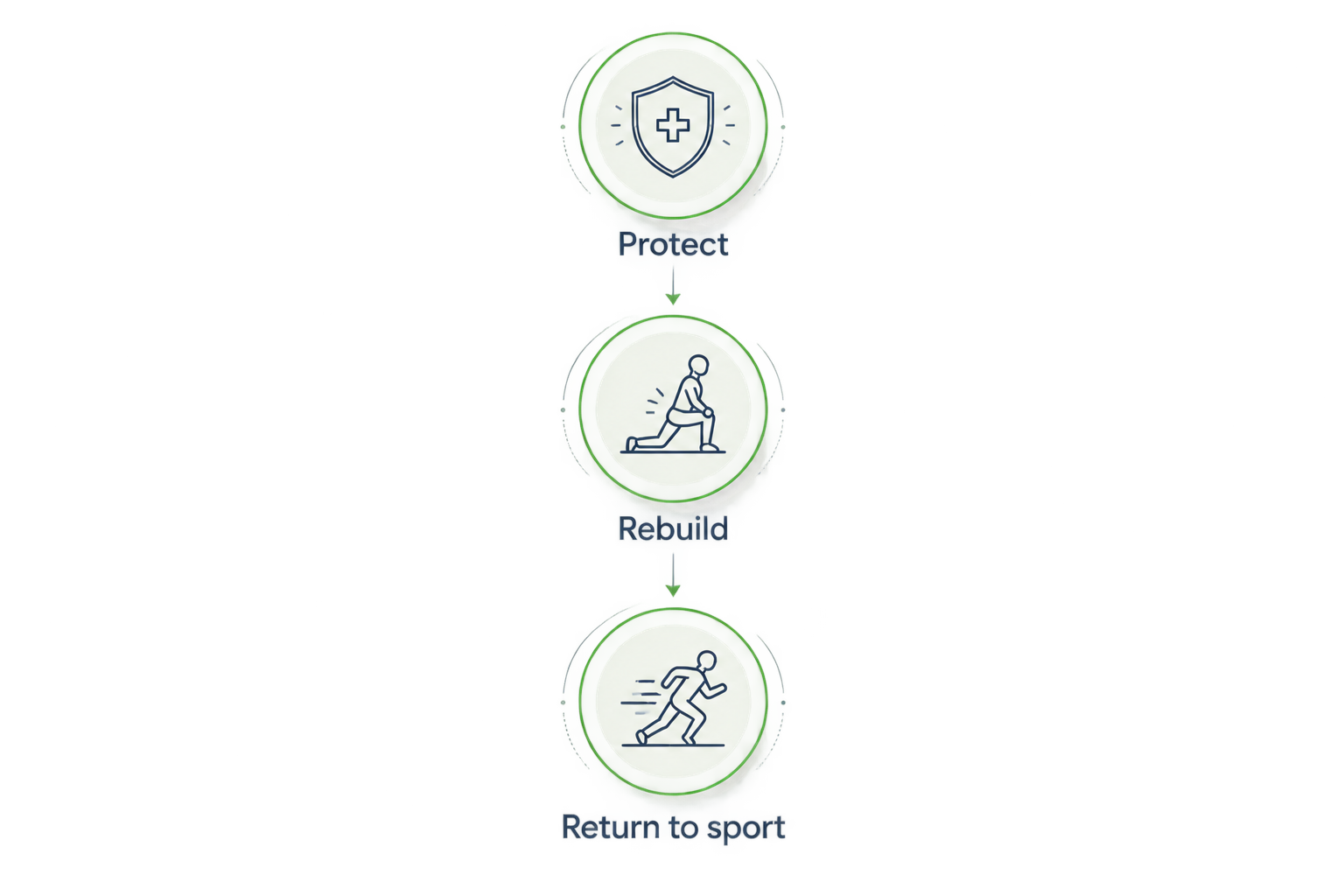
A practical 2026 plan follows your demonstrated abilities rather than an online calendar. Williams and Allen’s rehabilitation framework supports progression from protection through strengthening to advanced activity; the exact exercises depend on injury severity and response.
Protect
Follow boot, brace, movement, and weight-bearing instructions. Ask which exercises are permitted and what symptoms should trigger a call. Surgical instructions take priority over general rehabilitation advice.
Rebuild
Restore walking quality, appropriate ankle movement, strength, and balance. Change exercise difficulty deliberately instead of increasing resistance, range, and speed together. Report symptoms that worsen during activity or remain worse afterward.
Return to sport
Build toward running, jumping, braking, and sport-specific tasks after clearance. For baseball players, this includes more than jogging: pitching, fielding, and base running place different demands on the ankle. Coordinate school or college participation restrictions with the treating clinician and athletic trainer.
How these exercises were ranked
This 2026 ranking assigns each exercise a distinct rehabilitation purpose; it is not a prescription to perform every exercise together. Protected movement ranks first for early use, while hopping belongs last because it requires greater loading capacity and clearance.
The clinical sources support staged rehabilitation, not a universal exercise winner or guaranteed recovery timeline. McKenzie Sports Physical Therapy offers sports injury diagnosis and rehabilitation; an individual assessment determines which stage and exercises fit you.
If previous treatment has not helped, bring the actual exercise list and explain what happened during walking, training, and afterward. That gives the next assessment a clearer starting point without assuming the earlier care was wrong.
Which high ankle sprain exercises should you choose?
Choose the exercise that addresses your current limitation without violating protection instructions. Early rehabilitation emphasizes permitted movement and muscle activation; later rehabilitation adds strength, control, and impact preparation.
In 2026, the practical default remains assessment before progression. Do not choose hopping because it looks athletic or force stretching because the ankle feels stiff. Neither appearance nor effort establishes readiness.
FAQ
What’s the best exercise for a high ankle sprain?
The best exercise depends on ankle stability, loading restrictions, and rehabilitation stage. Protected ankle pumps can fit early movement, calf raises address push-off strength, and hopping belongs later after impact clearance.
Can I start high ankle sprain exercises while wearing a boot?
Only perform exercises that your treating clinician permits while you are prescribed a boot. Do not remove the boot for ankle exercises or increase weight bearing unless your instructions allow it.
Should I stretch a high ankle sprain?
Do not force stretching across a painful high ankle sprain. Upward ankle movement and outward rotation can stress the syndesmosis, so your clinician should guide movement range and stretching progression.
How many sets and repetitions should I do?
Your clinician should prescribe sets, repetitions, resistance, and frequency for your injury stage. A generic exercise dose cannot account for stability, surgery, weight-bearing restrictions, or your response to loading.
Can I run if walking no longer hurts?
Pain-free walking alone does not establish readiness to run. Running requires additional strength, impact tolerance, and movement control assessed within a return-to-sport plan.
Is a high ankle sprain the same as an ATFL sprain?
No. A high ankle sprain affects the syndesmosis between the tibia and fibula, while an ATFL sprain affects a ligament on the outside of the ankle; assessment and protection needs can differ.
Can a high ankle sprain require surgery instead of exercises?
Yes, an unstable syndesmotic injury can require surgical treatment. Exercises do not replace assessment for instability, an associated fracture, or other injuries.
One last thing
Walking without pain is a milestone, not return-to-sport clearance. Bring your sport, position, training schedule, and previous exercise plan to the appointment so rehabilitation can address the tasks you actually need back.
Related guides
- What to expect at a sports injury clinic visit
- Physical therapy in Manayunk: an athlete’s guide
- High school sports and return-to-play clearance
For an ankle injury affecting training or everyday activity in Manayunk, Roxborough, or nearby northwest Philadelphia, request a new-patient appointment with McKenzie Sports Physical Therapy to assess the injury and plan your next rehabilitation step.