


An ankle injury needs prompt medical assessment if you cannot take four steps, have tenderness directly over ankle or foot bones, or develop substantial swelling, pain above the ankle, or repeated giving way. A crooked ankle, an open wound, or a cold, pale, or numb foot needs emergency care; swelling and bruising alone cannot tell you whether a ligament is partly torn, completely torn, or accompanied by a fracture.
- How do I know if my ankle sprain is severe? Walking difficulty, bone tenderness and instability warrant assessment.
- A deformed ankle or cold, numb foot needs emergency care, not a home walking test.
- Being able to walk does not rule out a fracture or significant ligament injury.
- McKenzie Sports Physical Therapy offers sports injury evaluation and rehabilitation for Philadelphia athletes and active adults.
How do I know if my ankle sprain is severe?
Look at where the pain is, whether you can bear weight, and whether the ankle feels stable. Do not judge severity by the size or color of the bruise. A clinical examination determines whether you need imaging, protection, rehabilitation, or referral.
For athletes considering sports injury rehabilitation services, McKenzie Sports Physical Therapy provides sports injury diagnosis and rehabilitation in Philadelphia. Urgent warning signs come first, before an exercise plan.
| Finding after an ankle injury | What it means | Best next step |
|---|---|---|
| Visible deformity, open wound, or cold or numb foot | Possible serious bone, joint, nerve, or circulation injury | Emergency assessment |
| Inability to take four steps or focal bone tenderness | A fracture needs consideration | Prompt in-person assessment for possible imaging |
| Pain above the ankle, especially after twisting | Possible injury to the ligaments connecting the lower-leg bones | Clinical assessment before returning to sport |
| Persistent giving way or difficulty pushing off | Function remains impaired | Examination and a rehabilitation plan |
| Improving symptoms with comfortable walking | Progress is encouraging, but does not establish the injury grade | Monitor symptoms and restore function progressively |
Why this matters in 2026
A runner can mistake a fracture for a sprain. A baseball player can walk comfortably but still struggle to plant, pivot, or push off. Walking ability and readiness for sport are different decisions.
For high school and college athletes, pressure to return can make symptoms easy to minimize. Parents should pay attention to limping, avoidance of stairs, and swelling after ordinary activity—not just whether an athlete says the ankle feels better.
This 2026 guide uses established clinical assessment principles rather than a symptom score. It cannot diagnose your ankle remotely, and no checklist replaces examination when warning signs are present.
Which ankle symptoms need emergency care?
Seek emergency care for an ankle that looks displaced, an open injury, or a foot that becomes cold, pale, persistently numb, or difficult to move. Severe, rapidly worsening pain with marked tightness or swelling also needs urgent medical evaluation.
Do not repeatedly test walking, stretch a visibly deformed ankle, or try to straighten it yourself. Protect the injured area and arrange medical help.
A different group of symptoms calls for prompt assessment even when there is no obvious emergency:
- You cannot bear weight or take four steps.
- Pain is concentrated directly over an ankle or foot bone.
- Pain extends above the ankle joint after a twisting injury.
- The ankle repeatedly buckles or cannot support ordinary movement.
- Pain or swelling is worsening rather than settling.
These findings do not prove a severe sprain. They mean a clinician needs to consider fracture, a high ankle sprain, or another injury before treating it as a routine ligament strain.
When does an ankle injury need an X-ray?
Clinicians use the Ottawa Ankle Rules to help decide whether radiographs are appropriate after an acute injury. The rules screen for possible fracture; they do not grade ligament damage or clear an athlete to play.
For pain around the ankle bones, the assessment includes tenderness along the posterior edge or tip of either ankle bone, covering the lowest 6 centimeters, and the ability to bear weight. Inability to take 4 steps both immediately after the injury and during assessment is an imaging criterion.
For midfoot pain, clinicians also check specific bones, including the navicular and the base of the fifth metatarsal. Pointing generally to the outside of your foot is not precise enough to apply the rule yourself.
Important limits:
- Walking does not exclude every fracture. Bone tenderness can still justify imaging.
- An X-ray does not show the full ligament injury. A normal result does not establish that the ankle is ready for sport.
- The rules require clinical judgment. Age, sensation, communication, and other circumstances affect whether they apply.
The American College of Radiology's Acute Trauma to the Ankle guidance supports using clinical findings and the Ottawa criteria to guide initial imaging. For a 2026 injury, the practical decision remains the same: get examined when fracture signs are present rather than ordering your own return-to-play test.
What do ankle sprain grades actually mean?
Clinicians commonly describe lateral ankle sprains using three grades. You cannot assign a reliable grade from a photograph, bruise, or pain rating. Examination considers tenderness, swelling, ligament stability, and function; early pain and guarding can limit testing.
| Injury grade | General description | Practical limitation |
|---|---|---|
| Grade 1 | Mild ligament injury without substantial mechanical instability | Walking can still hurt, and sport demands can exceed current capacity |
| Grade 2 | Partial ligament tearing with greater functional impairment | Symptoms overlap with other grades and associated injuries |
| Grade 3 | Complete ligament rupture, often with substantial instability | Treatment depends on the whole injury, not the grade alone |
A higher grade generally represents greater ligament disruption, but the label is not a complete treatment plan. A relatively small sprain can still require rehabilitation when balance, strength, or confidence remains impaired.
A complete tear also does not automatically mean surgery. Clinical guidelines support nonsurgical management for many lateral ankle sprains, with protection and exercise selected according to severity and examination findings.
Why ankle sprain symptoms vary
The same-looking bruise can accompany different injuries. These factors explain why appearance alone is a poor severity test:
- Injury location: A lateral ankle sprain affects different structures from a high ankle sprain or midfoot injury.
- Ligament involvement: The number of injured ligaments and degree of disruption affect stability.
- Associated injury: A fracture, tendon injury, or cartilage injury can change the assessment and treatment.
- Previous sprains: Existing instability or movement deficits can complicate a new injury.
- Activity demands: Jogging straight ahead differs from cutting, landing, or planting to throw.
- Time since injury: Swelling, bruising, and tolerance for examination can change after the initial event.
Tell the clinician exactly how the injury happened. Landing on another player's foot, twisting while sliding, and feeling pain during a running push-off provide different clues.
What should I do before my ankle is assessed?
Protect the ankle from another twist and stop activities that increase pain or instability. Avoid using a sprint, hop, or hard throw from the mound as a test of whether the injury is serious.
If you cannot walk without a pronounced limp, ask a clinician whether you need a walking aid or other support. Do not force weight through the ankle simply because someone called it a sprain.
Elevation and carefully applied compression can help manage swelling. Compression should not cause numbness, increased pain, or changes in foot color; remove it and seek advice if those occur.
Cold application can provide short-term comfort, but protect your skin and do not treat temporary pain relief as clearance to exercise. Ask a clinician or pharmacist about medication suitability, especially if you have other medical conditions or take prescription medicines.
For straightforward lateral sprains, the JOSPT clinical practice guideline supports progressive weight bearing with appropriate external support and structured exercise. More severe injuries sometimes need a period of greater protection, so copying another athlete's plan is not a substitute for assessment.
How does return-to-sport rehabilitation work?
A useful rehabilitation plan connects examination findings to the movements your sport requires. McKenzie Sports Physical Therapy offers sports rehabilitation for athletes and active adults; your evaluation should establish what needs protection, what needs training, and what warrants medical referral.
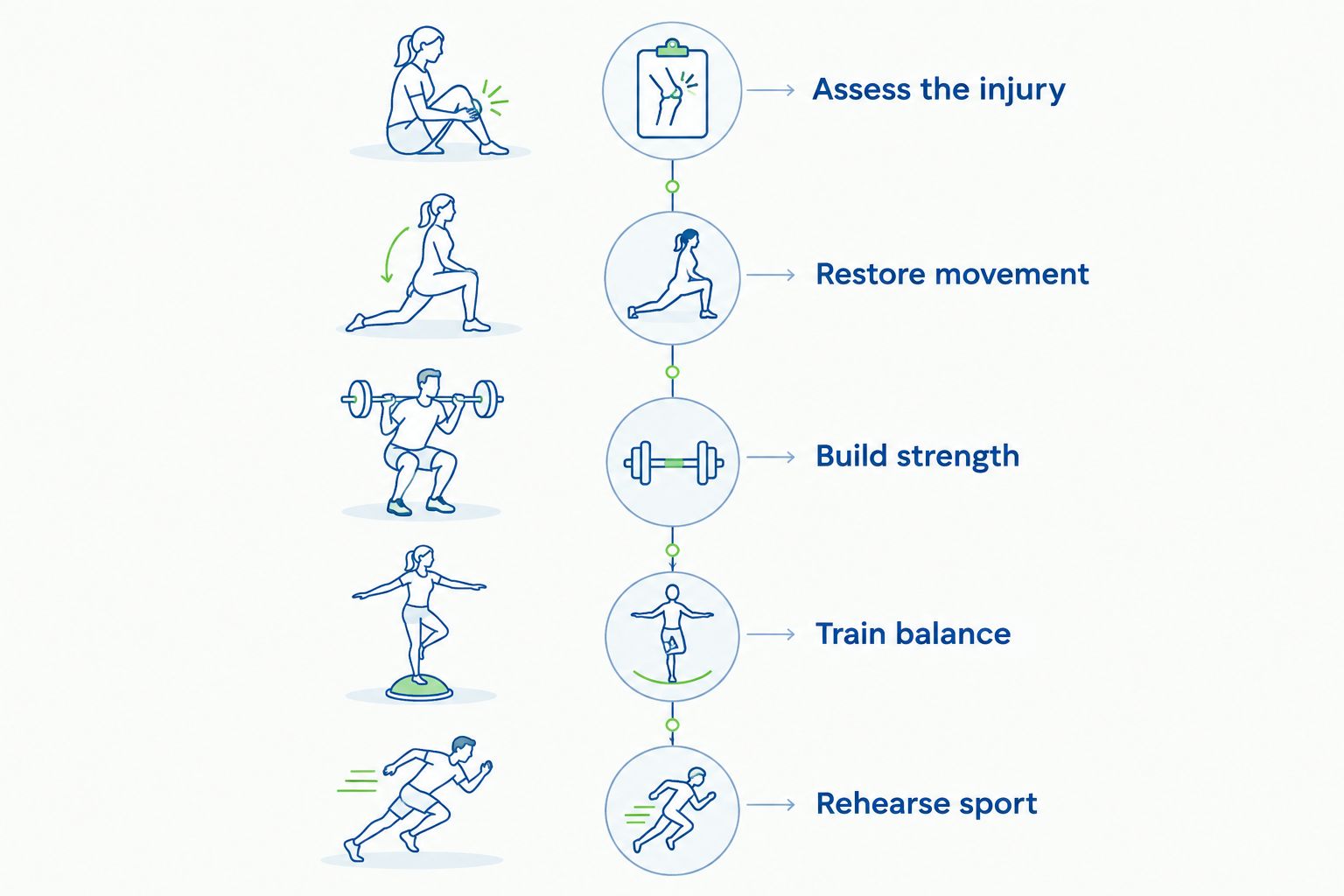
A practical progression includes:
- Assess the injury. Identify pain location, walking limitations, swelling, and findings that require imaging or referral.
- Restore movement. Address ankle motion and walking mechanics without ignoring symptom response.
- Build strength. Progress ankle and calf loading to match current capacity.
- Train balance. Restore control during single-leg tasks before adding more demanding movement.
- Rehearse sport. Progress toward running, hopping, landing, cutting, or throwing-related footwork as appropriate.
The PAASS return-to-sport consensus, published in the British Journal of Sports Medicine, organizes assessment into 5 domains: pain, ankle impairments, athlete perception, sensorimotor control, and sport performance. It includes pain during sport and over the previous 24 hours, not just how the ankle feels during an appointment.
For a runner in Manayunk or Roxborough, that means considering the ankle's response after a run as well as during it. For a pitcher, it means looking beyond comfortable walking to the demands of landing, bracing, and pushing off. Those examples guide assessment; they are not self-clearance tests.
What if previous ankle treatment has not helped?
Recurring symptoms deserve a reassessment, not blame. Rest can reduce discomfort without restoring strength or balance, and an exercise plan that once fit your injury can need adjustment as your activity changes.
Bring your previous exercises, imaging reports, and a clear account of what still fails. Useful details include pain on stairs, repeated rolling, swelling after practice, or difficulty controlling a single-leg landing.
Ask what findings explain the symptoms and how progress will be measured. Persistent focal pain, locking, or unexplained difficulty bearing weight can require further medical investigation rather than simply more of the same exercises.
McKenzie Sports Physical Therapy is a sports rehabilitation option for Philadelphia athletes who need injury evaluation and a return-to-sport plan. The clinic offers dry needling, shockwave therapy, and sports massage, but the choice of treatment should follow the diagnosis—not replace it. No individual treatment guarantees recovery.
Can I have a serious ankle injury if I can still walk?
Being able to take 4 steps does not rule out a serious injury. Focal bone tenderness, pain above the ankle, or ongoing instability still warrants examination; comfortable walking also does not demonstrate readiness to run or compete.
Should I wait for the bruising to appear?
Do not wait for bruising when you have emergency symptoms or difficulty bearing weight. Bruising can develop after the injury and cannot reliably distinguish a partial ligament tear from a complete tear or fracture.
How should I judge my ankle's response after exercise?
Consider symptoms over the previous 24 hours, not only during exercise. The PAASS framework includes that period when evaluating pain; increased swelling, limping, or reduced function afterward is information your clinician needs before progressing activity.
FAQ
How do I know if my ankle sprain is severe enough to see a doctor?
Seek prompt assessment if you cannot bear weight, have focal bone tenderness, pain above the ankle, or substantial instability. A deformed ankle, open wound, or cold or numb foot needs emergency care.
Can I walk on an ankle with a torn ligament?
Some people can walk despite a torn ankle ligament. Walking ability alone does not establish the extent of tearing or readiness for sport.
Does a lot of swelling mean my ankle ligament is completely torn?
Substantial swelling does not prove a complete ligament tear. Swelling overlaps across injury types, so clinicians also assess pain location, stability, function, and possible fracture signs.
Do I need an MRI for a severe ankle sprain?
An MRI is not automatically the first test for a suspected severe sprain. Examination and, when indicated, X-rays guide initial decisions; persistent symptoms or concern about associated injury can justify further imaging.
Is a high ankle sprain the same as a regular ankle sprain?
A high ankle sprain affects the ligaments connecting the lower-leg bones near the ankle, rather than the usual outer ankle ligaments. Pain above the joint after twisting warrants assessment because protection and rehabilitation needs can differ.
Can my teenager return to baseball when the limp is gone?
The absence of a limp is not enough to clear a teenager for baseball. Return decisions should consider strength, balance, confidence, and sport-specific tasks, with the treating clinician and school requirements guiding clearance.
What if my ankle keeps rolling after the original sprain?
Repeated rolling warrants assessment for ongoing instability and other contributors. Rehabilitation can address strength, balance, and movement control, while persistent or unusual symptoms can require additional investigation.
One last thing
An ankle that feels fine during warm-up can still respond poorly to a full practice. For your 2026 return-to-sport plan, record what you did, how the ankle felt, and whether walking or swelling changed afterward. That short record gives your clinician more useful information than repeatedly asking whether the ankle is healed.
The clinical basis for this 2026 guide includes the Ottawa Ankle Rules for fracture screening, ACR guidance on acute ankle trauma imaging, the JOSPT lateral ankle sprain clinical practice guideline, and the PAASS return-to-sport consensus. These sources support assessment and rehabilitation decisions; none provides a guaranteed recovery date for an individual athlete.
Related guides
- Can you walk on a sprained ATFL ligament?
- How soon after an injury should you see a physical therapist?
- High school sports physicals and return-to-play clearance
If ankle pain or repeated sprains are keeping you from running, baseball, or everyday activity in northwest Philadelphia, request a new-patient appointment with McKenzie Sports Physical Therapy.