

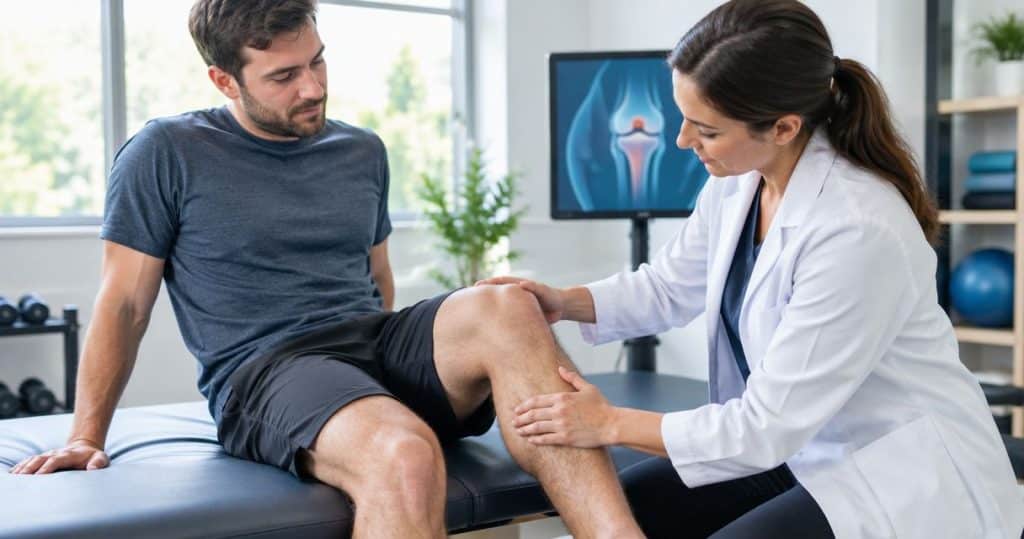
Yes, some meniscus tears can heal without surgery, and others can become less painful and more functional with rehabilitation even when the tear itself does not fully heal. The key distinction is whether your tear has healing potential and whether the knee has a displaced fragment, true locking, or another injury that needs prompt orthopedic assessment.
- Can a meniscus tear heal without surgery? Yes, but tear location, stability, and associated injuries affect the answer.
- Less pain does not prove the meniscus has healed; return to sport also requires strength and movement control.
- A knee that becomes physically stuck needs prompt assessment rather than repeated attempts to exercise through it.
- McKenzie Sports Physical Therapy offers sports injury diagnosis and rehabilitation for Philadelphia athletes and active adults.
Why this matters
An MRI report does not make the treatment decision by itself. Your symptoms, examination, tear pattern, and sport all matter. A runner with gradual knee discomfort needs a different discussion from a baseball player whose knee locks after a sudden pivot.
For athletes in Manayunk, Roxborough, and nearby northwest Philadelphia, the practical question is not simply whether you can avoid an operation. It is whether your knee can safely tolerate running, landing, throwing mechanics, or changing direction. Sports injury assessment and rehabilitation are among the clinic's services.
Can a meniscus tear heal without surgery?
Some tears can heal without surgery; successful nonsurgical treatment does not always mean the torn tissue has rejoined. Rehabilitation can improve strength, movement, and symptoms while a tear remains visible on imaging.
Each knee has 2 menisci, cartilage structures that help distribute load between the thighbone and shinbone. Their blood supply is not uniform. The American Academy of Orthopaedic Surgeons, in its OrthoInfo resource Meniscus Tears, explains that the outer portion has a richer blood supply than the inner portion, affecting healing potential.
| Treatment approach | Best for | Main benefit | Main limitation |
|---|---|---|---|
| Nonsurgical rehabilitation | Selected stable tears without a mechanical block | Builds function without an operation | Does not guarantee structural healing or eliminate a later surgical discussion |
| Meniscus repair | Selected repairable tears assessed by an orthopedic surgeon | Attempts to preserve and heal meniscal tissue | Requires surgery and protection during recovery; not every tear is repairable |
| Partial meniscectomy | Selected symptomatic tears when repair is unsuitable | Removes an unstable torn portion when indicated | Removes meniscal tissue and does not restore the original meniscus |
These are treatment categories, not interchangeable choices. An orthopedic clinician determines whether repair or removal is appropriate; a rehabilitation plan should reflect the diagnosis and any surgical restrictions.
Tears near the outer edge: greater healing potential
Clinicians commonly describe 3 vascular zones: red-red, red-white, and white-white. These labels describe relative blood supply, not a guarantee about your outcome. The outer red-red region has the strongest blood supply; the inner white-white region has little.
A stable tear near the outer edge has more biological healing potential than an inner-edge tear. However, location alone does not determine treatment. Tear size, direction, displacement, tissue quality, and associated ligament injury also matter.
Ask your clinician to explain where the tear sits and whether the torn segment is stable. That explanation is more useful than assuming every tear with the same MRI label needs the same treatment.
Inner or degenerative tears: function can improve without tissue healing
A tear in a poorly supplied region is less likely to heal back together on its own. That does not mean surgery is automatically necessary, especially when symptoms developed gradually and the knee is not mechanically blocked.
The ESCAPE randomized clinical trial's 5-year follow-up, published in JAMA Network Open, found exercise-based physical therapy was not inferior to arthroscopic partial meniscectomy for knee function in the studied population with degenerative meniscal tears. The finding supports rehabilitation as an initial option for that population—not for every traumatic sports injury.
A high school athlete with an acute displaced tear is not the same clinical situation as an adult with a degenerative tear. Evidence for degenerative tears should not be used to dismiss a potentially repairable athletic injury.
Displaced tears and locked knees: prompt assessment matters
True locking means the knee becomes physically blocked from moving through its usual range, particularly straightening. It is different from briefly hesitating because movement hurts. A displaced meniscal fragment is one possible cause, but an examination is needed to establish what is happening.
The AAOS clinical practice guideline on acute isolated meniscal pathology identifies displaced tears that restrict knee motion as situations that can benefit from early surgical intervention. Do not repeatedly force a stuck knee straight or use a workout to test whether it will release.
Seek urgent medical assessment after a significant injury if you cannot bear weight, have a visibly deformed knee, or develop marked swelling. A hot, red knee with fever also needs urgent assessment rather than a routine rehabilitation appointment.
Why meniscus healing and recovery vary
The decision is based on more than pain intensity. These factors help determine whether rehabilitation is appropriate and what it needs to address:
- Blood supply: The tear's location affects its capacity for biological healing.
- Tear pattern and stability: A displaced fragment or root injury requires a different assessment from a stable tear.
- Associated injury: Ligament damage, cartilage changes, and other sources of knee pain can change the plan.
- Knee function: Persistent loss of extension, repeated swelling, and giving way deserve reassessment.
- Sport demands: Distance running, pitching, catching, and cutting sports expose the knee to different loads.
- Response to rehabilitation: Progress in strength and activity tolerance matters more than simply completing appointments.
These factors explain why a teammate's recovery is not a reliable timeline for yours. Your clinician should connect the treatment recommendation to your examination and activity goals.
What does personalized return-to-sport rehabilitation involve?
A useful rehabilitation plan answers what you can do now, what you are building toward, and what would trigger a change in treatment. It should not end at a list of exercises.
If you are unsure when to arrange an assessment, the guide on how soon after an injury to see a physical therapist addresses that next step. Mechanical blocking and urgent warning signs require more immediate medical attention.
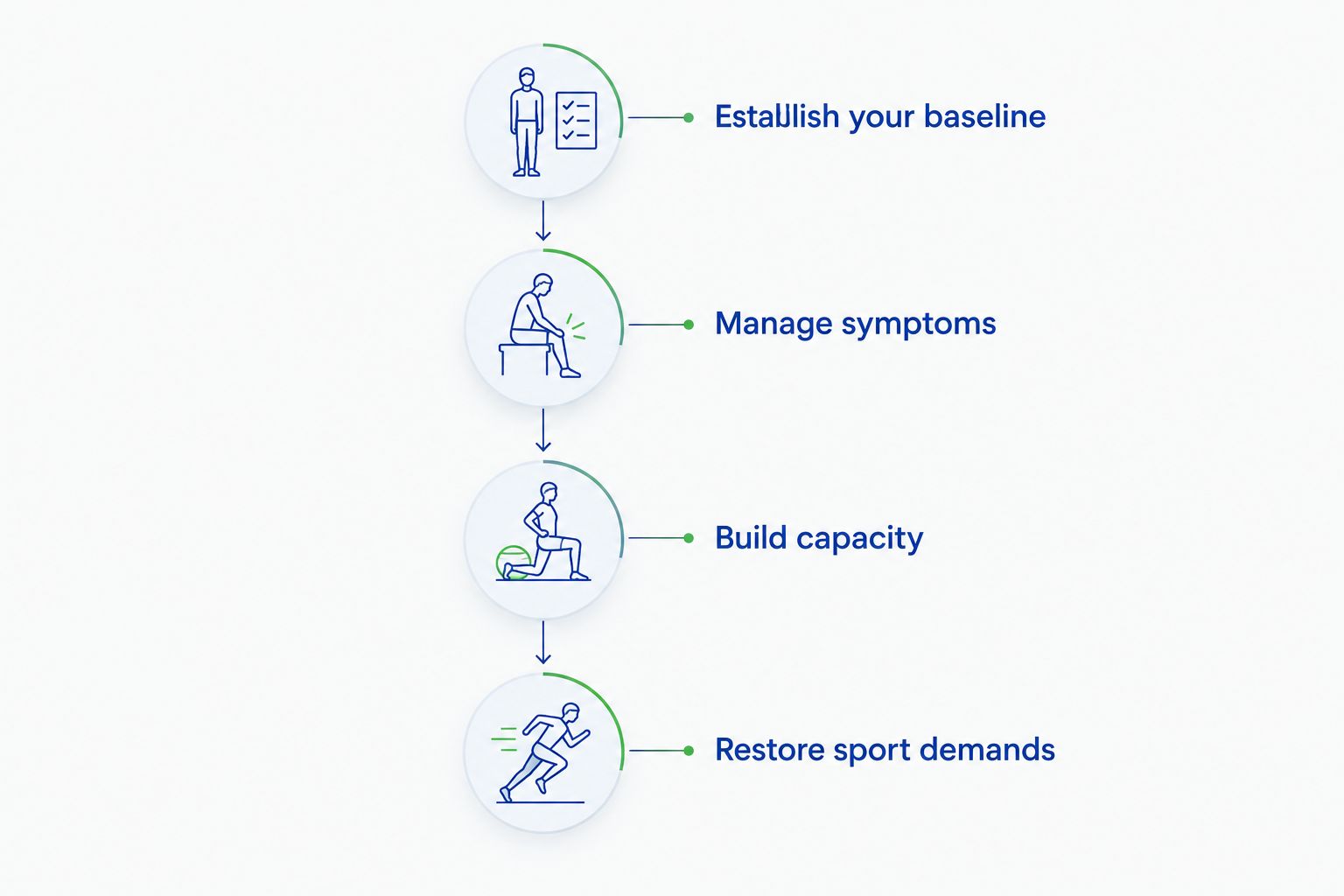
Establish your baseline
Assessment should consider how the injury happened, swelling, knee movement, strength, walking, and relevant sport tasks. Bring any imaging report and explain what currently stops you: stairs, squatting, acceleration, landing, or the morning after a run.
For a pitcher, describe which leg hurts and when symptoms occur during delivery. For a runner, explain whether discomfort starts during the run or appears afterward. These details help make the assessment specific rather than generic.
Manage symptoms
Early rehabilitation can include adjusting painful activities and working on comfortable movement. This is not the same as complete inactivity. Exercise selection depends on your examination and any restrictions from the treating clinician.
Do not force deep knee bending or twisting because an online routine says it is necessary. The right exercise is one you can perform within the plan without provoking a response that exceeds the clinician's agreed limits.
Build capacity
Progressive exercise can address thigh and hip strength, balance, and control of the injured leg. Your clinician should explain how to progress resistance and how to interpret symptoms during and after activity.
The limitation is straightforward: exercise cannot guarantee that a torn segment will reconnect. Its purpose is to improve the knee's capacity and help establish whether nonsurgical management is meeting your goals.
Restore sport demands
Returning to running is not the same as returning to sprinting, cutting, or competitive baseball. Rehabilitation should build toward the movements and fatigue demands that your sport requires, rather than treating comfortable walking as the finish line.
For high school and college athletes, parents and coaches need clear activity guidance. Ask which drills are permitted, which remain restricted, and who makes the final return-to-play decision. A competition date is a planning detail, not evidence that the knee is ready.
Can you walk with a meniscus tear?
You can sometimes walk with a meniscus tear, but walking does not establish that the tear is minor. A person can tolerate straight-line walking yet have pain, catching, or instability during twisting and deeper bending.
Use your clinician's guidance about weight bearing, particularly after a traumatic injury. If walking causes a pronounced limp, worsening pain, or increasing swelling, seek reassessment instead of treating step count as a recovery target.
Can you keep running or playing baseball?
Running or playing baseball requires more than a pain-free walk. Your clinician should assess swelling, motion, strength, control, and sport-specific tolerance before recommending unrestricted participation.
A pitcher needs to tolerate loading and transferring force through the legs. A catcher must manage repeated deep bending; a runner must tolerate repeated loading. Those demands justify different exercise progressions, even when the diagnosis sounds similar.
Avoid testing readiness through competition. A planned progression gives you and your clinician a clearer picture of how the knee responds before game-day intensity enters the equation.
What if previous treatment has not helped?
Persistent symptoms call for reassessment, not blame. Review whether the working diagnosis still fits, whether the knee has a mechanical restriction, and whether the exercise progression matched your actual sport demands.
Bring your previous exercise plan and describe what changed—or did not change. Useful information includes whether swelling returns after activity, whether you regained full straightening, and which exercises you could progress. That is more actionable than describing treatment only as unsuccessful.
McKenzie Sports Physical Therapy is for Philadelphia athletes and active adults seeking sports injury diagnosis and rehabilitation. Its sports rehabilitation services fit a discussion about returning to activity; they do not replace orthopedic assessment when a tear needs surgical consideration.
The clinic also offers dry needling, shockwave therapy, and sports massage. Those services should not be presented as methods that reconnect a torn meniscus. Ask what each proposed treatment is intended to address and how it supports the exercise plan.
Questions to bring to your appointment
You should leave the assessment understanding the decision, not just the diagnosis. Ask:
- Is the knee mechanically blocked, or is pain limiting movement?
- Does this tear need an orthopedic opinion before rehabilitation progresses?
- What activities can I continue, and what should I temporarily change?
- What improvements will show that rehabilitation is working?
- What findings would change the treatment plan?
For a student athlete, share the same guidance with the parent, athletic trainer, and relevant coach. Clear boundaries help prevent conflicting instructions between treatment, practice, and competition.
FAQ
Can a meniscus tear heal without surgery if the MRI shows a tear?
Yes, some tears can heal without surgery, while others improve functionally without complete tissue healing. The MRI must be interpreted alongside your symptoms, examination, tear pattern, and activity goals.
Does less knee pain mean my meniscus has healed?
No, less knee pain does not prove that the meniscus has healed. Strength, swelling, movement, and sport-specific tolerance also matter when deciding whether to progress activity.
Is physical therapy better than surgery for a meniscus tear?
Physical therapy is an appropriate initial option for many degenerative tears, but it is not better for every tear. A displaced tear, a mechanically blocked knee, or a potentially repairable traumatic injury requires a different discussion.
How long does a meniscus tear take to heal without surgery?
There is no single healing timeline that applies to every meniscus tear. Tear location, stability, associated injuries, and your response to rehabilitation determine the plan; symptom improvement and tissue healing are different outcomes.
Should I exercise if my knee locks?
Do not force exercise through a knee that becomes physically stuck. Seek prompt assessment to distinguish a mechanical block from movement limited by pain.
Can dry needling or shockwave therapy heal a torn meniscus?
Dry needling and shockwave therapy should not be presented as treatments that reconnect a torn meniscus. Ask your clinician what symptom or associated problem a proposed treatment is intended to address.
Where can I discuss sports rehabilitation in northwest Philadelphia?
McKenzie Sports Physical Therapy offers sports injury diagnosis and rehabilitation in Philadelphia. Athletes and active adults from Manayunk, Roxborough, and nearby neighborhoods can request a new-patient appointment to discuss assessment and next steps.
One last thing
Ask for a return-to-sport plan, not just permission to exercise. Being comfortable at rest and being ready for a hard landing, a pitching stride, or a demanding run are different milestones. Agree on what progress looks like and what would trigger another medical review.
Clinical references informing this 2026 guide include AAOS OrthoInfo's Meniscus Tears, the AAOS guideline on acute isolated meniscal pathology, and the ESCAPE trial follow-up in JAMA Network Open. Their scope differs: general tear education, acute isolated injuries, and degenerative tears should not be treated as identical evidence.
Related guides
- Can you avoid ACL surgery with physical therapy?
- High school sports physical to return-to-play clearance
- Cross-training exercises for injured runners
Request a new-patient appointment at McKenzie Sports Physical Therapy to discuss your knee symptoms, sport demands, and next steps.
Request a new-patient appointment
Discuss your knee symptoms and return-to-sport goals.