

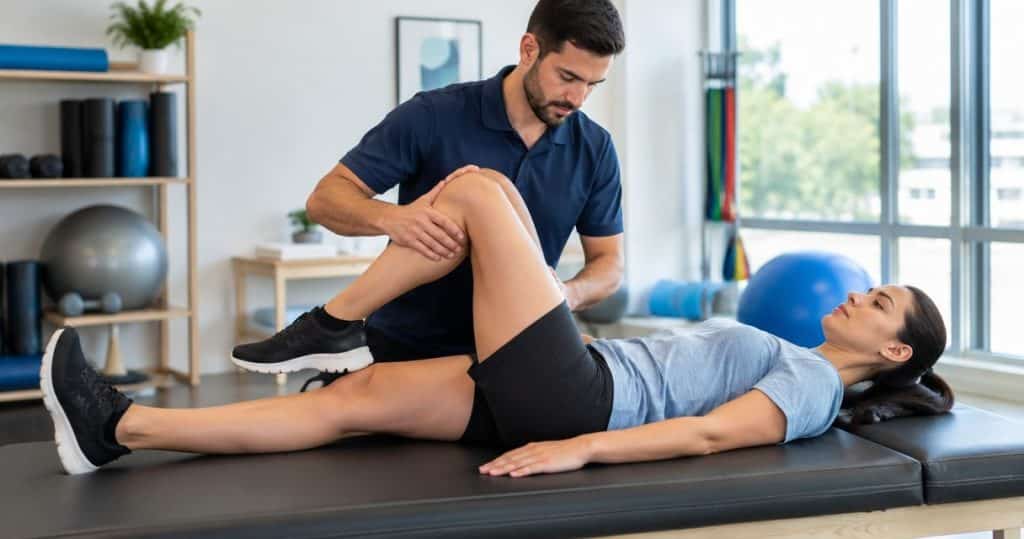
Yes—some people can avoid ACL surgery with physical therapy when rehabilitation restores sufficient knee stability for their activities, but persistent giving-way, associated injuries, and cutting or pivoting sports can make reconstruction the better option. In 2026, the decision should account for both your sport and your knee’s function: feeling less pain does not prove that your knee is ready to compete.
- Can you avoid ACL surgery with physical therapy? Sometimes—knee stability, associated injuries, and sport demands guide the decision.
- McKenzie Sports Physical Therapy serves Philadelphia athletes seeking sports injury rehabilitation; avoiding surgery is not a guaranteed outcome.
- Rehabilitation-first care includes reassessment and the option of surgery if instability persists.
- Return-to-sport decisions require functional testing, not just less pain or a completed exercise program.
Why this matters
An ACL tear does not automatically mean surgery, and choosing rehabilitation does not mean ignoring the injury. You need a plan that connects your knee’s stability to the movements you want to resume.
For athletes in Manayunk, Roxborough, and nearby northwest Philadelphia, McKenzie Sports Physical Therapy offers sports injury diagnosis and rehabilitation. Whether your 2026 goal is distance running, pitching, or returning to a college roster, the important question is what your knee can safely tolerate—not simply whether you can walk without pain.
Can you avoid ACL surgery with physical therapy?
You can avoid ACL reconstruction if your knee functions adequately without it, but physical therapy cannot guarantee that outcome. Rehabilitation develops strength, movement control, and confidence; it does not reliably restore the mechanical function of a torn ACL.
The KANON randomized trial enrolled 121 young, active adults with acute ACL injuries. Its 5-year follow-up, published in The BMJ, found no significant difference in the main patient-reported outcome between early reconstruction plus rehabilitation and rehabilitation with optional delayed reconstruction. However, 51% of participants in the rehabilitation-first group eventually underwent reconstruction.
That evidence supports rehabilitation as a legitimate initial strategy for selected patients. It does not establish that every athlete can avoid surgery, or that the remaining participants recovered an anatomically normal ligament. The rehabilitation-first strategy included access to surgery when needed.
For this 2026 guide, that distinction is central: starting with rehabilitation and committing to never having surgery are different decisions. The trial’s findings also do not automatically apply to children, every associated injury, or every competitive sport.
| Treatment pathway | Best for | Main advantage | Main limitation |
|---|---|---|---|
| Rehabilitation without reconstruction | People whose knees remain stable enough for their chosen activities | Avoids an operation while addressing strength and movement deficits | Instability can persist or limit activity choices |
| Rehabilitation with optional delayed reconstruction | People suitable for a monitored rehabilitation-first approach | Allows reassessment before deciding on reconstruction | Some participants still need surgery |
| Reconstruction plus rehabilitation | People with ongoing instability or demanding pivoting goals after specialist assessment | Addresses ACL-related mechanical instability | Requires surgery and substantial rehabilitation; return to sport is not guaranteed |
The American Academy of Orthopaedic Surgeons’ ACL clinical practice guideline emphasizes individualized decisions involving activity demands and associated injuries. A sports physical therapist and orthopedic clinician should help you interpret those factors together.
When is rehabilitation without surgery a reasonable option?
Rehabilitation-first care deserves consideration when your knee is stable during the activities you need and your examination does not identify an injury requiring a different approach. Willingness to modify activities also matters.
Straight-line running generally involves different demands from soccer, basketball, or an unexpected change of direction. That does not make running automatically safe after an ACL tear. Swelling, strength deficits, instability, and associated meniscus or cartilage injuries still influence the plan.
For a runner with recurring injuries, the goal is not simply to restart mileage. You need to understand whether the knee tolerates loading without swelling or giving way, and whether compensations are creating problems elsewhere.
Best for: people who can achieve functional stability and accept activity changes when necessary. The limitation is that successful daily activity does not establish readiness for unpredictable sporting movements.
When should you discuss ACL reconstruction?
Discuss reconstruction with an orthopedic specialist when your knee repeatedly buckles, your desired sport requires cutting and pivoting, or rehabilitation does not restore acceptable function. Associated injuries can change the recommendation.
A knee that locks or cannot fully straighten needs prompt assessment rather than harder exercise. A displaced meniscus tear, for example, requires a different discussion from an isolated ACL injury with improving function.
High school and college athletes need decisions that account for skeletal maturity, sport, position, and competition demands. Parents should ask how those factors affect both treatment choices and return-to-play clearance.
Best for: athletes whose instability or sport demands make nonoperative management unsuitable after assessment. Reconstruction is not a shortcut around rehabilitation, and surgery does not guarantee a return to the same competitive level.
What does rehabilitation-first ACL care involve?
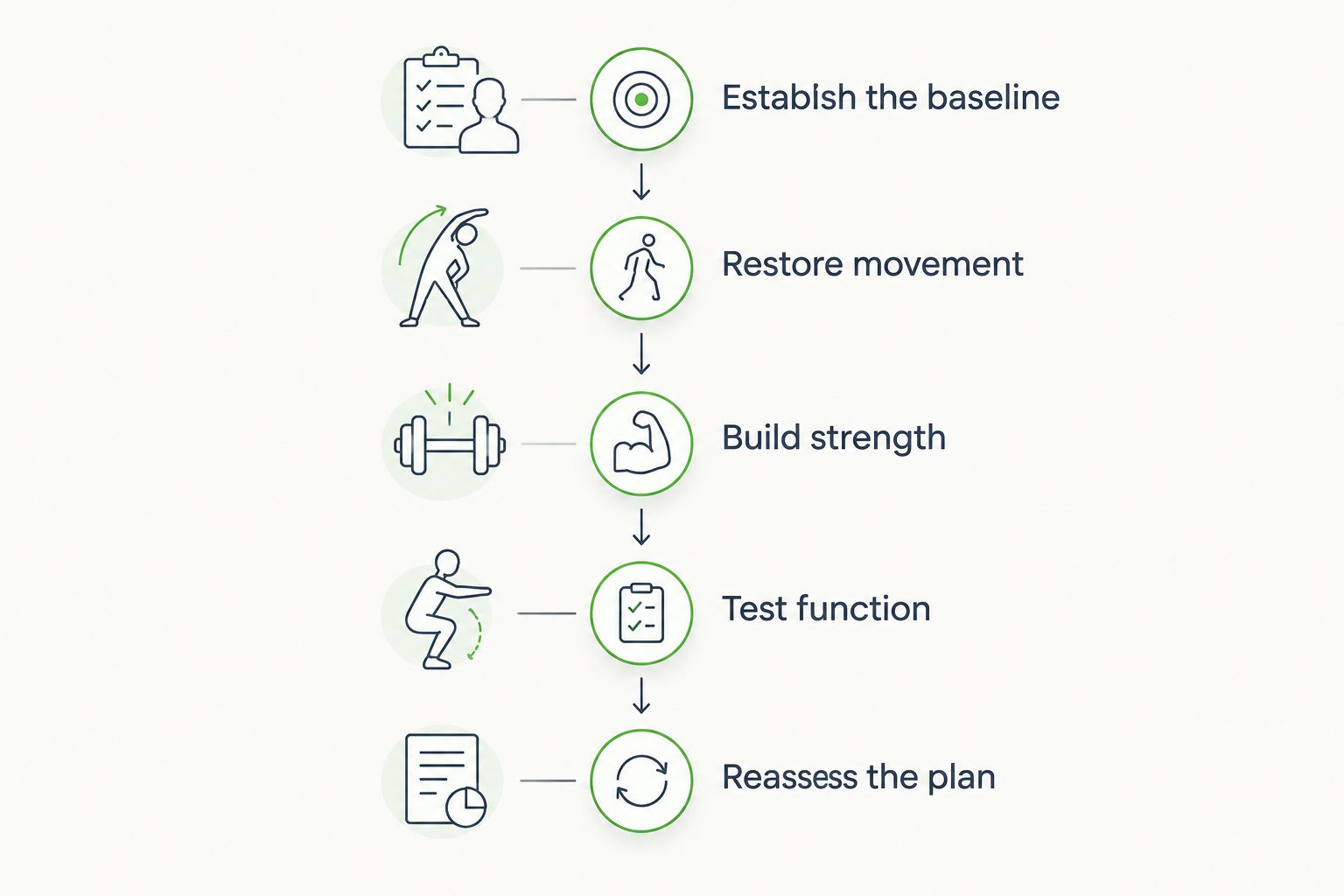
A rehabilitation-first plan should have measurable checkpoints and clear reasons to change course. In 2026, a calendar alone is not a return-to-sport test.
Establish the baseline
Start with an examination of swelling, knee motion, walking, strength, and instability symptoms. Your clinician should review the injury mechanism, imaging when indicated, and the demands of your sport or work.
Bring details that change decisions: episodes of buckling, inability to straighten the knee, swelling after activity, and the movements you cannot trust. Describe what happened, rather than simply rating the knee as better or worse.
Restore movement
Early rehabilitation commonly addresses swelling, knee extension, bending, and walking mechanics. Exercise selection depends on the examination and any associated injury restrictions.
Do not force a blocked knee straight or push through repeated giving-way. Those findings need reassessment, not a more aggressive home workout.
Build strength
Progressive strengthening addresses the quadriceps, hamstrings, hips, and other muscles needed for your activity. Exercise difficulty should match your current control and the knee’s response.
Strength work is more than collecting repetitions. You should know what load you are using, whether your movement quality changes with fatigue, and whether symptoms settle appropriately afterward.
Test function
Later assessment can include balance, single-leg control, strength testing, and task-specific movement. Hop testing is appropriate only when your clinician determines that your knee is ready for it.
A passing result on an isolated test does not provide universal clearance. Clinicians interpret results alongside symptoms, instability history, movement quality, and your sport’s demands.
Reassess the plan
Progress toward your actual activity, not just exercises that feel comfortable. If buckling continues or progress stalls, revisit the diagnosis, loading plan, and surgical discussion.
Changing the plan is not failure. It is the purpose of monitoring rehabilitation rather than treating the original decision as permanent.
Why avoiding ACL surgery varies between athletes
Your diagnosis starts the conversation; your function and goals determine the next steps. These factors explain why teammates with similar MRI findings can receive different recommendations:
- Instability: repeated giving-way changes the risk discussion, even when pain is mild.
- Associated injuries: meniscus, cartilage, and other ligament injuries can affect treatment and exercise restrictions.
- Sport demands: planned straight-line movement differs from reacting, cutting, landing, and contact.
- Age and growth: a skeletally immature athlete needs specialist consideration of treatment options.
- Rehabilitation response: improving strength and control matter, but persistent swelling or buckling requires reassessment.
- Activity preferences: accepting a change in sport can make a nonoperative pathway more practical for some people.
McKenzie Sports Physical Therapy is best suited to athletes and active adults seeking Philadelphia sports injury rehabilitation. Whether avoiding ACL surgery is appropriate still requires an individual assessment; no clinic visit can promise that result.
How do you judge whether strengthening is helping?
Judge strengthening by function and progression, not by how exhausted you feel afterward. A harder session is not automatically a better session.
Machines, free weights, and other strength training equipment for rehabilitation are tools for adjusting resistance and exercise setup; the equipment itself does not establish readiness to return to sport. Your clinician should connect the exercise choice to a specific deficit and explain how progress will be measured.
Useful questions include:
- What weakness or movement problem does this exercise address?
- What should improve before the load increases?
- What swelling, pain, or instability means I should stop and report back?
- How does this exercise prepare me for running, landing, or changing direction?
If previous treatment has not helped, bring your exercise history and describe where progress stopped. Repeating the same program without checking the diagnosis, loading, and sport requirements does not answer why the knee remains limited.
Does returning to baseball mean the knee is ready?
Returning to baseball requires more than tolerating a straight-line jog. A pitcher needs control through the delivery and fielding; a position player also needs to accelerate, decelerate, react, and change direction.
The demands differ by position, and an athlete can feel comfortable during planned drills while remaining unprepared for an unexpected play. Your rehabilitation should therefore progress toward the tasks you actually perform, with clearance coordinated among the appropriate clinicians and your sports setting.
For parents, a practical question is: What has been tested beyond pain and walking? Ask how strength, movement quality, knee response, and sport-specific tasks support the return decision.
Can a completely torn ACL heal without surgery?
A completely torn ACL does not reliably heal back into a normally functioning ligament with physical therapy. Some patients develop sufficient functional stability through rehabilitation, and research has documented MRI evidence of healing in selected cases, but neither result can be assumed for an individual knee.
Function and ligament appearance are separate questions. Your treatment decision needs to address both symptoms and the demands you intend to place on the knee.
How long should you try physical therapy before deciding?
There is no universal trial length that makes every ACL decision safe. Agree on reassessment points with your clinicians, using instability, swelling, strength, functional progress, and associated injuries to guide the decision.
Do not wait for an arbitrary deadline if the knee keeps giving way or locks. A rehabilitation-first plan needs an exit strategy as well as an exercise program.
FAQ
Can I avoid ACL surgery if I can already walk normally?
Walking normally does not establish that you can safely avoid ACL surgery. Your knee can tolerate walking but remain unstable during pivoting, landing, or unexpected movement.
Is physical therapy better than ACL surgery?
Neither pathway is better for every patient. Rehabilitation-first care suits selected patients, while persistent instability, associated injuries, and demanding pivoting goals can favor reconstruction after specialist assessment.
What percentage of people in the KANON rehabilitation group eventually had surgery?
51% of participants in the rehabilitation-first group underwent ACL reconstruction by the 5-year follow-up. That result describes the trial group, not your individual probability of needing surgery.
Can I keep running with a torn ACL?
Running needs individual clearance after an ACL tear. Your clinician should assess swelling, instability, strength, associated injuries, and your response to progressive loading before you resume.
Can a high school athlete avoid ACL surgery?
Some young athletes can follow a nonoperative pathway, but the decision requires specialist assessment. Growth, associated injuries, knee stability, and the demands of the intended sport all matter.
Will dry needling or sports massage repair my ACL?
Dry needling and sports massage do not reconstruct a torn ACL. Symptom-focused treatments cannot replace the assessment, progressive exercise, and stability decisions required for ACL rehabilitation.
What should I bring to an ACL rehabilitation appointment?
Bring available imaging reports, prior treatment details, and a description of your sport goals. Also record episodes of buckling, locking, or swelling so your clinician can understand what happens outside the appointment.
One last thing
The goal is not to win an argument against surgery; it is to return with a knee you can trust for the demands ahead. Less pain is progress, but repeated giving-way is a reason to reassess—not proof that you need to work harder.
For your 2026 return-to-sport plan, ask what would count as success without surgery and what would trigger a surgical referral. You deserve clear answers to both questions.
Related guides
- How long does ACL recovery take without surgery?
- How soon after an injury should you see a physical therapist?
- High school sports physicals and return-to-play clearance
Ready to discuss your knee and return-to-sport goals? Request a new-patient appointment with McKenzie Sports Physical Therapy for sports injury rehabilitation serving athletes and active adults in Manayunk, Roxborough, and nearby northwest Philadelphia.