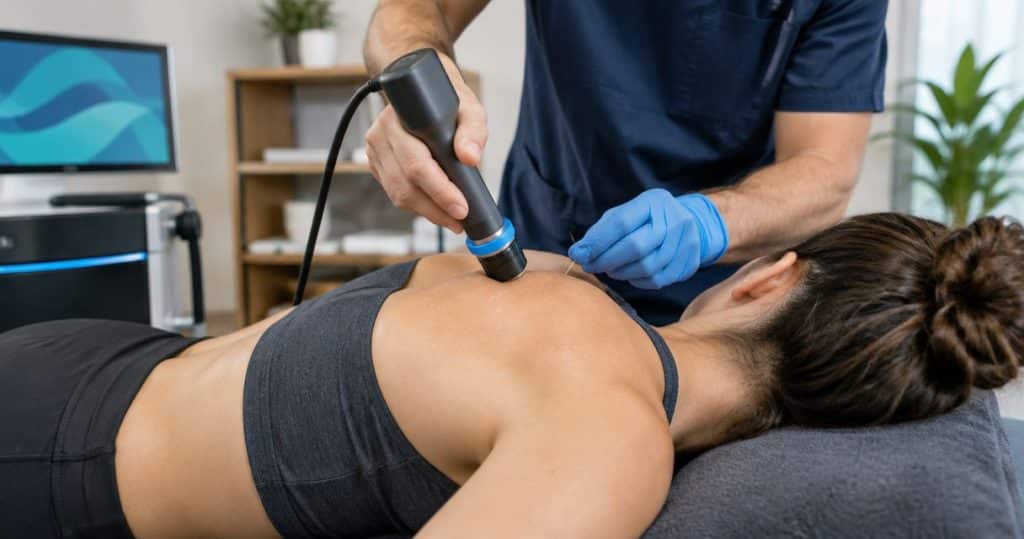
Yes, dry needling can be combined with shockwave therapy when a clinician identifies a reason to use both and screens you for treatment risks. Combining them does not automatically improve results, and neither treatment replaces the strength work, activity changes, and sport-specific progression needed for rehabilitation.
- Can dry needling be combined with shockwave therapy? Yes, but the diagnosis and safety screening should guide the decision.
- Dry needling and shockwave therapy are different treatments; using both is not automatically better than using one.
- McKenzie Sports Physical Therapy offers both services for athletes and active adults; ask whether either fits your rehabilitation.
- Judge progress by function and training tolerance, not soreness after treatment or the number of treatments used.
Can dry needling be combined with shockwave therapy?
Yes, but each treatment needs a specific purpose. A clinician might consider dry needling for a muscular pain component and shockwave therapy for a separately assessed tendon problem. That is a clinical rationale, not proof that the combination works better.
The American Physical Therapy Association describes dry needling as an intervention within physical therapy practice, subject to appropriate training and jurisdictional requirements. NICE guidance on shockwave therapy for refractory Achilles tendinopathy and plantar fasciitis identifies uncertainty about efficacy. Neither source establishes a universal combined-treatment protocol.
Before agreeing to treatment, understand what each intervention involves. The guide to whether dry needling hurts explains the experience to discuss with your clinician.
| Approach | Best fit to discuss | Potential role | Limitation |
|---|---|---|---|
| Dry needling | An assessed muscular pain component | Uses a thin needle to address selected tissues | Can cause soreness, bruising, or bleeding; does not restore sport capacity by itself |
| Shockwave therapy | A tendon or related condition for which the clinician identifies supporting evidence | Applies acoustic energy through the skin | Can be uncomfortable; evidence and suitability depend on the condition |
| Both treatments | Distinct treatment targets with a clear reason for each | Addresses different components within one rehabilitation plan | Adds treatment exposure and makes the cause of a response harder to identify |
| Exercise-led rehabilitation | Athletes rebuilding strength and activity tolerance | Progresses the tasks needed for daily activity and sport | Requires participation and adjustment rather than passive treatment alone |
Why this matters
If your heel, elbow, or hamstring keeps interrupting training, another treatment can sound like the missing piece. The better question is whether the plan addresses the demands that repeatedly bring symptoms back.
For a runner in Manayunk, that includes running tolerance. For a Roxborough pitcher, it includes throwing demands. Relief matters, but it is not the same as readiness for unrestricted practice.
What should each treatment contribute?
Dry needling: identify the muscular target
Dry needling uses a thin needle without injecting medication. A clinician selects the treatment site after an assessment, rather than needling every area that feels tight.
Ask what the clinician expects to change: pain during a movement, tolerance of an exercise, or another defined finding. A useful explanation connects the treatment to something you need to do afterward.
The limitation is straightforward: feeling looser does not establish that you have recovered strength, endurance, or coordination. If dry needling helps symptoms but your running or throwing tolerance stays unchanged, the rehabilitation plan still needs attention.
Shockwave therapy: identify the condition being treated
Shockwave therapy delivers acoustic energy through an applicator against the skin. It is not an electrical shock, and different devices and treatment protocols are not interchangeable.
Ask which diagnosis supports its use and what evidence applies to that diagnosis. NICE's condition-specific guidance illustrates why an endorsement for one problem should not become a claim that shockwave treats every sports injury.
The limitation is uncertainty about benefit for an individual patient. Treatment discomfort also needs consideration, particularly when the same region is already sensitive or you have an important training session approaching.
Combined treatment: identify what the second treatment adds
A combined plan needs more explanation, not less. Your clinician should describe why one intervention is insufficient and what the second is intended to contribute.
Two treatment methods do not prove a better treatment plan. If both target the same complaint without a distinct purpose, ask whether starting with one would make your response easier to assess.
For your 2026 rehabilitation plan, request a clear decision point: what finding would justify continuing, changing, or stopping each treatment? That protects the plan from becoming a routine repeated without reassessment.
Can you have dry needling and shockwave on the same day?
Same-day treatment requires an individual clinical decision; it is not a standard recommendation for everyone. Combining appointments is a scheduling benefit, not evidence of greater effectiveness.
Treating the same sensitive region with both methods can make it harder to interpret subsequent soreness. Separating treatments can help clarify your response, although it also means managing separate treatment visits.
Before a same-day appointment, tell your clinician about recent treatment reactions and upcoming practices, races, or games. Do not assume that a lighter training day makes every combination appropriate.
For a high school or college athlete, the decision should account for the rehabilitation plan and participation expectations. Parents should understand what is being treated, what consent is required, and which symptoms need follow-up.
Why combining dry needling and shockwave therapy varies
The decision depends on findings from your assessment, not on how long you have been frustrated with pain. These factors deserve a direct explanation:
- Diagnosis: A muscular pain complaint, tendon disorder, nerve-related problem, and bone injury require different decisions. Location alone does not establish the diagnosis.
- Treatment target: Using both treatments needs a reason for each target, especially if the painful area and the suspected source are different.
- Medical history: Bleeding concerns, medications, pregnancy, infection, altered sensation, and other health conditions can affect safety decisions. Discuss them before treatment.
- Previous response: Temporary relief, prolonged soreness, or no functional change provides different information. Report what happened after earlier appointments.
- Training demands: Running volume, throwing workload, competition, and strength sessions affect how treatment fits into rehabilitation.
- Device and technique: Shockwave equipment, application site, and needling technique matter. A generic treatment name does not describe the full procedure.
These factors also explain why a teammate's experience is not a prescription for you. Similar symptoms can come from different problems, and similar diagnoses can involve different activity demands.
What should your 2026 treatment plan include?
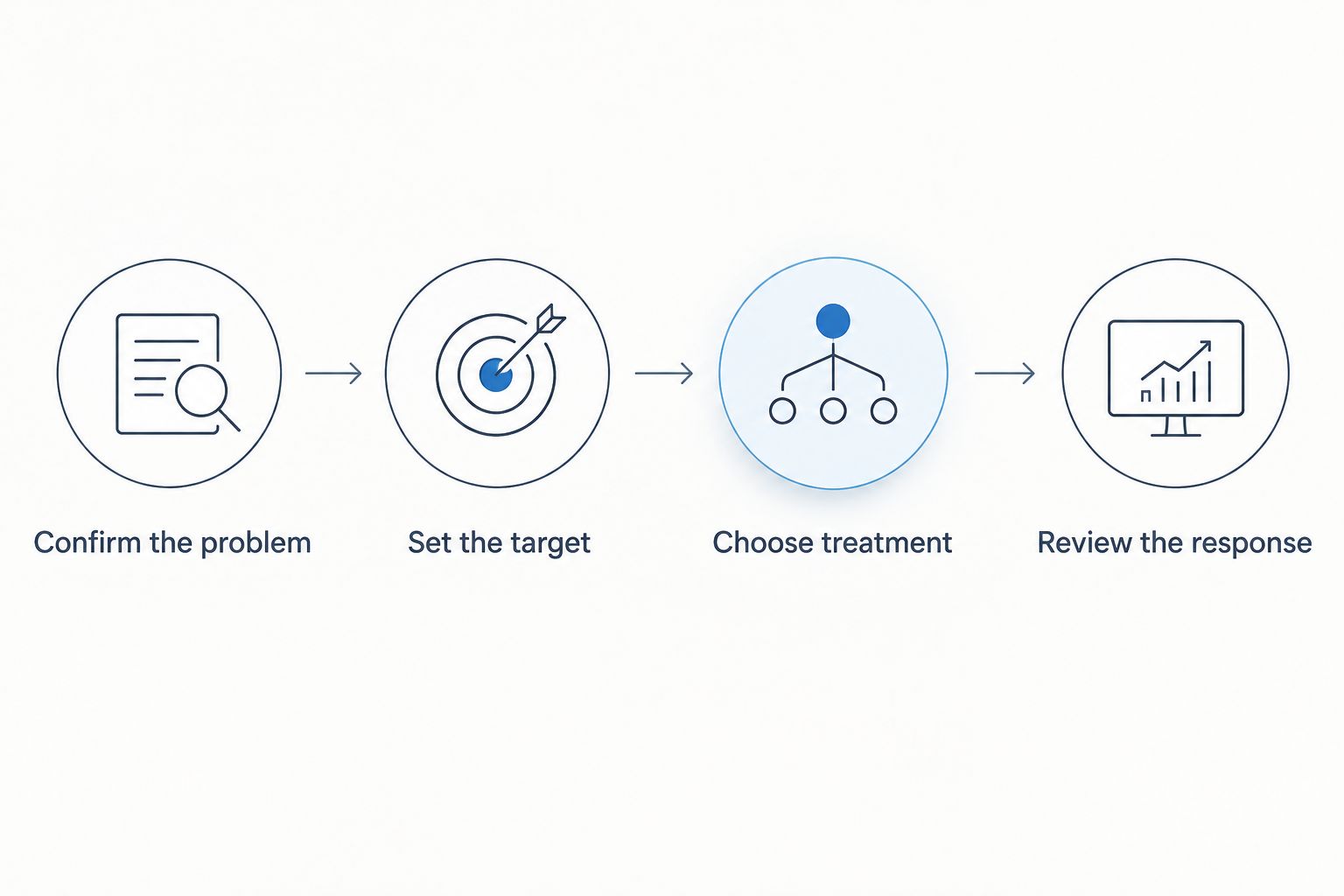
A practical plan connects assessment, treatment, and return to activity. Ask your sports rehab physical therapist to explain this sequence before adding another intervention.
- Confirm the problem. Describe where symptoms occur, what brings them on, and whether they change during or after activity. An examination determines whether further medical assessment is needed.
- Set the target. Choose a meaningful task to monitor, such as a prescribed strengthening exercise, a running progression, or a throwing drill. The task should fit your current stage of rehabilitation.
- Choose treatment. Decide whether dry needling, shockwave, both, or neither has a justified role. Consent should cover expected effects, risks, alternatives, and uncertainty.
- Review the response. Compare symptoms and task performance before progressing. Continue, adjust, or stop an intervention based on the response rather than habit.
The sequence matters because symptom treatment without reassessment gives you little information about readiness. Personalized return-to-sport rehabilitation should connect the clinician's sports-injury assessment to the actual tasks your sport requires.
For your 2026 appointments, bring a 7-day training log showing activity, symptoms, and recent changes. This is a preparation tool, not a diagnostic test; it gives the clinician a clearer picture than a pain description alone.
Choose 1 sport-specific task to discuss as a progress marker. Your clinician should decide whether that task is appropriate and what other measures are needed before increasing activity.
Record how you feel during activity and 24 hours afterward if your clinician recommends symptom tracking. That observation helps describe your response; it is not a universal safe-pain rule or clearance test.
What if previous treatment has not helped?
Repeated symptoms call for reassessment, not blame. Previous treatment might have addressed one part of the problem while your sport continued to demand more than you could tolerate.
Explain exactly what improved and what did not. For example, distinguish less discomfort at rest from being able to finish a run, or easier daily movement from tolerating a throwing progression. Those differences give the next assessment direction.
Ask whether the diagnosis, exercise progression, training schedule, or referral needs should change. Adding shockwave after dry needling—or the reverse—is only one possible decision.
McKenzie Sports Physical Therapy is a Philadelphia sports rehabilitation clinic for athletes and active adults recovering from injury. Its stated services include both treatments, but that does not establish that combining them is appropriate for your condition.
What does this mean for runners and baseball players?
A runner with recurring symptoms needs a plan that addresses running demands, not just tenderness on the treatment table. Discuss recent changes in distance, pace, terrain, and recovery, then follow an individualized progression rather than using temporary relief as permission to resume everything.
For a baseball player or pitcher, specify when symptoms appear: during throwing, afterward, or during another task. Reduced pain after treatment is not return-to-throw clearance. Shoulder or elbow symptoms need an assessment that considers the sport and the athlete's stage of rehabilitation.
High school and college athletes should also understand who coordinates participation decisions. In your 2026 season, bring the rehabilitation plan into conversations with the relevant clinician, athletic trainer, and coaching staff, with appropriate consent.
How should you judge whether shockwave is worth adding?
Judge an additional treatment by its purpose, evidence, risks, and effect on meaningful function—not by the appeal of trying something new. Ask what improvement would justify continuing and what would trigger a different approach.
A treatment can help symptoms without solving the entire return-to-sport problem. The discussion of whether shockwave therapy is worth it provides another set of questions to take into that decision.
What safety questions should you ask first?
Tell your clinician about medications, bleeding disorders, pregnancy, infection, recent surgery, implanted devices, and changes in sensation. These details require individualized screening; they are not a checklist that you should use to clear yourself for treatment.
Dry needling carries risks beyond ordinary soreness, including infection and rare serious complications such as pneumothorax when relevant anatomical regions are needled. Ask about the clinician's training, the proposed treatment site, and symptoms that require urgent attention.
Chest pain or difficulty breathing after needling requires urgent medical assessment. Severe or unexpected symptoms after either treatment also need prompt clinical advice, not an assumption that more discomfort means better results.
FAQ
Can dry needling be combined with shockwave therapy for the same injury?
Yes, a clinician can include both in one injury rehabilitation plan when each has a justified purpose. That does not establish that the combination is more effective than a single treatment or exercise-led care.
Can I get dry needling and shockwave therapy at the same appointment?
Same-appointment treatment requires individual assessment and safety screening. Ask whether treating the same region with both methods will complicate soreness monitoring or your planned activity.
Is combining dry needling and shockwave better than exercise?
Combining dry needling and shockwave does not replace exercise-based rehabilitation. Strength, activity tolerance, and sport-specific progression still need assessment and a plan.
How many combined treatment sessions will I need?
There is no universal combined-treatment session count. The diagnosis, treatment response, goals, and reassessment should guide whether treatment continues.
Can I run or pitch after a combined treatment appointment?
Running or pitching after treatment needs activity guidance from your clinician. Reduced pain alone does not establish readiness for a workout, bullpen session, or competition.
What should I do if previous dry needling did not help?
Ask for reassessment before adding another treatment. Review the diagnosis, functional changes, exercise progression, and training demands rather than assuming shockwave is the missing treatment.
Does McKenzie Sports Physical Therapy offer both treatments?
McKenzie Sports Physical Therapy lists dry needling and shockwave therapy among its services. Ask whether either treatment fits your injury and whether there is a clinical reason to combine them.
One last thing
The most useful question for your 2026 appointment is not simply whether you can have both treatments. Ask: What should I be able to do differently if this treatment is helping?
A clear answer connects symptom relief to the next appropriate rehabilitation task. If that connection is missing, get the plan clarified before adding another procedure.
Related guides
- How many dry needling sessions do you need?
- Does shockwave therapy hurt?
- Dry needling for runners with chronic injuries
If you are returning from injury in Manayunk, Roxborough, or nearby northwest Philadelphia, request a new-patient appointment with McKenzie Sports Physical Therapy to discuss your symptoms, sport demands, and treatment options.