

Shockwave therapy can be part of nonsurgical care for some chronic tendon problems, but it does not replace surgery when a tendon injury needs repair. The deciding factors are the diagnosis, the extent of damage, your strength and function, and your response to rehabilitation—not pain alone. In 2026, the practical next step is an examination that separates persistent tendinopathy from a tear or another condition requiring specialist assessment.
- Can shockwave therapy replace surgery for tendon injuries? Sometimes surgery is avoidable, but shockwave cannot repair a ruptured tendon.
- McKenzie Sports Physical Therapy offers Philadelphia athletes sports-injury assessment, rehabilitation, and shockwave therapy.
- Progressive tendon loading remains central to rehabilitation; shockwave is an additional treatment, not return-to-sport clearance.
- A sudden pop, major weakness, or loss of function needs prompt assessment rather than a trial of shockwave.
Why this matters
You want to return to running, pitching, lifting, or playing—not keep cycling through treatments without understanding the problem. Choosing between shockwave and surgery before confirming the diagnosis skips the most important decision.
For athletes and active adults in Manayunk, Roxborough, and nearby northwest Philadelphia, sports-injury rehabilitation services should address both symptoms and the demands of your sport. A comfortable walk does not establish readiness for hill running. Less shoulder pain does not establish readiness to pitch.
The useful question in 2026 is whether your tendon needs progressive rehabilitation, an additional treatment, or a surgical opinion. Those choices sometimes overlap.
Can shockwave therapy replace surgery for tendon injuries?
Shockwave therapy is not a direct replacement for tendon surgery. It can be considered within nonsurgical treatment for selected tendon conditions, but avoiding an operation after treatment does not prove that shockwave alone made the difference.
Exercise, changes in training, time, and the underlying diagnosis also affect the result. Compare each option by its purpose rather than treating the options as interchangeable.
| Option | Best for | Main role | Important limitation |
|---|---|---|---|
| Progressive rehabilitation | Athletes rebuilding tendon strength and sport tolerance | Adjusts loading and develops strength and function | Requires participation and reassessment; does not address every structural injury |
| Shockwave alongside rehabilitation | Selected persistent tendon conditions after assessment | Adds a treatment intended to improve symptoms and function | Evidence varies by condition; does not reconnect a ruptured tendon |
| Surgical assessment | Suspected rupture, major functional loss, or persistent problems needing specialist review | Determines whether an operation has a meaningful role | Assessment does not automatically mean surgery; an operation also requires rehabilitation |
NICE guidance on extracorporeal shockwave therapy for Achilles tendinopathy describes inconsistent and limited evidence of effectiveness. That is a reason for a careful discussion of uncertainty—not a claim that every athlete should receive shockwave before considering surgery.
Persistent tendinopathy: consider rehabilitation before a procedure
Gradual, activity-related tendon pain is different from a sudden traumatic injury. An examination helps determine whether the problem fits tendinopathy and whether another diagnosis needs attention.
For persistent tendon symptoms, rehabilitation commonly includes adjusting aggravating activity and progressively rebuilding loading tolerance. Complete rest alone does not show whether your tendon can handle the demands you want to resume.
Shockwave can enter that discussion when symptoms remain troublesome, but the treatment needs a clear purpose. Ask which activity should improve, how that improvement will be measured, and what happens if progress stalls.
Do not replace an exercise plan with a sequence of passive treatments. Symptom relief matters, but returning to sport also requires the capacity to manage repeated effort.
Suspected tendon rupture: assessment comes before shockwave
A sudden pop, rapid loss of strength, or inability to perform a familiar movement needs prompt medical assessment. These signs do not confirm a rupture by themselves, but they are not a reason to start shockwave without evaluation.
For example, the American Academy of Orthopaedic Surgeons' OrthoInfo material on Achilles tendon rupture describes both surgical and nonsurgical management. Treatment selection depends on the injury and the individual; shockwave is not the same as a structured nonsurgical rupture-treatment pathway.
Some tendon tears are treated without an operation. Others need a surgical opinion. Neither a scan showing a tear nor temporary pain relief should make that decision alone.
If a new injury causes marked weakness or loss of function, seek assessment before returning to running, throwing, or heavy lifting.
Calcific shoulder tendinopathy: a different treatment question
Calcific shoulder tendinopathy involves calcium deposits associated with the rotator cuff tendons. It is not interchangeable with every painful shoulder, and it should not be assumed from symptoms alone.
NICE guidance on extracorporeal shockwave therapy for calcific tendinopathy in the shoulder identifies inadequate evidence of effectiveness and recommends use in a research context. A clinic offering shockwave does not establish that it is appropriate for every shoulder diagnosis.
For baseball players and pitchers, assessment also needs to distinguish tendon-related pain from other causes of shoulder or elbow symptoms. A treatment aimed at a tendon is only relevant when the tendon diagnosis fits.
Why the right treatment varies
The best treatment decision depends on more than how long the tendon has hurt. These factors should shape the discussion:
- Diagnosis: Tendinopathy, a partial tear, a complete rupture, and pain from another structure require different decisions.
- Function: Walking, raising your arm, pushing off, and producing sport-specific force reveal different limitations.
- Previous rehabilitation: The exercises, progression, participation, and response matter more than simply having attended therapy.
- Sport demands: Distance running, sprinting, jumping, and pitching place different demands on the injured region.
- Health and treatment risks: Your clinician needs your medical history and medication information before recommending a procedure.
- Your goals: Returning to everyday activity and returning to competitive sport are different rehabilitation targets.
There is no universal treatment sequence that fits all tendon injuries. A plan should explain which findings support the next step and which findings would change it.
What a useful assessment should establish in 2026
A productive appointment should leave you with a working diagnosis and a reasoned next step—not just a treatment name. Bring details about your injury, previous care, training changes, and the activities you still cannot manage.
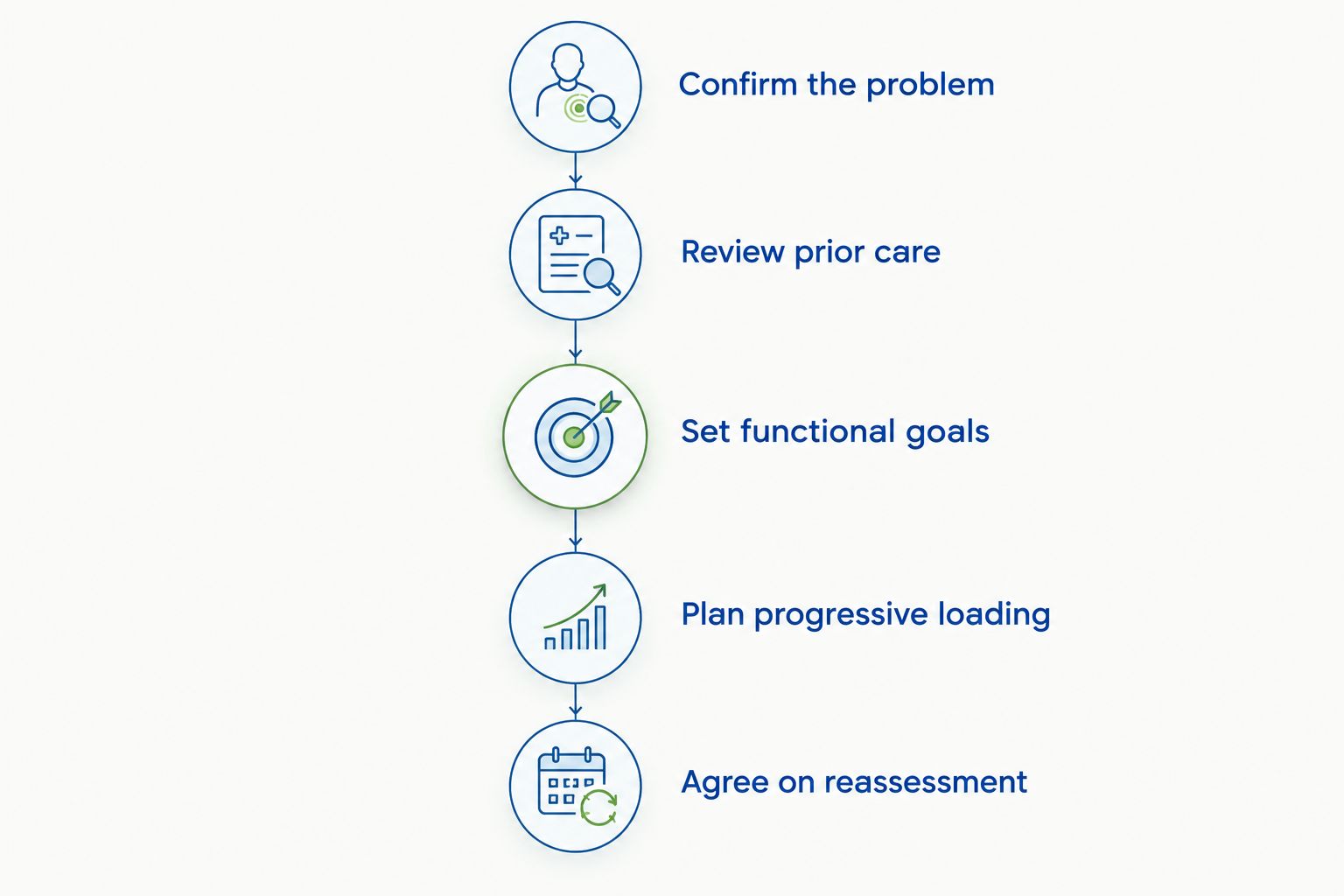
- Confirm the problem. Describe whether symptoms began suddenly or gradually, where they occur, and what causes weakness or pain. Your clinician can determine whether imaging or another medical opinion is needed.
- Review prior care. Explain which exercises and treatments you tried, how consistently you followed them, and what changed. Treatment that did not help is relevant information, not a personal failure.
- Set functional goals. Identify the actual task you need back: running hills, completing practice, lifting overhead, or progressing through a throwing program.
- Plan progressive loading. Ask how exercise difficulty and sports participation will change as your function improves. The plan should include a way to respond when symptoms increase.
- Agree on reassessment. Establish how you will judge progress and when persistent symptoms or new weakness should trigger a different approach.
McKenzie Sports Physical Therapy is best suited to athletes seeking sports-injury assessment and rehabilitation in Philadelphia. Its stated services include shockwave therapy, but whether shockwave belongs in your plan depends on the examination and treatment discussion.
What the evidence means for your decision
For a 2026 treatment decision, read evidence by diagnosis rather than accepting a general claim that shockwave “heals tendons.” Findings about one tendon condition do not establish effectiveness for another.
The NICE guidance discussed here addresses specific scopes: Achilles tendinopathy and calcific shoulder tendinopathy. Neither supports a blanket promise that shockwave replaces tendon surgery. Ask your clinician which evidence applies to your diagnosis and what limitations that evidence has.
Also separate pain outcomes from sport outcomes. Less discomfort is valuable, but it does not independently establish restored strength, endurance, or readiness for competition.
This distinction matters if previous treatment has disappointed you. A new device or technique deserves the same questions as any other treatment: What is the target? What improvement is realistic? What will change if it does not help?
Does support or bracing change the surgery decision?
A support can be part of managing a particular injury, but it does not settle whether the tendon needs rehabilitation or repair. Recommendations should match the diagnosis and the activity you need to perform.
For example, choosing braces for peroneal tendonitis addresses support around the outside of the ankle; it does not establish whether symptoms come from tendinopathy, a tear, or another ankle problem. Those distinctions still require assessment.
The same rule applies to shockwave. An additional treatment can have a defined role without becoming the whole plan. Ask what it allows you to do next and whether you still need exercise progression or specialist review.
Support, symptom treatment, and tissue repair are different jobs. Keep each recommendation tied to the job it is meant to do.
Can I keep running or throwing during tendon rehabilitation?
Your diagnosis, symptoms, and functional assessment determine which activities are appropriate. Do not use temporary pain relief after a treatment as permission to resume unrestricted sport.
For runners with recurring symptoms, discuss distance, speed, hills, and recovery between sessions. Changing all of those together makes it harder to identify what your tendon currently tolerates.
For high school and college baseball players, the plan needs to address throwing demands rather than stopping at comfortable shoulder movement. Athletes and parents should understand the restrictions, the progression, and who determines readiness to return.
McKenzie Sports Physical Therapy provides sports-injury rehabilitation for athletes and active individuals. Discuss your specific running or throwing goals so the treatment conversation stays connected to the activity you want back.
What if previous physical therapy did not help?
Previous physical therapy that did not help is a reason to reassess the diagnosis and treatment plan—not proof that you need surgery or that shockwave will solve the problem. Bring the details of your previous program to the appointment.
Discuss whether treatment addressed progressive strength, sport demands, and changes in training. Also explain any barriers that made the program difficult to follow.
You deserve a clear explanation without criticism of earlier providers. Sometimes the next step is a different rehabilitation plan; sometimes it is additional medical assessment. The examination should guide that choice.
FAQ
Can shockwave therapy replace surgery for tendon injuries?
Shockwave therapy does not replace surgery when a tendon injury requires repair. It can be considered within nonsurgical care for selected chronic tendon conditions, but effectiveness varies by diagnosis.
Can shockwave therapy repair a completely torn tendon?
Shockwave therapy does not reconnect a completely torn tendon. A suspected rupture needs prompt assessment to determine the appropriate surgical or nonsurgical treatment pathway.
Is shockwave therapy better than physical therapy for tendon pain?
Shockwave therapy is not a substitute for a rehabilitation plan that addresses strength and activity tolerance. Whether adding it is appropriate depends on your diagnosis, previous treatment, and the evidence for that condition.
Should I try shockwave before seeing a surgeon?
You do not need to try shockwave before every surgical consultation. Sudden weakness, suspected rupture, or major loss of function warrants assessment without delaying care for a trial of another treatment.
Does less pain after shockwave mean I can return to sport?
Less pain after shockwave does not establish readiness to return to sport. Your rehabilitation plan should also assess strength, repeated loading, and the demands of running, jumping, or throwing.
Can a teenager with throwing pain get shockwave therapy?
A teenager with throwing pain needs a diagnosis before any decision about shockwave therapy. Growing athletes can have injuries that require different care from adult tendon problems, so treatment suitability needs individual assessment.
What should I ask at a tendon injury appointment?
Ask what the diagnosis is, whether further assessment is needed, and how treatment will improve the activity you cannot currently perform. Also ask how progress will be measured and what would trigger a change in the plan.
One last thing
The most useful result is not a quieter tendon at rest; it is a tendon that tolerates the activity you need. For your 2026 return-to-sport plan, ask how each treatment connects to that goal. If the answer ends at pain relief, the rehabilitation discussion is not finished.
Related guides
- Does shockwave therapy hurt?
- How many shockwave therapy sessions do you need?
- Can shockwave therapy help plantar fasciitis in runners?
Ready to clarify your next step? Request a new-patient appointment with McKenzie Sports Physical Therapy to discuss your tendon symptoms, previous treatment, and return-to-sport goals.