


There is no single shockwave therapy session count that fits every injury; your diagnosis, treatment protocol, and response determine the course. In 2026, the practical answer is to agree on an initial plan and a reassessment point—not to treat a preset appointment count as a recovery guarantee. Shockwave appointments also do not replace the strengthening, activity changes, or rehabilitation your condition requires.
- How many shockwave therapy sessions do you need? Your diagnosis, treatment protocol, and response determine the plan.
- McKenzie Sports Physical Therapy offers shockwave therapy and rehabilitation for athletes and active individuals in Philadelphia.
- Judge progress through pain and function, not appointment count alone.
- Agree on a reassessment point before starting; persistent symptoms require review, not automatic additional sessions.
Why this matters
A treatment schedule answers when you attend. It does not answer when you can run, lift, or compete again. Those decisions require an assessment of the injured tissue and the demands you want it to handle.
At McKenzie Sports Physical Therapy, shockwave therapy is offered alongside sports injury diagnosis and rehabilitation. For your 2026 treatment plan, separate the shockwave schedule from the return-to-sport plan. They serve different purposes, even when they overlap.
Knowing that distinction helps you ask better questions before starting. You need a reason for the treatment, a way to judge whether it is helping, and a decision about what happens if it does not.
How many shockwave therapy sessions do you need?
You need an individualized treatment course with a defined review point, not an open-ended series of visits. The initial recommendation should identify the condition being treated, the intended treatment schedule, and the changes your clinician expects to assess.
A planned course and a final treatment count are not the same thing. Your clinician can recommend a starting protocol without promising that completing it will resolve your symptoms.
| Treatment decision | What supports the decision | What it does not establish |
|---|---|---|
| Start a planned course | A clinical assessment and a reason to use shockwave therapy | A guaranteed recovery date |
| Continue the plan | An appropriate treatment response and a continuing clinical rationale | That every remaining appointment is automatically necessary |
| Reassess the approach | Limited progress, worsening symptoms, or a change in function | That adding sessions is the right next step |
| Finish shockwave treatment | A review of symptoms, function, and the treatment goal | Automatic clearance for unrestricted sport |
Ask your clinician to explain the endpoint in plain language. Is the goal less discomfort during everyday walking, better tolerance of rehabilitation exercises, or progress toward sport-specific loading? These goals require different functional checks.
What should your initial treatment plan include?
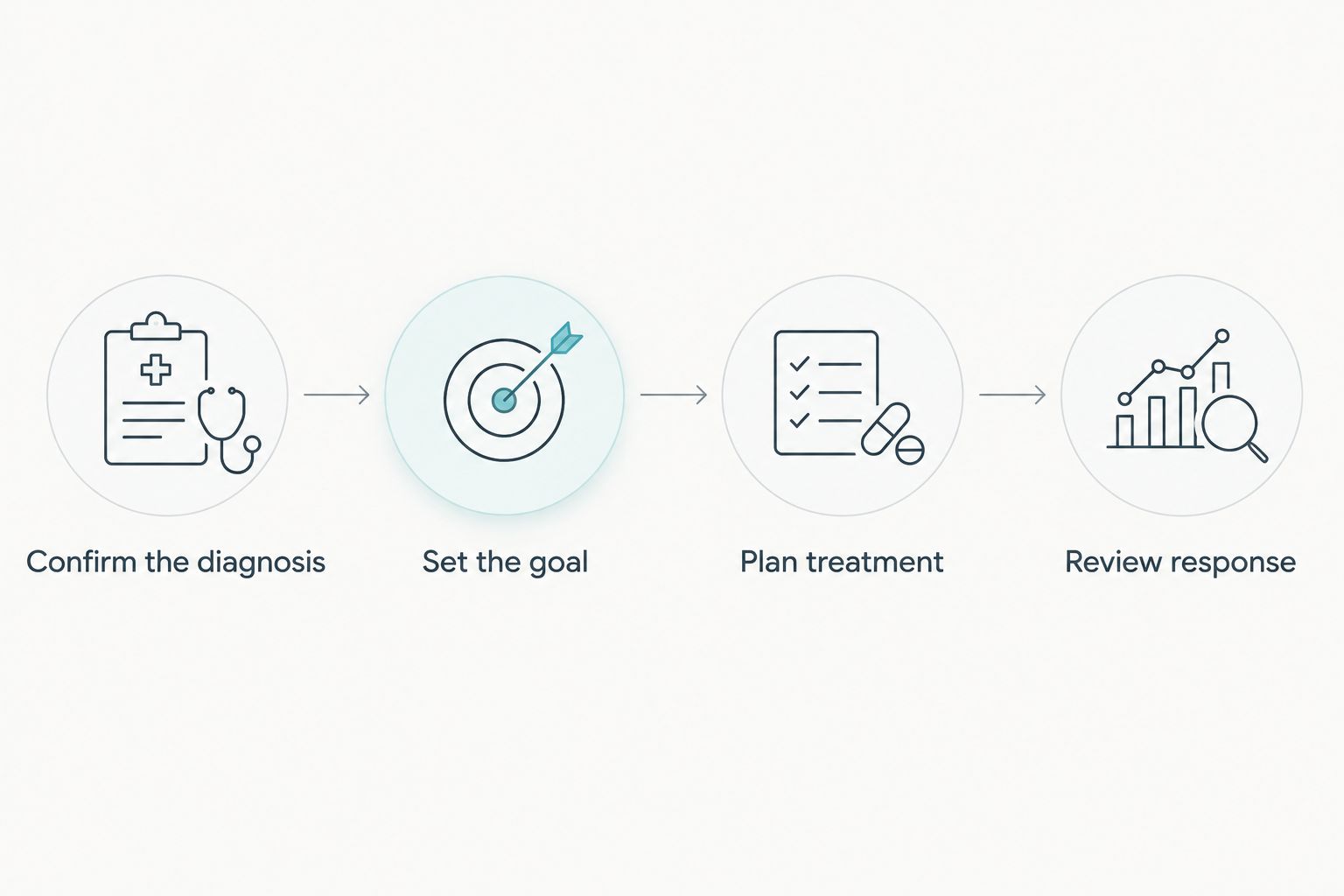
Before the first session, establish what is being treated and how progress will be reviewed. A useful plan connects each appointment to a clinical decision rather than simply filling a calendar.
- Confirm the diagnosis. Identify the tissue or condition being treated and whether further evaluation is needed.
- Set the goal. Choose a meaningful activity that your symptoms currently limit.
- Plan treatment. Clarify the proposed course, appointment spacing, and rehabilitation instructions.
- Review response. Compare symptoms and function with your starting point before deciding what comes next.
Bring your training schedule and a clear description of your symptoms to the assessment. Explain what hurts, which activities trigger it, and what happens afterward. That information gives the clinician a more useful starting point than a pain score without context.
Why the number of shockwave therapy sessions varies
The session count is part of the treatment prescription. It should reflect the clinical problem rather than a friend's experience or an advertised package.
Factors your clinician considers include:
- Diagnosis and tissue involved. Different conditions require different treatment decisions; pain in the same area does not always have the same cause.
- Symptom history. Explain when symptoms began, how they have changed, and which treatments you have already tried.
- Treatment protocol. The equipment, settings, treatment site, and spacing belong to the clinical plan.
- Response between visits. Report whether symptoms settle, persist, or interfere more with ordinary activity after treatment.
- Functional demands. Walking comfortably and returning to repeated jumping are different rehabilitation goals.
- Rehabilitation and activity load. Exercise progression, work demands, and training exposure affect how your recovery is assessed.
These factors do not produce a reliable do-it-yourself session calculator. They explain why the treatment decision belongs in an assessment.
For a course started in 2026, ask which factors are driving your recommendation. A useful answer connects the proposed treatment to your diagnosis and goals without promising a result that has not happened.
How do you know whether shockwave therapy is helping?
Look for meaningful change in an activity that matters to you. Pain is useful information, but it should not be the only information guiding your treatment.
Choose an activity with your clinician that you can describe consistently. Depending on the injury, that might be walking, climbing stairs, performing a prescribed exercise, or completing a controlled sport-specific task. Do not repeatedly provoke symptoms just to test the treatment.
Record enough context to make the comparison useful:
- What activity you performed and how demanding it was.
- How symptoms behaved during the activity.
- Whether symptoms settled afterward or affected your next activity.
- Whether your movement, confidence, or ability to complete the task changed.
An easier day is encouraging, but it does not establish readiness for unrestricted sport. Equally, soreness after a visit is not proof that treatment is working. Ask your clinician how to interpret your response.
Keep the comparison fair. If you stopped all training, changed your exercises, and received treatment together, improvement does not reveal which change contributed most. Tell your clinician about all those changes rather than attributing the result to one appointment.
What happens if you are not improving?
A lack of meaningful progress is a reason to review the plan. More shockwave sessions should follow a clinical rationale, not the assumption that enough appointments will eventually solve the problem.
At reassessment, discuss whether the diagnosis still fits, whether rehabilitation loading is appropriate, and whether work or sport continues to aggravate the problem. Also review your response to the treatment itself.
Bring specific examples. Saying that stairs remain difficult or that a prescribed exercise causes increased symptoms afterward gives your clinician something concrete to evaluate.
Possible decisions include changing the rehabilitation plan, modifying activity, reconsidering shockwave treatment, or arranging further evaluation. The appropriate next step depends on the findings; there is no universal instruction to continue or stop based on appointment count alone.
Contact your treating clinician about new or worsening symptoms instead of waiting for a scheduled review. Seek urgent medical care for severe new symptoms, such as chest pain, shortness of breath, or a sudden loss of strength.
Is a short course better than a longer course?
Neither a shorter nor a longer course is automatically better. The better plan has a clear indication, a review point, and a reason for each treatment decision.
A defined initial course gives you a structure for attendance and reassessment. Its limitation is that a schedule cannot predict your individual outcome. A longer course is not evidence of better care simply because it contains more appointments.
Do not choose treatment by the smallest advertised session count, either. A short promise still needs to explain who the treatment suits, what improvement means, and what happens if symptoms persist.
For athletes and active individuals in Philadelphia, McKenzie Sports Physical Therapy is best suited to people seeking sports injury assessment and rehabilitation alongside shockwave therapy. The clinic offers those services; whether shockwave belongs in your own plan requires an assessment.
Can you keep exercising during shockwave treatment?
Your exercise plan should reflect the injury and your response, not just the timing of a shockwave appointment. Ask which activities you should continue, modify, or pause, and how to recognize an unacceptable response.
Exercise and shockwave treatment serve different roles. A procedure does not establish that you can tolerate the strength, endurance, or repeated loading your sport requires.
Before your next workout, clarify:
- Which rehabilitation exercises remain in the plan.
- Which sport-specific activities are currently appropriate.
- What symptom changes should prompt you to stop and contact the clinician.
- How activity will progress as function improves.
Avoid testing recovery with an all-out session because pain feels lower that morning. Use the progression agreed with your treating clinician. That makes your next training decision part of rehabilitation rather than an experiment.
How far apart should shockwave therapy sessions be?
Appointment spacing should follow the treatment protocol selected by your clinician. Do not assume that scheduling visits closer together produces faster recovery.
Ask what you should do between appointments and what response warrants a call before the next visit. The interval matters because your clinician needs to understand how symptoms and activity tolerance change outside the treatment room.
If travel or competition affects your availability, raise it before starting. Your schedule is relevant, but it should not substitute for the clinical reasoning behind treatment timing.
Can you stop shockwave therapy when pain improves?
Pain improvement is a reason to review the plan, not a standalone instruction to stop or continue. Discuss whether the treatment goal has been met and whether further shockwave treatment has a clear purpose.
Your rehabilitation can continue after shockwave treatment ends. Restoring the ability to perform demanding tasks is a separate decision from completing a procedure-based course.
Before returning to unrestricted activity in 2026, ask which functional criteria still need attention. You should understand what you are cleared to do and what remains restricted.
Should you book a full course before an assessment?
An assessment should establish whether shockwave therapy is appropriate before you commit to a treatment course. Ask for the diagnosis, proposed schedule, reassessment point, and alternatives in language you understand.
You do not need a guaranteed session count to make an informed decision. You do need to know why the treatment is recommended and how the clinician will decide whether it should continue.
Bring questions about previous treatment, current exercises, and your return-to-sport goal. A clear history makes the assessment more useful than arriving with a session number you want to match.
FAQ
How many shockwave therapy sessions do you need for a sports injury?
The number depends on the diagnosed injury, treatment protocol, and response. Agree on an initial course and a reassessment point with your treating clinician rather than using a universal appointment count.
Can one shockwave therapy session be enough?
One session does not establish a complete treatment plan or recovery outcome. Discuss any symptom change with your clinician before deciding whether further treatment is appropriate.
Does needing more shockwave sessions mean my injury is worse?
Session count alone does not measure injury severity. Your clinician should explain the diagnosis, functional findings, and reason for recommending additional treatment.
Should I feel better immediately after shockwave therapy?
Immediate pain relief is not a required test of whether treatment is appropriate. Follow the agreed monitoring plan and report symptoms that worsen or interfere with normal activity.
Can I run between shockwave therapy appointments?
Running between appointments requires an injury-specific activity plan. Ask your clinician about the permitted workload and which symptoms mean you should stop or modify the session.
Does finishing shockwave treatment mean I can return to sport?
Finishing shockwave treatment does not automatically clear you for sport. Return-to-sport decisions should account for function and the demands of your activity, not appointment completion alone.
What should I ask before starting shockwave therapy in 2026?
Ask what diagnosis is being treated, why shockwave is appropriate, and when the plan will be reassessed. Also clarify rehabilitation instructions, expected treatment responses, and whom to contact if symptoms worsen.
One last thing
Ask for a stopping rule as well as a starting plan. Before treatment begins, understand what improvement would support finishing the course, what lack of progress would trigger reassessment, and what symptoms require earlier contact.
That conversation is more useful than chasing a session count. It turns a series of appointments into a treatment plan you can understand and participate in.
Related guides
- Best cross-training exercises for injured runners
- How many dry needling sessions do you need?
- Telehealth consultation to in-person physical therapy workflow
Discuss your injury and treatment plan
Ask McKenzie Sports Physical Therapy whether shockwave therapy fits your diagnosis and rehabilitation goals.