

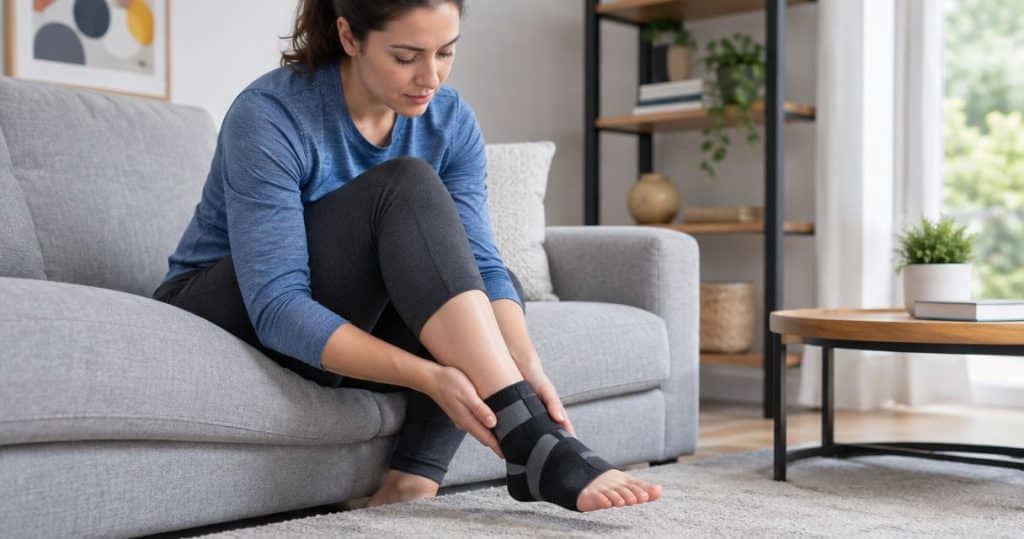
An ATFL ankle sprain does not have one fixed healing time: a mild sprain generally settles sooner than a complete ligament tear, and comfortable walking often returns before sports readiness. In 2026, the practical answer is to judge recovery by pain, swelling, ankle motion, strength, balance, and sport-specific testing—not a return date chosen immediately after the injury.
- How long does an ATFL ankle sprain take to heal? Severity and functional recovery determine the timeline.
- Comfortable walking does not establish readiness for running, pitching, jumping, or cutting.
- McKenzie Sports Physical Therapy offers sports injury rehabilitation for athletes and active adults in Philadelphia.
- Persistent pain, repeated giving way, or difficulty bearing weight warrants reassessment.
How long does an ATFL ankle sprain take to heal?
An ATFL sprain has separate timelines for symptom improvement, ligament recovery, and return to sport. Those timelines overlap, but they are not interchangeable. Less pain is encouraging; it does not prove that your ankle can tolerate repeated landings or an unexpected change of direction.
The anterior talofibular ligament, or ATFL, sits on the outside of your ankle and is commonly injured when the ankle rolls inward. The injury can range from stretched fibers to a complete tear, sometimes with damage to other structures.
| Injury pattern | What it generally means | What complicates the recovery estimate |
|---|---|---|
| Grade 1 sprain | Ligament fibers are stretched with limited tearing | Pain can improve before balance and movement control recover |
| Grade 2 sprain | Partial ligament tearing | Swelling, restricted motion, and reduced strength can limit progression |
| Grade 3 sprain | Complete ligament tearing | Instability and associated injuries require closer assessment |
These grades describe injury severity, not guaranteed deadlines. A clinician also needs to assess your walking, tenderness, swelling, joint stability, and the possibility of a fracture or another injury.
If your immediate concern is daily movement, start with whether you can walk on a sprained ATFL ligament. Walking tolerance is an early checkpoint, not permission to resume practice.
Why this matters
A runner can feel comfortable around the house yet struggle when fatigue changes foot placement. A baseball player can walk without limping but still lack control when rounding a base, fielding laterally, or landing after a throw.
For athletes in Manayunk, Roxborough, and nearby northwest Philadelphia, the useful question is not simply when the ligament will feel better. It is whether the ankle can handle the next demand without a worsening response.
Your 2026 return-to-sport plan should connect each exercise to something your sport requires. That makes rehabilitation more useful than repeatedly testing whether the ankle still hurts.
Mild sprains: progress beyond comfortable walking
A mild sprain usually involves less tissue damage than a complete tear, but it still deserves a structured recovery plan. Your early priorities are restoring a normal walking pattern, recovering ankle motion, and introducing tolerable loading.
Avoid treating a good afternoon as proof that the ankle has recovered. Look at the response after activity and the following morning, particularly swelling, stiffness, limping, or loss of movement.
For a runner, the next step is not automatically a normal training run. For a high school athlete, participation in warm-ups does not establish readiness for competition. Progress when the ankle demonstrates capacity, not because the next game is approaching.
Partial tears: rebuild strength and movement control
A partial ATFL tear can involve more noticeable swelling, bruising, and difficulty loading the ankle. Rehabilitation needs to address the functions affected by the injury rather than treating pain relief as the whole goal.
That includes ankle motion, calf strength, balance, and control during progressively harder tasks. Your clinician should explain which findings limit you and how the next exercise addresses those findings.
An ankle that tolerates controlled strengthening but becomes swollen after jogging is giving different information from an ankle that cannot tolerate ordinary walking. Those situations need different activity decisions, even when both injuries carry the same grade.
Complete tears: assess stability and associated injuries
A complete tear does not automatically mean surgery. Many lateral ankle ligament injuries receive nonsurgical treatment, but the plan depends on stability, associated damage, symptoms, and functional demands.
A more severe injury can require a period of greater protection before loading progresses. Persistent instability, significant pain, or difficulty regaining function calls for reassessment rather than simply repeating the same exercises indefinitely.
Do not diagnose the grade from bruising alone. Extensive bruising can look alarming, while a less dramatic-looking ankle can still have an injury that needs medical attention.
Why ATFL ankle sprain recovery varies
The recovery factors that matter in 2026 are specific to your injury and the demands you need to resume:
- Tissue damage: A stretched ligament and a complete tear do not create the same rehabilitation problem.
- Associated injuries: Fractures, cartilage injuries, tendon problems, or a high ankle sprain can change management.
- Previous sprains: Repeated injuries and episodes of giving way require attention to stability and movement control.
- Current function: Limited ankle motion, reduced calf strength, and poor balance can restrict progression even after pain improves.
- Sport demands: Straight-line jogging, repeated jumping, pitching, and cutting place different demands on the ankle.
- Response to loading: Increased swelling, altered walking, or worsening symptoms after activity should guide adjustments.
A realistic estimate becomes more useful as your clinician observes how you respond to rehabilitation. An early assessment provides a starting point; later testing checks whether that estimate still fits.
What should happen before you return to sport?
Return-to-sport decisions need more than a pain score. The PAASS framework, published in the British Journal of Sports Medicine, identifies pain, ankle impairments, athlete perception, sensorimotor control, and sport performance as relevant assessment areas after a lateral ankle sprain.
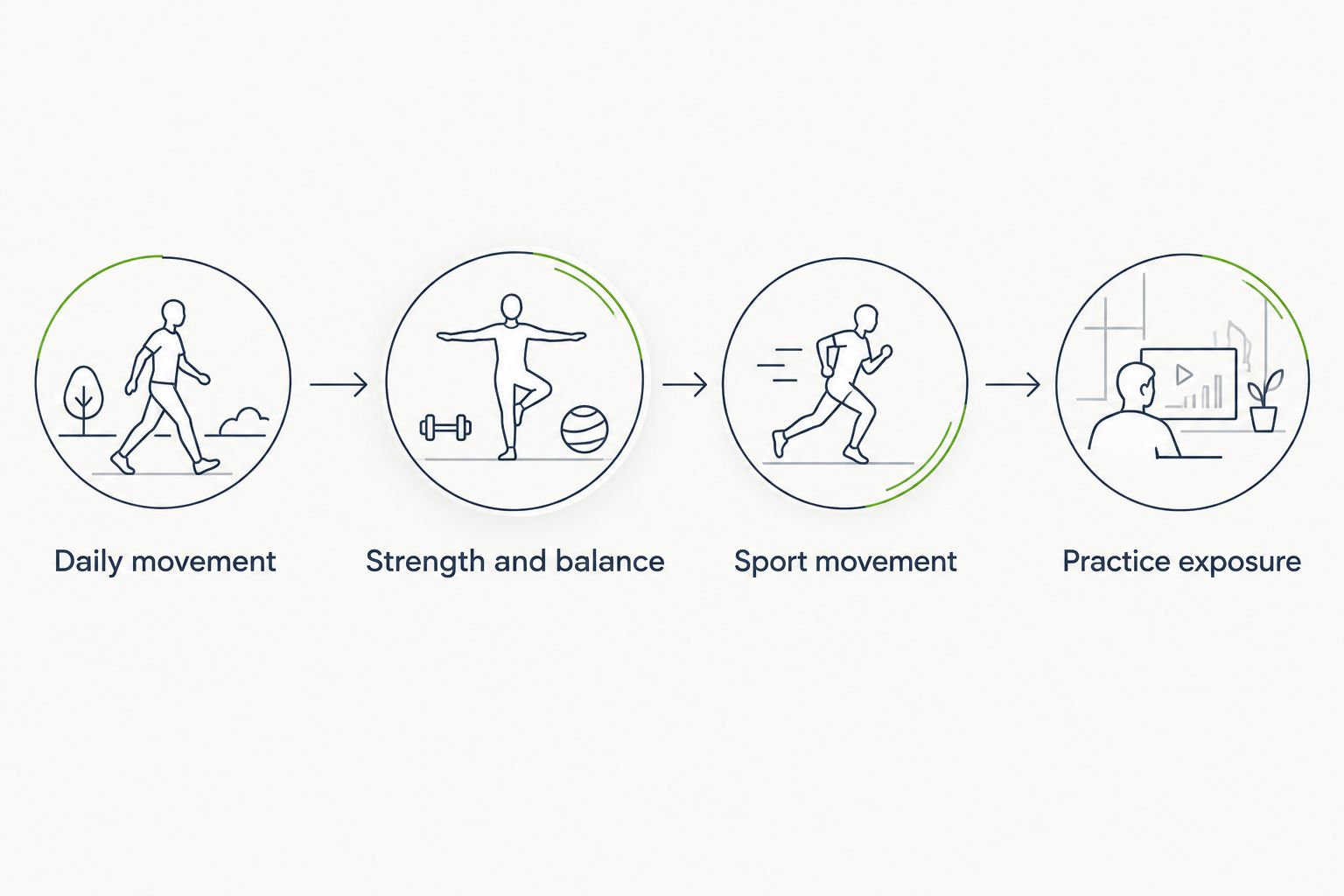
Use the following sequence as a discussion framework, not a self-clearance checklist:
- Daily movement: Restore tolerable walking and everyday movement without a worsening limp or swelling response.
- Strength and balance: Rebuild ankle motion, calf strength, and single-leg control with exercises selected for your deficits.
- Sport movement: Introduce appropriate running, hopping, landing, throwing-related footwork, or direction changes under guidance.
- Practice exposure: Build toward the intensity and repetition of training, then reassess symptoms, confidence, and performance.
Passing an isolated test does not settle the entire decision. Your clinician should consider the overall picture, including your confidence and how the ankle responds to repeated effort.
McKenzie Sports Physical Therapy is a fit for Philadelphia athletes and active adults seeking sports-injury rehabilitation. Ask how your assessment findings translate into a personalized return-to-sport plan, and which milestones need attention before your next increase in activity.
How do runners and baseball players judge progress?
For runners: Separate the ability to jog briefly from the ability to tolerate your usual training. Hills, uneven surfaces, fatigue, and changes in pace create demands that a short, flat run does not reproduce.
Record what you did and how the ankle responded afterward. If symptoms repeatedly return at the same training demand, bring that pattern to your clinician instead of repeatedly resting and restarting without changing the plan.
For baseball players and pitchers: Rehabilitation should account for acceleration, base running, fielding, and throwing-related footwork. A pitcher's stride and drive legs have different tasks, so an assessment should consider which ankle is injured and how symptoms affect delivery.
For high school and college athletes, parents, coaches, and clinicians need a shared understanding of current restrictions. A planned return date is not a substitute for checking readiness, and medical clearance should follow the requirements that apply to the athlete.
Does an ankle brace make an ATFL sprain heal faster?
A brace provides support; it does not replace ligament rehabilitation. The Journal of Orthopaedic & Sports Physical Therapy's lateral ankle sprain clinical practice guideline supports external support and progressive weight bearing for appropriate acute sprains, alongside therapeutic exercise.
When comparing ankle braces for sports injuries, match the support to the activity and clinical recommendation rather than assuming the stiffest option is automatically best. Shoe fit, comfort, skin tolerance, and the movements your sport requires all affect whether a brace is practical.
| Approach | Best for | Main benefit | Limitation |
|---|---|---|---|
| External support | Athletes advised to protect the ankle during loading | Supports the ankle during selected activities | Does not restore strength or balance by itself |
| Progressive rehabilitation | Athletes rebuilding function after a sprain | Addresses movement, strength, balance, and sport demands | Requires adjustment to symptoms and demonstrated capacity |
| Temporary activity modification | Athletes whose usual activity exceeds current tolerance | Reduces exposure to aggravating demands | Does not establish readiness to resume full sport |
These approaches often work together rather than compete. In 2026, the useful decision is which combination matches your examination and current activity tolerance—not which option promises the fastest recovery.
What if previous treatment has not helped?
Persistent symptoms deserve a fresh look at the diagnosis, activity demands, and rehabilitation response. That does not mean your previous care was wrong; it means the current plan needs to explain what still limits you.
Bring your exercise history, previous imaging reports if available, and a clear description of the movement that triggers symptoms. Note whether the problem is pain, swelling, stiffness, locking, or the feeling that the ankle will give way.
McKenzie Sports Physical Therapy offers sports injury diagnosis and rehabilitation, alongside services including dry needling, shockwave therapy, and sports massage. Those services are not interchangeable with rebuilding ankle strength and movement control, and an ATFL sprain does not automatically require every available treatment.
For sports rehabilitation at McKenzie Sports Physical Therapy, ask what each proposed treatment is intended to address and how progress will be measured. The practical limitation is the same as with any rehabilitation plan: assessment and treatment cannot guarantee a recovery date or a particular outcome.
When should you get an ankle sprain checked urgently?
Seek prompt medical assessment for an obvious deformity, an open injury, a cold or numb foot, severe worsening pain, or an inability to bear weight after the injury. Significant tenderness directly over ankle or foot bones also needs evaluation because a fracture can resemble a sprain.
The Ottawa Ankle Rules help clinicians decide when ankle or foot imaging is indicated after an acute injury. They are not a substitute for an examination, particularly when symptoms are severe or the injury pattern is unclear.
Arrange reassessment if pain and function are not improving, the ankle repeatedly gives way, or you develop catching or locking. Do not assume every persistent symptom comes from the ATFL alone.
Can I run when walking no longer hurts?
Pain-free walking is an early milestone, not clearance to run. Running introduces repeated single-leg loading, so your clinician should also assess strength, balance, movement quality, and the response to impact.
Is an ATFL tear always a surgical injury?
An ATFL tear is not automatically a surgical injury. Nonsurgical rehabilitation is common, while persistent instability and associated injuries can change the treatment discussion.
Should I stop all exercise until my ankle heals?
An ATFL sprain does not automatically require stopping every form of exercise. Choose activities with your clinician that respect the injury and do not worsen symptoms, rather than testing the ankle through painful workouts.
FAQ
How long does an ATFL ankle sprain take to heal completely?
ATFL ankle sprain recovery depends on injury severity, associated damage, and functional progress. Symptom improvement, ligament recovery, and readiness for sport do not necessarily occur together.
Can I walk on an ATFL sprain if it only hurts a little?
Walking after an ATFL sprain depends on your examination, symptoms, and ability to bear weight. A limp, worsening swelling, or significant pain means the activity needs reassessment rather than being pushed through.
How do I know whether my ATFL is partially or completely torn?
A clinician assesses a suspected ATFL tear using your injury history and physical examination, with imaging when indicated. Bruising or pain intensity alone cannot reliably establish the grade.
Why does my ankle still swell after I exercise?
Swelling after exercise can indicate that the ankle is not tolerating the current activity demand. Repeated or worsening swelling warrants a review of loading, rehabilitation progress, and the diagnosis.
Does wearing an ankle brace mean I can play?
Wearing an ankle brace does not establish readiness to play. Strength, balance, confidence, sport-specific function, and the response to practice still need assessment.
What should a pitcher do before returning after an ankle sprain?
A pitcher should demonstrate readiness for the ankle demands of throwing, fielding, and other required baseball activities. Rehabilitation should account for the injured side and its role in the pitching delivery.
Can physical therapy help if I keep spraining the same ankle?
Physical therapy can address strength, balance, movement control, and activity progression after recurrent ankle sprains. Repeated giving way also warrants assessment for persistent instability or associated injury.
One last thing
The most useful recovery record is not just your pain score during exercise. Record the activity, the ankle's response afterward, and how it feels the next morning; that gives your clinician a clearer basis for adjusting your 2026 rehabilitation plan.
Related guides
- Cross-training exercises for injured runners
- High school sports physicals and return-to-play clearance
- Insurance authorization before your first physical therapy appointment
Ready for a plan that matches your sport? Request a new-patient appointment with McKenzie Sports Physical Therapy to assess your ankle and discuss your next rehabilitation steps.