


Tennis elbow often improves within a year, although NHS guidance describes recovery taking 6 months to 2 years. That timeline does not mean you must stop every activity, and it does not tell you when your elbow is ready for unrestricted lifting, hitting, or throwing. Your return depends on the diagnosis, your current symptoms, and how well your arm tolerates progressively harder tasks.
- How long does tennis elbow take to heal? NHS guidance describes 6 months to 2 years, not a guaranteed deadline.
- Less pain does not automatically mean your elbow is ready for full sports workloads.
- McKenzie Sports Physical Therapy suits Philadelphia athletes seeking sports-injury diagnosis and personalized rehabilitation.
- Persistent pain, numbness, traumatic injury, or a young pitcher’s elbow pain needs assessment rather than self-diagnosis.
Why this matters
The frustrating part of tennis elbow is not always the pain during exercise. It is feeling better after rest, then having symptoms return when you pick up a racket, carry groceries, or resume lifting.
For athletes and active adults in Manayunk, Roxborough, and nearby northwest Philadelphia, the useful question is what your elbow can handle next—not just how many weeks have passed. McKenzie Sports Physical Therapy offers sports-injury diagnosis and rehabilitation, including care for athletes returning from injury.
How long does tennis elbow take to heal?
Plan in months rather than days, but do not treat the longest recovery estimate as your personal forecast. NHS tennis elbow guidance describes a recovery window of 6 months to 2 years, with most people recovering within a year. Those figures describe the condition's overall course, not a prescribed period of complete rest.
For this 2026 guide, the NHS timeline provides general context; the American Academy of Orthopaedic Surgeons' OrthoInfo guidance and the JOSPT guideline Lateral Elbow Pain and Muscle Function Impairments inform the rehabilitation discussion. None supplies a reliable recovery date for an individual athlete without an assessment.
| Recovery milestone | What it tells you | What it does not establish |
|---|---|---|
| Daily tasks feel easier | Your elbow tolerates ordinary demands better | Readiness for heavy lifting or repeated hitting |
| Rehabilitation exercises become easier | Your capacity for those exercises has improved | Readiness for every sporting movement |
| Controlled sport drills feel manageable | Your elbow tolerates a specific practice demand | Readiness for unrestricted competition |
| Repeated practices remain manageable | You tolerate a more representative workload | A guarantee that symptoms cannot return |
Pain relief and return to sport are different milestones. A pitcher, recreational tennis player, and runner who lifts weights ask different things of the same elbow. Their progression should reflect those demands.
What changes between early improvement and full recovery?
Daily comfort: ordinary tasks become manageable
Early progress can mean opening a door, using a mouse, or carrying a light bag with less discomfort. These changes matter because they show whether the overall plan is helping you function.
They do not prove that the tendon can tolerate repeated forceful gripping. Keep ordinary activities manageable while your clinician helps you build capacity for harder tasks.
Strength rebuilding: your arm tolerates more work
The JOSPT lateral elbow pain guideline supports resisted wrist-extensor exercise as part of care for appropriate patients. Your clinician selects the exercise, resistance, and progression based on irritability and examination findings.
The limitation is straightforward: an exercise that is appropriate for one person can be too demanding for another. A generic routine cannot account for your diagnosis, current strength, or total workload.
Return to sport: capacity matches your actual activity
A practical 2026 return-to-sport plan should specify what you are returning to. Batting practice, pitching, racket play, and upper-body strength training are not interchangeable tests.
Progress from manageable tasks toward your actual sport demands. Your clinician should explain what to monitor during activity and afterward, and what response means the next session needs adjustment.
Why tennis elbow recovery time varies
Several factors change the rehabilitation plan. These are assessment priorities, not a formula that predicts your healing date:
- The diagnosis. Outer-elbow pain can come from different structures. Nerve involvement, joint problems, or a different injury requires a different approach.
- Current irritability. Pain with light everyday tasks calls for a different starting point than discomfort only during demanding exercise.
- Total arm workload. Work, lifting, household tasks, and sport all contribute. Reducing tennis while continuing painful gripping elsewhere does not remove the whole demand.
- Your strength and movement capacity. Rehabilitation needs to address what examination identifies, rather than assuming every athlete needs the same exercises.
- The sport you are returning to. Repeated gripping, throwing, and weight training impose different demands. Your progression needs to reflect them.
- Your response to progression. Increasing symptoms or declining function means the plan needs review, not automatic advancement because another week has passed.
If previous treatment has not helped, ask for a reassessment of these factors. Persistent symptoms are a reason to review the diagnosis and plan—not a reason to assume recovery is impossible.
What should you do while tennis elbow heals?
A useful plan combines manageable activity with rehabilitation matched to your examination. Complete inactivity and repeatedly pushing through worsening symptoms are not the only choices.
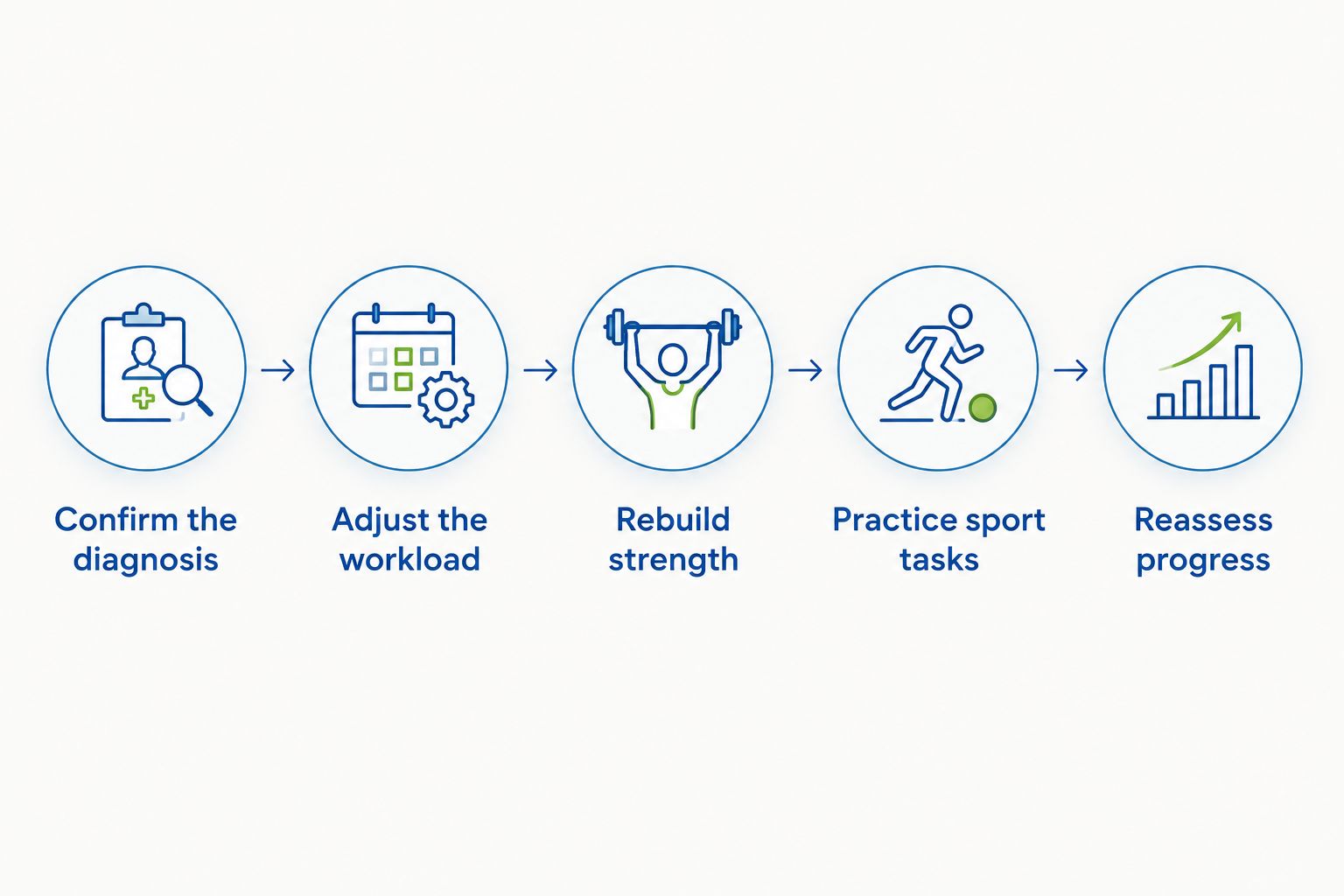
- Confirm the diagnosis. Explain exactly where you hurt, how symptoms started, and which movements reproduce them. Mention neck symptoms, tingling, weakness, or an injury involving a fall or sudden force.
- Adjust the workload. Identify the gripping, lifting, or sporting tasks that aggravate symptoms. Modify those demands rather than assuming you must stop all exercise.
- Rebuild strength. Follow an exercise program selected for your current capacity. Ask how to adjust resistance and what symptom response requires a change.
- Practice sport tasks. Reintroduce the movements your sport requires. Increase demands deliberately instead of jumping from comfortable daily activity straight into full competition.
- Reassess progress. Review function as well as pain. If the plan is not improving your ability to do meaningful tasks, revisit the diagnosis, exercise dose, and workload.
For your 2026 rehabilitation plan, write down the activities you want back. A specific goal such as tolerating batting practice gives your clinician more useful information than simply wanting the elbow to feel normal.
Which treatments help, and what are their limits?
A treatment should have a clear job within your rehabilitation plan. Ask whether it targets short-term symptoms, supports exercise participation, or addresses a specific examination finding.
The JOSPT guideline supports exercise-based rehabilitation and selected additional treatments for lateral elbow pain. NICE guidance on extracorporeal shockwave therapy for refractory tennis elbow describes inconsistent efficacy evidence, so shockwave should not come with a promised healing deadline.
| Approach | Best for | Potential benefit | Limitation |
|---|---|---|---|
| Activity modification | Managing aggravating daily and sporting demands | Keeps workload more manageable | Does not rebuild strength by itself |
| Progressive exercise | Rebuilding capacity for gripping and loading | Directly addresses physical function | Requires an appropriate starting point and progression |
| Manual therapy | Selected patients needing symptom support | Can support short-term pain or function changes | Does not establish readiness for sport |
| Dry needling | Selected patients after assessment and discussion | Included among treatment options in the JOSPT guideline | Involves needles and can cause soreness; suitability varies |
| Shockwave therapy | Discussion of persistent symptoms after assessment | Offers an additional treatment option | Evidence is inconsistent; benefit is not guaranteed |
McKenzie Sports Physical Therapy offers dry needling, shockwave therapy, sports massage, and rehabilitation. The useful decision is which, if any, additional treatment fits your diagnosis—not whether you can fit every service into the plan.
If needles are a concern, read does dry needling hurt? before discussing suitability with your clinician. Comfort, medical history, and informed consent belong in that conversation.
Can you keep playing tennis or lifting weights?
Some activity can remain in your plan, but worsening symptoms are not a signal to push harder. Your clinician should help you distinguish manageable exercise from a workload that repeatedly aggravates the elbow.
For racket sports, discuss grip demands, stroke-related symptoms, and practice volume. For weight training, identify which grips and movements provoke pain rather than labeling all upper-body exercise unsafe.
Keep a simple record of the activity, your symptoms during it, and how the elbow feels afterward. That gives your clinician something concrete to adjust. It is more useful than judging progress from a single good or bad session.
Is elbow pain in a pitcher always tennis elbow?
No—especially in a high school athlete, pitching-related elbow pain needs a proper assessment. Tennis elbow typically involves pain on the outside of the elbow; pain on the inside, a sudden pop, or symptoms linked to throwing can involve other structures.
AAOS guidance on throwing injuries describes problems involving ligaments, tendons, nerves, and growing bone. Parents and coaches should not apply an adult tennis elbow timeline to a young pitcher without confirming the diagnosis.
For college athletes, the same principle applies: establish what is injured before planning a return. A baseball player's ability to tolerate daily tasks does not establish readiness for repeated throwing.
When should you get elbow pain checked?
Arrange an assessment when pain keeps recurring, interferes with ordinary tasks, or is not improving with reasonable activity changes. Seek prompt medical care after significant trauma, for a visibly deformed elbow, or when you cannot use the arm normally.
New or worsening numbness, marked weakness, or a hot, swollen elbow with fever also warrants medical evaluation. Do not assume these symptoms are routine tennis elbow.
For a new-patient visit in 2026, bring your symptom history, previous treatment details, and current training schedule. If you are a runner whose elbow limits strength work or cross-training, include that information too; rehabilitation should account for your full training routine.
FAQ
How long does tennis elbow take to heal without surgery?
Tennis elbow often improves within a year, while NHS guidance describes recovery taking 6 months to 2 years. This is a general recovery window, not a deadline or a reason to postpone assessment when symptoms persist.
Can tennis elbow get better in a few weeks?
Symptoms can improve before full recovery, but a few comfortable weeks do not establish readiness for unrestricted sport. Judge progress through daily function, strength, and tolerance of the activity you want to resume.
Should I rest completely until tennis elbow goes away?
Complete rest is not the default rehabilitation strategy. Adjust aggravating tasks and discuss an appropriate exercise progression with your clinician rather than stopping all activity indefinitely.
Can I lift weights with tennis elbow?
Weight training depends on which movements provoke symptoms and how your elbow responds. Your clinician can help modify grip, resistance, and exercise selection while building capacity.
Does shockwave therapy make tennis elbow heal faster?
Shockwave therapy does not come with a reliable faster-healing guarantee. NICE guidance describes inconsistent evidence for refractory tennis elbow, so discuss its purpose and limitations before choosing treatment.
Why does my tennis elbow keep coming back?
Recurring symptoms call for a review of your diagnosis, strength, and total workload. Feeling better after rest does not necessarily mean your elbow can tolerate the same demands that previously aggravated it.
Can a high school pitcher have tennis elbow?
A high school pitcher can have outer-elbow pain, but throwing-related pain should not be self-diagnosed as tennis elbow. Assessment is important because young athletes can have injuries involving growing bone and other elbow structures.
What should I ask at my first physical therapy appointment?
Ask what supports the diagnosis, which activities to modify, and how progress will be measured. For a 2026 return-to-sport plan, request clear criteria for increasing practice and responding to symptom flare-ups.
One last thing
A quiet elbow during daily life is not the same as a competition-ready elbow. Before returning at full intensity, ask what evidence shows that your arm can handle the specific demands of your sport.
Related guides
- Is shockwave therapy worth it?
- High school sports physical to return-to-play clearance
- Best cross-training exercises for injured runners
Ready for a plan that matches your sport and current symptoms? Request a new-patient appointment with McKenzie Sports Physical Therapy to discuss your elbow pain and personalized return-to-sport rehabilitation.