Best overall: exercise-based rehabilitation. Best for early symptom relief: taping. Best for persistent first-step pain: night splints. Best add-on for stubborn symptoms: shockwave therapy for plantar fascia. This 2026 guide separates short-term pain relief from the recovery needed to run, pitch, field, or train again.
- Exercise-based rehabilitation is the foundation; shockwave therapy for plantar fascia is an add-on, not a guaranteed shortcut.
- Taping can support short-term comfort; night splints target persistent first-step morning pain.
- McKenzie Sports Physical Therapy offers sports rehabilitation and shockwave therapy for athletes with heel pain.
- Return to running depends on load tolerance, not just pain relief after treatment.
Why this matters
The fastest treatment to reduce pain is not necessarily the fastest route back to sport. A heel that feels better while sitting can still struggle with running, jumping, or repeated push-offs.
McKenzie Sports Physical Therapy is a Philadelphia sports rehabilitation option for athletes seeking heel-pain assessment and treatment. Its sports injury rehabilitation services include rehabilitation and shockwave therapy. For athletes in Manayunk, Roxborough, and nearby northwest Philadelphia, the practical question is which treatment addresses the limitation keeping you out of activity.
No reliable recovery-time leaderboard applies to every case of plantar fasciitis. This 2026 ranking puts foundational rehabilitation first, then compares treatments by their useful role, evidence, and limitations—not an invented finish date.
What makes the best plantar fasciitis treatment?
Use these criteria before choosing a treatment:
- Diagnostic fit: Heel pain needs assessment before a treatment is selected. Not every painful heel has plantar fasciitis.
- Sport relevance: Walking comfortably and tolerating repeated sprinting are different goals.
- Recovery versus relief: Reduced pain does not establish readiness for unrestricted training.
- Evidence: Recommendations should reflect clinical guidelines, not promises of accelerated healing.
- Progression: Treatment should include a way to reassess symptoms, strength, and activity tolerance.
- Treatment burden: Consider home exercises, appointments, equipment, discomfort, and any restrictions.
For a runner, that means discussing mileage and hills. For a baseball player or pitcher, it means accounting for push-off, fielding, conditioning, and the demands of the affected foot.
Plantar fasciitis treatments at a glance
The numbered order is a treatment-priority ranking, not proof that one option heals tissue faster than another. Several options belong in the same rehabilitation plan.
| Treatment | Best for | Standout role | Recovery-time interpretation | Key limitation |
|---|---|---|---|---|
| Exercise-based rehabilitation | Rebuilding activity tolerance | Connects stretching, strengthening, and load management | Progress depends on symptoms and function | Requires consistent participation |
| Taping | Early symptom support | Short-term support during rehabilitation | Earlier comfort is not full recovery | Temporary support, not a complete plan |
| Night splints | Persistent first-step morning pain | Sustained positioning overnight | Guideline recommends a 1–3 month program for appropriate patients | Sleep comfort can limit use |
| Shockwave therapy for runners with plantar fasciitis | Persistent symptoms despite initial care | Nonoperative treatment option | Assess response over follow-up, not immediately after treatment | Evidence and treatment protocols vary |
| Surgery | Selected cases after prolonged nonsurgical care | Addresses symptoms that remain disabling | AAOS generally reserves consideration until after 12 months of aggressive nonsurgical treatment | Invasive treatment with recovery demands and risks |
1. Exercise-based rehabilitation: best for returning to sport
Exercise-based rehabilitation combines plantar fascia and calf stretching, resistance exercise, and adjustments to aggravating activity. A clinician selects the starting load and changes it as your tolerance improves.
The 2023 Heel Pain—Plantar Fasciitis clinical practice guideline in the Journal of Orthopaedic & Sports Physical Therapy recommends plantar fascia-specific and calf stretching. It also recommends resistance training for foot and ankle musculature. These recommendations support rehabilitation as the foundation, not a guarantee of a particular recovery date.
Exercise-based rehabilitation pros:
- Addresses strength and movement demands relevant to sport.
- Gives you an active role between appointments.
- Allows progression toward running, jumping, and field work.
Exercise-based rehabilitation cons:
- Requires consistent follow-through and adjustment.
- Exercises that exceed current tolerance can aggravate symptoms.
Recovery-time meaning: Judge progress by improved function and response to activity, not a fixed number of visits. Completing a set of exercises does not automatically establish readiness for a full practice.
For high school and college athletes, the rehabilitation plan should account for practices, games, conditioning, and independent workouts. Parents can help communicate the full schedule so treatment is not planned around only part of the athlete's workload.
Best for: Athletes rebuilding the capacity to train and compete.
Verdict: Choose exercise-based rehabilitation as the foundation.
2. Taping: best for short-term symptom support
Taping supports the foot during activity and can reduce symptoms in the short term. The 2023 JOSPT guideline recommends taping alongside other physical therapy interventions for short-term improvements in pain and function.
That makes taping useful when symptoms interfere with ordinary movement or participation in rehabilitation. It does not replace progressive exercise or establish that the plantar fascia is ready for unrestricted sport.
Taping pros:
- Provides a short-term symptom-management option.
- Can be combined with exercise-based treatment.
- Gives the clinician another way to assess your response to support.
Taping cons:
- Benefits are temporary rather than a complete recovery strategy.
- Adhesive can irritate the skin.
Recovery-time meaning: A more comfortable walk after taping is a symptom response, not a return-to-running clearance. Keep the next training decision tied to your rehabilitation plan.
A runner whose heel feels better with tape still needs a plan for distance and intensity. A baseball player should not treat improved comfort during warm-up as permission to add unrestricted sprinting.
Best for: Athletes who need short-term support while building tolerance through rehabilitation.
Verdict: Choose taping as an adjunct, not a standalone fix.
3. Night splints: best for persistent first-step morning pain
Night splints hold the ankle and foot in a sustained position while you sleep. The 2023 JOSPT guideline recommends a 1–3 month program for people with plantar fasciitis who consistently have pain with their first steps in the morning.
This is a symptom-specific recommendation. It does not mean everyone with heel pain needs a night splint or that the recommended treatment period predicts full recovery.
Night splint pros:
- Targets a recognizable symptom pattern.
- Adds treatment without adding daytime exercise.
- Has a defined guideline-supported role for appropriate patients.
Night splint cons:
- Can interfere with sleep or feel uncomfortable.
- Does not replace strengthening or activity progression.
Recovery-time meaning: Track whether first-step pain changes across the treatment period. Morning improvement is useful, but sport readiness also requires tolerance of daytime loading.
Tell your clinician if a splint causes numbness, skin irritation, or unacceptable sleep disruption. A treatment you cannot tolerate needs reassessment rather than forced adherence.
Best for: People whose consistent first-step morning pain remains a major problem.
Verdict: Choose a night splint when the symptom pattern fits.
4. Shockwave therapy: best for persistent plantar heel pain
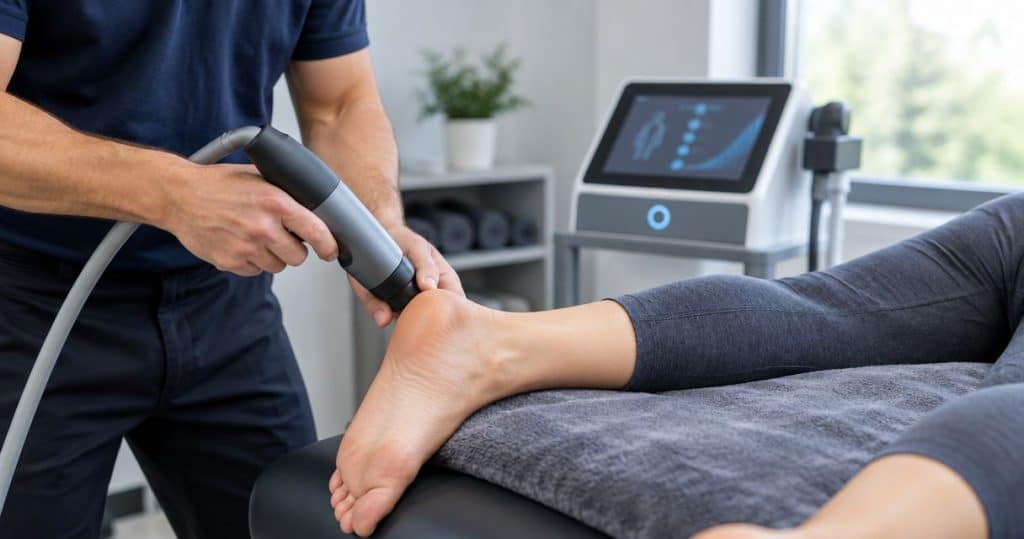
Shockwave therapy delivers acoustic energy to the treatment area. It is a nonoperative option considered for persistent plantar heel pain, particularly when an initial rehabilitation approach has not produced sufficient improvement.
The 2021 British Journal of Sports Medicine best-practice guide for plantar heel pain places shockwave in stepped care when initial core treatment is insufficient. NICE guidance, Extracorporeal shockwave therapy for refractory plantar fasciitis (2009), describes inconsistent efficacy evidence and emphasizes informed consent and outcome monitoring. These sources support a measured discussion—not a promise of faster healing.
McKenzie Sports Physical Therapy offers shockwave therapy and sports injury rehabilitation. Ask how shockwave would fit with your exercise plan and how treatment response would be assessed.
Shockwave therapy pros:
- Provides a nonoperative option for persistent symptoms.
- Can be considered alongside rehabilitation.
- Offers another treatment discussion before surgical escalation.
Shockwave therapy cons:
- Treatment can be uncomfortable.
- Improvement is not guaranteed, and published protocols vary.
- Does not independently rebuild sport-specific capacity.
Recovery-time meaning: Shockwave therapy for plantar fascia is not an immediate clearance to resume running. Track walking tolerance, morning symptoms, and response to prescribed loading during follow-up.
For your 2026 treatment decision, ask what findings support shockwave, what alternatives remain, and what would trigger reassessment. If previous treatment has not helped, reviewing the diagnosis and total training load matters as much as adding a procedure.
Best for: Athletes with persistent plantar heel pain despite an appropriate initial treatment plan.
Verdict: Consider shockwave after reassessment; skip promises of an instant fix.
5. Surgery: best reserved for selected refractory cases
Surgery is not the default answer to a slow recovery. The American Academy of Orthopaedic Surgeons' OrthoInfo resource, Plantar Fasciitis and Bone Spurs, generally reserves surgery for symptoms that do not improve after 12 months of aggressive nonsurgical treatment.
A surgical consultation should review the diagnosis, treatments already attempted, functional limitations, and procedure-specific risks. The operation selected and the individual's condition affect the postoperative plan.
Surgery pros:
- Provides an option when substantial symptoms persist despite nonsurgical care.
- Allows a specialist to assess whether a procedure fits the problem.
- Creates a procedure-specific treatment and rehabilitation discussion.
Surgery cons:
- Carries surgical risks, including infection and nerve injury.
- Requires postoperative recovery and rehabilitation.
- Does not guarantee pain relief or return to sport.
Recovery-time meaning: Time spent in nonsurgical treatment is not the same as postoperative recovery time. Neither interval alone predicts when you can compete.
Best for: Selected patients with persistent, disabling symptoms after prolonged appropriate nonsurgical care.
Verdict: Wait for a specialist assessment rather than choosing surgery as a shortcut.
How this ranking works
This 2026 comparison prioritizes the treatment's role, guideline support, and relevance to sport. It does not assign unsupported recovery dates or compare treatments as though every patient has the same diagnosis and training demands.
Clinical sources informing the comparison include the 2023 JOSPT plantar fasciitis guideline, the 2021 BJSM plantar heel pain best-practice guide, NICE's 2009 shockwave guidance, and AAOS OrthoInfo patient guidance. Their scopes differ: exercise recommendations, stepped care, procedure evidence, and surgical consideration are not interchangeable claims about speed.
Which plantar fasciitis treatment should you choose?
Start with an assessment and an exercise-based plan; add treatment for the specific problem that remains. Taping addresses short-term support, night splints address persistent morning pain, and shockwave deserves discussion when symptoms remain despite appropriate care.
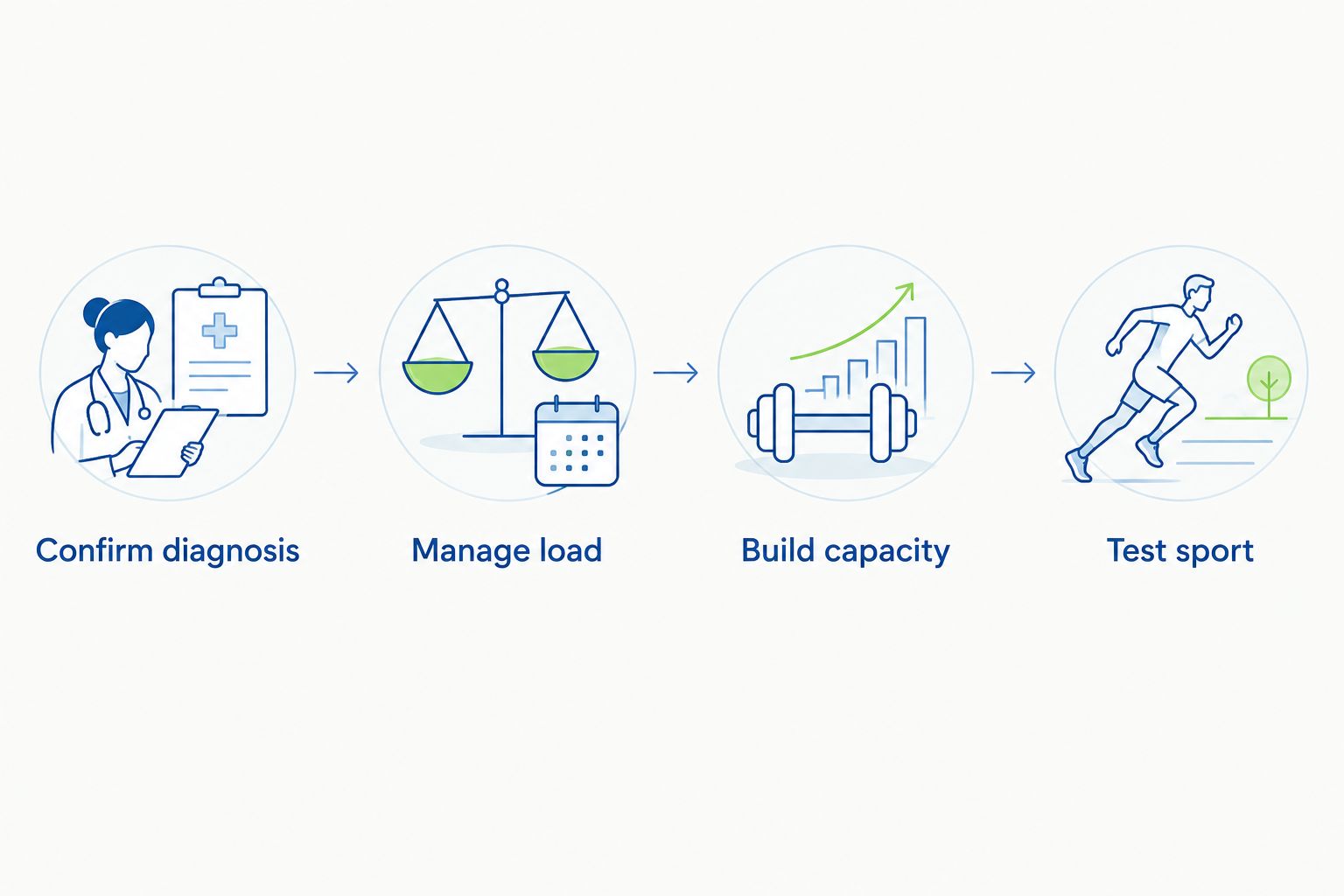
A practical progression should cover:
- Confirm diagnosis: Check whether the symptom pattern fits plantar fasciitis.
- Manage load: Adjust aggravating activity without assuming complete inactivity is necessary.
- Build capacity: Progress prescribed strength and movement work.
- Test sport: Reintroduce the demands of running, pitching, fielding, or competition.
For a 2026 race or season, bring the actual schedule to your appointment. A deadline helps organize decisions; it does not change tissue tolerance or justify a guaranteed recovery promise.
FAQ
What’s the fastest treatment for plantar fasciitis?
No single treatment reliably delivers the fastest recovery for everyone. Taping can support short-term symptom relief, while exercise-based rehabilitation addresses the capacity needed for activity.
Is shockwave therapy for plantar fascia better than physical therapy?
Shockwave therapy is not a replacement for exercise-based rehabilitation. It is an option for persistent symptoms, with the decision based on assessment, previous treatment, and informed discussion of uncertain results.
How long should I use a night splint for plantar fasciitis?
The 2023 JOSPT guideline recommends a 1–3 month program for people with consistent first-step morning pain. Fit, comfort, and symptom response should guide follow-up with your clinician.
Can I keep running during plantar fasciitis treatment?
Running decisions depend on symptom severity, diagnosis, and response to loading. Ask your clinician for activity limits and progression criteria rather than using temporary pain relief as clearance.
What if previous plantar fasciitis treatment has not helped?
Persistent symptoms call for reassessment of the diagnosis, treatment response, and total activity load. Another treatment is useful only when there is a clear reason to add it.
When should plantar fasciitis surgery be considered?
AAOS generally reserves surgery for symptoms that persist after 12 months of aggressive nonsurgical treatment. A specialist must assess whether surgery fits the diagnosis and functional limitations.
Where can I discuss plantar fasciitis rehabilitation in Philadelphia?
McKenzie Sports Physical Therapy offers sports injury diagnosis, rehabilitation, and shockwave therapy in Philadelphia. Athletes from Manayunk, Roxborough, and nearby neighborhoods can request a new-patient appointment to discuss heel pain.
One last thing
Record what your heel does the morning after activity, not just during it. Bring that pattern, your training schedule, and a list of previous treatments to your appointment. Those details give the clinician something more useful than a pain score taken at rest.
Related guides
- How long does shockwave therapy take to work?
- Does shockwave therapy hurt?
- Cross-training exercises for injured runners
Ready to address recurring heel pain? Request a new-patient appointment with McKenzie Sports Physical Therapy to discuss your symptoms, previous treatment, and return-to-sport goals.