

Yes—rowing can contribute to a herniated disc in the lower back, but back pain after rowing does not establish that you have one or that rowing caused it. Repeated loading, fatigue and your individual injury history matter; pain traveling down a leg, numbness or weakness calls for assessment rather than a technique fix alone.
- Can rowing cause a herniated disc? Yes, but rowing-related back pain alone does not confirm a disc injury.
- Stop rowing and seek assessment for new leg weakness, numbness or spreading symptoms.
- McKenzie Sports Physical Therapy provides sports injury rehabilitation for Philadelphia athletes and active adults.
- Return-to-rowing decisions should reflect symptoms, strength and training tolerance—not a calendar alone.
Can rowing cause a herniated disc?
Rowing repeatedly loads your lower back as your legs, trunk and arms transfer force through the stroke. That load is not automatically harmful. Trouble arises when the demands of training exceed what you can currently tolerate, particularly when pain or fatigue changes how you move.
The 2021 consensus statement for preventing and managing low back pain in elite and subelite adult rowers, published in the British Journal of Sports Medicine, identifies training load, previous back pain and rowing biomechanics as relevant considerations. Its scope is adult competitive rowing; it does not prove the cause of an individual athlete's symptoms.
A painful rowing session is a reason to assess your back—not a diagnosis of a herniated disc.
McKenzie Sports Physical Therapy offers sports injury diagnosis and rehabilitation for athletes and active adults in Philadelphia.
What does your symptom pattern tell you?
Symptoms help guide an examination, but they cannot reliably identify a damaged structure on their own. The American Academy of Orthopaedic Surgeons describes leg pain, numbness and weakness among the possible features of a lumbar disc herniation.
| Symptom pattern | What it means for your next step | Important limitation |
|---|---|---|
| Local back soreness without leg symptoms | Adjust the aggravating activity and arrange assessment if symptoms persist or recur | Local pain does not identify a disc injury |
| Pain traveling into the buttock or leg | Get assessed for possible nerve involvement | Referred pain has more than one possible cause |
| New numbness or weakness | Seek prompt medical assessment | Do not rely on stretching or rowing adjustments alone |
| New bladder problems or saddle numbness | Seek emergency evaluation | These symptoms require urgent assessment, not routine rehabilitation |
Why this matters for your 2026 training plan
Calling every rowing-related backache a slipped disc creates unnecessary fear. Calling every backache tight muscles creates a different problem: you can overlook symptoms that deserve medical attention.
For a Manayunk or Roxborough runner using an ergometer while recovering from another injury, rowing is still a training load. For a high school or college athlete, rowing also sits alongside lifting, practices and competition—not outside them.
Your 2026 plan should account for that full workload. A substitute workout is useful only when your current injury and your back can tolerate it.
Why rowing-related back symptoms vary
There is no single rowing setting or body position that explains every painful back. The adult-rowing consensus supports looking at the athlete, the stroke and the training environment together.
- Previous back pain: A history of symptoms belongs in the assessment, even if the current episode feels different.
- Training changes: Added rowing, lifting or sport practice changes your total workload. Consider the combination rather than blaming one session.
- Fatigue: Your stroke can change as you tire. A position you control early in a workout can become harder to maintain later.
- Stroke mechanics: How you coordinate the catch, drive and recovery affects how force moves through your trunk.
- Current symptoms: Local discomfort, spreading leg pain and weakness require different responses. Do not treat them as interchangeable.
These factors help explain back-pain risk and management; they do not establish which movement caused a disc herniation. No technique cue guarantees that you will avoid a back injury.
Does rounding your back automatically damage a disc?
No. Spinal movement is part of normal activity, and a rounded position alone does not diagnose injury. The practical question is how much load you are applying, how often you repeat it and how your symptoms respond.
Avoid turning a posture cue into a rigid rule. A clinician or rowing coach can examine whether reaching farther at the catch or losing control under fatigue is relevant to your symptoms without labeling every bit of spinal movement dangerous.
Is the rowing machine worse than rowing on water?
Neither setting is automatically safe or unsafe for an injured back. The adult-rowing consensus discusses differences in spinal movement between ergometer and on-water rowing, including changes associated with fatigue.
That evidence does not establish a universal winner for someone with a herniated disc. Your assessment should reflect the activity you actually perform, including equipment, technique and training demands.
What should you do when your back hurts during rowing?
Start by separating a training adjustment from a medical decision. Reducing a workout is not a substitute for assessment when you have neurological symptoms, and an MRI is not automatically the first step for uncomplicated back pain.
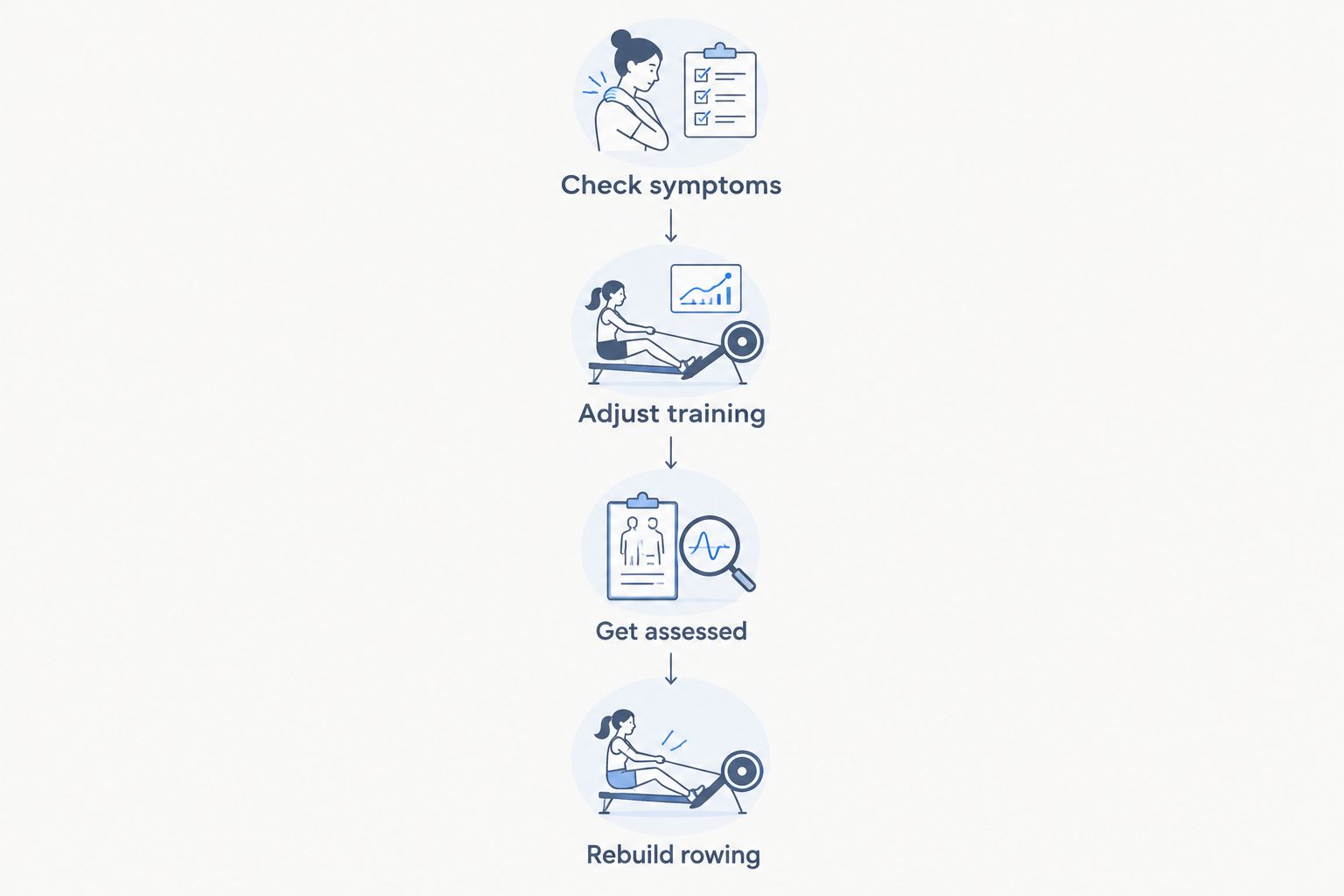
Use these 4 stages to organize the next move. They are decision stages, not a treatment schedule or a promise of recovery.
- Check symptoms. Stop the session if pain escalates, spreads down your leg or comes with new tingling, numbness or weakness. Seek emergency care for the warning signs below.
- Adjust training. Remove the rowing exposure that aggravates your symptoms. Avoid repeatedly testing a hard effort to see whether your back has improved.
- Get assessed. Describe the onset, symptom location, recent workload and any changes in leg sensation or strength. Include previous back episodes and treatment.
- Rebuild rowing. Work toward tolerable activity and then rowing-specific demands, using an individualized plan rather than returning directly to your previous workout.
If earlier treatment has not helped, bring that information to the assessment. Explain what changed temporarily, what never changed and which activities still trigger symptoms; this gives the clinician a clearer starting point without assuming the previous care was wrong.
When is back pain an emergency?
Seek emergency care for new difficulty emptying your bladder, loss of bladder or bowel control, or numbness around the genitals, buttocks or inner thighs. Severe or rapidly worsening leg weakness also requires urgent evaluation.
The American Association of Neurological Surgeons identifies bladder or bowel changes, genital or rectal sensory changes and significant weakness as reasons for urgent assessment in the context of a herniated disc. Do not wait for a scheduled physical therapy visit when these symptoms appear.
Back pain accompanied by fever, significant trauma or a relevant cancer history also needs medical evaluation. Tell the clinician about these features rather than assuming they are unrelated to training.
Do you need an MRI before starting rehabilitation?
Not everyone with back pain needs imaging before rehabilitation. NICE guideline NG59 recommends against routine imaging in nonspecialist settings and supports imaging in specialist care when the result is likely to change management.
For your 2026 appointment, the useful starting point is a clear history and examination. A clinician assesses symptoms, movement and neurological findings before deciding whether additional medical evaluation is needed.
An MRI can show disc changes, but the image must be interpreted alongside your symptoms. It cannot, by itself, establish that a particular rowing session caused the finding or determine your return-to-sport date.
What does a return-to-rowing plan include?
A useful plan addresses what you need to do, not just where you hurt. That includes tolerating everyday activity, rebuilding relevant strength and practicing rowing demands at a manageable level.
McKenzie Sports Physical Therapy is best suited to Philadelphia athletes and active adults seeking sports injury assessment and return-to-sport rehabilitation. The clinic's sports physical therapy services address injury rehabilitation; individual examination determines the appropriate plan, and no outcome is guaranteed.
For rowing, discuss 3 training variables with your clinician: duration, intensity and frequency. Changing them deliberately makes your response easier to interpret than increasing everything together.
- Duration: Establish how much rowing you tolerate before symptoms or fatigue change the session.
- Intensity: Consider the effort required, not just the time spent on the machine.
- Frequency: Account for how rowing fits between lifting, running and sport practices.
Progression should also account for symptoms after activity, not only how you feel during it. Reduced pain is encouraging, but return-to-sport decisions also need to reflect the strength, control and workload your sport requires.
What if you are a pitcher or a runner?
A baseball pitcher needs a plan that considers throwing, lifting and team practice as well as rowing. Parents of high school and college athletes should share the athlete's full schedule so rehabilitation does not become another uncounted workload.
A runner with recurring injuries needs the same whole-schedule view. If rowing replaces a painful run but provokes back or leg symptoms, reconsider the substitute rather than forcing it; the guide to cross-training exercises for injured runners explains the broader decision.
Your 2026 goal is not simply to complete a rowing workout. It is to choose activity that supports your return to the sport you want to play.
What can you do instead of rowing while your back settles?
Choose an alternative by symptom response and clinical advice, not by its reputation as low impact. Less impact does not mean no spinal loading or no possibility of aggravating symptoms.
| Activity | Best for | Potential advantage | Limitation |
|---|---|---|---|
| Walking | Maintaining tolerable everyday activity | Easy to adjust or stop | Still needs modification if it increases symptoms |
| Stationary cycling | Athletes who tolerate the cycling position | Effort is adjustable | A sustained bent position can aggravate some backs |
| Modified rowing | Athletes cleared to rebuild rowing exposure | Keeps practice specific to the sport | Repetition can aggravate symptoms if progressed too quickly |
These are options to discuss, not a universal exercise prescription. Stop and seek reassessment if an activity produces new neurological symptoms.
FAQ
Can rowing cause a herniated disc even if my technique is good?
Yes, rowing can contribute to disc injury even when your technique looks controlled. Technique is only part of the assessment; training load, previous symptoms and individual health also matter, and symptoms alone cannot establish the cause.
How do I know whether rowing pain is a muscle strain or a herniated disc?
You cannot reliably distinguish a muscle strain from a herniated disc through pain location alone. A clinical examination assesses your history, movement, strength, sensation and other findings; imaging is considered when it would affect care.
Should I keep rowing if pain travels down my leg?
Stop the aggravating rowing session and arrange assessment when pain travels down your leg. New weakness or numbness needs prompt medical attention, while bladder changes or saddle numbness require emergency evaluation.
Is walking better than rowing with a herniated disc?
Walking is an option when you tolerate it better than rowing, but it is not automatically the right exercise for every disc injury. Your symptoms and examination should guide the choice and progression.
How long does it take to return to rowing after a herniated disc?
There is no single return-to-rowing timeline that fits every herniated disc. Progress depends on symptoms, neurological findings, functional recovery and the demands of your rowing and other sports.
Can dry needling put a herniated disc back in place?
No, dry needling does not put a herniated disc back in place. Discuss any proposed treatment in terms of the symptoms or functional limitation it targets, rather than expecting it to mechanically reposition a disc.
Can McKenzie Sports Physical Therapy help with rowing-related back pain?
McKenzie Sports Physical Therapy offers sports injury diagnosis and rehabilitation for athletes and active adults in Philadelphia. An individual assessment establishes the appropriate next step, including whether symptoms require further medical evaluation.
One last thing
Bring your training schedule, not just your pain description. For a 2026 assessment, knowing when you row, lift, run or throw helps connect symptoms with the demands you need to rebuild.
Before the appointment, write down 2 questions: What currently aggravates your symptoms, and what activity do you most want to return to? Those answers help keep rehabilitation practical and sport-specific.
Related guides
- From telehealth consultation to in-person physical therapy
- High school sports physicals and return-to-play clearance
- Is sports massage the same as deep tissue massage?
If you live in Manayunk, Roxborough or nearby northwest Philadelphia, request a new-patient appointment to discuss your rowing symptoms and a personalized return-to-sport rehabilitation plan.