

Physical therapy can help reduce CrossFit shoulder pain and restore training capacity when rehabilitation matches the underlying problem, but it cannot guarantee a fix for every injury. For your 2026 return to training, the priority is identifying what hurts, checking for injuries that need medical evaluation, and rebuilding the strength and control your workouts demand.
- Can physical therapy fix CrossFit shoulder pain? It can help, but the diagnosis determines the treatment and limits.
- McKenzie Sports Physical Therapy serves Philadelphia athletes seeking sports injury rehabilitation.
- Return-to-sport rehabilitation should rebuild overhead strength and training tolerance, not just reduce pain.
- Stop training and seek urgent assessment after trauma with deformity, major weakness, or a cold or numb arm.
Why this matters
A shoulder that feels better at rest is not automatically ready for repeated overhead lifts. CrossFit combines strength, speed, fatigue, and demanding positions; your rehabilitation needs to address the movements you actually want back.
McKenzie Sports Physical Therapy is for Philadelphia athletes and active adults seeking sports injury rehabilitation. For readers in Manayunk, Roxborough, and nearby northwest Philadelphia, McKenzie Sports Physical Therapy offers sports injury diagnosis and rehabilitation. The useful question is not simply whether treatment reduces discomfort, but whether your plan prepares you for your sport.
Can physical therapy fix CrossFit shoulder pain?
Physical therapy is an established treatment option for several causes of shoulder pain, including rotator cuff-related problems. It does not replace medical assessment when symptoms suggest a dislocation, fracture, significant tear, or another condition requiring different care.
The American Academy of Orthopaedic Surgeons' OrthoInfo guidance on rotator cuff tears describes physical therapy as a nonsurgical treatment that can improve motion and strength. Its guidance also distinguishes symptom improvement from structural healing: exercise does not necessarily repair a torn tendon. That distinction matters when someone promises to fix your shoulder.
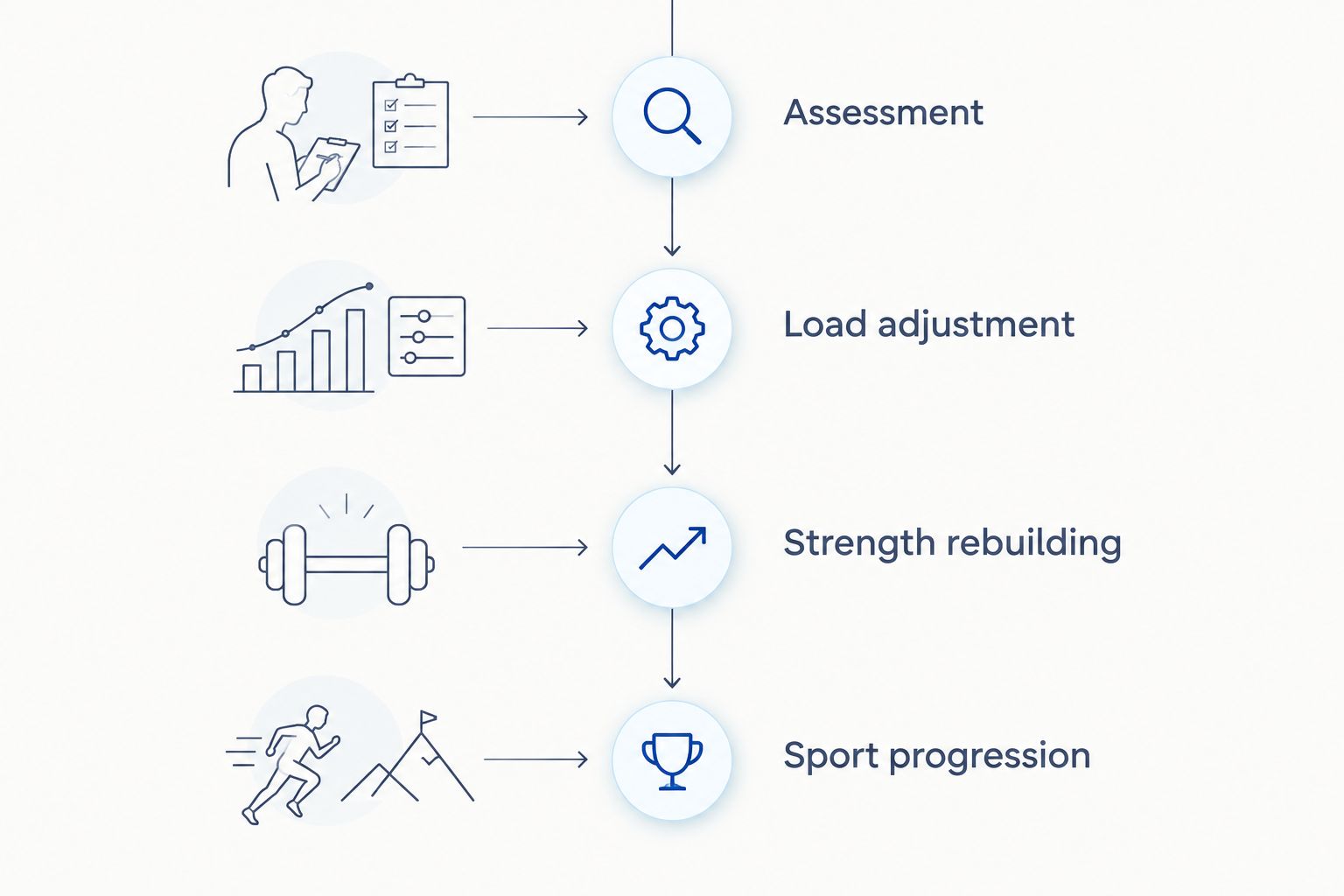
A practical rehabilitation process has these steps:
- Identify the problem. Discuss the injury mechanism, symptoms, previous episodes, and changes in training. The examination helps determine whether further medical assessment is needed.
- Adjust the workload. Remove or modify the movements that provoke symptoms while identifying suitable ways to stay active.
- Rebuild capacity. Use an individualized exercise plan to address relevant strength, movement, and control deficits.
- Test sport demands. Reintroduce the positions, loads, speed, and repetition required for your workouts.
Less pain is progress; readiness for training requires more evidence. Your therapist should explain what you can do now, what remains restricted, and what will justify the next progression.
Which shoulder symptoms need medical assessment first?
Do not treat every painful shoulder as an exercise-selection problem. An injury during a failed lift, a fall, or a sudden pulling movement needs a different assessment from discomfort that gradually builds across workouts.
Seek urgent assessment after trauma if you have an obvious deformity, cannot move the arm, or develop substantial weakness. A cold, pale, or numb arm also needs urgent attention. Shoulder discomfort accompanied by chest pressure, shortness of breath, or other symptoms of a possible heart attack requires emergency care, not a rehabilitation appointment.
These warning signs align with public guidance from the NHS on shoulder pain and the American Heart Association on heart attack symptoms. They are safety checks, not a way to diagnose yourself.
Persistent pain, recurrent slipping sensations, or worsening function also deserves an examination. Clicking alone does not establish a labral tear, and pain during an overhead lift does not establish a rotator cuff tear. If a clinician identifies a labral injury, the guide to labral tear rehabilitation without surgery addresses that separate recovery question.
Why CrossFit shoulder rehabilitation varies
Two athletes can hurt during the same exercise and need different treatment. For your 2026 training plan, the relevant differences are clinical findings and sport demands—not whether a generic shoulder routine worked for a teammate.
- Injury mechanism: A sudden traumatic injury changes the assessment compared with symptoms that developed gradually.
- Symptoms and examination: Pain, weakness, restricted movement, and instability are different problems, even when they overlap.
- Training demands: Strict pressing, kipping, handstand work, and Olympic lifting place different demands on the shoulder.
- Workload changes: Added repetitions, heavier lifting, and less recovery belong in the history your clinician reviews.
- Other sports: Pitching, college practices, and additional strength sessions contribute to the same athlete's overall workload.
- Previous response: Exercises that consistently aggravate symptoms or a plan that has stopped progressing warrant reassessment.
No single factor proves the diagnosis. Together, these details help your clinician choose a starting point and explain the limits of the plan.
What should personalized return-to-sport rehabilitation include?
A useful rehabilitation plan connects each exercise to a limitation found during your assessment. You should understand why you are doing it and what improvement would allow the program to change.
Assessment
Bring details about the exact movement that hurts, where you feel symptoms, and whether the problem starts during training or afterward. If you have previous imaging reports or treatment instructions, bring those too.
A short training record helps make the conversation specific. Record symptoms before exercise, immediately afterward, and about 24 hours later; this is an observation window, not a universal clearance rule. Include the exercise, load, repetitions, and any changes you made.
Load adjustment
Your clinician should help distinguish activities to pause from activities you can modify. Scaling is useful only if the replacement avoids the same provoking demand and fits your examination findings.
That does not mean replacing every overhead movement with a supposedly safe alternative. A push-up, row, or front-rack position can still be unsuitable for a particular shoulder.
Strength rebuilding
Exercises should address the deficits relevant to your shoulder and your sport. The American Academy of Orthopaedic Surgeons' shoulder conditioning guidance includes strengthening and mobility work, with advice to discuss appropriate exercises with a clinician.
Avoid treating a published exercise sheet as a personalized prescription. The appropriate resistance, movement range, and progression depend on your assessment and response.
Sport progression
Your final phase should resemble the work you intend to resume. Controlled repetitions, overhead positioning, faster movements, and fatigue exposure are separate demands to assess rather than restore all at once.
For a baseball player who also trains CrossFit, returning to the gym does not establish readiness to pitch. High school and college athletes should coordinate rehabilitation restrictions with the appropriate healthcare team and coaching staff. Parents can help by keeping practice, lifting, and competition schedules in the same conversation.
Should you rest, scale workouts, or keep training?
Choose activity around the assessed injury, not around a rule to always push through or always stop. The right decision can change as symptoms and function change.
| Approach | Best for | Main benefit | Important limitation |
|---|---|---|---|
| Temporarily pausing a provoking movement | Athletes whose symptoms escalate with that movement | Removes a specific aggravating demand | Does not rebuild strength or establish readiness to return |
| Clinician-guided scaling | Athletes with an assessed problem and suitable alternatives | Preserves appropriate activity during rehabilitation | A lighter exercise can still provoke the same symptoms |
| Progressive rehabilitation | Athletes with identified strength or movement limitations | Connects exercise progression to the examination | Requires reassessment rather than repeating an unchanged routine |
| Medical evaluation before training | Athletes with trauma, marked weakness, instability, or warning signs | Helps identify problems needing a different treatment pathway | Is not replaced by trying additional stretches |
For a runner using CrossFit as cross-training, preserving running is a separate decision from clearing overhead lifting. Tell your clinician whether arm swing, carrying equipment, or other training tasks also reproduce symptoms. Keep the conversation specific to what you do.
What if previous physical therapy did not help?
An unsuccessful course of treatment does not tell you, by itself, whether rehabilitation can help now. It does mean the next evaluation should examine what was treated, what changed, and what remained limited.
Bring the exercises you were prescribed and explain how consistently you completed them. Describe whether treatment helped briefly, never changed symptoms, or improved daily activity without restoring training.
Ask these questions at your next assessment:
- What is the working diagnosis, and what findings support it?
- What would prompt imaging or referral to another clinician?
- Which training demands are currently beyond my shoulder's capacity?
- How will we measure progress beyond pain at rest?
- What will change if the current plan stops helping?
You do not need to criticize previous care to ask for a clearer plan. A useful 2026 reassessment should produce specific decisions about your current training, not simply restart the same routine without explanation.
Can dry needling or sports massage replace shoulder rehabilitation?
Dry needling and sports massage are not substitutes for rebuilding the strength and task tolerance needed for CrossFit. A clinician can discuss whether either treatment has a relevant role, what the intended benefit is, and what limitations apply to your condition.
McKenzie Sports Physical Therapy offers dry needling and sports massage alongside rehabilitation. That does not mean either belongs in every shoulder treatment plan, or that temporary symptom relief establishes readiness for heavy or high-repetition lifting.
The American Academy of Orthopaedic Surgeons' shoulder treatment guidance supports exercise-based rehabilitation as part of nonsurgical care for relevant shoulder conditions. Ask how any additional treatment supports that plan rather than judging the plan by how many treatments it contains.
How long should you wait before returning to overhead lifting?
There is no single waiting period that clears every painful shoulder. Your diagnosis, symptoms, examination, and ability to perform the required tasks determine the progression.
For your 2026 return, ask for functional checkpoints: which movement you need to demonstrate, what resistance you should tolerate, and what response should make you stop or step back. A calendar date without those checks leaves the main question unanswered.
Consider the next 2 training sessions as opportunities to record your response rather than prove full recovery. That is a practical logging suggestion, not a medical return-to-play standard; your clinician decides whether those sessions are appropriate.
Is pain-free daily activity enough to return to CrossFit?
Pain-free daily activity is not enough on its own to clear CrossFit training. Reaching a shelf and repeatedly controlling a loaded bar overhead are different tasks.
Your return plan should address the movements you intend to resume, including their repetition and speed. Do not use one comfortable lift as evidence that every shoulder-demanding exercise is ready.
FAQ
Can physical therapy fix CrossFit shoulder pain without surgery?
Physical therapy can improve pain and function for several shoulder conditions without surgery, but the diagnosis determines whether nonsurgical care is appropriate. Improvement in symptoms does not necessarily mean a torn structure has healed.
Should I stop CrossFit completely if my shoulder hurts?
You do not automatically need to stop every activity, but you should stop movements that aggravate an unassessed injury. A clinician can help identify appropriate modifications and symptoms that require medical evaluation.
How do I know whether my shoulder pain is a rotator cuff injury?
You cannot reliably identify a rotator cuff injury from the painful exercise alone. A clinical history and examination help determine the likely cause and whether imaging or referral is needed.
Is stretching enough for shoulder pain from overhead lifting?
Stretching alone does not address every cause of shoulder pain. Your assessment should determine whether mobility, strength, instability, workload, or another issue needs attention.
Can I keep pitching while rehabilitating a CrossFit shoulder injury?
Pitching needs its own assessment and return-to-throwing decision. Tolerating gym exercises does not establish that your shoulder is ready for throwing volume or intensity.
What should I bring to my first shoulder physical therapy appointment?
Bring your training schedule, symptom history, previous treatment details, and any relevant imaging reports. Include the movements that hurt and what happens later that day or the next day.
When does shoulder pain need urgent care?
Shoulder pain needs urgent assessment after trauma with deformity, inability to move the arm, substantial weakness, or a cold or numb arm. Shoulder discomfort with chest pressure or shortness of breath requires emergency care.
One last thing
A scaled workout can still contain a large amount of shoulder work. Before your next 2026 session, review the entire workout—not just the exercise you already know hurts—and bring that list to your clinician.
Spend 5 minutes writing down your goal, the movements you cannot tolerate, and what previous treatment changed. That preparation time is a practical suggestion, not a treatment dose. A clear target makes it easier to discuss whether rehabilitation is moving you toward the activity you actually want back.
Related guides
- How often should athletes get a sports massage?
- Does dry needling hurt?
- High school sports physicals and return-to-play clearance
Request a new-patient appointment with McKenzie Sports Physical Therapy to discuss your shoulder symptoms and a personalized return-to-sport rehabilitation plan.