


You should not keep playing a cutting, pivoting, or contact sport with a suspected mild ACL sprain until a clinician checks your knee’s stability and clears the activity. A confirmed low-grade injury can allow modified exercise, but mild pain does not prove that the ligament is intact or the knee is ready for competition. Your return depends on the diagnosis, associated injuries, strength, movement control, and your sport—not just how the knee feels today.
- Can you play sports with a mild ACL sprain? Only within restrictions based on knee stability and clinical assessment.
- AAOS distinguishes Grade 1 stretching from Grade 2 partial tearing; mild pain cannot identify the injury grade.
- Return-to-sport rehabilitation should restore strength and movement control before unrestricted cutting, pivoting, or competition.
- McKenzie Sports Physical Therapy provides sports injury diagnosis and rehabilitation for Philadelphia athletes and active adults.
Why this matters
An injured knee can feel comfortable during walking yet struggle when you plant, turn, or react to another player. Being able to finish a workout is not the same as being ready for sport. That distinction matters for a pitcher landing on the lead leg, a soccer player changing direction, and a runner negotiating uneven ground.
For athletes in Manayunk, Roxborough, and nearby northwest Philadelphia, sports injury rehabilitation services provide a starting point for an assessment rather than a guess. Your 2026 season schedule belongs in that conversation, but a game date should not determine medical clearance.
Can you play sports with a mild ACL sprain?
Modified activity can be appropriate for a clinically assessed, stable knee; unrestricted sport requires a separate return-to-sport decision. Until you have that assessment, avoid using practice or a game to test whether the injury is serious.
The American Academy of Orthopaedic Surgeons, or AAOS, describes ACL sprains by ligament damage and stability, not by pain alone. Its guidance also distinguishes partial tears without instability from injuries that leave the knee functionally unstable. Those differences change the treatment discussion.
Use this sequence before returning:
- Confirm the injury. Describe how it happened, any pop, swelling, locking, or giving way. A clinician examines the knee and determines whether imaging or orthopedic assessment is needed.
- Set activity limits. Ask which exercises are acceptable and which movements to avoid. Walking, cycling, running, and cutting are separate decisions.
- Rebuild capacity. Follow an individualized plan addressing motion, strength, balance, and sport-specific control.
- Earn clearance. Progress through the tasks your sport requires rather than moving straight from symptom relief to competition.
Which activities need separate clearance?
This table is a discussion guide, not permission to exercise through an undiagnosed injury. Each option assumes that your treating clinician has assessed whether it is appropriate.
| Activity | Best for | Potential benefit | Limitation or concern |
|---|---|---|---|
| Modified daily walking | Maintaining necessary daily movement | Keeps activity practical when gait is comfortable | Walking tolerance does not demonstrate sport readiness |
| Stationary cycling | Selected athletes rebuilding motion and conditioning | Allows controlled movement without cutting | Resistance and knee motion still need individual adjustment |
| Straight-line running | Athletes cleared for impact progression | Reintroduces running demands in a predictable setting | Does not test pivoting, contact, or reactive movement |
| Cutting and pivoting drills | Athletes preparing for field or court sports | Tests demands that basic exercise misses | An unstable knee needs further assessment, not harder drills |
| Full practice and competition | Athletes who meet individualized clearance criteria | Restores exposure to actual sport demands | Fatigue, contact, and unpredictable play add demands |
Grade 1 ACL sprain: stretching without loss of stability
AAOS describes a Grade 1 ACL sprain as mild ligament damage: the ligament is slightly stretched but still helps keep the knee stable. That is more specific than saying your knee hurts only a little.
A confirmed Grade 1 injury still deserves an activity plan. Swelling, reduced motion, weakness, or altered movement can interfere with sport even when the ligament remains stable. Do not turn a low-grade diagnosis into blanket permission to play.
For your 2026 return-to-sport plan, ask what you must demonstrate before running, practicing, and competing. Those milestones should reflect your examination and position, not a generic sprain timeline.
Grade 2 ACL sprain: partial tearing needs closer assessment
AAOS describes a Grade 2 ACL sprain as stretching that leaves the ligament loose, often called a partial tear. Partial tearing does not establish whether your knee is functionally stable during your sport.
Some partial ACL injuries are managed without surgery, particularly when instability is absent. Others require an orthopedic discussion because of instability, associated injury, or athletic demands. The word partial does not make cutting or pivoting safe.
If your knee gives way during a turn or landing, stop that activity and report it. Repeatedly testing the movement is not a useful substitute for reassessment.
Grade 3 ACL sprain: complete tearing is not a mild injury
AAOS describes a Grade 3 ACL sprain as a complete ligament tear, with the ligament no longer providing its normal stability. A complete tear requires a treatment discussion based on the whole injury and your goals.
You cannot reliably distinguish a Grade 1 injury from a Grade 3 injury by pain intensity, walking ability, or an online self-test. Avoid asking a teammate or family member to perform ligament stress tests. A proper examination considers findings together rather than treating any single symptom as proof.
Why return-to-sport readiness varies
The same label does not create the same rehabilitation plan. Your clinician should account for:
- Knee stability: Giving way during daily tasks or athletic movement changes the decision.
- Associated injuries: Meniscus, cartilage, or other ligament injuries can change restrictions and treatment.
- Swelling and motion: Persistent swelling or difficulty straightening the knee needs attention before progression.
- Strength and control: Your ability to produce force and control landings matters beyond pain relief.
- Sport demands: Straight-line running differs from reacting, cutting, landing, and contact.
- Response to progression: Increased symptoms or instability after an activity signals a need to reassess the workload.
These factors explain why a teammate’s recovery schedule is not a useful clearance standard. A 2026 tournament deadline does not change the demands your knee must tolerate.
What should personalized ACL rehabilitation include?
An individualized plan connects your examination findings to the movements you need back. Early work often addresses swelling, knee motion, walking mechanics, and muscle function; later work introduces progressively harder strength and sport tasks as appropriate.
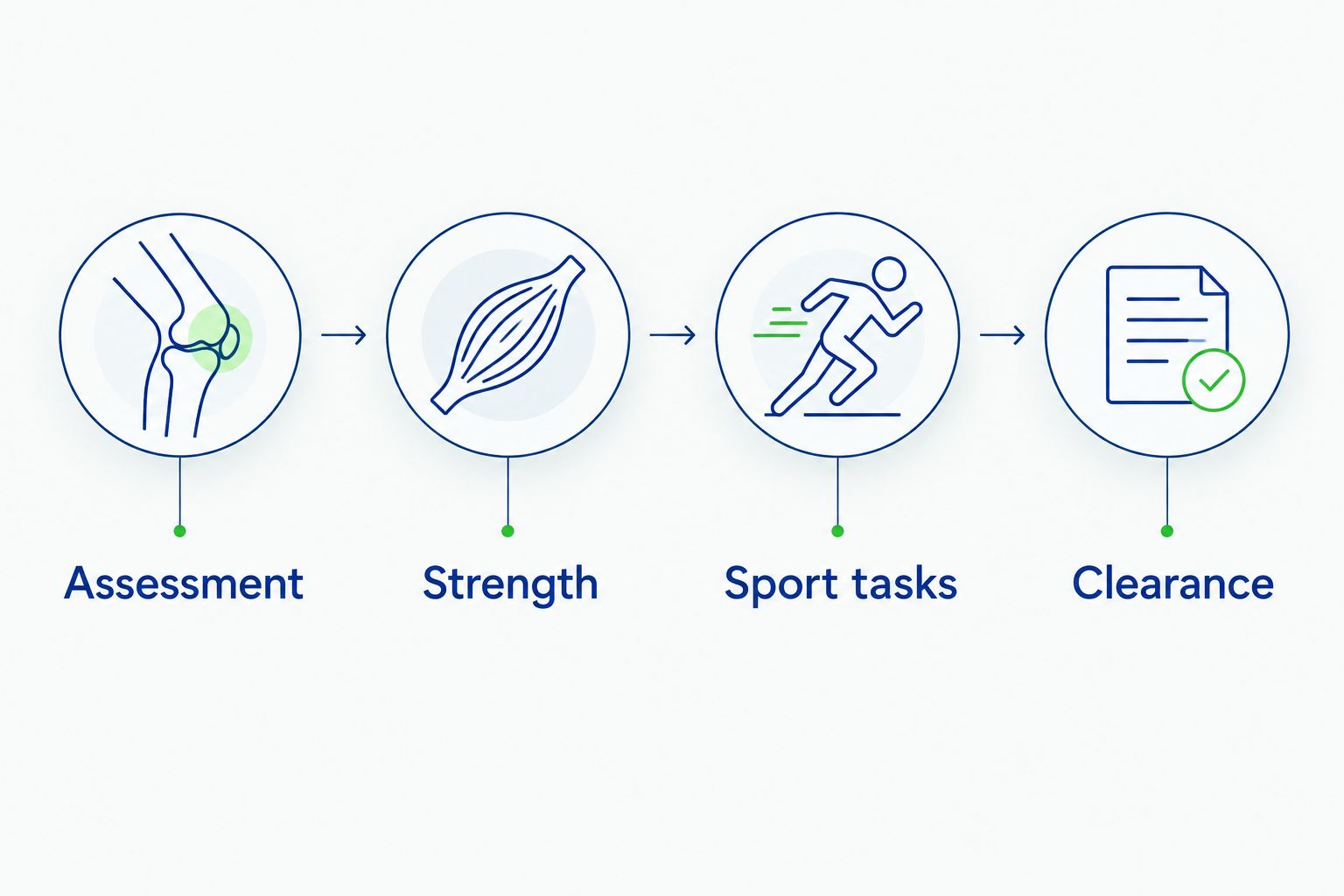
The practical sequence is assessment, strength, sport tasks, and clearance. It is not a fixed calendar, and progression is not always linear. Your clinician should explain what allows you to advance and what would send you back for reassessment.
McKenzie Sports Physical Therapy is a Philadelphia sports rehabilitation option for athletes and active adults returning from injury. Its services include sports injury diagnosis and rehabilitation; your assessment should establish whether physical therapy is appropriate or another medical evaluation is needed.
Physical therapy addresses strength, movement, and activity progression, but it does not guarantee that every ACL injury can be managed without surgery. Ask how progress will be measured and when persistent instability would trigger referral.
Baseball players and pitchers
Baseball involves more than straight-line jogging. Fielding, baserunning, sliding, and reacting to a ball create different knee demands. Pitchers also need control through the stride, landing, and follow-through.
Tell your clinician your position, throwing side, injured side, and the exact movement that causes difficulty. Clearance for controlled throwing does not automatically include fielding, covering a base, or competing.
High school and college athletes
Parents, coaches, athletic trainers, and treating clinicians should work from the same restrictions. A general preseason sports physical is not a substitute for evaluating a new knee injury.
For a 2026 school-season return, request clear guidance on permitted conditioning, practice participation, and competition. School and team clearance requirements also need to be addressed.
Runners with recurring symptoms
A runner who tolerates a short, flat outing has not necessarily demonstrated readiness for hills, uneven surfaces, or fatigue. Repeated swelling, altered stride, or giving way deserves reassessment rather than another attempt to push through.
If previous treatment has not helped, bring the exercise plan and describe what changed—or did not change. That information helps the next clinician identify unresolved limitations without starting from assumptions.
Can I play if my knee does not hurt?
Pain-free movement alone does not establish ACL stability or readiness for sport. Strength, swelling, movement quality, and sport-specific function also matter.
Tell your clinician whether the knee feels unreliable, even if discomfort is minimal. A painless giving-way episode is still relevant to the return-to-sport decision.
Can a knee brace make playing safe?
A knee brace does not replace an examination, rehabilitation, or clearance. Whether bracing belongs in your plan depends on the injury and the clinician’s assessment.
Do not use a brace as permission to resume cutting or contact. Ask what the brace is intended to do and which restrictions remain while wearing it.
How long should I wait before playing again?
There is no single waiting period that clears every mild ACL sprain. The injury grade, stability, associated damage, and required sport skills determine the plan.
Ask for functional milestones rather than an unsupported return date. Your 2026 training calendar can help organize progression, but elapsed time alone cannot demonstrate that your knee is ready.
When should you seek prompt medical assessment?
Stop playing and arrange assessment after a twisting injury with substantial swelling, a pop, loss of motion, or giving way. A locked knee, inability to bear weight, or difficulty fully straightening the knee also warrants prompt medical evaluation.
Seek urgent care for a visibly deformed knee or a foot that becomes cold, pale, or numb after injury. These findings require immediate attention rather than routine rehabilitation scheduling.
For suspected ACL injury, an examination determines the next step. MRI can help assess ligament and associated soft-tissue injuries when clinically indicated; not every painful knee requires the same imaging pathway.
Evidence behind this guidance
AAOS OrthoInfo’s Anterior Cruciate Ligament (ACL) Injuries explains the Grade 1, Grade 2, and Grade 3 classifications, clinical evaluation, and associated knee injuries. Its ACL Injury: Does It Require Surgery? discusses nonsurgical management for selected partial tears without instability.
The AAOS Management of Anterior Cruciate Ligament Injuries clinical practice guideline, published August 22, 2022, addresses management of diagnosed ACL injuries. These resources support the distinctions on this page; they do not provide personal clearance or a universal return date. This 2026 guide is educational and does not replace an examination.
FAQ
Can you play sports with a mild ACL sprain?
Do not resume unrestricted cutting, pivoting, or contact sport until a clinician evaluates the injury and clears those demands. A stable, confirmed low-grade injury can allow modified exercise within individualized restrictions.
Can I walk normally and still have an ACL injury?
Yes, walking ability does not rule out an ACL injury. Walking does not place the same demands on the knee as turning, landing, or reacting during sport.
Does a mild ACL sprain always mean a partial tear?
No. AAOS describes Grade 1 as slight stretching with retained stability and Grade 2 as a partial tear; a clinical assessment is needed to distinguish them.
Should I stop running if my knee gives way?
Yes, stop running and arrange reassessment if your knee gives way. Instability needs evaluation even when pain is limited.
Can physical therapy help me avoid ACL surgery?
Physical therapy is part of nonsurgical care for selected ACL injuries, but it does not eliminate the need for surgery in every case. Stability, associated injuries, and sport demands guide that decision.
Can a high school pitcher return to throwing before games?
Controlled throwing and game participation require separate decisions based on the injured knee and the pitching task. Clearance must address landing, fielding, baserunning, and other expected demands.
Where can I get a sports knee assessment near Manayunk?
McKenzie Sports Physical Therapy offers sports injury diagnosis and rehabilitation in Philadelphia. Request a new-patient appointment to discuss your knee symptoms and return-to-sport goals.
One last thing
Tell your clinician what happens after activity, not just during it. Later swelling, stiffness, or a change in walking can reveal that a workload exceeded your current tolerance, even when the session felt manageable. Bring those observations to your next assessment.
Related guides
- Can you avoid ACL surgery with physical therapy?
- How long does ACL recovery take without surgery?
- From a high school sports physical to return-to-play clearance
Ready to stop guessing about your knee? Request a new-patient appointment with McKenzie Sports Physical Therapy to discuss your injury, current limitations, and return-to-sport goals.