
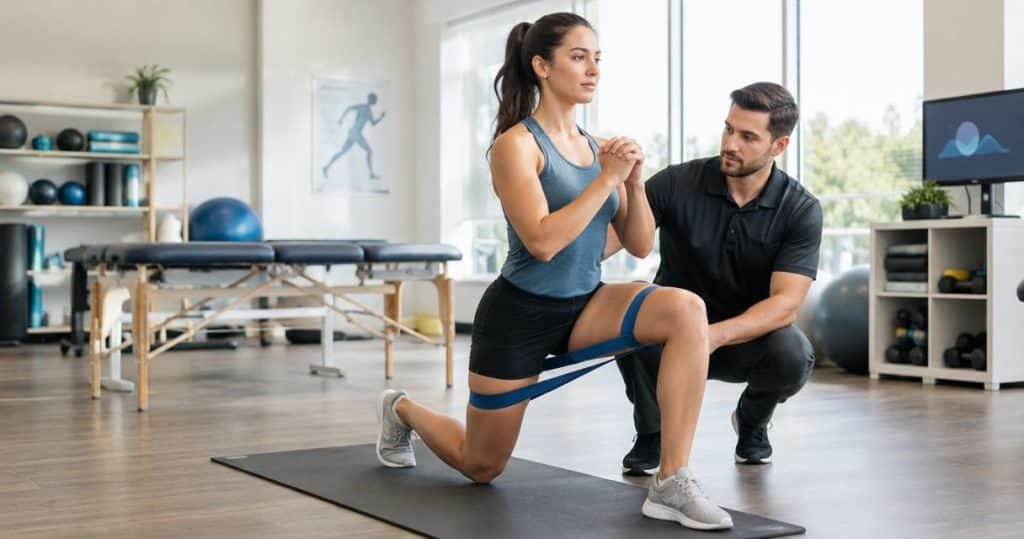
Physical therapy can help reduce your risk of a second ACL tear, but it cannot guarantee prevention. A return-to-sport plan should rebuild strength, improve landing and cutting control, and test readiness before unrestricted competition. Both knees need attention: another ACL injury can affect the reconstructed knee or the opposite knee.
- Can physical therapy prevent a second ACL tear? It can reduce risk, not eliminate it.
- McKenzie Sports Physical Therapy serves athletes and active adults seeking sports injury rehabilitation in Philadelphia.
- ACL rehabilitation should assess strength, movement control, sport demands, and psychological readiness—not pain alone.
- Return-to-sport testing informs clearance; no single test guarantees protection against another ACL injury.
Can physical therapy prevent a second ACL tear?
Physical therapy addresses changeable risk factors; it does not make an athlete injury-proof. Progressive exercise can rebuild muscle capacity and help you practice the demanding movements your sport requires. Clearance also depends on healing, associated injuries, surgical guidance, and exposure to sport.
For athletes in Manayunk, Roxborough, and nearby northwest Philadelphia, McKenzie Sports Physical Therapy is a fit for sports injury rehabilitation focused on returning to activity. The practical question for your 2026 comeback is not simply whether you have finished therapy. It is whether your rehabilitation has prepared you for the demands you are returning to.
| Rehabilitation component | Best for | What it contributes | Limitation |
|---|---|---|---|
| Progressive strength training | Athletes with remaining muscle weakness | Rebuilds capacity for running, braking, and sport tasks | Strength alone does not establish competition readiness |
| Landing and cutting practice | Athletes returning to jumping or direction changes | Develops control during demanding movements | Predictable drills do not reproduce every game situation |
| Graded sport exposure | Athletes moving from rehabilitation into practice | Introduces sport demands in controlled stages | Participation still carries injury risk |
| Return-to-sport assessment | Athletes approaching clearance decisions | Identifies remaining deficits and guides next steps | Passing a test battery cannot guarantee safety |
These components complement one another. Choosing only strength work, only balance exercises, or only a clearance test leaves different questions unanswered.
Why this matters
A knee that feels comfortable during daily activities has not necessarily recovered the capacity required for competition. Walking across campus, jogging in a straight line, and reacting to an opponent place different demands on your body.
A second injury can interrupt school, training, work, and confidence. That makes an honest readiness assessment more useful than reassurance based only on a quiet knee or a date on the calendar.
Parents and athletes should share the same expectations. Ask what the athlete must demonstrate before advancing, who makes clearance decisions, and how the rehabilitation plan connects with the coach's practice schedule.
What evidence supports risk-focused ACL rehabilitation?
The clinical evidence informing this 2026 guide supports exercise-based rehabilitation and a staged return to sport, while leaving uncertainty about exactly how much any individual athlete's risk will fall.
The Aspetar clinical practice guideline on rehabilitation after anterior cruciate ligament reconstruction, published in the British Journal of Sports Medicine, addresses rehabilitation after reconstruction. It supports progressive exercise and proposes return-to-sport criteria covering symptoms, motion, strength, performance, and readiness. It also identifies gaps in the evidence behind individual interventions and discharge criteria.
The Panther Symposium ACL Injury Return to Sport Consensus Group describes return as a continuum: participation, sport, and performance. Its guidance supports decisions that combine clinical findings, functional assessment, psychological readiness, and sport context rather than time alone.
Research by Beischer and colleagues in the Journal of Orthopaedic & Sports Physical Therapy examined young athletes returning to knee-strenuous sport after reconstruction. Returning before 9 months was associated with more second ACL injuries. That observational finding supports caution; it does not mean that reaching 9 months makes every athlete ready.
The evidence supports a process, not a promise. Much of the return-to-sport research concerns reconstructed ACLs and young athletes in demanding sports. Your clinician must account for whether you had surgery, your associated injuries, and your intended activity.
What should a second-injury-focused rehabilitation plan include?
A useful plan connects each exercise to a limitation and each progression to a measurable goal. Your therapist should explain both in language you can use outside the clinic.
1. Establish your baseline
Assessment should consider knee motion, swelling, strength, symptoms, movement, and current activity tolerance. Your history matters too, including previous ACL injuries, surgical instructions, and other knee damage.
Bring your current exercise program and describe what happens during activity and afterward. If previous treatment has not helped, identify the exact sticking point: running, stairs, landing, cutting, or confidence. That gives the reassessment a practical starting point without assuming the earlier care was wrong.
2. Build strength
Progressive resistance work targets the quadriceps, hamstrings, and other muscles involved in controlling your lower body. The exercise selection and load should match your stage of rehabilitation and clinical restrictions.
Both legs need assessment. A strong-looking result compared with your opposite leg can be misleading when that leg has also lost strength during time away from sport.
3. Train movement
Landing, slowing down, and changing direction require more than completing a repetition. Your therapist should consider how you distribute load and control your trunk, hip, knee, and ankle during the task.
Practice should progress with your ability. Unplanned reactions and more demanding drills belong later in the process, not at the expense of basic strength or symptom control.
4. Reintroduce sport
Return should progress from controlled activities toward the actual demands of practice and competition. Your therapist, surgeon when involved, athletic trainer, and coach should understand the restrictions and progression criteria.
For a baseball player, straight-line running does not answer every question about fielding, base running, or reacting to a play. A pitcher also needs a plan that accounts for the stride leg, drive leg, and repeated delivery demands without treating knee clearance as automatic throwing clearance.
5. Reassess readiness
Repeat assessment helps determine whether the plan is working and what still needs attention. It should inform the next training decision rather than function as a certificate that risk has disappeared.
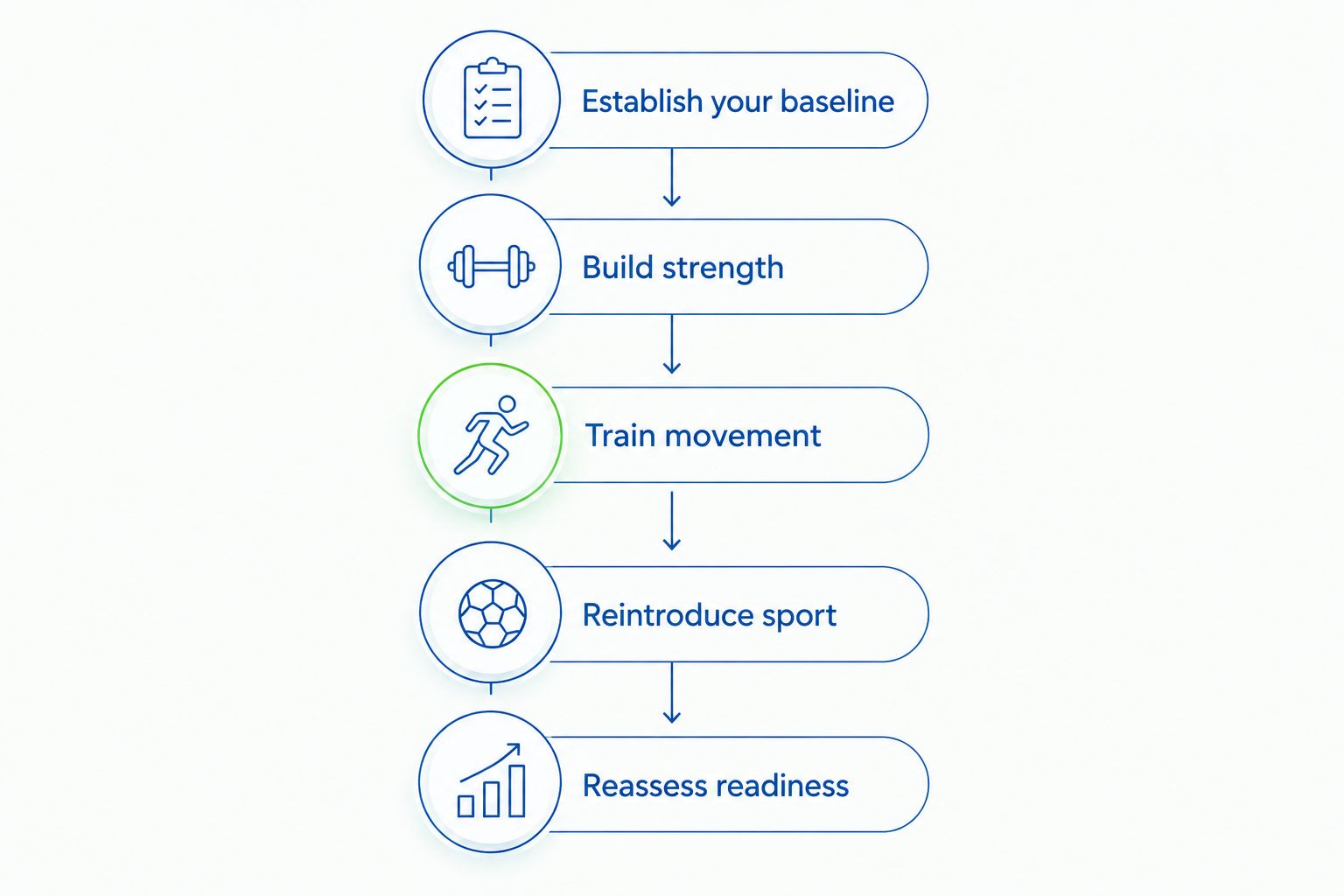
The sequence is not rigid. New swelling, loss of confidence, or difficulty tolerating practice can send you back to an earlier task while your clinician reassesses the plan.
Why second ACL injury risk varies
Athletes do not return to identical knees, sports, or schedules. These factors change the rehabilitation decisions:
- Sport demands: Cutting, pivoting, jumping, and reacting to other players introduce demands that straight-line activity does not reproduce.
- Remaining strength deficits: Muscle weakness can persist even when walking feels normal and pain has settled.
- Movement control: Completing a drill is different from controlling repeated landings, braking, and direction changes.
- Timing and healing: Time after reconstruction matters, but time alone does not establish readiness. Associated procedures can also change restrictions.
- Exposure and workload: A controlled drill, full practice, and competitive play represent different levels of exposure. Progression needs to account for those differences.
- Psychological readiness: Fear, hesitation, and confidence deserve assessment alongside physical performance. Feeling confident does not replace testing, and feeling worried deserves discussion.
You cannot change every risk factor. You can ask for a plan that identifies the factors your rehabilitation can address and explains the remaining uncertainty.
Is passing a hop test enough to return to sport?
Passing a hop test is not enough to establish readiness for unrestricted sport. Hop performance provides useful information, but distance alone does not describe strength, landing strategy, symptoms, or readiness for reactive play.
A commonly used benchmark is 90% limb symmetry on selected strength or hop measures. That means the involved leg reaches 90% of the comparison leg's result; it is not a 90% probability of avoiding injury.
The comparison also has limits. If both legs are underprepared, a good symmetry score can hide a broader capacity problem. Some high-demand return-to-sport recommendations use stricter criteria, and your clinician should explain which benchmarks apply to your sport.
For your 2026 clearance discussion, ask what was measured, how it was measured, and what the result changes. A number without a training decision attached is less useful than a clear explanation of the remaining deficit.
Does waiting longer guarantee that I will not tear my ACL again?
Waiting 9 months after reconstruction does not guarantee protection from another ACL tear. The timing evidence supports avoiding an early return to knee-strenuous sport, but a calendar cannot measure your strength, control, or readiness.
Use the waiting period for progressive rehabilitation rather than treating it as passive recovery. If you reach a planned return date with unresolved deficits, the next step is to address those deficits—not to ignore them because the season has started.
For high school and college athletes, make that conversation before tryouts or preseason. Parents can help by asking for the criteria behind restrictions rather than pressing for a date that the clinical findings do not support.
Can I reduce my risk if my first rehabilitation did not help?
A fresh assessment can identify what still needs attention, but it cannot guarantee a different outcome. Persistent symptoms or repeated difficulty progressing deserve review rather than simply repeating the same exercises without reassessment.
McKenzie Sports Physical Therapy provides sports injury diagnosis and rehabilitation for athletes and active individuals. A useful discussion should connect your current limitations with the activity you want to resume; no clinic visit or treatment technique can eliminate reinjury risk.
Ask your sports rehab physical therapist:
- What is limiting my progress now?
- Which findings support that explanation?
- What will change in the exercise plan?
- How will we judge whether the change is helping?
- What findings require review by my surgeon or another clinician?
For runners with recurring symptoms, distinguish permission to begin running from readiness for a normal training schedule. For field athletes, distinguish controlled drills from reacting at competition speed. Those are different decisions.
FAQ
Can physical therapy prevent a second ACL tear completely?
Physical therapy cannot completely prevent a second ACL tear. It can address strength, movement, and sport-readiness deficits, but injury risk remains even after rehabilitation and clearance.
Can I tear the ACL in my other knee after reconstruction?
Yes, a subsequent ACL injury can affect the opposite knee as well as the reconstructed knee. Rehabilitation should assess and train both legs rather than focusing exclusively on the surgical side.
Is 9 months enough to return to sport after ACL surgery?
Reaching 9 months does not establish readiness by itself. Strength, symptoms, movement performance, psychological readiness, associated injuries, and your treating team’s guidance also matter.
Does 90% strength symmetry mean my knee is safe?
A 90% symmetry result does not guarantee safety. It compares the legs on a particular measure and can miss problems when both legs remain underprepared.
Should I keep doing rehabilitation exercises after returning to sport?
Returning to sport does not automatically end strength and neuromuscular training. Ask your therapist how to integrate an ongoing program with practices, games, and recovery.
What should parents ask before a high school athlete returns?
Parents should ask which clearance criteria the athlete has met and which restrictions remain. The athlete, treating clinicians, athletic trainer, and coach should understand the same progression plan.
What if my knee swells or gives way during my comeback?
New swelling or giving way calls for reassessment before you continue progressing. Stop the provoking sport activity and contact your treating clinician, especially after a new twisting injury or pop.
One last thing
The other leg is not automatically a reliable definition of normal. If time away from sport has reduced capacity in both legs, matching them is only part of the job. Ask your clinician how your results compare with the demands you need to handle, not just with your opposite side.
Make that your practical 2026 takeaway: request clear criteria for the next step, a plan for the deficits that remain, and guidance for maintaining strength after your return.
Related guides
- Can you avoid ACL surgery with physical therapy?
- How long does ACL recovery take without surgery?
- High school sports physical to return-to-play clearance
If you are planning a 2026 return to sport in Manayunk, Roxborough, or nearby northwest Philadelphia, request a new-patient appointment with McKenzie Sports Physical Therapy to discuss your injury, current limitations, and rehabilitation goals.