


You can return to running with a mild hamstring strain once a clinician-guided progression shows you can tolerate it; running through fresh pain, limping, or weakness is not a safe shortcut. Comfortable walking alone does not establish readiness for jogging, sprinting, or returning to sport.
- Can you run with a mild hamstring strain? Only when symptoms, strength, and a graded running progression support it.
- McKenzie Sports Physical Therapy provides sports injury diagnosis and rehabilitation for Philadelphia athletes and active adults.
- Walking comfortably does not prove your hamstring is ready for running or sprinting.
- Stop running if pain increases, your stride changes, or symptoms worsen afterward.
Can you run with a mild hamstring strain?
Yes, at the appropriate rehabilitation stage—not simply because the strain feels mild. Start by establishing what is injured, then rebuild the capacity needed for your running or sport. For local assessment, McKenzie Sports Physical Therapy offers sports injury diagnosis and rehabilitation in Philadelphia.
The Journal of Orthopaedic & Sports Physical Therapy published its 2022 clinical practice guideline, “Hamstring Strain Injury in Athletes,” covering assessment, rehabilitation, and return to activity. It supports progressive strengthening, including eccentric exercise, alongside an appropriate running progression. It does not provide a universal day when every athlete can safely resume running.
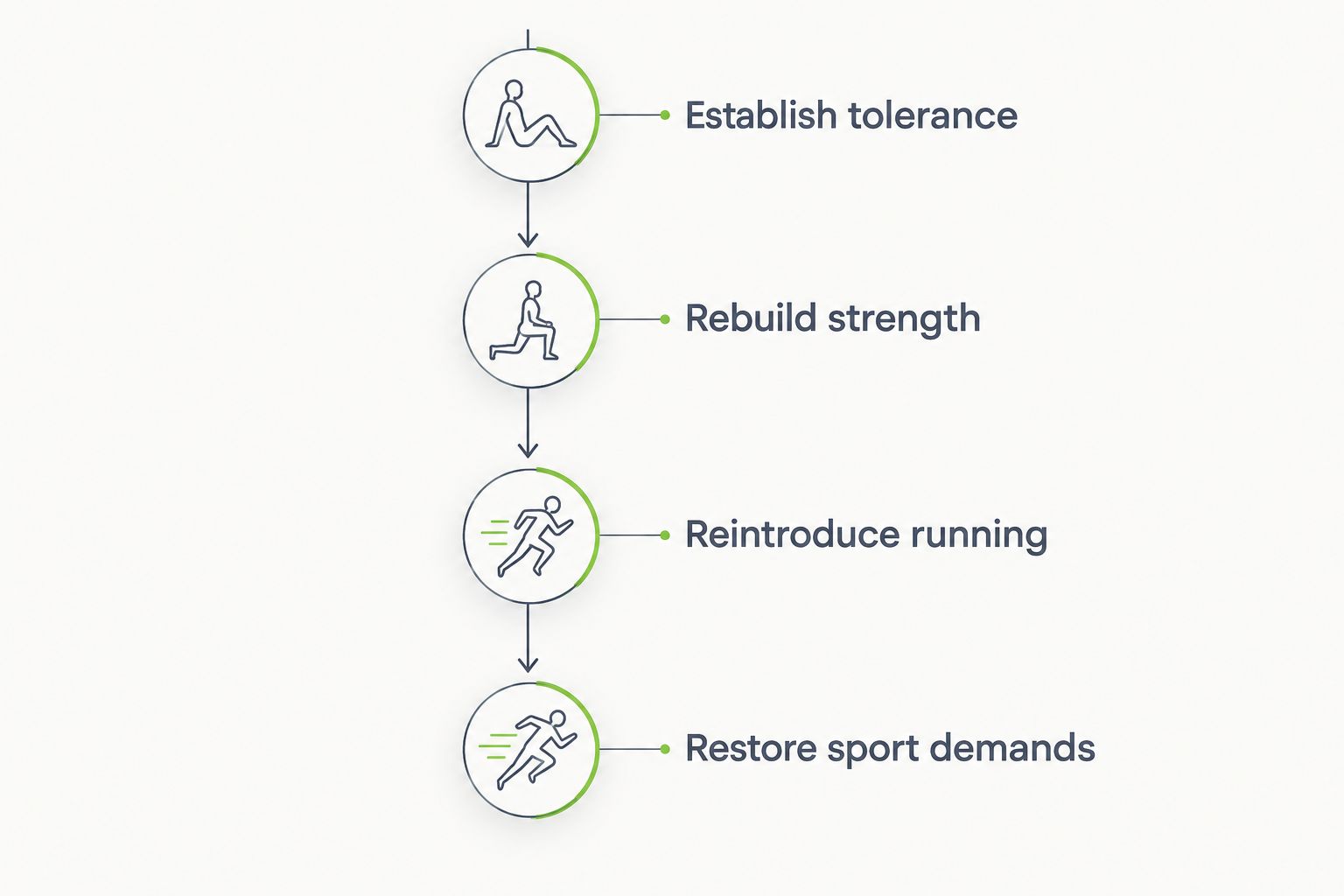
For a return-to-running decision in 2026, use these checkpoints with your treating clinician:
- Confirm the problem. Pain behind your thigh is not automatically a mild muscle strain. Location, injury mechanism, examination findings, and associated symptoms matter.
- Restore basic function. Walking and ordinary daily movements should not require you to protect the injured leg or change your gait.
- Build strength. Rehabilitation should address the hamstring’s ability to produce and absorb force, not just its flexibility.
- Introduce running gradually. Begin at a demand you can tolerate, then evaluate symptoms and movement before advancing.
- Restore sport demands. Sprinting, cutting, accelerating, and competing require more than completing an easy jog.
These are decision points, not a self-clearance test. An athlete with recurring pain or an uncertain diagnosis needs an individual assessment.
Why this matters
A mild sensation can still interrupt a demanding season. Runners need repeated loading, baseball players need acceleration, and pitchers must tolerate the demands of their delivery and fielding—not merely a comfortable walk around the block.
Pain relief and return-to-sport readiness are different milestones. You need a plan that connects rehabilitation exercises to the actual demands you want to resume.
For athletes in Manayunk, Roxborough, and nearby northwest Philadelphia, the practical question in 2026 is not whether you can finish today’s workout. It is whether today’s workload fits your current recovery stage without forcing you to compensate.
What should you do instead of testing another run?
If your hamstring hurts during running, stop using repeated test runs as your assessment. Each attempt tells you that the current demand remains difficult, but it does not explain which capacity needs work.
Start with a sports-injury evaluation. Describe where the pain began, whether it followed a sudden sprint or developed gradually, and what happens during and after activity.
Bring useful details rather than trying to label the injury yourself:
- Injury mechanism: A sudden pull during acceleration differs from gradually developing discomfort.
- Pain location: Point to the specific area rather than describing the whole back of your leg.
- Functional changes: Mention limping, weakness, or difficulty with stairs and ordinary walking.
- Training changes: Explain recent changes in running intensity, terrain, practices, or competition.
- Previous symptoms: Describe earlier hamstring problems and which activities brought symptoms back.
If previous treatment has not helped, say what improved and what did not. That information helps refine the next assessment without assuming the earlier diagnosis or treatment was wrong.
Which activities fit each stage of recovery?
Choose activity by its demands, not by whether you can push through it. Walking, cross-training, easy running, and sprinting are different options, with different limitations.
| Activity | Best for | Potential benefit | Limitation or reason to hold |
|---|---|---|---|
| Comfortable walking | Maintaining daily movement when tolerated | Keeps ordinary activity manageable | A limp or increasing pain means the demand needs reassessment |
| Modified cross-training | Maintaining activity while running is restricted | Offers another way to exercise | Cycling and swimming can still provoke symptoms; neither is automatically suitable |
| Graded easy running | Athletes who meet individualized running-entry criteria | Reintroduces running-specific loading | Tolerating a jog does not establish sprint readiness |
| Sprinting and sport drills | Later rehabilitation and return-to-sport preparation | Rebuilds exposure to competition demands | High demand makes this an inappropriate first test of recovery |
For other training options, the guide to cross-training exercises for injured runners provides a starting point for discussion with your clinician. Exercise selection still needs to account for your hamstring symptoms and examination.
Avoid treating cross-training as permission to maintain your full usual workload. The substitute session needs to fit your current capacity, too.
How should you progress back to running?
A useful return-to-running plan in 2026 links symptoms, strength, and running exposure. It should also explain what makes you advance, repeat a stage, or step back.
Establish tolerance
Begin with the movements and exercises your clinician selects after assessment. You should understand the purpose of each exercise and what symptom response requires adjustment.
Pain rules used during supervised rehabilitation are not a blanket permission to run through pain. Do not borrow another athlete’s threshold and assume it applies to your injury.
Rebuild strength
Hamstring rehabilitation involves more than stretching. The JOSPT guideline supports strengthening that includes eccentric loading—producing force as the muscle lengthens—as part of an individualized program.
Exercise choice and difficulty should match your current ability. A challenging exercise is useful only when its demands fit the stage of rehabilitation.
Reintroduce running
Your clinician can help select an appropriate starting exposure and progression. Keep the first running sessions controlled rather than turning them into pace tests.
Check how you move during the session and how the leg responds afterward. Increasing pain, a shortened stride, or a new limp are reasons to stop and reassess rather than finish the planned distance.
Restore sport demands
Build toward the tasks that matter for your sport. For a runner, that includes the intended training demands; for a baseball player, it includes acceleration, base running, and fielding.
Pitchers also need their delivery and fielding demands considered. Completing an easy jog does not answer whether the leg is ready for those tasks.
Why readiness to run varies
The word mild does not describe every feature that affects your return. Your clinician needs to connect the diagnosis to your symptoms, examination, and intended activity.
- Injury location: Muscle injuries and injuries involving tendon tissue require attention to the structures involved.
- Current function: Walking, strength testing, and movement quality reveal more than pain at rest alone.
- Previous injury: A history of hamstring problems belongs in the assessment and progression plan.
- Running demand: Easy jogging and maximum-speed running place different demands on the hamstrings.
- Response to loading: Symptoms during activity and afterward help guide progression.
- Sport requirements: Distance running, base running, and pitching require different preparation.
Use criteria, not a calendar promise. A race date or playoff schedule establishes your goal; it does not establish your tissue’s readiness.
For high school and college athletes, parents and coaches should understand the restrictions and progression. The athlete should not have to interpret conflicting instructions from rehabilitation, practice, and competition on their own.
When should you get medical attention instead of trying to run?
A sudden pop, substantial bruising or swelling, marked weakness, or difficulty bearing weight needs prompt medical assessment. Do not assume these symptoms represent a mild strain because you can still move the leg.
Adolescent athletes with sudden pain near the sitting bone after a forceful movement also need assessment. The American Academy of Orthopaedic Surgeons explains that a hamstring injury can involve an avulsion, where the tendon pulls away with a piece of bone; that possibility changes management.
New numbness, progressive weakness, or pain spreading from the back also deserves evaluation rather than a self-directed hamstring routine. Seek urgent care for severe or rapidly worsening symptoms.
This 2026 guide provides general education, not a diagnosis or personal clearance. An examination determines whether the recommendations fit your injury.
Should you stretch a mild hamstring strain before running?
Stretching is not a clearance test for running with a hamstring strain. Being able to reach farther does not establish that the muscle can tolerate acceleration or repeated running loads.
Do not force a stretch into sharp pain. Your rehabilitation plan should specify whether mobility work is appropriate and how it fits alongside strengthening and running progression.
The same distinction applies to symptom-relief treatments. Feeling looser after treatment does not replace checking strength, movement, and running tolerance.
Can you run if the pain disappears after warming up?
Pain that disappears during a warm-up does not prove a hamstring strain is ready for running. Your stride, strength, and symptom response after the session still matter.
Tell your clinician if symptoms repeatedly settle during exercise and return later. That pattern is useful assessment information, not a reason to ignore the problem.
What if your hamstring keeps hurting every time you return?
Recurring hamstring pain needs reassessment rather than another identical return attempt. Review the diagnosis, strengthening progression, running exposure, and the demands that trigger symptoms.
McKenzie Sports Physical Therapy is a sports rehabilitation option for Philadelphia athletes and active adults returning from injury. The clinic provides sports injury diagnosis and rehabilitation; an individual assessment is needed to determine which treatment fits your problem.
For recurring running injuries in 2026, ask for a plan you can explain plainly: what you are rebuilding, how running will progress, and what will indicate readiness for your sport. No treatment can guarantee that an injury will not recur.
FAQ
Can I jog with a mild hamstring strain if I am not limping?
Not limping is useful, but it does not establish readiness to jog with a mild hamstring strain. Strength, symptoms, and tolerance of a graded running progression also matter.
How long should I wait before running after a mild hamstring strain?
There is no universal waiting period that clears every mild hamstring strain for running. Your clinician should base progression on the injury assessment, function, strength, and response to loading.
Can I walk for exercise while my hamstring heals?
Comfortable walking can be appropriate when it does not increase symptoms or change your gait. Adjust the activity and seek guidance if you develop pain or a limp.
Should I stretch my hamstring before trying a run?
Stretching does not establish that your hamstring is ready for running. Avoid forcing painful stretches and follow the mobility and strengthening plan selected for your injury.
Is cycling better than running with a hamstring strain?
Cycling is an alternative only if its demands fit your injury and do not provoke symptoms. It is not automatically safe simply because it has less impact than running.
Can a high school baseball player return once jogging feels fine?
Comfortable jogging alone does not clear a high school baseball player for competition. Return preparation also needs to address acceleration, base running, fielding, and position-specific demands.
Do I need a scan for a mild hamstring strain?
A scan is not automatically required for every suspected mild hamstring strain. Your clinician uses the history and examination to decide whether imaging or further medical assessment is appropriate.
One last thing
Before your first run back, know what will make you stop. A clear stop rule is more useful than deciding halfway through a workout whether worsening pain is acceptable.
Write down the response your clinician wants you to monitor during the session and afterward. That turns a test run into a planned rehabilitation step.
Related guides
- High school sports physicals and return-to-play clearance
- How often should athletes get a sports massage?
- From telehealth consultation to in-person physical therapy
Request a new-patient appointment with McKenzie Sports Physical Therapy to assess your hamstring and discuss a personalized return-to-sport rehabilitation plan for running, baseball, or your next season.