


A hamstring strain can improve within days when mild, while a substantial tear can take months; the injury’s severity determines the starting estimate, not a universal recovery deadline. Feeling comfortable walking does not mean you are ready to sprint, and this 2026 guide explains the milestones that matter before returning to running, baseball, or competition.
- How long does a hamstring strain take to heal? Severity, tendon involvement, and sport demands determine the timeline.
- NHS guidance distinguishes mild injuries that improve within days from severe injuries that can require months.
- Pain-free walking is not clearance for sprinting; return-to-sport rehabilitation must rebuild strength and faster movement.
- McKenzie Sports Physical Therapy offers sports-injury rehabilitation for Philadelphia athletes and active adults.
How long does a hamstring strain take to heal?
A mild hamstring strain can improve within days, but a severe tear can require months of recovery. NHS guidance on hamstring injuries describes this broad difference; it does not provide a dependable personal return-to-sport date. An examination helps distinguish a smaller muscle injury from a more substantial tear or an injury involving the tendon.
McKenzie Sports Physical Therapy provides sports-injury diagnosis and rehabilitation for athletes and active adults in Philadelphia. The practical goal is to identify what is injured, establish what you can currently tolerate, and build toward the demands of your sport.
| Injury pattern | General recovery expectation | What affects the next step |
|---|---|---|
| Mild strain | Symptoms can improve within days | Whether walking, strengthening, and progressive running remain comfortable |
| Partial tear | Recovery is longer than a minor strain and varies with injury extent | Strength loss, injury location, and response to rehabilitation |
| Complete tear or tendon avulsion | Recovery can take months and requires specialist assessment | Whether the tendon has detached and whether surgery is appropriate |
These are injury descriptions, not self-diagnosis categories. Bruising, pain, or the ability to walk cannot reliably tell you how much tissue is injured.
Why this matters
Your hamstring has to tolerate more than everyday movement. A runner must absorb repeated loading; a baseball player must accelerate and stop; a pitcher must control the lower body through delivery and fielding.
For your 2026 season, separate the date symptoms settle from the date you can handle competition. Returning because the calendar says you should be ready leaves an important question unanswered: can the injured leg perform the work you are asking of it?
The clinical framework here follows the Hamstring Strain Injury in Athletes clinical practice guideline published in the Journal of Orthopaedic & Sports Physical Therapy in 2022. That guideline addresses examination, exercise-based rehabilitation, and return-to-sport assessment; it does not establish a guaranteed healing date for every athlete.
Mild hamstring strain: improvement is not clearance
A mild strain can settle relatively quickly, particularly during ordinary walking. The limitation is that walking places different demands on the hamstring than accelerating, sprinting, or reaching forward at speed.
Best for a mild strain: a graded return based on function, not the first pain-free day. Start by understanding which activities provoke symptoms and which remain tolerable. Your clinician can then progress strengthening and running rather than asking you to test the injury repeatedly at practice.
The benefit of a milder injury is that everyday function can return sooner. The drawback is that early improvement can make the injury seem finished before faster movement has been rebuilt.
Partial hamstring tear: rebuild capacity before speed
A partial tear involves more tissue disruption than a minor strain. Pain, weakness, bruising, and difficulty moving can occur, but those findings alone do not establish the extent of the tear.
Best for a suspected partial tear: an examination followed by progressive rehabilitation. Your plan should address strength, controlled movement, and exposure to running demands. Imaging is a clinical decision, not an automatic requirement for every sore hamstring.
Exercise provides a way to rebuild the capacity needed for sport. Its limitation is that progression requires monitoring: an exercise that feels manageable in isolation does not automatically establish readiness for a full practice.
Complete tear or tendon avulsion: get specialist assessment
A complete tear is different from a routine muscle pull. An avulsion occurs when a tendon pulls away from its attachment, sometimes with a piece of bone; the American Academy of Orthopaedic Surgeons describes this distinction in its patient guidance on hamstring injuries.
Best for a suspected complete tear or avulsion: prompt medical assessment. Surgery is considered for selected injuries, not every strain. The appropriate pathway depends on the examination and, when indicated, imaging.
For parents of high school athletes, sudden pain high in the back of the thigh or near the buttock deserves attention, particularly after an explosive movement. Do not assume a growing athlete has the same injury as an adult teammate with similar symptoms.
Why hamstring recovery time varies
A useful recovery estimate explains what is driving it. These factors matter more than choosing a deadline from someone else’s experience:
- Injury extent: A smaller muscle injury and a complete tear require different management.
- Injury location: Muscle and tendon involvement change the assessment and rehabilitation decisions.
- Previous injury: A recurring problem warrants review of what remained difficult after the earlier rehabilitation.
- Current function: Walking tolerance, strength, and running ability help guide progression.
- Sport demands: Easy jogging does not establish readiness for sprinting, cutting, or repeated acceleration.
- Response to loading: Symptoms during exercise and afterward help determine whether the current workload is appropriate.
A deadline still matters for planning. In 2026, use your race, tournament, or tryout date to organize the discussion—not to override the findings of your examination.
What should hamstring rehabilitation include in 2026?
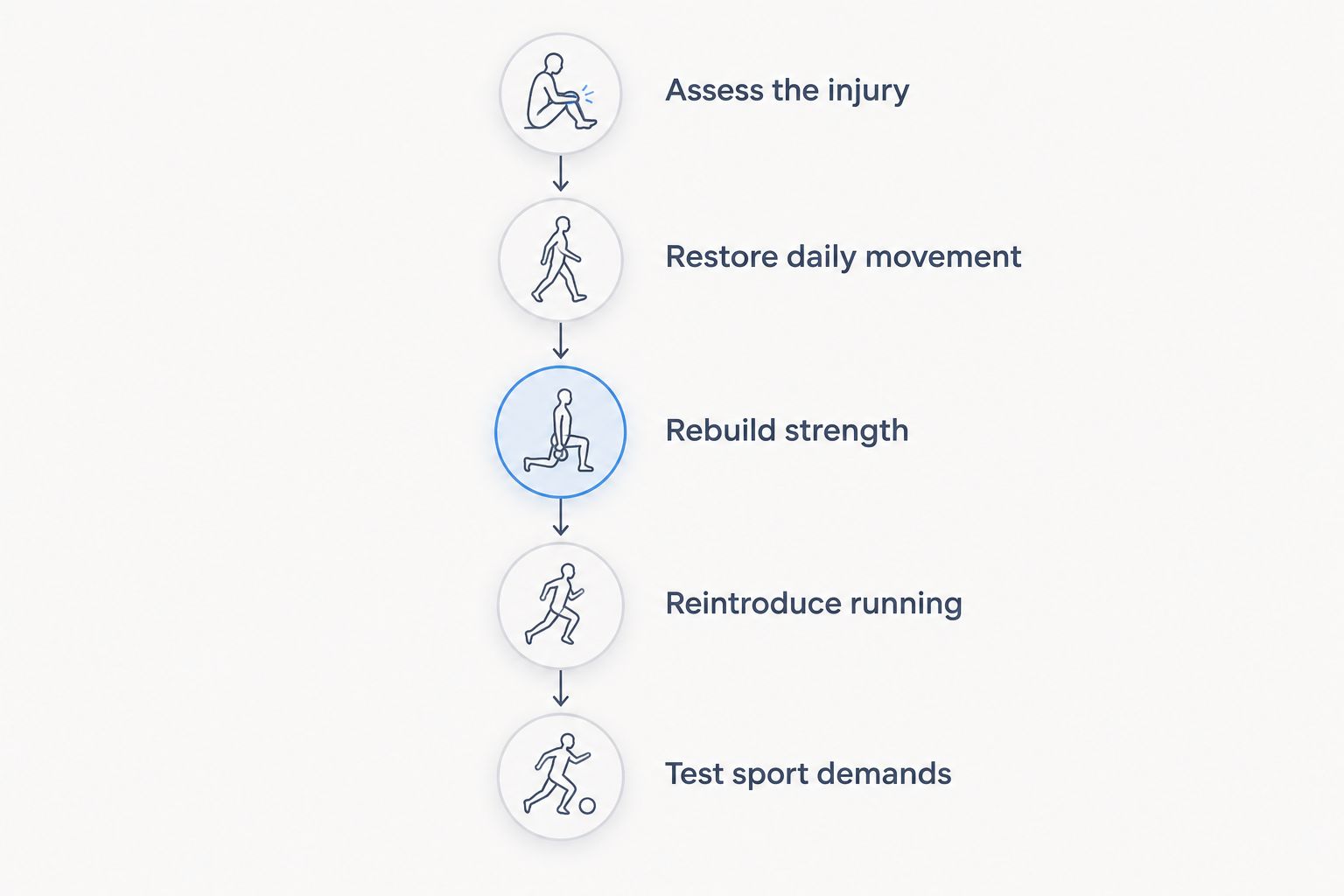
Effective planning connects your current abilities to the activity you want back. The sequence below describes decision points, not a home exercise prescription or a promise that every injury follows the same schedule.
- Assess the injury. Review how the injury happened, where symptoms occur, and whether there are findings that need medical investigation.
- Restore daily movement. Work toward comfortable walking and manageable everyday activity while avoiding repeated aggravation.
- Rebuild strength. Progress hamstring and related lower-body exercises according to your examination and tolerance.
- Reintroduce running. Increase running demands deliberately rather than moving straight from rest to fast efforts.
- Test sport demands. Rehearse the movements and workloads your position or event requires before unrestricted competition.
The JOSPT guideline supports exercise-based rehabilitation, including progressive strengthening and running-related work. The exact exercises, resistance, and speed should reflect your injury rather than a generic routine copied from another athlete.
For runners, maintaining fitness is a separate decision from testing the hamstring. Discuss tolerable options before choosing cross-training exercises for injured runners; an activity is not appropriate simply because it is described as low impact.
What does this mean for baseball players and pitchers?
A baseball return plan should account for more than batting or throwing without pain. Running to a base, accelerating out of a fielding position, and reacting to an unexpected play create different demands.
For pitchers, discuss the injured side, delivery mechanics, fielding responsibilities, and running expectations with your clinician. A throwing session alone does not test every task that occurs during a game.
What should parents ask before clearance?
Ask what the athlete has demonstrated, what remains limited, and how practice participation will progress. School scheduling, tournaments, and recruiting pressure belong in the conversation, but they do not substitute for a functional assessment.
When several adults are involved, make the restrictions clear to the athlete, parent, coach, and treating clinician. A defined progression is more useful than an instruction to return whenever the leg feels better.
When can I run again after a hamstring strain?
Return to running when your assessment supports it, not simply when walking stops hurting. Your clinician should consider symptoms, strength, movement, and your response to the current rehabilitation workload.
An easy run and a sprint are separate milestones. Build exposure to faster running before treating a comfortable jog as permission for racing, base running, or unrestricted practice.
Should I stretch a strained hamstring?
Do not force a painful stretch to check whether the strain has healed. Stretching is not a substitute for rebuilding strength or assessing the injury.
Range-of-motion work can be part of rehabilitation when appropriate. Ask what movement is suitable for your current stage rather than assuming that a stronger pulling sensation means better treatment.
Why does my hamstring keep getting injured?
Recurring symptoms need reassessment, not another automatic cycle of rest and return. Review the diagnosis, previous strength progression, running exposure, and the workload that brought symptoms back.
If previous treatment has not helped, bring the details: which activities improved, which remained difficult, and what happened when you returned. That information helps your clinician adjust the plan without assuming that all earlier treatment was wrong.
Can massage or dry needling speed up healing?
McKenzie Sports Physical Therapy offers sports massage and dry needling alongside injury rehabilitation. These services are not substitutes for evaluating a tear or rebuilding the strength and movement needed for sport.
Best for return-to-sport planning: an exercise-based rehabilitation plan with a clear purpose for any additional treatment. Hands-on care can address symptoms in selected circumstances; its limitation is that symptom relief alone does not demonstrate that a hamstring is ready for sprinting.
Ask what a proposed treatment is intended to change and how that change will be assessed. Do not treat reduced soreness after an appointment as proof of faster tissue healing or permission to skip running progression.
When should I seek medical care?
Seek prompt assessment after a sudden injury with marked weakness, substantial bruising or swelling, difficulty standing or walking, or symptoms that are worsening. A suspected tendon avulsion also needs timely evaluation.
A pop during activity does not establish the diagnosis by itself. Give the clinician the full picture: the movement, the pain location, your ability to continue, and what changed afterward.
For recurring pain without a new dramatic injury, arrange an assessment rather than repeatedly testing the same painful run or sprint. Persistent symptoms deserve a clear explanation and a plan you can follow.
FAQ
How long does a hamstring strain take to heal in 2026?
A mild hamstring strain can improve within days, while a severe tear can take months. The personal timeline depends on the injury and the demands you need to return to; symptom improvement is not the same as sports clearance.
Can I walk with a strained hamstring?
Some people can walk with a hamstring strain, but walking ability does not establish the injury’s severity. Difficulty standing or walking after an injury warrants prompt assessment.
Can I play baseball if my hamstring only hurts when sprinting?
Pain during sprinting means an important baseball demand remains limited. Get assessed before unrestricted play rather than assuming comfortable throwing or batting makes game participation appropriate.
Do I need an MRI for a hamstring strain?
Not every hamstring strain requires an MRI. A clinician decides whether imaging is needed based on the examination, suspected injury, and whether the result would change treatment.
Should I stop all exercise while my hamstring heals?
Complete exercise avoidance is not the default for every hamstring strain. Your clinician can help identify tolerable activity while restricting movements that aggravate the injury or are inappropriate for its severity.
Will sports massage heal a hamstring tear?
Sports massage does not replace assessment and progressive rehabilitation for a hamstring tear. Any symptom-focused treatment should have a defined role alongside the work needed to restore function.
What if physical therapy has not helped my hamstring before?
Ask for a reassessment of the diagnosis, remaining limitations, and return-to-sport progression. Explain what you tried and exactly when symptoms returned so the next plan addresses those findings.
One last thing
The useful question is not just when your hamstring will heal; it is what your leg must demonstrate before you return. Ask your clinician to explain the next milestone and the findings that will determine progression. That gives you something more useful than a countdown.
Related guides
- High school sports physicals and return-to-play clearance
- How often should athletes get a sports massage?
- Telehealth consultation to in-person physical therapy
If you live in Manayunk, Roxborough, or nearby northwest Philadelphia, request a new-patient appointment with McKenzie Sports Physical Therapy to assess your hamstring injury and discuss a personalized return-to-sport rehabilitation plan.