


Shockwave therapy costs depend on the treatment recommended for your injury, what each visit includes, and your insurance benefits; get a written, patient-specific quote before agreeing to treatment in 2026. Ask whether the evaluation, rehabilitation exercises, and follow-up assessments are billed separately. The useful comparison is your expected out-of-pocket expense for the proposed plan—not an isolated session fee.
- Compare shockwave therapy costs across the proposed treatment plan, not just the advertised session fee.
- McKenzie Sports Physical Therapy offers shockwave therapy and sports rehabilitation for Philadelphia athletes and active adults.
- Ask about insurance coverage, separate rehabilitation charges, and reassessment before committing to treatment.
- Choose treatment around your diagnosis and return-to-sport goals, not a predetermined package.
Why this matters
You want to return to running, pitching, lifting, or competing—not keep paying for treatment without understanding its purpose. A clear estimate connects the proposed service to your diagnosis, the work you need to do between appointments, and the point when your clinician will reassess progress.
If you are comparing Philadelphia physical therapy options, start with the clinic’s sports injury and rehabilitation services. Then ask how shockwave fits your particular injury rather than assuming every painful tendon needs the same treatment.
A useful quote explains both what you will pay for and why that care is being recommended. It should also distinguish symptom treatment from the rehabilitation needed to tolerate your sport again.
How much does shockwave therapy cost in 2026?
Your shockwave therapy costs require an individual quote that identifies the recommended treatment, planned visits, included services, and applicable benefits. There is no single figure that answers what you personally will owe without those details.
Use this breakdown when requesting an estimate. It helps you compare the same services rather than two totals that cover different care.
| Estimate component | What to ask | Why it matters |
|---|---|---|
| Initial evaluation | Is the assessment included or billed separately? | The examination establishes what needs treatment. |
| Shockwave treatment | What does the quoted visit include? | A treatment-only visit and a rehabilitation visit are not interchangeable. |
| Rehabilitation | Are exercise instruction and progression separate charges? | Returning to sport requires a plan beyond the treatment itself. |
| Reassessment | When will the clinician review the plan? | Further treatment should have a stated reason. |
| Insurance responsibility | What is covered, and what remains your responsibility? | A clinic accepting insurance does not establish coverage for every service. |
| Changes to care | What happens to the estimate if the plan changes? | Your financial commitment should remain clear as care progresses. |
Ask for the estimate in writing. Keep the billing explanation with it, especially if someone gives you a verbal description of coverage.
Do not treat an estimated insurance payment as a guarantee. Your insurer’s benefit determination and the services actually billed affect your responsibility.
Why shockwave therapy costs vary
When you compare estimates in 2026, separate the clinical recommendation from the billing arrangement. Both affect the decision, but they answer different questions.
- Services included: An evaluation, shockwave application, exercise session, and reassessment are distinct parts of care. Ask which appear in the quote.
- Proposed treatment course: The recommended frequency and number of visits affect the total commitment. Ask what supports that recommendation for your injury.
- Insurance benefits: Coverage, deductibles, and other patient responsibilities depend on your plan and the service being billed. Verify the specific treatment rather than general physical therapy benefits alone.
- Treatment approach: Ask what form of shockwave treatment is proposed and why it fits your diagnosis. Do not assume differently described treatments are equivalent.
- Changes after reassessment: An initial recommendation is not a reason to continue indefinitely. Ask how changes to the treatment plan change the estimate.
These are questions to resolve before treatment, not reasons to choose the least expensive appointment automatically. A clearly explained plan gives you a better basis for deciding whether the proposed care fits your goals.
Compare the role of treatment—not just the bill
Shockwave therapy and exercise-based rehabilitation serve different purposes. Comparing them only by appointment cost misses the question that matters: what does your injury need?
| Approach | Best for | Practical advantage | Limitation |
|---|---|---|---|
| Shockwave therapy | Selected conditions after a clinical assessment | Offers a nonsurgical treatment option to discuss | Evidence and response vary by condition; improvement is not guaranteed. |
| Exercise-based rehabilitation | Rebuilding strength and sport-specific capacity when clinically appropriate | Connects treatment to running, lifting, or throwing demands | Requires participation and progression outside passive treatment. |
| Shockwave with rehabilitation | Cases where the clinician identifies a reason for both | Addresses the proposed treatment and activity progression together | Adds services that need a clear clinical and billing explanation. |
These are not interchangeable packages or a ranking of treatments. The right choice depends on the examination, diagnosis, medical history, and your activity goals.
For the evidence behind shockwave, NICE’s guidance titled Extracorporeal shockwave therapy for refractory plantar fasciitis and Extracorporeal shockwave therapy for Achilles tendinopathy describes inconsistent evidence of effectiveness. Those documents address particular conditions; they do not establish that shockwave works for every sports injury.
Use that limitation in your 2026 decision: ask what evidence applies to your diagnosis, not simply whether shockwave is offered. A treatment recommendation should explain uncertainty as well as its intended benefit.
How to get a useful estimate before treatment
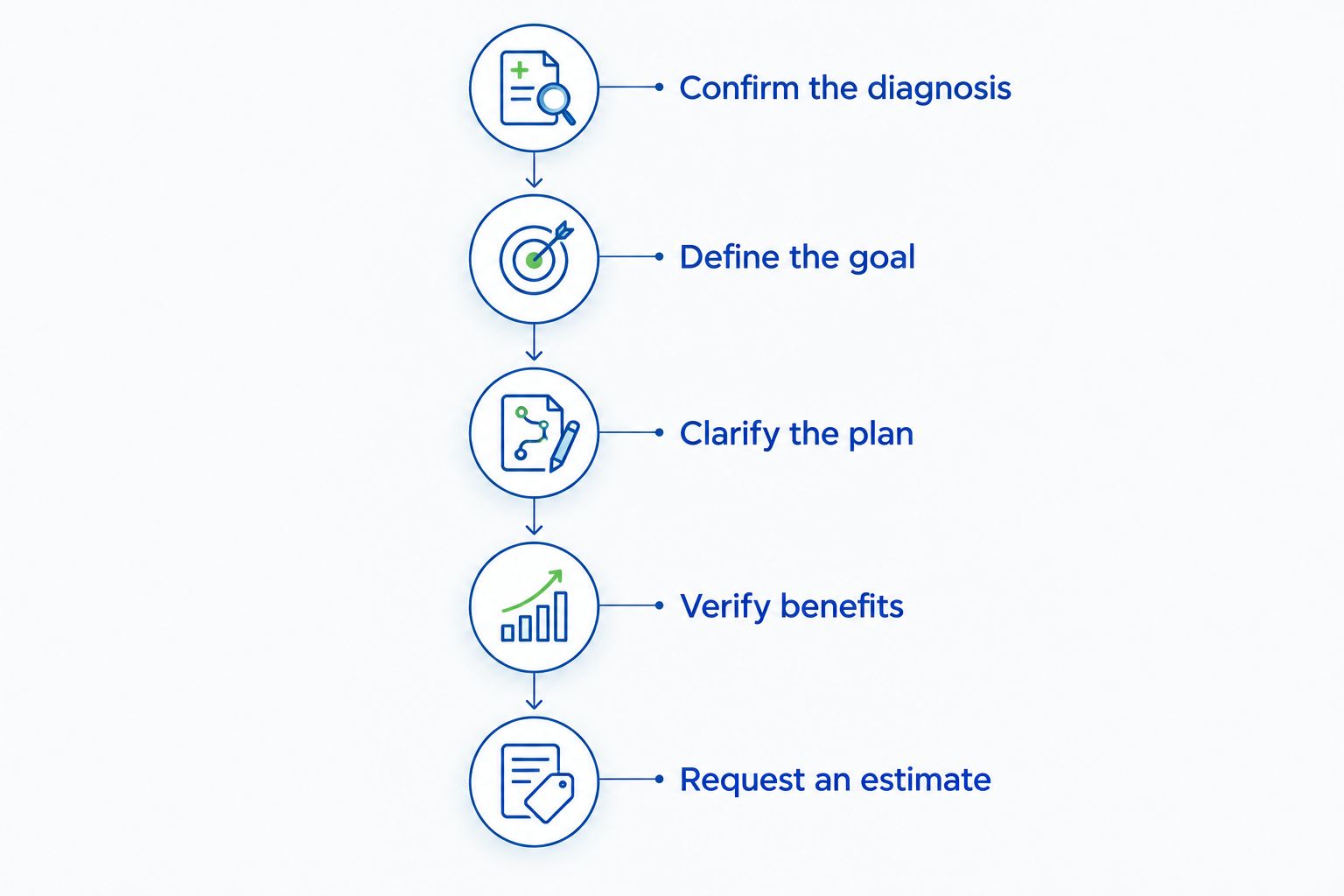
Follow this sequence before you commit. You do not need to understand billing terminology in advance; you need answers that make the proposed care clear.
- Confirm the diagnosis. Ask what the examination suggests, what remains uncertain, and whether further medical assessment is needed before treatment.
- Define the goal. Describe the activity you want back: comfortable daily walking, sustained running, lifting, or throwing. Ask what the proposed treatment is intended to change.
- Clarify the plan. Request the proposed visits, services, home exercises, and reassessment point. Ask why shockwave belongs in that plan.
- Verify benefits. Ask the clinic what it expects to bill, then confirm the relevant benefits with your insurer. Keep any written benefit explanation.
- Request an estimate. Ask for your expected responsibility, what is excluded, and how changes in care affect the estimate.
Bring your training schedule and a summary of previous treatment to the evaluation. Include which activities provoke symptoms, what you have already tried, and what changed afterward.
That information supports a more useful discussion than asking for a package before anyone has examined the injury. It also gives you a starting point for judging progress.
What if previous treatment has not helped?
A frustrating treatment history deserves a fresh assessment, not an automatic recommendation for another procedure. Ask your clinician to explain the working diagnosis, the reason symptoms persist, and what would be different about the proposed plan.
You do not need to dismiss previous care to ask better questions. Treatment response, exercise tolerance, and the demands of your sport all belong in the discussion.
Before adding shockwave, ask:
- What finding makes shockwave relevant to this injury?
- What benefit are we trying to achieve?
- What will I need to do between appointments?
- How will we assess whether treatment is helping?
- What happens if the expected change does not occur?
For a separate discussion of the decision itself, read whether shockwave therapy is worth it. Cost matters, but an unexplained treatment plan remains unexplained even when its fee is clear.
What should Philadelphia athletes ask about return to sport?
Your estimate should make sense alongside your rehabilitation goals. A runner with recurring heel pain, a pitcher with elbow symptoms, and a student athlete returning to competition need an assessment of their own situation—not the same treatment simply because all three are active.
McKenzie Sports Physical Therapy is a fit for Philadelphia athletes seeking sports-injury assessment and rehabilitation. The clinic offers shockwave therapy alongside sports rehabilitation, dry needling, and sports massage; offering those services does not mean each belongs in your plan.
For athletes and active adults in Manayunk, Roxborough, and nearby northwest Philadelphia, make these questions part of the appointment:
- Runners: How will the plan address running volume, symptom response, and progression back to the distances you want?
- Baseball players and pitchers: What assessment is needed before progressing throwing, and who should be involved in clearance?
- High school athletes and parents: How will the rehabilitation plan relate to school sports requirements and communication with the treating medical team?
- College athletes: How will treatment fit the demands of practice, competition, and the existing sports medicine plan?
Personalized rehabilitation means choosing and progressing care around those demands. It does not mean promising a return date before the injury has been assessed.
Does insurance cover shockwave therapy?
Insurance coverage for shockwave therapy requires service-specific verification; coverage for physical therapy alone does not answer the question. Ask what the clinic intends to bill and confirm the applicable benefits directly with your insurer.
For a 2026 appointment, request the current benefit information rather than relying on a previous visit or another patient’s experience. Ask whether authorization is required and whether it establishes coverage or only permission to proceed with a particular service.
How many shockwave sessions should I budget for?
Budget for the proposed course only after the clinician explains the recommendation and reassessment point. A visit count without a diagnosis or treatment goal is not enough to establish that the plan fits you.
Ask what would justify continuing, changing, or stopping treatment. You should understand that decision before agreeing to additional visits, not only after the original plan ends.
Is the least expensive shockwave appointment the best value?
The least expensive appointment is not automatically the best value because quotes can include different services. Compare the evaluation, treatment, rehabilitation instruction, reassessment, and expected patient responsibility on the same basis.
A more expensive visit is not automatically better either. Choose a clearly justified plan with transparent billing, not a fee presented as proof of quality.
FAQ
How do I find out my shockwave therapy costs before booking?
Request a written estimate that identifies the evaluation, shockwave treatment, rehabilitation, and reassessment charges. Confirm applicable insurance benefits separately so you understand your expected responsibility.
Does insurance covering physical therapy mean it covers shockwave too?
Physical therapy coverage does not by itself establish shockwave coverage. Ask about the specific service the clinic plans to bill and verify it with your insurer.
Should I buy a shockwave treatment package before an evaluation?
Get an assessment and understand the proposed treatment before committing to a package. Ask what happens financially if the clinician changes or stops the plan.
Can shockwave therapy replace my rehabilitation exercises?
Shockwave therapy is not a substitute for an individualized return-to-sport plan. Ask which exercises and activity changes are appropriate for your diagnosis and goals.
Is shockwave guaranteed to fix a recurring running injury?
Shockwave therapy does not guarantee recovery from a recurring running injury. Its suitability and evidence depend on the condition, and your clinician should explain the limitations.
What should parents ask before a student athlete starts shockwave?
Parents should ask about the diagnosis, age-appropriate suitability, evidence, risks, alternatives, and expected financial responsibility. Clarify how treatment relates to the athlete’s rehabilitation and return-to-play requirements.
Can I discuss shockwave at McKenzie Sports Physical Therapy?
McKenzie Sports Physical Therapy offers shockwave therapy and sports-injury rehabilitation. Request a new-patient appointment to discuss your symptoms, activity goals, and whether the treatment belongs in your plan.
One last thing
Ask what would make your clinician recommend not using shockwave. A useful answer explains alternatives, limitations, and the findings that would change the recommendation.
Keep that answer with your 2026 estimate. You are choosing a clinical plan, not simply purchasing a series of appointments.
Related guides
- How long does shockwave therapy take to work?
- Does shockwave therapy hurt?
- Can shockwave therapy help plantar fasciitis in runners?
Request a new-patient appointment to discuss your injury, return-to-sport goals, and treatment options before committing to shockwave therapy.
Request a new-patient appointment
Discuss your injury, sports goals, and treatment options with McKenzie Sports Physical Therapy.