

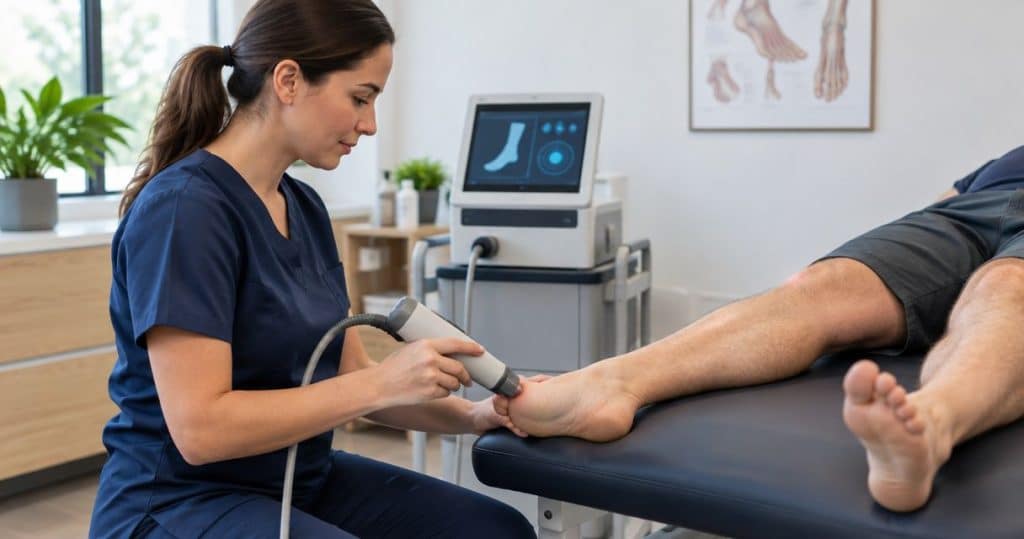
Instead of repeatedly carrying messages between offices, organize your podiatrist referral to shockwave therapy around a shared diagnosis, transferred records, and a physical therapy evaluation. The workflow below helps you confirm treatment suitability, clarify coverage, and connect treatment with your return to running, practice, or competition.
- A podiatrist referral to shockwave therapy requests evaluation; it does not guarantee treatment suitability or insurance coverage.
- McKenzie Sports Physical Therapy offers shockwave therapy and sports rehabilitation for athletes and active adults in Philadelphia.
- Send the diagnosis, prior treatment history, relevant imaging reports, and activity restrictions before your evaluation.
- Connect any shockwave treatment with an individualized rehabilitation plan and measurable return-to-sport goals.
Why this matters
A referral starts a clinical handoff, not an automatic treatment order. Your podiatrist identifies the foot or ankle concern; the treating clinician evaluates whether shockwave therapy belongs in your rehabilitation plan.
McKenzie Sports Physical Therapy is best suited to athletes and active adults seeking sports rehabilitation with access to shockwave therapy in Philadelphia. For readers in Manayunk, Roxborough, and nearby northwest Philadelphia, the next step is an evaluation—not selecting a treatment schedule before someone examines the injury. McKenzie Sports Physical Therapy offers sports injury diagnosis, rehabilitation, and shockwave therapy.
If previous treatment has not helped, bring that history. An unsuccessful approach gives the next clinician useful information; it does not establish that shockwave therapy is the answer.
Before you start
- Gather your clinical materials. Obtain the referral, diagnosis, relevant imaging reports, medication list, previous treatment details, and current restrictions. Ask whether the receiving office needs images themselves as well as written reports.
- Confirm the administrative route. Ask the receiving office how to send records, whether it needs a referral for your appointment, and what information your insurer requires. Use the office’s confirmed process rather than sending health information to an unverified address.
- Catch the coverage gotcha. A referral, authorization, and covered service are different things. For your 2026 benefits, verify physical therapy and shockwave therapy separately; approval for one does not establish coverage for the other.
For a high school athlete, also ask what parent or guardian participation and consent are required. Bring school or team paperwork when it affects the evaluation or return-to-play process.
Referral packet
Build the clinical handoff
- Ask your podiatrist to identify the referral question. The paperwork should explain what needs evaluation, such as persistent heel pain, rather than simply naming a device-based treatment.
- Confirm the location and side. Check that the paperwork identifies the correct foot or ankle and the area of concern. Report any change since the podiatrist examined you.
- Document previous care. List exercises, activity changes, footwear changes, procedures, and other treatments you actually tried. Include what improved, what stayed unchanged, and what aggravated symptoms.
- Request relevant records. Ask the referring office to send examination findings, restrictions, and relevant reports through the receiving office’s accepted channel.
- Create a 1-page activity summary. Describe the activities you want back, the tasks you currently avoid, and the circumstances that bring symptoms on.
For runners, that summary should distinguish ordinary walking from running, hills, and faster efforts. A baseball player or pitcher should describe push-off, landing, fielding, and running demands rather than reporting only whether the foot hurts at rest.
Expected result: The receiving clinician understands why you were referred, what has already been tried, and which sports tasks matter to you.
Confirm receipt before the visit
Ask the receiving office whether the referral and records arrived and whether anything remains outstanding. A sent message is not confirmation that the right person received a complete packet.
Keep your own copy. Your activity summary is especially useful when the referral describes the diagnosis but says little about your training or competition goals.
Appointment and benefits checks
Separate clinical suitability from payment approval
- Request an evaluation. Explain that your podiatrist recommended assessment for shockwave therapy and that you need a rehabilitation plan for your sport or activity.
- Ask what the appointment includes. Confirm whether the visit is an evaluation, whether treatment could occur if appropriate, and what preparation the clinician requires. Do not assume treatment happens at the first visit.
- Verify your 2026 benefits. Ask your insurer about referral requirements, authorization requirements, network status, and whether shockwave therapy has a separate coverage policy.
- Clarify financial responsibility. Ask the office to explain potential charges and obtain the current terms before agreeing to treatment. Request written clarification when coverage remains uncertain.
- Keep the confirmation details. Record who answered your benefits questions, the date, and any reference information provided. An estimate or authorization is not a guarantee of payment.
Expected result: You know what appointment you are attending, what paperwork remains, and which payment questions still need resolution.
Use these 3 questions before agreeing
- What finding makes shockwave therapy appropriate for my diagnosis?
- What rehabilitation will accompany it?
- What change would prompt you to reassess the plan?
A useful answer connects the treatment to your examination and goals. “Your podiatrist referred you” explains the handoff, but it does not replace an individualized assessment.
Evaluation and rehabilitation plan
Establish the starting point
- Describe your symptoms accurately. Explain their location, onset, pattern, and effect on daily activity. Mention new swelling, altered sensation, or a recent change in your ability to bear weight.
- Review health and treatment history. Disclose medications, bleeding concerns, pregnancy where relevant, recent procedures, and other medical conditions. Let the treating clinician determine treatment precautions; do not stop prescribed medication yourself.
- Complete the examination. Expect the clinician to assess relevant movement, strength, function, and symptom behavior. The exact examination depends on the suspected condition.
- Agree on a functional baseline. Choose meaningful tasks to track, such as walking tolerance, stairs, or a sport-specific movement that the clinician considers appropriate to assess.
- Discuss the options and their limits. Ask why shockwave therapy is recommended, what alternatives fit the findings, and how progress will be reviewed.
Expected result: You have a working explanation for the symptoms and a treatment rationale—not merely a booked procedure.
Clinical context for this 2026 workflow: NICE guidance on extracorporeal shockwave therapy for refractory plantar fasciitis describes inconsistent efficacy evidence and emphasizes informed consent. That guidance concerns persistent plantar fascia symptoms; it does not establish that every foot or ankle injury benefits from shockwave therapy.
Compare the next steps
These are decision routes, not interchangeable treatments or a ranking of effectiveness.
| Route | Best for | Advantage | Limitation |
|---|---|---|---|
| Rehabilitation without shockwave | Patients whose assessment supports exercise and activity management without an added procedure | Keeps treatment focused on identified movement and loading needs | Requires participation and reassessment; improvement is not guaranteed |
| Shockwave within rehabilitation | Patients the treating clinician identifies as suitable candidates | Adds a treatment option while preserving functional rehabilitation goals | Evidence and suitability depend on the condition; discomfort and coverage questions need discussion |
| Further medical assessment | Patients with unresolved diagnostic questions or concerning changes | Addresses uncertainty before progressing treatment | Adds another assessment step and does not automatically identify a definitive answer |
McKenzie Sports Physical Therapy offers both rehabilitation and shockwave therapy. The appropriate choice depends on the examination, not on selecting the most intensive option.
Treatment and progress review
Connect treatment to sport
- Write down the plan. Clarify the proposed treatment, exercise instructions, activity limits, and the point at which the clinician will review progress. Do not borrow another athlete’s schedule.
- Get aftercare instructions. Ask what symptoms to report and what activity is appropriate after treatment. Follow individualized advice rather than assuming immediate running or practice is acceptable.
- Track function alongside symptoms. Note whether the agreed tasks become easier, harder, or unchanged. Record what activity preceded a flare instead of recording pain alone.
- Set 2 review checkpoints. Agree when to assess treatment tolerance and when to reconsider the overall plan. The clinician should choose timing based on your condition and response.
- Coordinate the handoff back. Ask who will update the podiatrist and what information should be shared, subject to the appropriate consent process.
Expected result: You understand what you are doing between visits, what progress means, and when the plan needs another look.
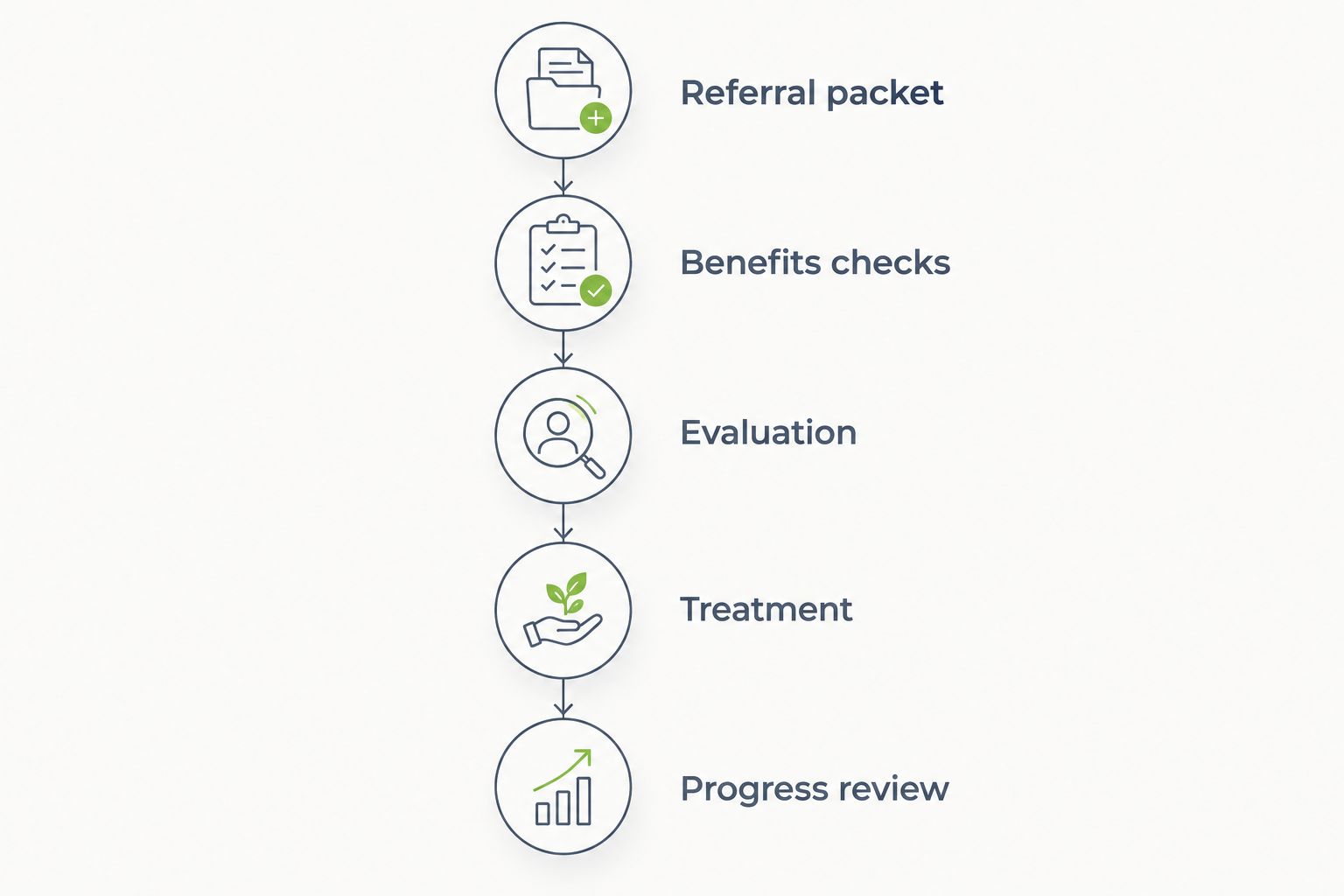
For your 2026 season, distinguish treatment attendance from readiness to compete. A runner’s plan needs running-specific progression; a pitcher’s plan needs to account for lower-body demands during throwing. Completing appointments does not, by itself, establish readiness for either activity.
When your symptoms or diagnosis change
An existing referral does not eliminate the need to reassess a changed injury. Use this adjacent workflow when symptoms shift while you are waiting or already receiving care.
- Describe the change to the treating clinician. Identify the new location, new symptoms, or new activity limitation rather than saying only that treatment stopped working.
- Ask whether the current plan still applies. The clinician should decide whether to modify rehabilitation, defer shockwave therapy, or seek additional medical assessment.
- Update the podiatrist when appropriate. Share the revised findings and request updated instructions or records if needed.
- Recheck administrative requirements. A changed diagnosis or proposed service can require another benefits review.
Sudden severe pain, inability to bear weight after an injury, or a hot, red, swollen foot with fever requires prompt medical assessment rather than waiting for a routine shockwave appointment. This workflow is not an emergency assessment tool.
Expected result: Your treatment follows the current problem rather than an outdated referral.
Troubleshooting the handoff
The office has no referral
Ask the referring office to confirm the destination and resend through the accepted channel. Then verify receipt with the receiving office; avoid making yourself the only person relaying clinical instructions.
Insurance approved physical therapy but not shockwave
Ask whether the services were reviewed separately and request the applicable coverage explanation. Discuss the clinical alternatives and financial terms before proceeding; do not interpret a physical therapy authorization as blanket approval.
The referral names a treatment but gives little history
Request the assessment findings, relevant reports, and previous treatment details. Bring your activity summary so the evaluation includes your actual sports demands.
Treatment feels tolerable, but sport still hurts
Report the difference between tolerating the procedure and tolerating running, jumping, or throwing-related footwork. Ask the clinician to review loading, functional progress, and whether the working diagnosis still fits.
You are frustrated because earlier care failed
Explain precisely what failed: symptoms, function, exercise tolerance, or the ability to sustain training. That detail supports a more useful reassessment than assuming you need more treatment of the same kind.
Customize your workflow
At McKenzie Sports Physical Therapy, the relevant starting point is sports injury evaluation and rehabilitation. Bring the demands of your sport into that discussion rather than asking only whether shockwave therapy is offered.
For high school and college athletes, identify who needs updates: a parent, athletic trainer, coach, or referring clinician. Ask what consent is needed before information is shared. For runners with recurring injuries, include changes in training and the point at which symptoms return.
Make your 2026 goal specific: return to a defined activity with an agreed progression and review criteria, not simply finish a course of appointments.
FAQ
Do I need a podiatrist referral to get shockwave therapy?
Confirm the requirement with the treating office and your insurer before scheduling. Clinical access requirements, referral paperwork, and insurance rules are separate questions.
Does a podiatrist referral mean shockwave therapy is right for me?
No. The treating clinician must assess your diagnosis, medical history, examination findings, and treatment goals before recommending shockwave therapy.
What should I bring to my shockwave therapy evaluation?
Bring the referral, relevant medical and imaging reports, medication list, prior treatment history, and activity restrictions. Include a short description of the running or sports tasks you want to resume.
Will insurance cover shockwave therapy if my podiatrist orders it?
A podiatrist’s order does not guarantee insurance coverage. Verify shockwave therapy separately from physical therapy and ask about authorization requirements and your financial responsibility.
Can I keep running or pitching during treatment?
Your activity plan depends on the injury, examination, and response to loading. Ask for specific instructions covering running, practice, competition, and any movements that reproduce symptoms.
What if previous physical therapy did not help?
Request a reassessment that reviews the diagnosis, prior treatment, exercise progression, and remaining limitations. Previous treatment failure does not automatically establish that shockwave therapy is appropriate.
How do I know when the treatment plan needs to change?
Report worsening symptoms, new symptoms, or a lack of progress in the functional tasks you agreed to track. Your clinician should review those findings against the planned reassessment criteria rather than continuing treatment automatically.
One last thing
The most useful referral includes the question the next clinician needs to answer. Ask your podiatrist to explain the suspected problem, what remains unresolved, and why shockwave evaluation is being considered. That makes the handoff more useful than a treatment name alone.
Related guides
- Insurance authorization to your first physical therapy appointment
- Shockwave therapy for plantar fasciitis in runners
- How long shockwave therapy takes to work
- High school sports physical to return-to-play clearance
Request a new-patient appointment at McKenzie Sports Physical Therapy to review your podiatrist referral, assess your injury, and discuss a personalized return-to-sport rehabilitation plan.